The Law of Supply: Why the Curve Slopes Upward
Definition
Supply: the quantity of a good or service that producers are willing and able to sell at a given price over a given period of time, other things being equal.
- Supply is the quantity producers are willing and able to offer for sale at each price over a period.
- The law of supply says a higher price raises quantity supplied, giving an upward-sloping curve.
- This direct relationship mirrors the downward-sloping demand curve.
Note
- Supply needs both willingness and ability to produce, not just a wish to sell.
- A change in the good's own price is a movement along the supply curve.
Rising Marginal Cost Makes the Curve Slope Upward
- Higher profitability
- A higher price makes supplying the good more profitable, so firms offer more.
- Rising marginal cost
- Producing extra units costs more, so firms need a higher price to justify it.
- New entrants
- A higher price can make it worthwhile for more firms to supply the market.
Note
- The rising-marginal-cost reason is the key one, not simply that firms want more revenue.
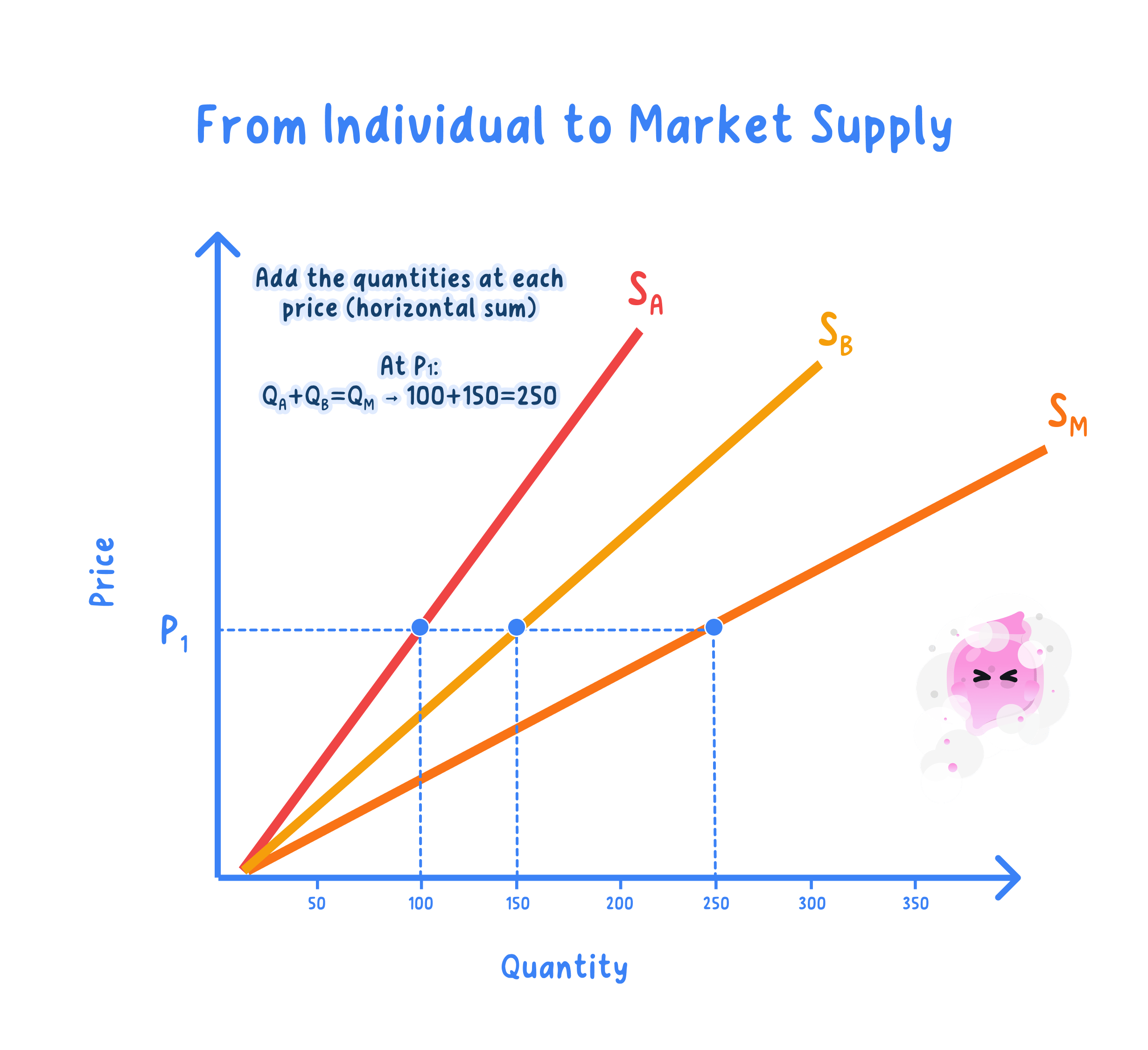
- Individual firm supply sums horizontally to give market supply.
Under Perfect Competition, the Supply Curve Is the Marginal Cost Curve
- A profit-maximising firm produces the output where price equals marginal cost.
- As the price rises, the firm moves up its marginal cost curve and supplies more.
- So under perfect competition the firm's supply curve is its marginal cost curve, above average variable cost.
Reading the Curve: Price on the Vertical Axis, Quantity Supplied on the Horizontal
- Price is on the vertical axis and quantity supplied on the horizontal axis.
- A change in own price moves the firm along the curve.
- A change in a condition of supply shifts the whole curve, as set out below.
The Conditions of Supply Shift the Whole Curve
- Costs of production
- Higher wages, raw materials or energy costs shift supply left, while lower costs shift it right.
- Technology
- Improved technology cuts costs and shifts supply right.
- Indirect taxes and subsidies
- An indirect tax shifts supply left, while a subsidy shifts it right.
- Prices of other goods the firm could make
- A more profitable alternative draws resources away, shifting supply of this good left.
- Number of suppliers
- More firms entering the market shift supply right.
Note
- An indirect tax raises costs at every price, shifting the whole curve left rather than moving along it.
- This is the most commonly confused case.
Example
- For example, a fall in oil prices lowers transport and input costs, shifting many supply curves right.
- A poor harvest raises costs and shifts agricultural supply left.
Evaluation: Does Supply Always Rise with Price?
- In most markets the direct relationship holds.
- In the very short run supply may be fixed, so quantity cannot rise however high the price.
- For some labour markets a backward-bending curve is possible, but this is an exception.
Justify the Slope with Marginal Cost
Exam technique
- Explain the upward slope by rising marginal cost and higher profitability, not just revenue.
- Label the axes with price and quantity supplied.
- Treat an own-price change as a movement along the curve.
Common Mistake
- Do not say supply slopes up only because firms want more revenue.
- The key reason is that marginal cost rises as output expands.
- Do not define supply as a mere willingness to sell.
- Supply needs both willingness and the ability to produce.
Self review
- Define supply precisely.
- State the law of supply and explain why higher prices encourage firms to expand production.
- Why does rising marginal cost explain the upward slope?
- Under perfect competition, what is the firm's supply curve?
- Name four conditions that shift the supply curve.
- How is an indirect tax shown on a supply diagram?
