Price Elasticity of Supply: How Quickly Producers Respond
Definition
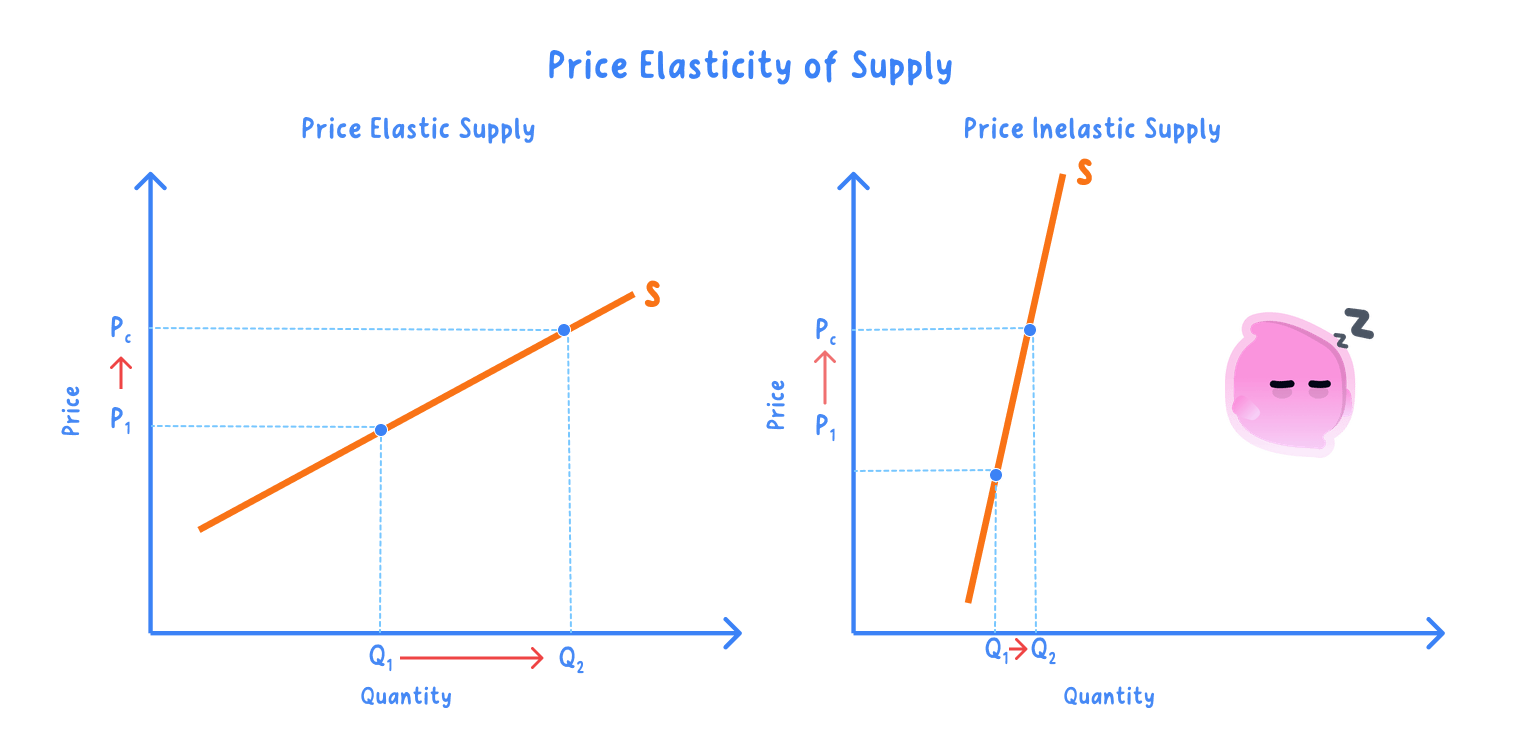
Price elasticity of supply: a measure of the responsiveness of quantity supplied to a change in a good's price, calculated as the percentage change in quantity supplied divided by the percentage change in price.
- Price elasticity of supply (PES) measures how responsive quantity supplied is to a change in price.
- It is the percentage change in quantity supplied divided by the percentage change in price: PES=%ΔQs%ΔP\text{PES} = \dfrac{\%\Delta Q_s}{\%\Delta P}PES=%ΔP%ΔQs.
- Because supply slopes upward, PES is normally positive.
Note
- PES shows how easily firms can expand output when price rises.
- It depends heavily on the time period, being more elastic in the long run.
Worked Example: Calculating PES
- PES is worked out just like the demand elasticities: the percentage change in quantity supplied on top, the percentage change in price on the bottom, with a value below one meaning inelastic and above one meaning elastic.
Example
- The market price of eggs rises from £2.00 to £2.40 a dozen, a rise of £0.40£2.00=20%\dfrac{\pounds 0.40}{\pounds 2.00} = 20\%£2.00£0.40=20%.
- In response, weekly quantity supplied rises from 10,000 to 11,000 dozen, a rise of 1,00010,000=10%\dfrac{1{,}000}{10{,}000} = 10\%10,0001,000=10%.
- PES=+10%+20%=0.5\text{PES} = \dfrac{+10\%}{+20\%} = 0.5PES=+20%+10%=0.5, a positive figure below one, so supply is price inelastic.
- That fits the short run, when producers cannot quickly enlarge their flocks, so a 20% price rise brings only a 10% rise in output.
What Determines the Responsiveness of Supply
- Spare capacity
- Idle capacity lets firms raise output quickly, making supply elastic.
- Availability and mobility of factors
- Easily obtained, movable inputs make supply elastic.
- Ability to hold stocks
- Stored goods can be released quickly, raising elasticity.
- Perishability and time
- Perishable goods and short time horizons make supply inelastic.
Example
- For example, a factory with spare capacity can raise output fast, so supply is elastic.
- A farmer cannot grow more wheat until the next harvest, so supply is inelastic in the short run.
PES Determines How Smoothly Markets Adjust
- It determines how fast a market can respond to a change in demand.
- High PES limits price volatility, while low PES allows price spikes.
- It explains why some markets adjust smoothly and others do not.
Evaluation: Why Time Is Central
- In the immediate run supply is often fixed, so PES is very low.
- Over the long run firms can adjust capacity, so PES rises.
- So any judgement about PES must specify the time period.
Always Specify the Time Period
Exam technique
- Define PES and keep it positive for a normal supply curve.
- Link elasticity to spare capacity, factor mobility, stocks and time.
- State the time period, since supply is more elastic in the long run.
Common Mistake
- Do not assume supply is equally responsive in the short and long run.
- PES is usually low in the short run and higher in the long run.
- Do not forget spare capacity and stocks as determinants.
- Both let firms raise output quickly, making supply more elastic.
Self review
- Define price elasticity of supply.
- State the formula for PES.
- Why is PES normally positive?
- Name three determinants of PES.
- Why is supply more elastic in the long run?
- How does spare capacity affect PES?
- If a 20% price rise raises quantity supplied by 10%, calculate PES and state whether supply is elastic or inelastic.
