Aggregate Demand Is Total Planned Spending, C Plus I Plus G Plus Net Exports
Definition
Aggregate demand: the total planned spending on an economy's domestic goods and services at a given price level, equal to consumption plus investment plus government spending plus net exports (C plus I plus G plus (X minus M)).
- Aggregate demand is total planned spending on domestic goods and services at a given price level.
- Its components are consumption, investment, government spending and net exports.
- In shorthand, AD=C+I+G+(X−M)AD=C+I+G+(X-M)AD=C+I+G+(X−M), where X is exports and M is imports.
Note
- Consumption is normally the largest component, at roughly three-fifths of AD.
- Net exports can be positive or negative.
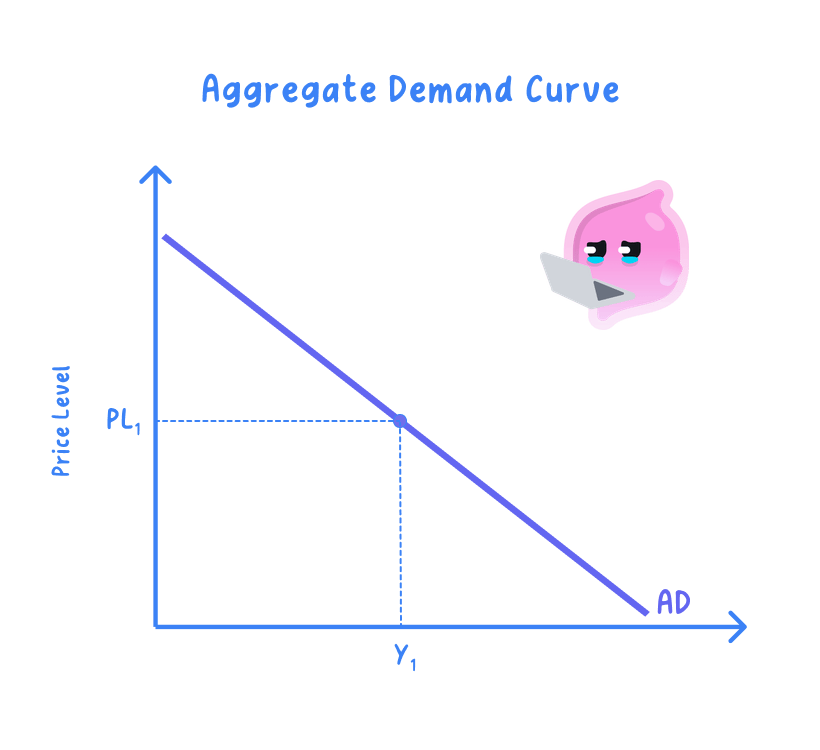
Consumption Is Usually the Largest of the Four Components
- Consumption is household spending, usually around three-fifths of AD.
- Investment is firms' spending on capital, and government spending is state spending on goods and services.
- Net exports are exports minus imports.
Example
- UK household spending is the biggest single part of AD.
- If imports exceed exports, net exports subtract from AD.
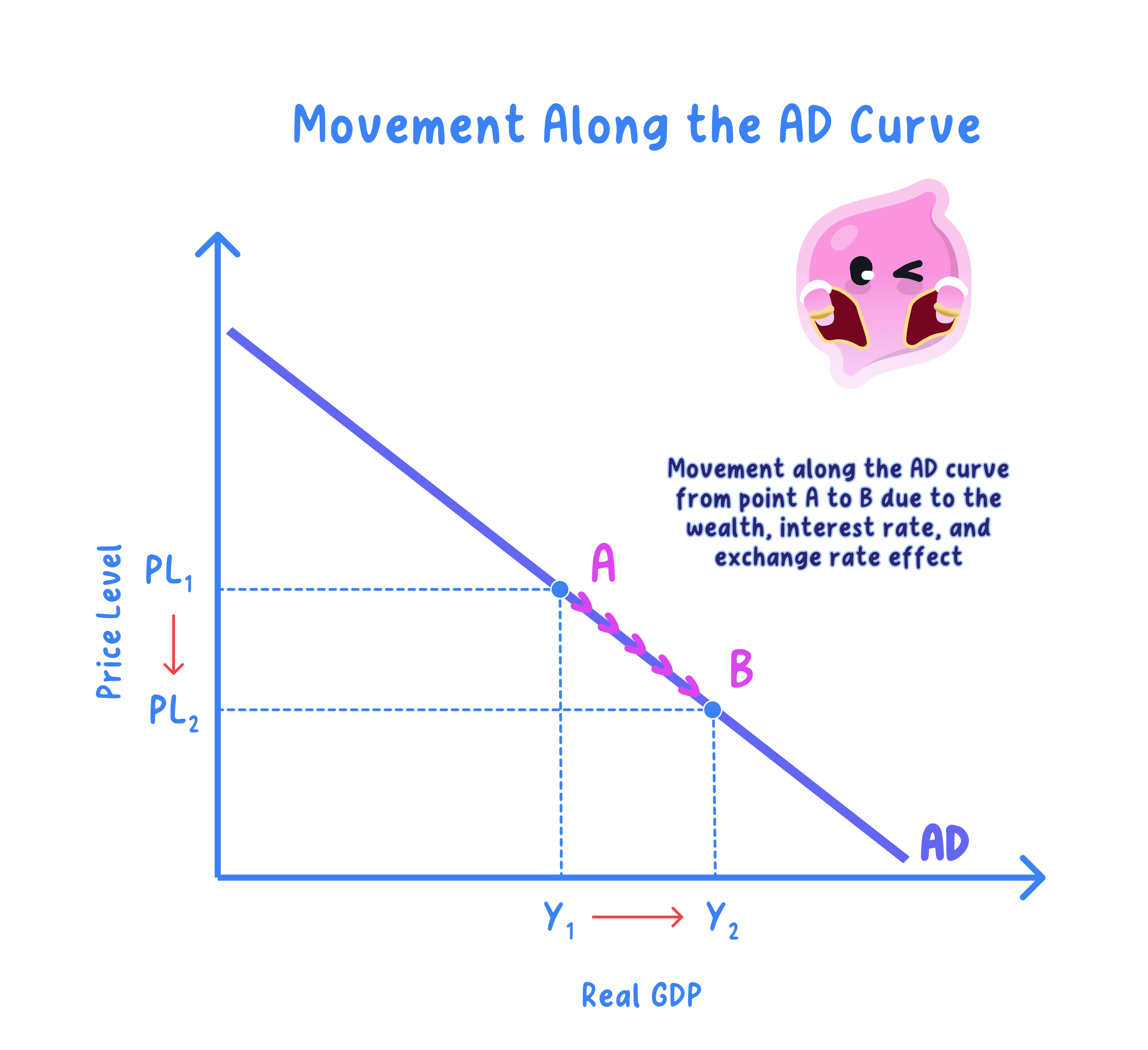
A Change in Any Component Moves Total Demand
- AD measures spending across the whole economy, not one market.
- A change in any component changes total demand.
- So the identity is the base for AD-AS analysis.
Always State the Full AD Identity
Exam technique
- Write AD as C+I+G+(X−M)C+I+G+(X-M)C+I+G+(X−M).
- Note that consumption is normally the largest component.
Common Mistake
- Do not confuse aggregate demand with the demand for a single good.
- And do not omit net exports from the identity.
Consumption and Saving Are Two Sides of Disposable Income
- Consumption is household spending out of disposable income.
- Saving is the part of disposable income not spent.
- So consumption and saving are inversely linked out of a given income.
Note
- What is not spent out of disposable income is saved.
- The savings ratio is the share of disposable income saved.
Income, Interest Rates, Confidence, Wealth and Credit Drive Consumption
- Higher disposable income raises consumption.
- Interest rates, confidence and wealth all shift spending.
- Easier credit lets households spend more of any income.
Example
- Rising house prices can lift spending through a wealth effect.
- Higher interest rates tend to raise saving and cut consumption.
Saving and Investment Are Different Acts by Different Agents
- Saving is income households choose not to spend.
- Investment is firms' spending on capital goods.
- So one is a withdrawal and the other an injection.
Link Consumption to Its Drivers
Exam technique
- Name the determinants: income, interest rates, confidence, wealth and credit.
- Explain saving as the mirror image of consumption.
Common Mistake
- Do not confuse saving with investment.
- Saving is a withdrawal; investment is an injection of spending on capital.
Investment Is Firms' Spending on Capital Goods
- Investment is spending by firms on capital goods.
- Gross investment is total spending on capital.
- Net investment is gross investment minus depreciation.
Note
- Gross investment includes replacing worn-out capital.
- Net investment is what adds to the capital stock.
Confidence, Interest Rates, Credit and Taxes Drive Investment
- The rate of economic growth and business confidence shape expected returns.
- Interest rates and the cost of borrowing affect the price of finance.
- The availability of credit and taxes on profits also matter.
Example
- Keynes called swings in confidence the animal spirits of firms.
- Lower interest rates make borrowing to invest cheaper.
Investment Is the Most Volatile Component of AD
- Investment depends on expectations about the future.
- Expectations can change quickly and sharply.
- So investment is the most volatile part of aggregate demand.
Separate Gross From Net Investment
Exam technique
- Distinguish gross from net investment before analysing.
- Link volatility to shifting expectations and confidence.
Common Mistake
- Do not treat buying shares or saving in a bank as investment.
- In economics, investment means firms' spending on capital goods.
Government Spending and Net Exports Complete Aggregate Demand
- Government spending and net exports are two components of aggregate demand.
- Government spending responds to the trade cycle, fiscal choices and political priorities.
- Net exports respond to incomes, the exchange rate and competitiveness.
Note
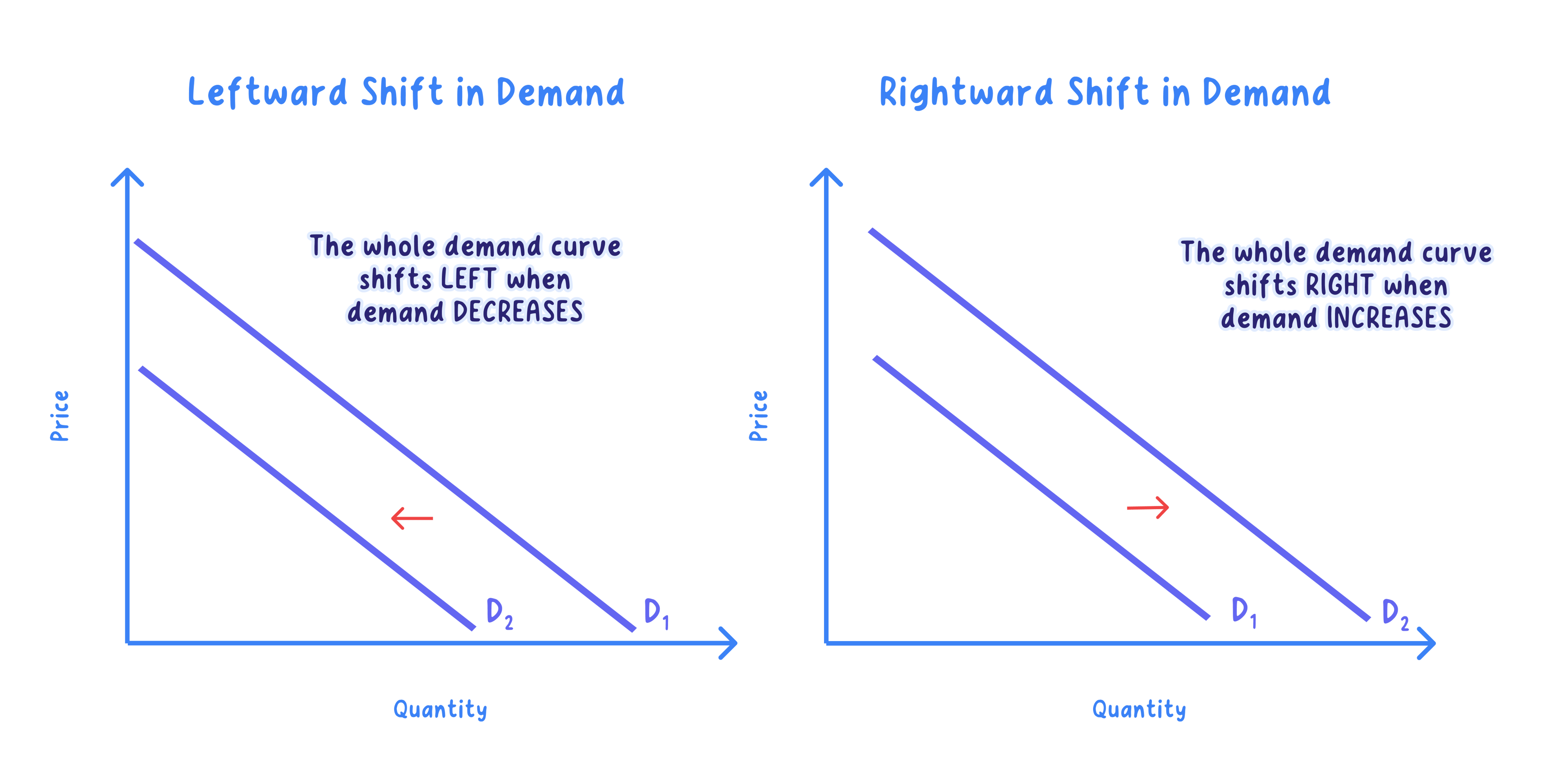
- A change in either component shifts aggregate demand.
- Net exports are exports minus imports.
The Trade Cycle, Exchange Rate and World Incomes Move G and Net Exports
- In a downturn, spending on benefits rises automatically.
- Real incomes at home and abroad change import and export demand.
- The exchange rate, protectionism and non-price competitiveness shift net exports.
Example
- A weaker pound tends to raise exports and cut imports.
- A strong world economy raises demand for UK exports.
Imports Are a Leakage, so They Are Subtracted From AD
- Exports add to aggregate demand.
- Imports are spending that leaks abroad, so they are subtracted.
- So a rise in imports lowers aggregate demand, all else equal.
Trace Each Influence to a Shift in AD
Exam technique
- Link each influence to a shift in aggregate demand.
- Remember that a rise in imports reduces net exports.
Common Mistake
- Do not forget that imports are subtracted in aggregate demand.
- A rise in imports lowers AD, all else equal.
The Accelerator Links Investment to the Rate of Change of Output
- The accelerator links net investment to the rate of change of output.
- Firms invest more when demand is growing faster.
- So even a slowdown in growth can cut investment.
Note
- Net investment depends on the rate of change of national income.
- A fall in the growth of demand can cause investment to fall.
Faster Output Growth Needs More Capital, so Investment Rises
- Rising output needs more capital, so investment rises.
- If output grows more slowly, less new capital is needed.
- So investment can fall even while output still rises.
Example
- Worked example: suppose firms need £2 of capital for every £1 of annual output, a capital-output ratio of 2.
- If output rises by £100 million this year, firms need 2×£100m=£200m2\times\pounds 100\text{m}=\pounds 200\text{m}2×£100m=£200m of extra capital, so net investment is £200 million.
- If next year output rises by only £40 million, net investment falls to 2×£40m=£80m2\times\pounds 40\text{m}=\pounds 80\text{m}2×£40m=£80m, a sharp drop even though output is still growing.
- The accelerator and multiplier can interact to amplify the cycle.
The Accelerator and Multiplier Interact to Amplify the Cycle
- The multiplier turns injections into larger income changes.
- The accelerator turns output changes into investment changes.
- Together they can magnify booms and slumps.
Focus on the Rate of Change, Not the Level
Exam technique
- Tie investment to the rate of change of output, not its level.
- Explain how the accelerator and multiplier interact.
Common Mistake
- Do not confuse the accelerator with the multiplier.
- The accelerator links investment to the rate of change of output; the multiplier links injections to a larger change in income.
Self review
- Define aggregate demand and state the identity AD=C+I+G+(X−M)AD=C+I+G+(X-M)AD=C+I+G+(X−M).
- Name the main determinants of consumption, investment, government spending and net exports.
- How does saving differ from investment, and what determines the level of saving?
- Using a capital-output ratio of 2, what is net investment if output rises by £50 million?
- What does the accelerator link, and why does it depend on the rate of change of output?
