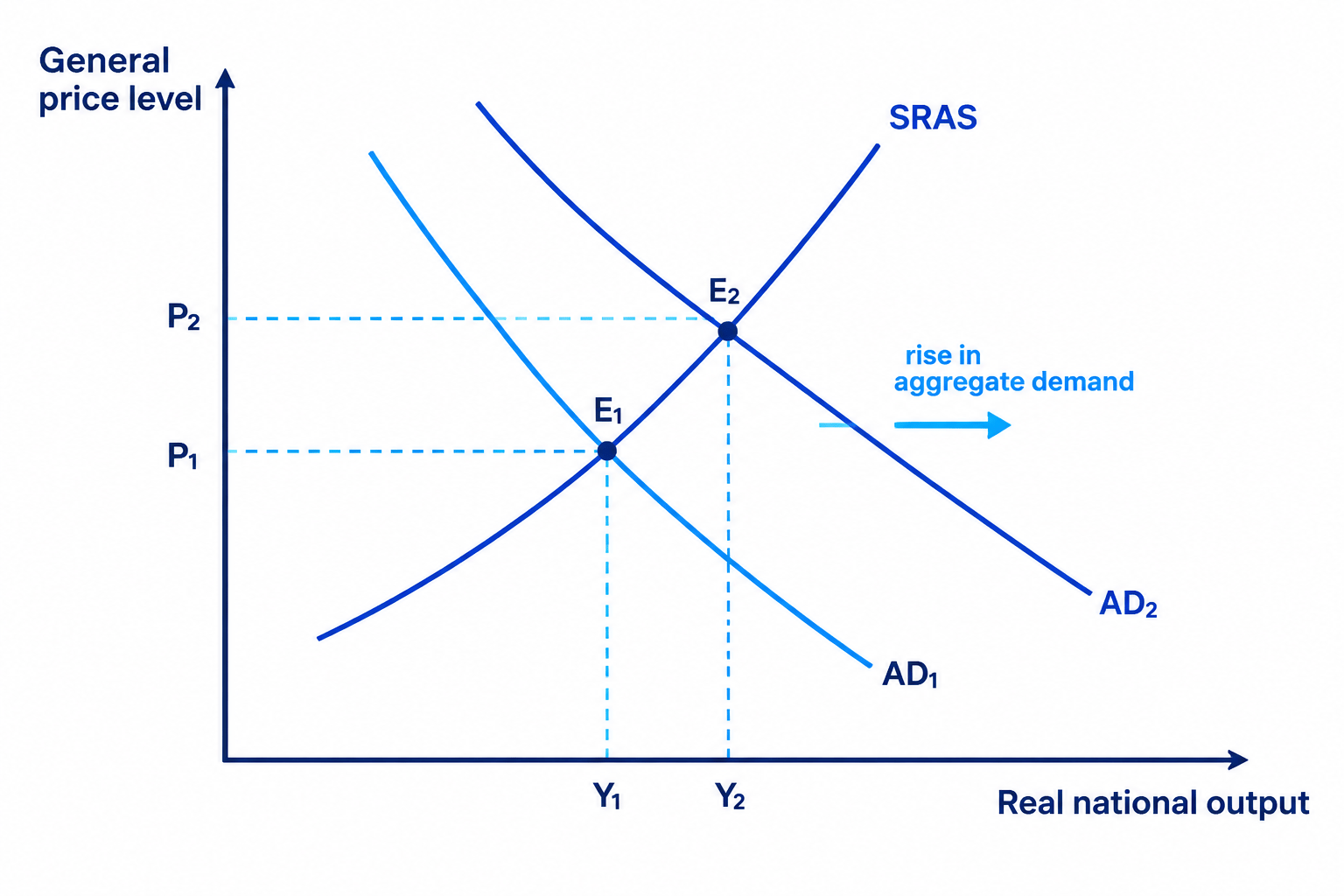
A Change in Aggregate Demand Changes National Output, and the Multiplier Makes the Final Effect Larger Than the Initial Injection
Definition
The multiplier: the process by which an initial change in injections or spending leads to a larger eventual change in national income, equal to 1 divided by (1 minus the marginal propensity to consume).
How Aggregate Demand Drives Economic Activity
- Aggregate demand is total planned spending in the economy, AD=C+I+G+(X−M)AD=C+I+G+(X-M)AD=C+I+G+(X−M).
- A rise in AD raises the level of economic activity, increasing real output and employment; a fall in AD lowers it.
- An injection such as investment, government spending or exports sets off a multiplier process that adds to income over several rounds.
Note
- Aggregate demand is C+I+G+(X−M)C+I+G+(X-M)C+I+G+(X−M).
- A change in any component shifts AD and changes the level of economic activity.
The Multiplier Process
- The multiplier means an initial injection leads to a larger eventual rise in national income.
- Spending becomes income for others, who then re-spend part of it in the next round.
- Each round is smaller because saving, taxation and imports leak income out of the flow.
Example
- Worked example: an injection of £10 billion with an MPC of 0.80.80.8, so 80%80\%80% of each extra pound is re-spent.
- Round 1 adds £10 billion; round 2 adds 0.8×£10bn=£8bn0.8\times\pounds 10\text{bn}=\pounds 8\text{bn}0.8×£10bn=£8bn; round 3 adds 0.8×£8bn=£6.4bn0.8\times\pounds 8\text{bn}=\pounds 6.4\text{bn}0.8×£8bn=£6.4bn, and so on.
- The shrinking series £10bn+£8bn+£6.4bn+…\pounds 10\text{bn}+\pounds 8\text{bn}+\pounds 6.4\text{bn}+\dots£10bn+£8bn+£6.4bn+… sums to £50 billion, exactly matching the formula answer of k=5k=5k=5.
Note
- The multiplier is k=11−MPCk=\dfrac{1}{1-\text{MPC}}k=1−MPC1.
- Equivalently k=1MPWk=\dfrac{1}{\text{MPW}}k=MPW1, where the MPW (marginal propensity to withdraw) equals MPS+MPT+MPM\text{MPS}+\text{MPT}+\text{MPM}MPS+MPT+MPM; for AQA you only need to calculate the multiplier from the MPC.
Example
- With an MPC of 0.80.80.8, the multiplier is 11−0.8=10.2=5\dfrac{1}{1-0.8}=\dfrac{1}{0.2}=51−0.81=0.21=5.
- So an injection of £10 billion raises national income by £10bn×5=£50bn\pounds 10\text{bn}\times 5=\pounds 50\text{bn}£10bn×5=£50bn.
Calculating the Multiplier From the Marginal Propensity to Consume
- The marginal propensity to consume (MPC) is the fraction of any extra income that households spend.
- From the MPC, the multiplier is 11−MPC\dfrac{1}{1-\text{MPC}}1−MPC1; the larger the leakages, the smaller the multiplier.
- The leakages are saving, taxation and imports, which together make up the marginal propensity to withdraw (MPW).
Example
- Suppose the MPC is 0.70.70.7, so households re-spend 70%70\%70% of each extra pound of income.
- The multiplier is 11−0.7=10.3≈3.3\dfrac{1}{1-0.7}=\dfrac{1}{0.3}\approx 3.31−0.71=0.31≈3.3, so an injection of £10 billion raises national income by about £33 billion.
Why the Size of the MPC Determines the Size of the Multiplier
- A larger MPC means households re-spend more of each extra pound, so less income leaks out and the MPW is smaller.
- Because the multiplier is 11−MPC\dfrac{1}{1-\text{MPC}}1−MPC1, a larger MPC (and smaller MPW) gives a larger multiplier and a bigger final change in national income.
- A smaller MPC (larger leakages) gives a smaller multiplier and a weaker effect on activity.
Example
- If the MPC is 0.50.50.5, the multiplier is 11−0.5=10.5=2\dfrac{1}{1-0.5}=\dfrac{1}{0.5}=21−0.51=0.51=2, so £10 billion raises income by £10bn×2=£20bn\pounds 10\text{bn}\times 2=\pounds 20\text{bn}£10bn×2=£20bn.
- A higher MPC would mean smaller leakages, giving a larger multiplier and a bigger effect.
Note
- The full multiplier effect only appears when there is spare capacity, so extra spending raises real output rather than prices.
- Near full capacity, extra AD feeds mainly into inflation, so the real multiplier is weaker; the effect also works in reverse, magnifying a fall in injections.
Exam technique
- Find the multiplier as 11−MPC\dfrac{1}{1-\text{MPC}}1−MPC1; do not divide by the MPC itself.
- Multiply the injection by the multiplier to find the final change in national income.
Self review
- What are the components of aggregate demand?
- State the formula for the multiplier in terms of the MPC.
- If the MPC is 0.80.80.8, what is the multiplier, and by how much would a £5 billion injection raise income?
- Why does a larger MPC give a larger multiplier?
- Why might the real multiplier be smaller when the economy is near full capacity?