Market Equilibrium: How Price Finds Its Level
Definition
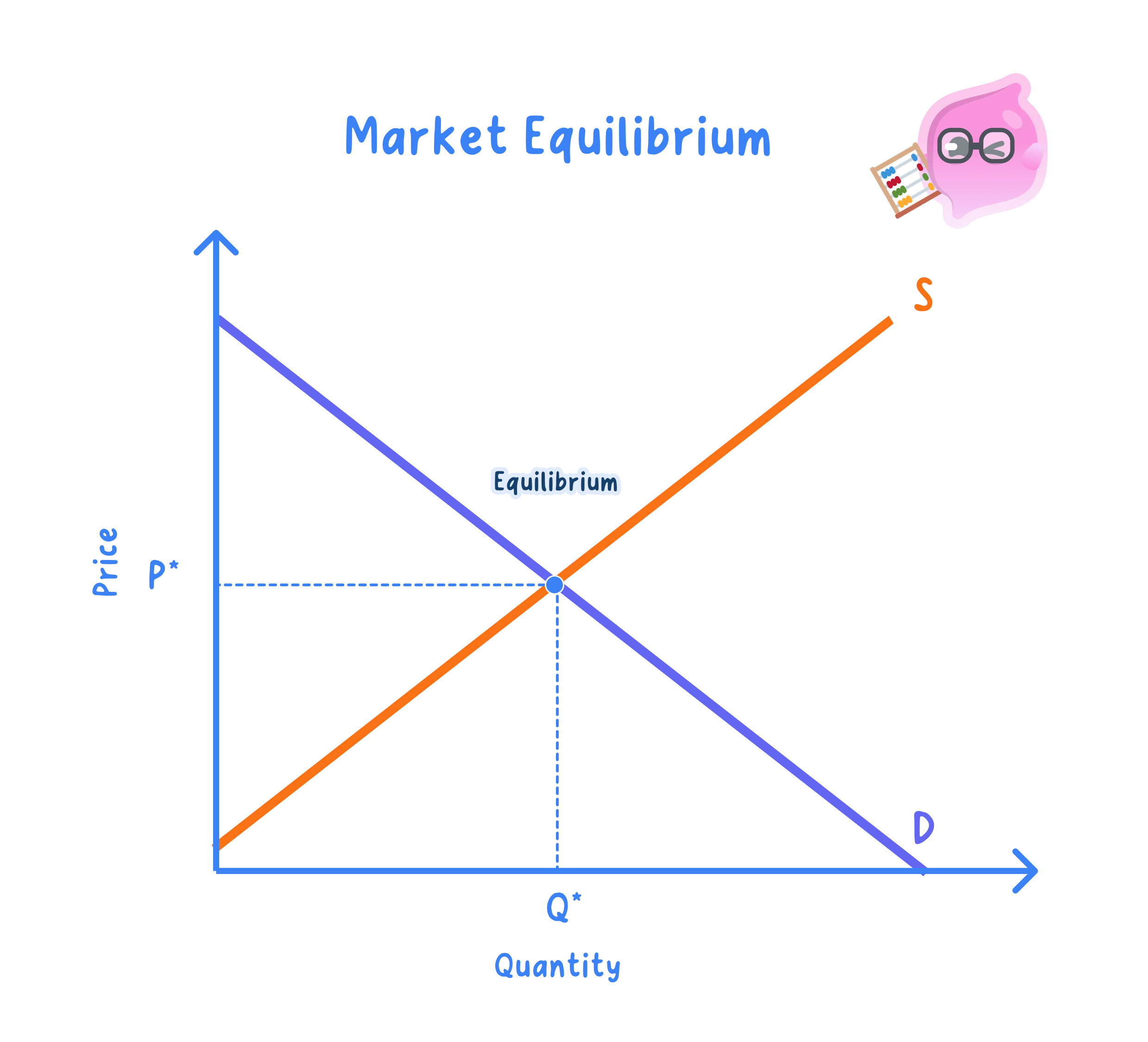
Equilibrium price: the price at which quantity demanded equals quantity supplied, so there is no tendency for the price to change; also known as the market-clearing price.
- Market equilibrium occurs where quantity demanded equals quantity supplied and the market clears.
- At any other price there is excess demand or excess supply.
- Price then adjusts to remove the imbalance and restore equilibrium.
Note
- Equilibrium is the price and quantity where the demand and supply curves cross.
- Away from it, market forces push price back towards equilibrium.
Equilibrium Clears the Market; Disequilibrium Means Shortage or Surplus
- Equilibrium
- Quantity demanded equals quantity supplied, so there is no pressure to change.
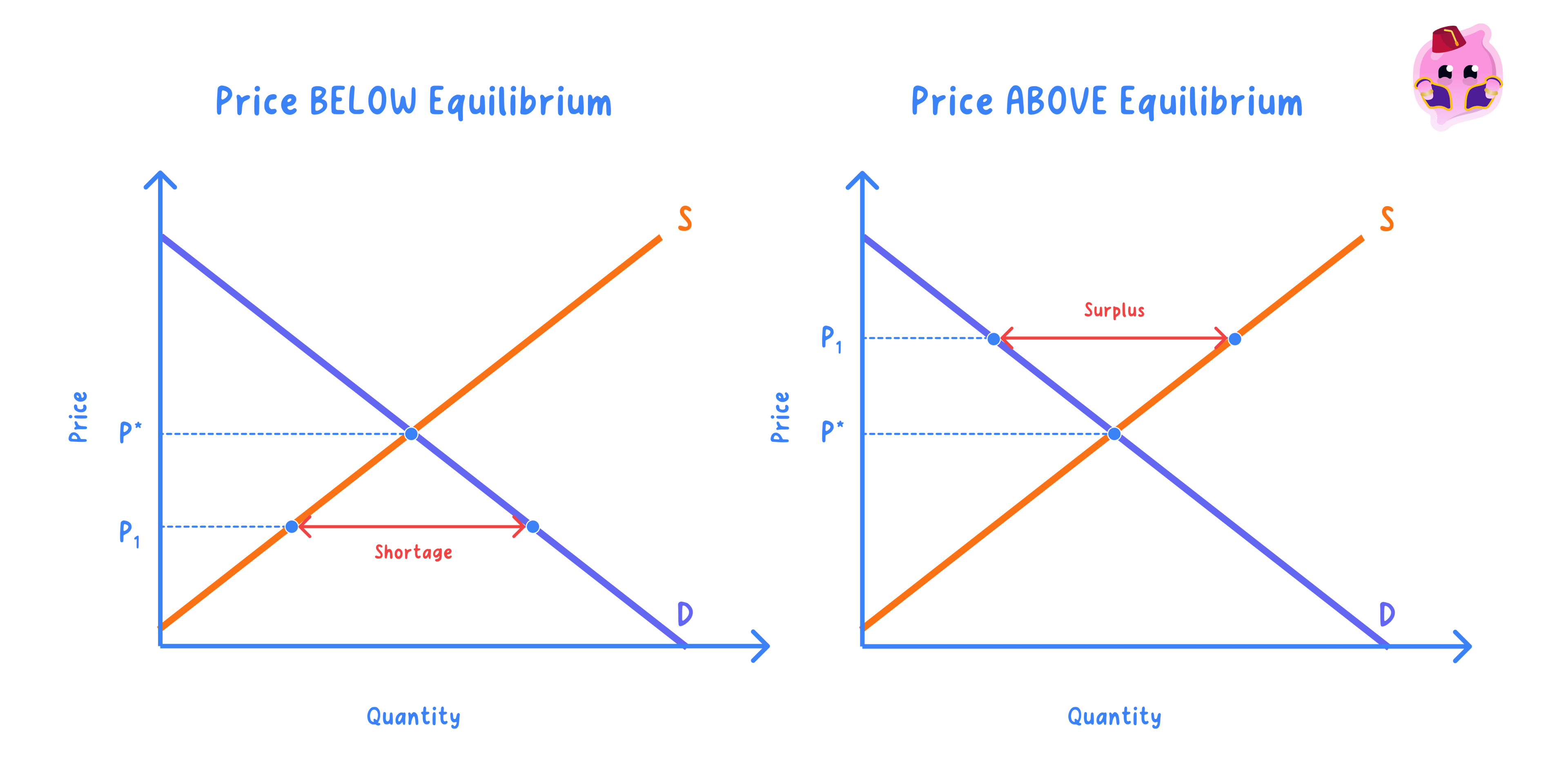
- Excess demand (shortage)
- At a price below equilibrium, demand exceeds supply and price is bid up.
- Excess supply (surplus)
- At a price above equilibrium, supply exceeds demand and price is driven down.
Note
- The key is the adjustment process: a shortage pushes price up, which raises quantity supplied and chokes off demand until the market clears.
- Simply stating that a shortage exists without explaining this adjustment loses marks.
How Price Removes a Shortage or Surplus
- A shortage gives sellers the power to raise prices, drawing out more supply.
- A surplus forces sellers to cut prices to shift unsold stock.
- These forces continue until quantity demanded equals quantity supplied.
Worked Example: A Demand Shift Moves the Equilibrium
- Work through a shift step by step: start from an equilibrium, apply one clear cause, find the excess at the old price, then let price adjust to the new equilibrium.
Example
- Start in equilibrium in the UK strawberry market at a price of £3.00 a punnet and a quantity of 8,000 punnets a week, where quantity demanded equals quantity supplied.
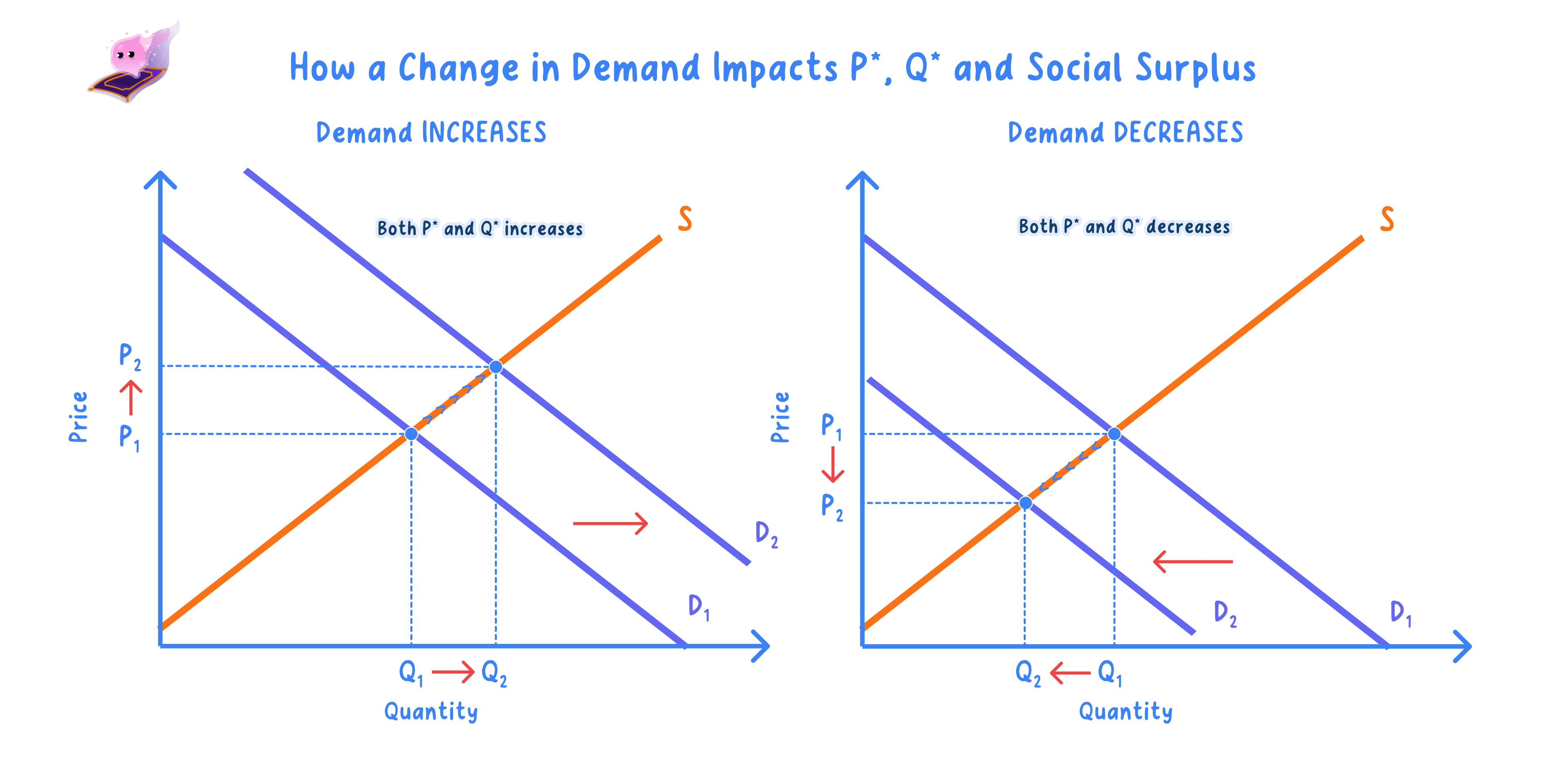
- A spell of hot weather raises demand for strawberries, shifting the demand curve to the right while supply is unchanged.
- At the old price of £3.00, quantity demanded rises to 11,000 punnets but quantity supplied stays at 8,000, so there is excess demand (a shortage) of 11,000−8,000=3,00011{,}000 - 8{,}000 = 3{,}00011,000−8,000=3,000 punnets.
- The shortage lets sellers raise the price, and as price rises quantity demanded falls back while quantity supplied is drawn out along the supply curve.
- Price settles at a new equilibrium of £3.50 a punnet with 9,500 punnets traded, where quantity demanded again equals quantity supplied.
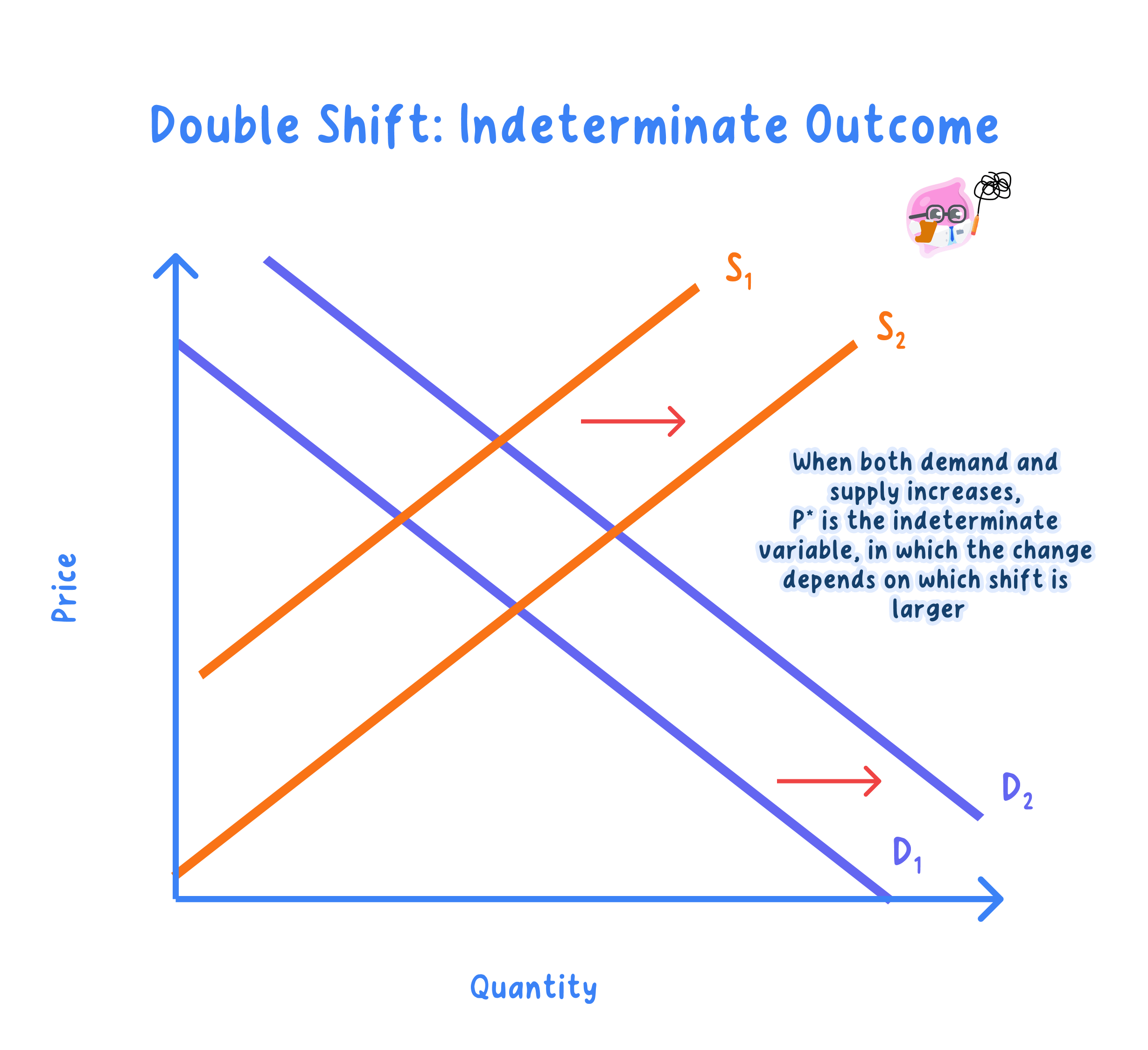
- On the diagram the demand curve shifts right from D1D_1D1 to D2D_2D2, supply stays put, and the equilibrium moves up along the supply curve from £3.00 and 8,000 units to £3.50 and 9,500 units, with the horizontal gap at £3.00 showing the 3,000-unit shortage.
The Assumptions Behind the Supply and Demand Model
- Many buyers and sellers act independently, and each is too small to set the price alone.
- Buyers and sellers are rational and pursue their own self-interest.
- Prices are flexible and free to adjust until the market clears.
- Ceteris paribus holds, so only the variable under study changes while all else stays equal.
- Buyers and sellers have good information about prices in the market.
Evaluation: Does the Market Always Clear Quickly?
- In flexible markets, prices adjust fast and equilibrium is restored quickly.
- Where prices are sticky, such as wages, disequilibrium can persist.
- Government controls, such as price ceilings, can also prevent the market clearing.
Always Explain the Adjustment
Exam technique
- Define equilibrium as quantity demanded equal to quantity supplied.
- For disequilibrium, explain how price adjustment removes the shortage or surplus.
- Draw and label the diagram, marking the excess clearly.
Common Mistake
- Do not just state that there is a shortage or surplus.
- You must explain how price adjusts to restore equilibrium.
- Do not confuse a shortage with scarcity.
- A shortage is a disequilibrium at a given price, while scarcity is the permanent economic problem.
Self review
- Define market equilibrium.
- What happens at a price below equilibrium?
- How does price remove a surplus?
- State two assumptions of the supply and demand model.
- Why might a market fail to clear quickly?
- Using numbers, show how a rightward shift in demand creates a shortage and raises the equilibrium price.
