Price Discrimination Charges Different Prices to Different Groups for the Same Good
Definition
Price discrimination: charging different prices to different consumers for the same good or service, where the price difference does not reflect a difference in the cost of supply.
- Price discrimination is charging different prices for the same good, where the price gap does not reflect a difference in cost.
- The firm must have price-setting power and be able to separate consumers.
- It must also prevent resale between the groups.
Note
- Firms charge more to less price-sensitive (inelastic) groups.
- Without a way to block resale, discrimination breaks down.
Discrimination Needs Price-Setting Power, Separable Groups and No Resale
- The firm needs price-setting power to charge above marginal cost.
- It must separate consumers by their price elasticity of demand.
- Third-degree discrimination splits the market into groups, each with its own price.
Example
- A train company charges peak commuters more than off-peak leisure travellers.
- Cheaper student tickets separate a price-sensitive group from others.
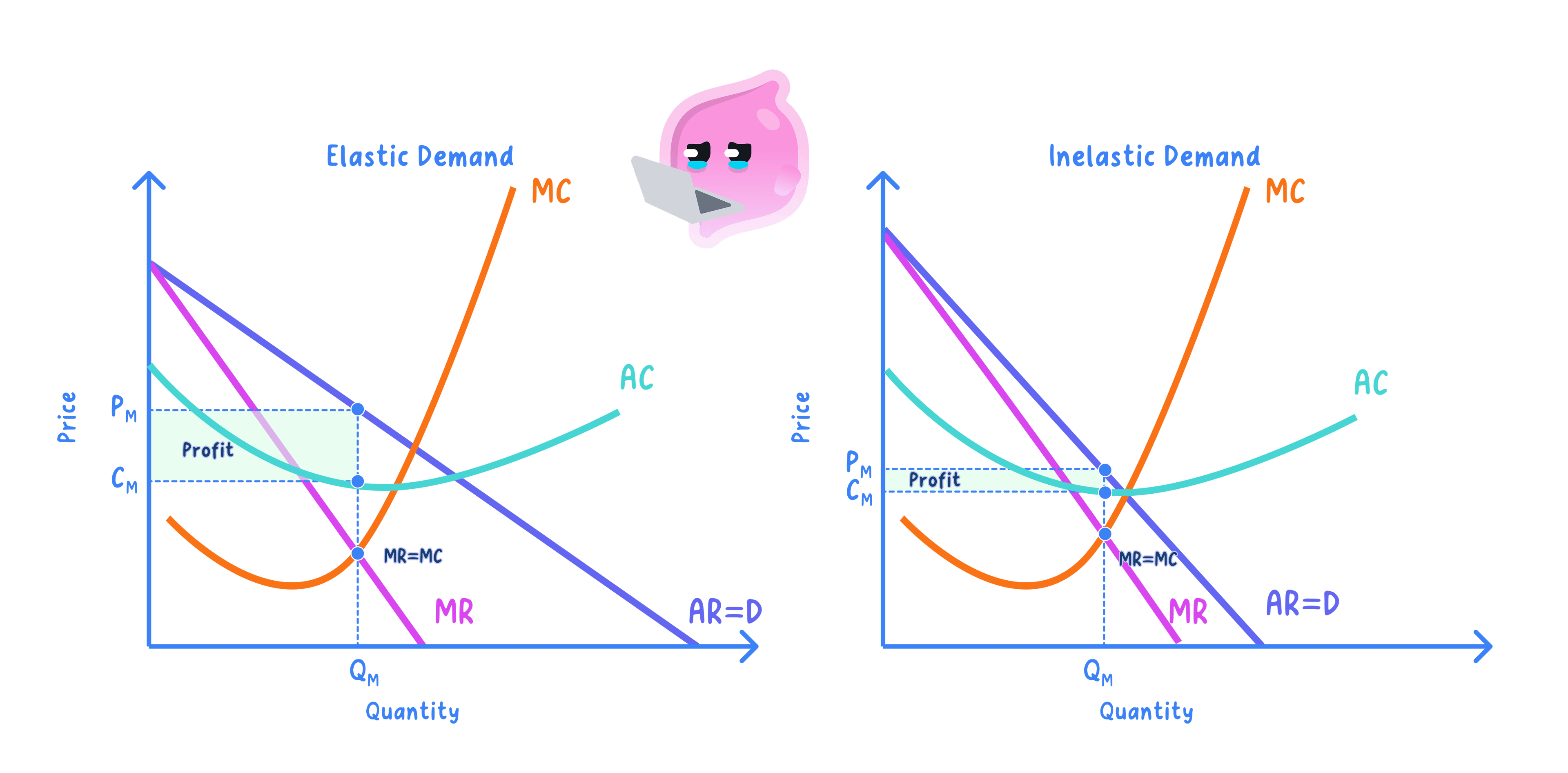
A Two-Part Diagram Sets a Higher Price in the Inelastic Sub-Market
- Draw two side-by-side sub-markets that share the same marginal cost curve.
- In each sub-market the firm produces where MC equals MR, then reads the price up to that sub-market's AR (demand) curve.
- The more inelastic sub-market ends up with the higher price and the more elastic sub-market with the lower price.
Example
- Suppose a rail operator faces 100 peak commuters who will pay up to £30 and 100 off-peak leisure travellers who will pay up to £15, with resale impossible because tickets are time-stamped.
- With a single price of £15, all 200 travel and revenue is £15×200=£3,000\pounds 15 \times 200 = \pounds 3{,}000£15×200=£3,000; raising the single price to £30 would sell only the 100 peak seats, again £3,000\pounds 3{,}000£3,000.
- Discriminating, the operator charges the peak group £30 and the off-peak group £15: revenue becomes (£30×100)+(£15×100)=£3,000+£1,500=£4,500(\pounds 30 \times 100) + (\pounds 15 \times 100) = \pounds 3{,}000 + \pounds 1{,}500 = \pounds 4{,}500(£30×100)+(£15×100)=£3,000+£1,500=£4,500.
- The extra £1,500\pounds 1{,}500£1,500 is consumer surplus converted into producer revenue, and with costs unchanged it is also the gain in profit.
The Firm Gains Profit While Consumers Face Mixed Effects
- The firm gains higher profit by capturing consumer surplus.
- Some consumers gain access who could not afford a single price.
- Others, in the less elastic group, end up paying more and lose consumer surplus.
Case study
- UK train operators charge higher peak fares to commuters, whose demand is inelastic, and cheaper off-peak and advance fares to flexible leisure travellers.
- The extra revenue can cross-subsidise loss-making services and fund investment, and some passengers travel who could not have afforded a single higher fare.
- Against this, the inelastic peak group loses consumer surplus and the practice can seem inequitable, which is why some regulated fares are capped.
Check the Three Conditions, Then Weigh the Effects
Exam technique
- State price-setting power, separable groups and no resale.
- Weigh the higher profit against the mixed effects on consumers.
Common Mistake
- Do not forget the no-resale condition.
- If buyers can resell, the cheap group undercuts the dear one and discrimination collapses.
Self review
- Define price discrimination.
- What three conditions must hold?
- Give an example of third-degree discrimination.
- Why is the no-resale condition essential?
- A cinema sells 200 adult seats at £12 and 100 student seats at £7; how much revenue does splitting the market add compared with charging all 300 the student price of £7?
