A Monopolist Is a Price Maker Who Maximises Profit at MC=MR\text{MC}=\text{MR}MC=MR
Definition
Monopoly: a market structure in which a single firm supplies the whole market, protected by high barriers to entry, though in UK law a firm with at least 25%25\%25% market share is said to have monopoly power.
- A pure monopoly is a single seller in a market.
- Monopoly power is the ability to influence price, as a price maker.
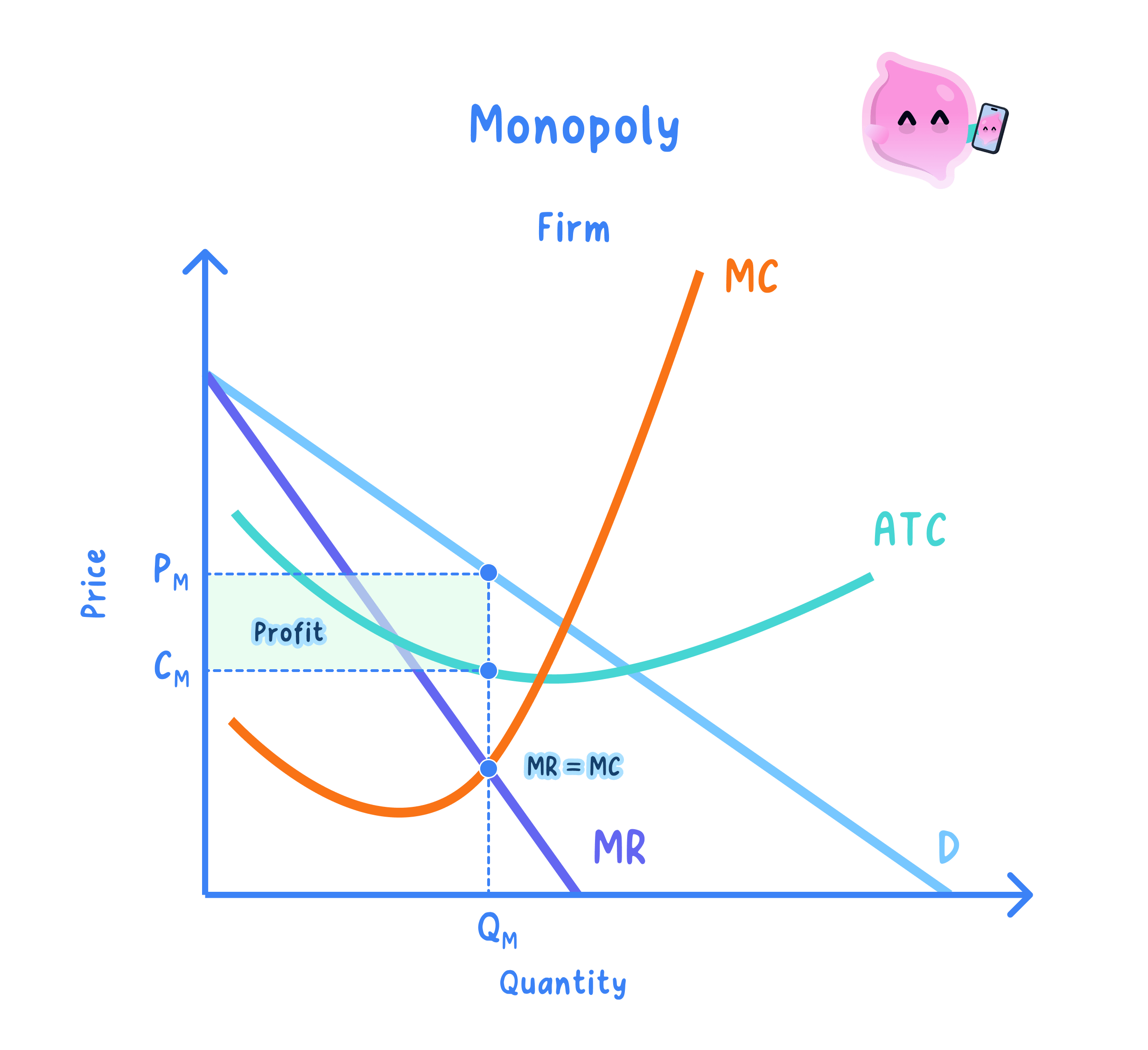
- A monopolist maximises profit where marginal cost equals marginal revenue.
Note
- The monopolist sets output at MC equals MR, then charges the price on the demand curve.
- Barriers to entry let it earn supernormal profit in the short and long run.
Barriers to Entry, Few Competitors, Branding and Differentiation Build Monopoly Power
- Barriers to entry may be legal, technical, cost, brand or strategic.
- Fewer competitors and strong branding add to the power.
- Advertising and product differentiation reinforce it.
Example
- A patent gives a drug firm a legal barrier and lasting market power.
- A strong brand can deter entry even without a legal barrier.
Set Output at MC=MR\text{MC}=\text{MR}MC=MR, Then Read Price up to the Demand Curve
- Find the profit-maximising output where marginal cost equals marginal revenue.
- Read the price up to the average revenue, or demand, curve.
- The gap between price and average cost shows the supernormal profit.
Read the Price off the Demand Curve, Not the MC=MR\text{MC}=\text{MR}MC=MR Point
Exam technique
- Set output where marginal cost equals marginal revenue.
- Then read the price up to the demand curve, not off the MC=MR point.
Common Mistake
- Do not set the price at the MC equals MR output level.
- Read the price up to the average revenue, or demand, curve.
Monopoly's Higher Prices Must Be Weighed Against Scale Economies and Innovation
- Monopoly can raise prices, cut output and create a deadweight welfare loss.
- But economies of scale may lower costs, and profit can fund innovation.
- So the costs must be weighed against the benefits.
Note
- Monopoly is allocatively and productively inefficient in the basic model.
- Yet scale economies and dynamic efficiency can offset some of the harm.
There Are Costs and Benefits on Each Side
- Costs: higher prices, lower output, X-inefficiency and deadweight loss.
- Benefits: economies of scale that can lower average cost.
- Benefits: supernormal profit that funds research and development.
Example
- A monopoly utility might charge more than a competitive market would.
- A large pharmaceutical monopoly can fund costly, risky research.
Whether Monopoly Harms or Helps Turns on Scale, Contestability and Innovation
- In the basic model, monopoly harms consumers through higher prices and lost welfare.
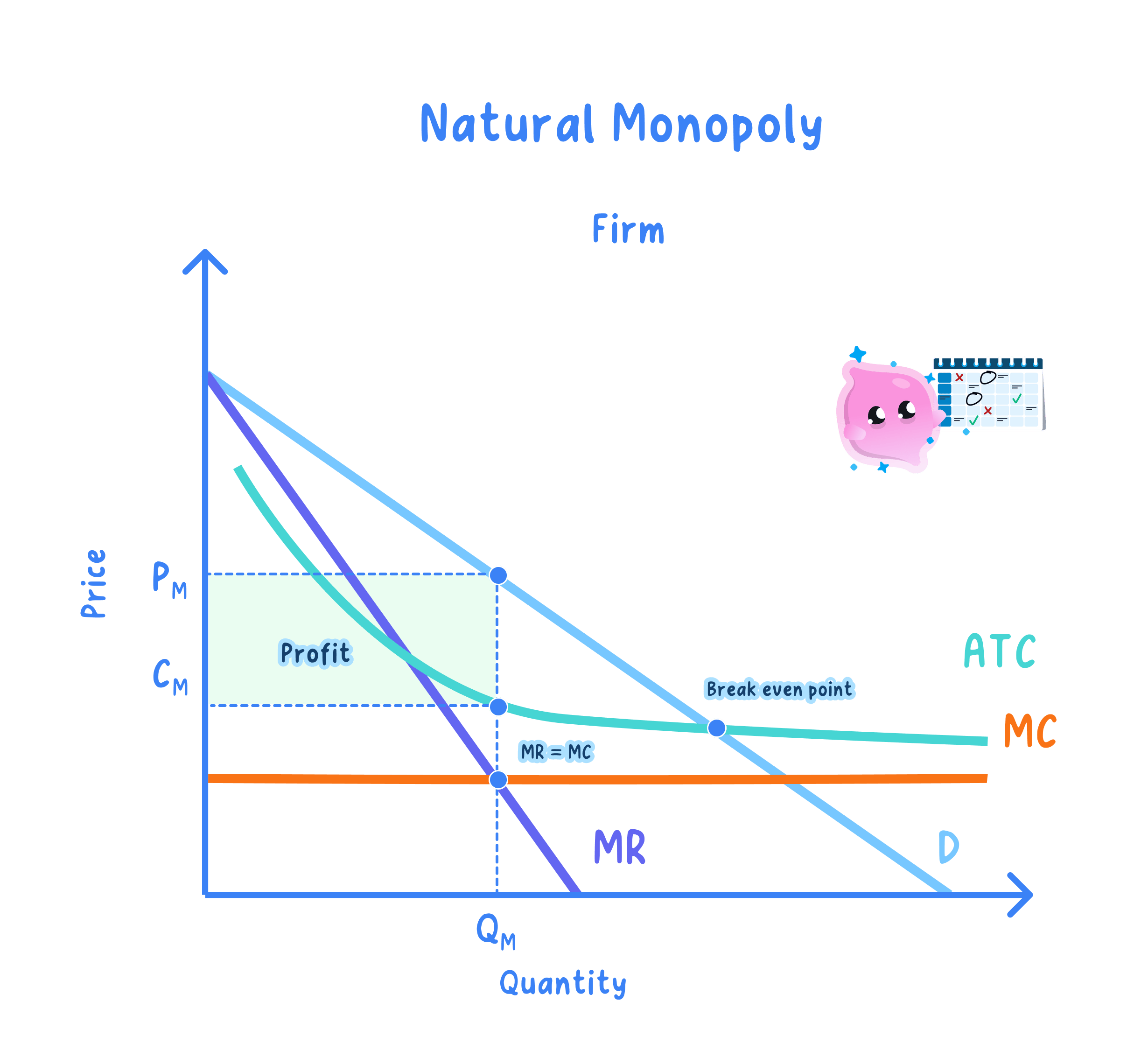
- But large scale economies can push average cost below the competitive level.
- The threat of entry can also discipline a monopolist's behaviour.
- On balance, whether monopoly harms or helps turns on scale economies, contestability and innovation.
Compare with the Competitive Outcome Using Consumer and Producer Surplus
Exam technique
- Compare monopoly with the competitive outcome using consumer and producer surplus.
- Make the verdict depend on scale economies, contestability and innovation.
Common Mistake
- Do not claim monopoly always raises price.
- Economies of scale can lower costs and even the price below the competitive level.
Self review
- Define a pure monopoly and monopoly power.
- Where does the monopolist set output, and how do you read the price on the diagram?
- What factors influence monopoly power?
- Name two disadvantages and two advantages of monopoly.
- What does the verdict on monopoly depend on?
