Competition Is a Dynamic Process of Rivalry and Creative Destruction
Definition
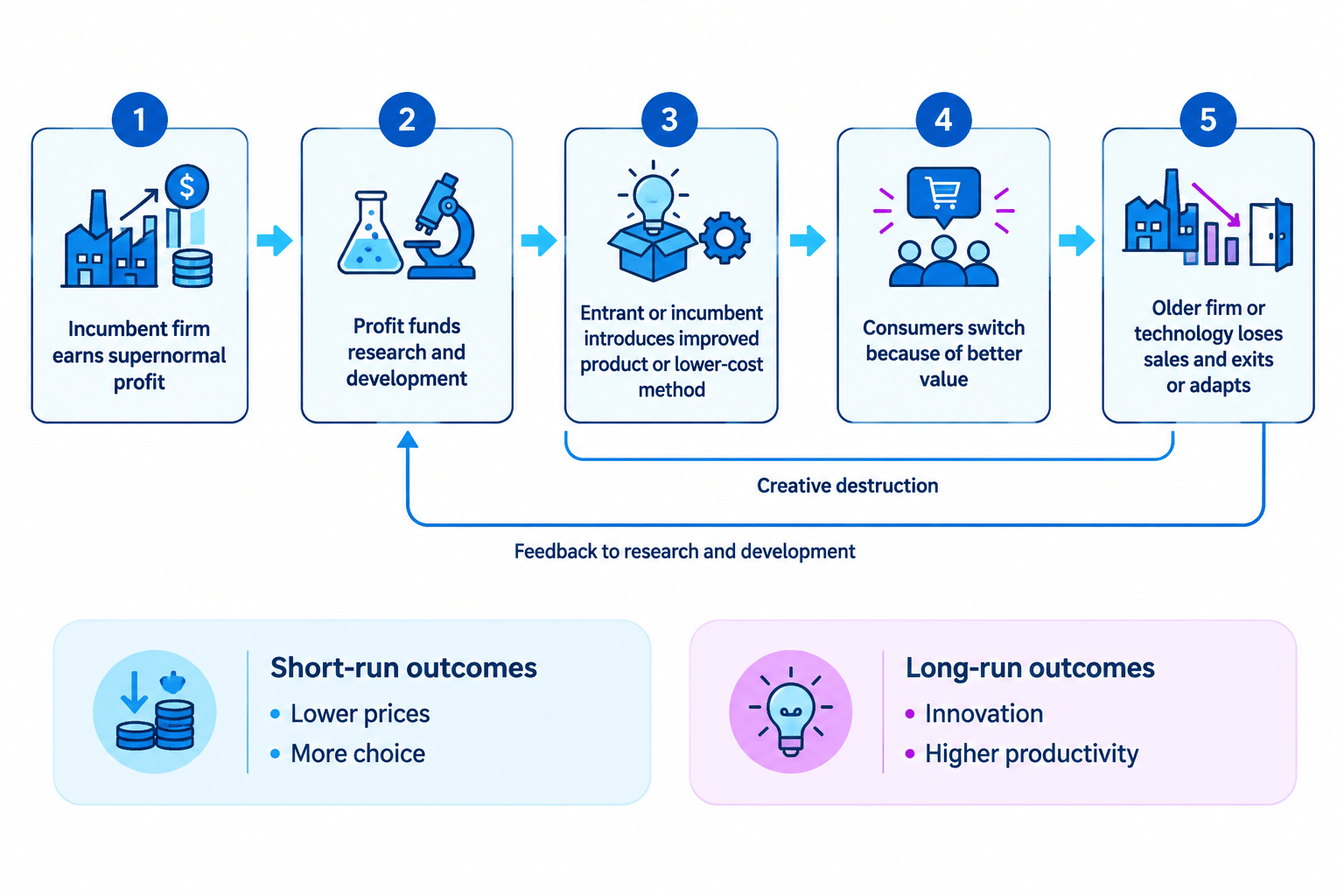
Creative destruction: the process by which competition and innovation lead new firms, products and methods to replace and destroy established ones over time.
- Competition is a dynamic process, not just a battle over price.
- Firms compete by improving products, cutting costs and raising the quality of service.
- Creative destruction is when new firms and products displace old ones.
- It brings benefits in both the short run, through lower prices and more choice, and the long run, through innovation and higher productivity.
Note
- Even concentrated markets can be disrupted over time.
- Supernormal profit can be the reward that funds the next innovation.
Innovative Firms Displace Established Firms and Old Technologies
- Innovative firms bring new products and methods to market.
- These displace established firms and older technologies.
- So today's dominant firm can be tomorrow's casualty.
Example
- Streaming services displaced the once-dominant video rental shops.
- Smartphones disrupted cameras, music players and much else at once.
Judged over Time, Even Concentrated Markets Face Competition
- A static snapshot of prices misses the process of rivalry.
- High profit today can fund the innovation that disrupts tomorrow.
- So concentration now need not mean a lack of competition over time.
Is More Competition Always Better?
- Competition brings clear short-run gains of lower prices and more choice and long-run gains of innovation and higher productivity through creative destruction.
- But creative destruction also has costs, since displaced firms shed workers and scrap investment, causing structural unemployment and disruption while the economy adjusts.
- More competition is not always better, because the supernormal profit that competition erodes is often what funds the research and development behind the next wave of innovation.
- Where economies of scale are large, one big firm or a few large firms can produce at lower average cost than many small rivals, so fragmenting the market can raise costs.
- So whether more competition is better depends on the balance between its static price gains and the dynamic gains from scale and innovation, and on how easily displaced workers and capital can be redeployed.
Judge the Process over Time, Not a Static Snapshot
Exam technique
- Use creative destruction to assess long-run competition.
- Make the case for profit funding disruptive innovation.
Common Mistake
- Do not judge competition only by a static snapshot of prices.
- Look at the dynamic process of rivalry and disruption over time.
Self review
- What short-run and long-run benefits does competition bring?
- Why is competition a dynamic process?
- What is creative destruction?
- How can a concentrated market still be competitive?
- Why can a static price snapshot mislead?