1.5.5a Characteristics and definition of oligopoly (A-level only)
Oligopoly Is a Few Interdependent Firms Behind High Barriers to Entry
Definition
Oligopoly: a market structure dominated by a few large firms whose decisions are interdependent, typically with high barriers to entry.
- Oligopoly is a market dominated by a few large firms with high barriers to entry.
- Its key feature is interdependence: each firm anticipates rivals' reactions.
- Oligopolies vary widely in the number of firms, the degree of product differentiation and ease of entry.
- It can be defined by structure (high concentration) or by conduct (strategic behaviour).
Note
- Interdependence and uncertainty shape how oligopolists behave.
- A concentration ratio measures the combined share of the largest firms.
The Concentration Ratio Sums the Market Shares of the Largest Firms
- The n-firm concentration ratio adds up the market shares of the largest n firms.
- A high ratio signals a concentrated, oligopolistic market.
- It is read from market-share data, usually as a four-firm or five-firm ratio.
Example
- UK grocery retailing is a clear oligopoly, so take the four largest chains with market shares of about 27%27\%27%, 15%15\%15%, 13%13\%13% and 9%9\%9%.
- The four-firm concentration ratio adds these shares: 27%+15%+13%+9%=64%27\% + 15\% + 13\% + 9\% = 64\%27%+15%+13%+9%=64%.
- A four-firm ratio of 64%64\%64% means almost two-thirds of the market is held by just four firms, confirming a concentrated, oligopolistic structure.
- The remaining 36%36\%36% is split among discounters such as Aldi and Lidl and smaller grocers, whose rapid growth shows that a high ratio need not mean rivalry is absent.
Interdependence Forces Each Firm to Anticipate Rivals' Reactions
- With few rivals, one firm's move affects the others directly.
- Each must guess how rivals will respond before acting.
- This uncertainty drives strategic behaviour and tends to produce price stability.
Case study
- The UK groceries market is dominated by a handful of national chains, a textbook oligopoly with strong interdependence on price and promotions.
- When Sainsbury's and Asda proposed to merge in 2019, the Competition and Markets Authority (CMA) blocked the deal, fearing higher prices and less choice for shoppers.
- The case shows regulators weigh concentration alongside evidence on rivalry and ease of entry, not firm numbers alone, when judging market power.
Define Oligopoly by Concentration and Conduct, Not Firm Numbers Alone
Exam technique
- Calculate the concentration ratio, then discuss interdependence.
- Stress that firms anticipate rivals' reactions.
Common Mistake
- Do not define oligopoly by the number of firms alone.
- It is defined by high concentration and interdependence.
Self review
- Define oligopoly.
- What is interdependence?
- Work out the four-firm ratio for shares of 40%40\%40%, 25%25\%25%, 15%15\%15% and 8%8\%8%.
- Why does interdependence shape behaviour?
1.5.5b Collusion and the kinked demand curve (A-level only)
Firms May Collude Overtly or Tacitly, but the Incentive to Cheat Makes It Unstable
Definition
Collusion: an agreement between firms to restrict competition, for example by fixing prices or limiting output, so that they can act together like a monopoly.
- In a collusive oligopoly firms coordinate their decisions; in a non-collusive oligopoly they act independently and compete.
- Collusion is an agreement to limit competition, and can be overt (a formal cartel) or tacit (an informal understanding).
- Cooperation, such as joint research or shared standards, can be legal and beneficial, whereas collusion to fix prices or output is anti-competitive and usually illegal.
- A cartel fixes price or restricts output, so firms act like a monopoly.
Note
- Firms have an incentive both to collude and to cheat.
- The prisoner's dilemma shows why collusion is unstable.
A Payoff Matrix Reveals Each Firm's Dominant Strategy
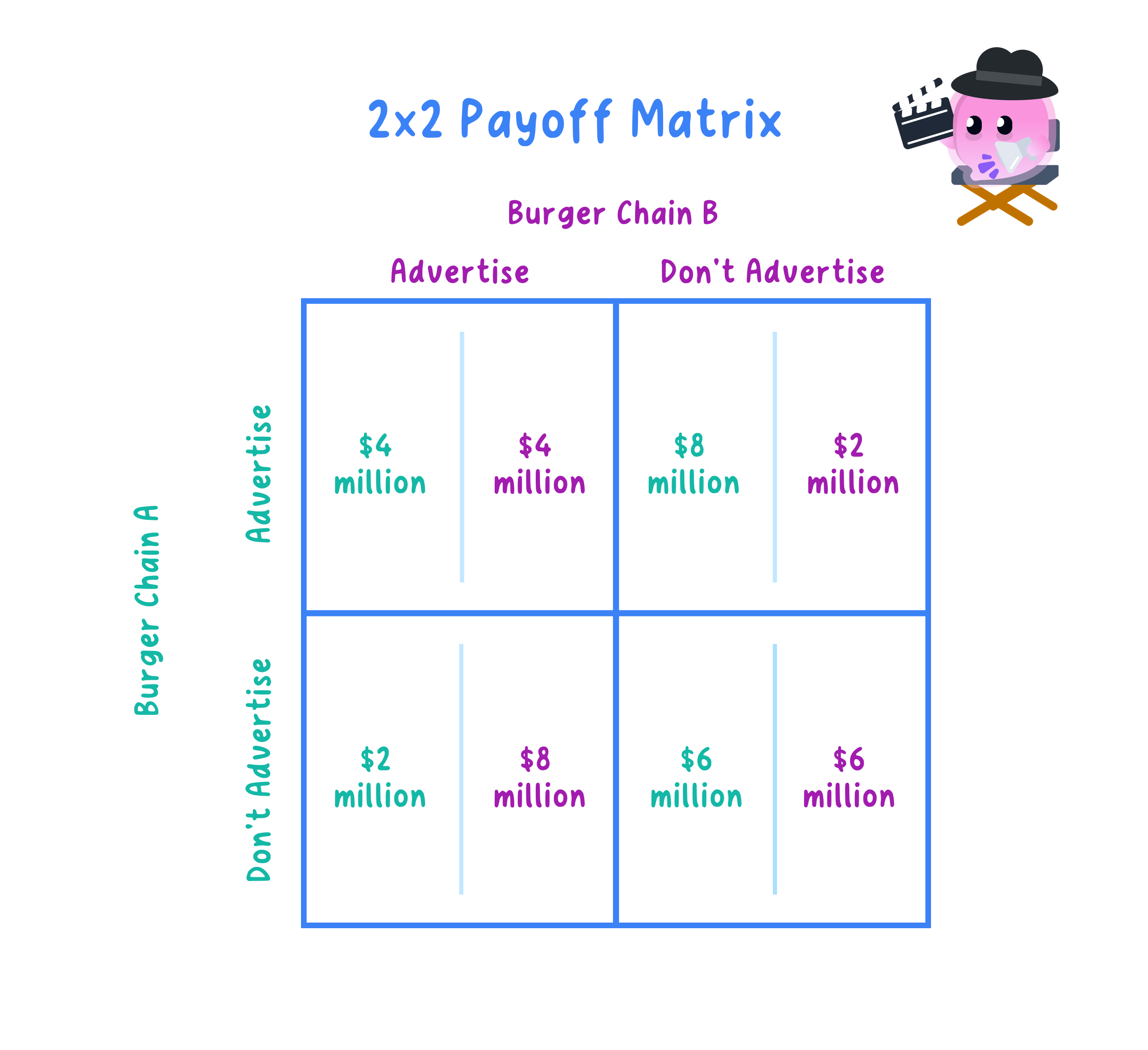
- A two-firm matrix shows each firm's profit for each pair of choices.
- A dominant strategy is the best choice whatever the rival does.
- When both cut price, they end up worse off than if both had held.
Example
- If both firms collude they might earn $4m each, but cheating raises one firm to $8m.
- Fearing the other will cheat, each cuts price and both end on £6m.
Each Firm's Incentive to Undercut Makes Cartels Unstable
- Each firm can gain by secretly undercutting the agreed price.
- If one cheats, the others follow, and the cartel collapses.
- Cartels hold best with few firms, easy monitoring and stable demand.
Find Each Firm's Dominant Strategy in the Matrix
Exam technique
- Read the matrix and identify each firm's dominant strategy.
- Explain the incentive to cheat that makes collusion unstable.
Common Mistake
- Do not assume collusion always holds.
- Each firm has an incentive to defect, which can break the cartel.
The Kinked Demand Curve Explains Price Rigidity in Non-Collusive Oligopoly
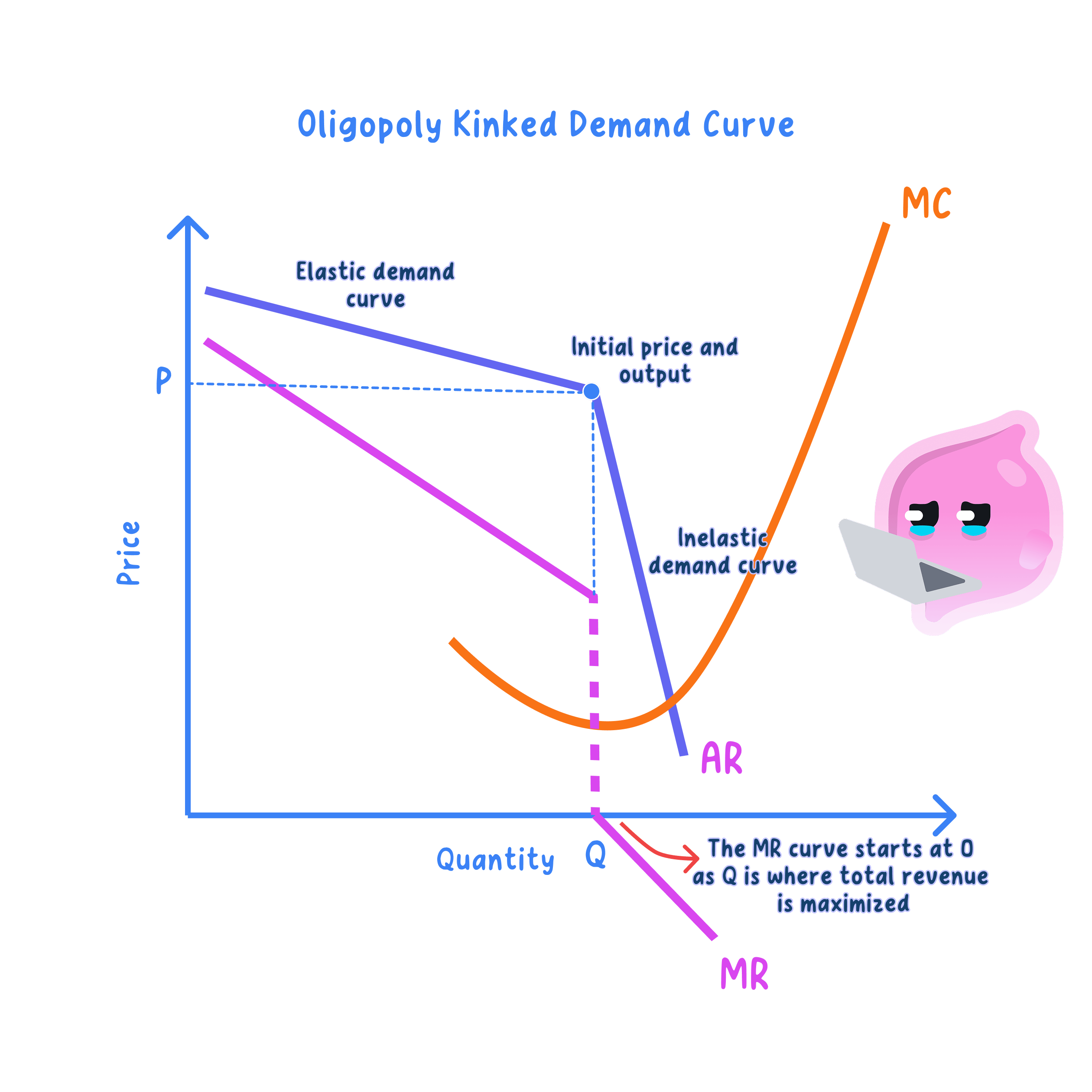
- The kinked demand curve explains stable prices in non-collusive oligopoly.
- A firm assumes rivals match a price cut but not a price rise.
- So demand is elastic above the current price and inelastic below it.
Note
- The kink creates a gap in the marginal revenue curve.
- With that gap, firms have little reason to change price.
Neither Raising nor Cutting Price Looks Attractive, so the Price Sticks
- Raise the price and rivals hold theirs, so the firm loses many sales.
- Cut the price and rivals match it, so the firm gains few sales.
- Either move looks unattractive, so the price tends to stick.
Example
- A petrol station hesitates to raise prices, fearing it will lose custom to rivals.
- It also gains little from cutting, since nearby stations quickly match it.
With Price Rigid, Firms Compete on Branding, Quality and Service
- With price rigid, firms turn to non-price competition.
- Branding, quality and service become the main weapons.
- This helps explain the stable prices often seen in oligopoly.
Draw Demand Elastic Above and Inelastic Below, with a Broken MR Curve
Exam technique
- Draw demand elastic above the price and inelastic below, with a broken MR curve.
- Use it to explain observed price stability.
Common Mistake
- Do not claim the model explains how the initial price is set.
- It describes why an existing price is rigid, not how it was first chosen.
Self review
- What is the difference between collusive and non-collusive oligopoly?
- How does cooperation differ from collusion?
- Distinguish overt (cartel) from tacit collusion.
- Why does game theory suggest collusion is unstable?
- What does the kinked demand curve model explain?
1.5.5c Non-price competition and pricing strategies (A-level only)
Non-Price Competition Wins Customers by Adding Value Rather than Cutting Price
Definition
Non-price competition: competition between firms through means other than price, such as advertising, branding, product quality and customer service.
- Non-price competition means attracting and keeping customers by changing something other than price.
- Instead of cutting price to win sales, a firm improves its product, builds its brand, or adds value through the service around the sale.
- It is the normal way firms behave in oligopoly and monopolistic competition, where goods are differentiated and a price cut often just triggers a price war.
Note
- Non-price competition is any method of winning customers that does not involve lowering price.
- It dominates markets where firms fear price wars or where products are differentiated.
Firms Add Value Through Advertising, Branding, Loyalty Schemes, Quality and Service
- Each of the following methods works by making the product more attractive at its current price rather than by making it cheaper.
- Advertising and marketing
- Advertising builds awareness and shapes preferences, as with the John Lewis Christmas advert or Coca-Cola's global campaigns.
- Branding
- A strong brand makes buyers loyal and less sensitive to price, which is why Apple can charge a premium.
- Loyalty schemes
- Rewards for repeat custom lock buyers in, such as the Tesco Clubcard and Nectar points.
- Packaging and design
- Distinctive packaging helps a product stand out on the shelf and signals quality.
- Quality improvements
- Better materials, reliability or features raise the product's appeal without a price change.
- After-sales service
- Warranties, support and easy returns reassure buyers, as with Kia's seven-year warranty in the UK car market.
- Product innovation
- New or improved products keep a firm ahead of rivals, as with smartphone makers releasing new models each year.
Example
- The cola market is the classic case of non-price competition, where near-identical drinks compete through branding and advertising.
Firms Also Coordinate Prices Through Leadership, Agreements and Cartels
- Price methods include price wars, predatory pricing (to drive out existing rivals) and limit pricing (to deter potential entrants).
- Under price leadership, one firm sets the price and rivals follow.
- Informal price agreements and cartels can coordinate prices, giving some gains of collusion, though cartels are illegal in the UK.
Note
- Predatory pricing aims to drive out existing rivals.
- Limit pricing sets a low price to deter potential entrants.
Example
- A dominant supermarket cuts prices and rivals quickly match it.
- A large firm prices low to make entry unattractive to newcomers.
Rigid Prices Push Firms to Compete Non-Price and Make Demand Less Elastic
- In oligopoly, prices are often rigid because a price cut is quickly matched by rivals, leaving everyone worse off.
- A price rise loses customers to firms that hold their price, which is the logic behind the kinked demand curve.
- With price a dangerous weapon, firms turn to non-price methods to gain an edge.
Note
- The deeper aim is to make demand more price-inelastic: advertising and branding shift the firm's average revenue (AR) curve to the right and make it steeper, so the firm can hold a higher price without losing many sales.
- Strong brands also act as a barrier to entry, because a new rival must spend heavily to build the same recognition.
- Diagram link: effective advertising shifts the firm's demand (AR) curve outward and makes it less elastic, so the firm can set a price further above marginal cost and earn more profit.
Non-Price Competition Brings Benefits and Costs That Must Be Weighed
- Non-price competition creates both gains and costs, and strong answers weigh them rather than listing methods.
- Benefits: consumers gain more choice, better quality and useful information; innovation can drive long-run improvements, supporting dynamic efficiency; and firms build stable revenue without a damaging price war.
- Costs: heavy advertising is an expense that can be passed on in higher prices; persuasive advertising may create wants rather than inform, wasting resources; and established brands entrench incumbents and make entry harder.
Note
- Whether non-price competition helps or harms consumers depends on the type used: informative advertising and genuine quality gains tend to help, while persuasive advertising and brand-building that mainly raises prices and blocks entry tend to harm.
Build the Chain of Reasoning from Method to Profit
Exam technique
- Name a specific method, then explain the chain: it makes demand more inelastic, so the firm can hold a higher price and earn greater profit.
- Always link back to profit, market share or barriers to entry, and use a real firm as evidence.
Common Mistake
- Do not confuse non-price competition with predatory or limit pricing, which are forms of price competition.
- Advertising does not shift the supply curve; it works on the demand side, and it is a cost that raises average cost and can act as a sunk-cost barrier to entry.
Self review
- Define non-price competition in one sentence.
- List four methods of non-price competition.
- How do price leadership and price agreements coordinate prices?
- Explain why non-price competition dominates in oligopoly.
- What happens to a firm's demand curve if its advertising succeeds?
- Give one benefit and one cost of non-price competition for consumers.
1.5.5d Interdependence and evaluation of oligopoly (A-level only)
Oligopoly Can Help or Harm Consumers Depending on How Firms Behave
Definition
Interdependence: in oligopoly, the situation in which each firm's decisions on price and output depend on the likely reactions of its rivals.
- Because oligopolists are interdependent, each anticipates rivals' reactions, and this uncertainty shapes whether they collude or compete.
- Oligopoly can harm consumers where firms collude and restrict output.
- But it can benefit them through economies of scale and innovation.
- The outcome depends on whether firms collude or compete.
Note
- Colluding oligopolists raise prices and restrict output.
- Competing oligopolists may pass on lower costs and fund innovation.
There Is a Case for and Against Oligopoly
- Against: collusion, higher prices and allocative inefficiency.
- For: economies of scale and stable prices.
- For: supernormal profit that can fund research and dynamic efficiency.
Example
- Colluding energy firms could keep bills high for consumers.
- Competing tech giants reinvest large profits into rapid innovation.
The Verdict Turns on Collusion, Competition and Contestability
- Where firms collude, oligopoly looks much like monopoly and harms consumers.
- Where they compete, or the market is contestable (easy for new firms to enter and challenge the incumbents), outcomes improve.
- The dynamic gains from scale and innovation can offset static losses.
- On balance, oligopoly is neither uniformly good nor bad, and the verdict turns on conduct and contestability.
Judge Oligopoly by Collusion and Contestability
Exam technique
- Set static harms against dynamic gains from scale and innovation.
- Make the verdict depend on whether firms collude and how contestable the market is.
Common Mistake
- Do not treat oligopoly as uniformly bad.
- Weigh its dynamic efficiency and economies of scale against the drawbacks.
Self review
- Why do interdependence and uncertainty matter in oligopoly?
- Give one drawback of oligopoly.
- Give one benefit of oligopoly.
- Why does the verdict depend on conduct?
- How can dynamic gains offset static losses?
