Monopolistic Competition Has Many Firms, Differentiated Products and Low Barriers
Definition
Monopolistic competition: a market structure with many firms selling differentiated products and freedom of entry and exit, so firms earn only normal profit in the long run.
- Monopolistic competition has many firms and low barriers to entry and exit.
- Products are differentiated, not identical.
- So each firm has a little price-setting power and a downward-sloping demand curve.
Note
- Differentiation gives each firm a small niche.
- Many close substitutes keep its demand curve relatively elastic.
Many Small Firms, Easy Entry and Product Differentiation Define the Market
- Many firms compete, each fairly small.
- Entry and exit are easy, with low barriers.
- Branding, quality and design set each firm's product apart.
Example
- Independent coffee shops each build a slightly different appeal.
- Hairdressers compete locally, each with its own style and following.
It Blends a Little Market Power with Strong Competition
- Unlike perfect competition, products are differentiated, not homogeneous.
- Unlike oligopoly, there are many firms and no interdependence.
- So it blends a little market power with strong competition.
In the Short Run Firms May Earn Supernormal Profit; Entry Erodes It to Normal Profit
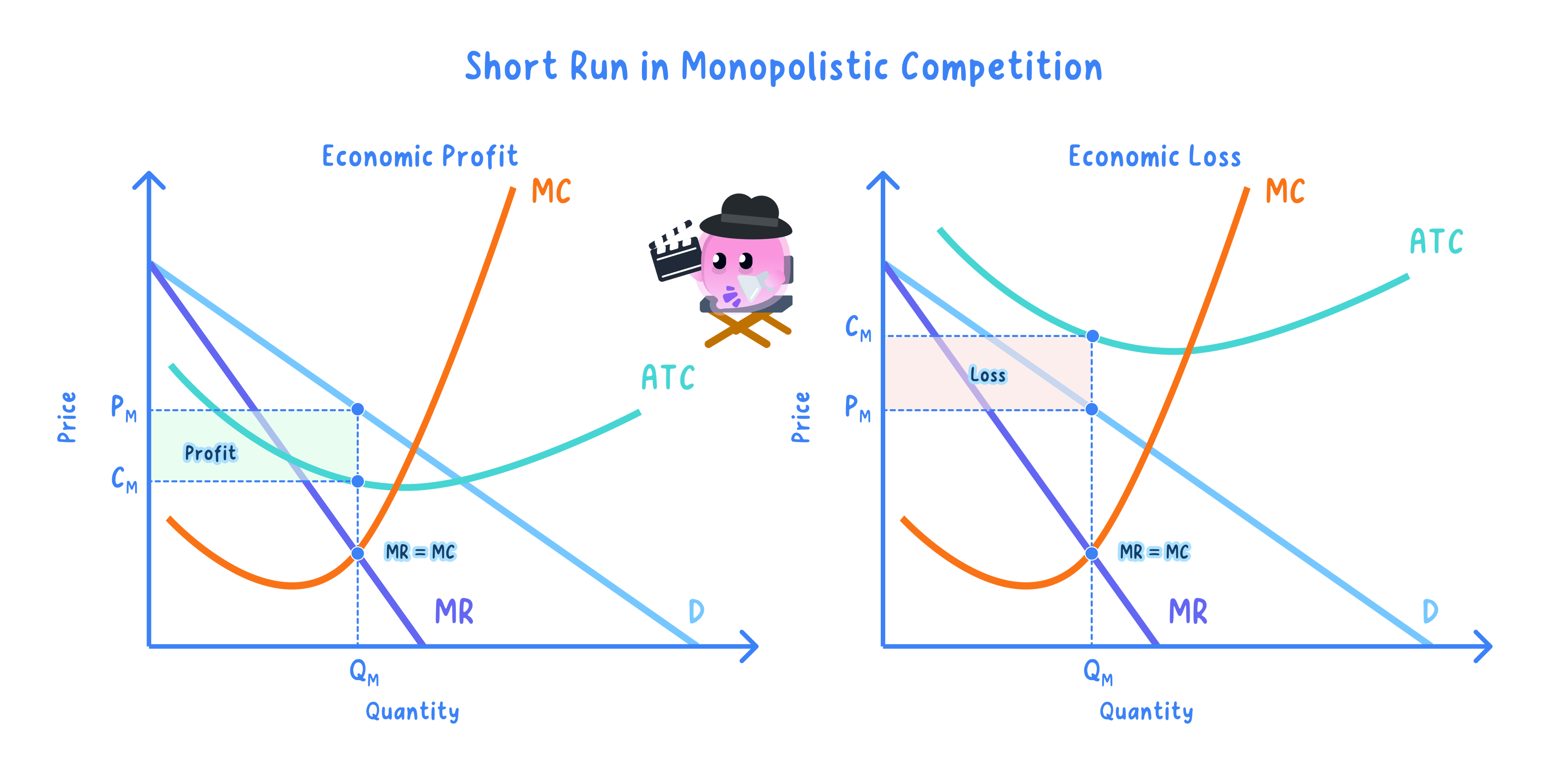
- The firm maximises profit where marginal cost equals marginal revenue.
- In the short run it can earn supernormal profit.
- New entrants shift its demand curve left until only normal profit remains.
Note
- Low barriers to entry compete away short-run profit.
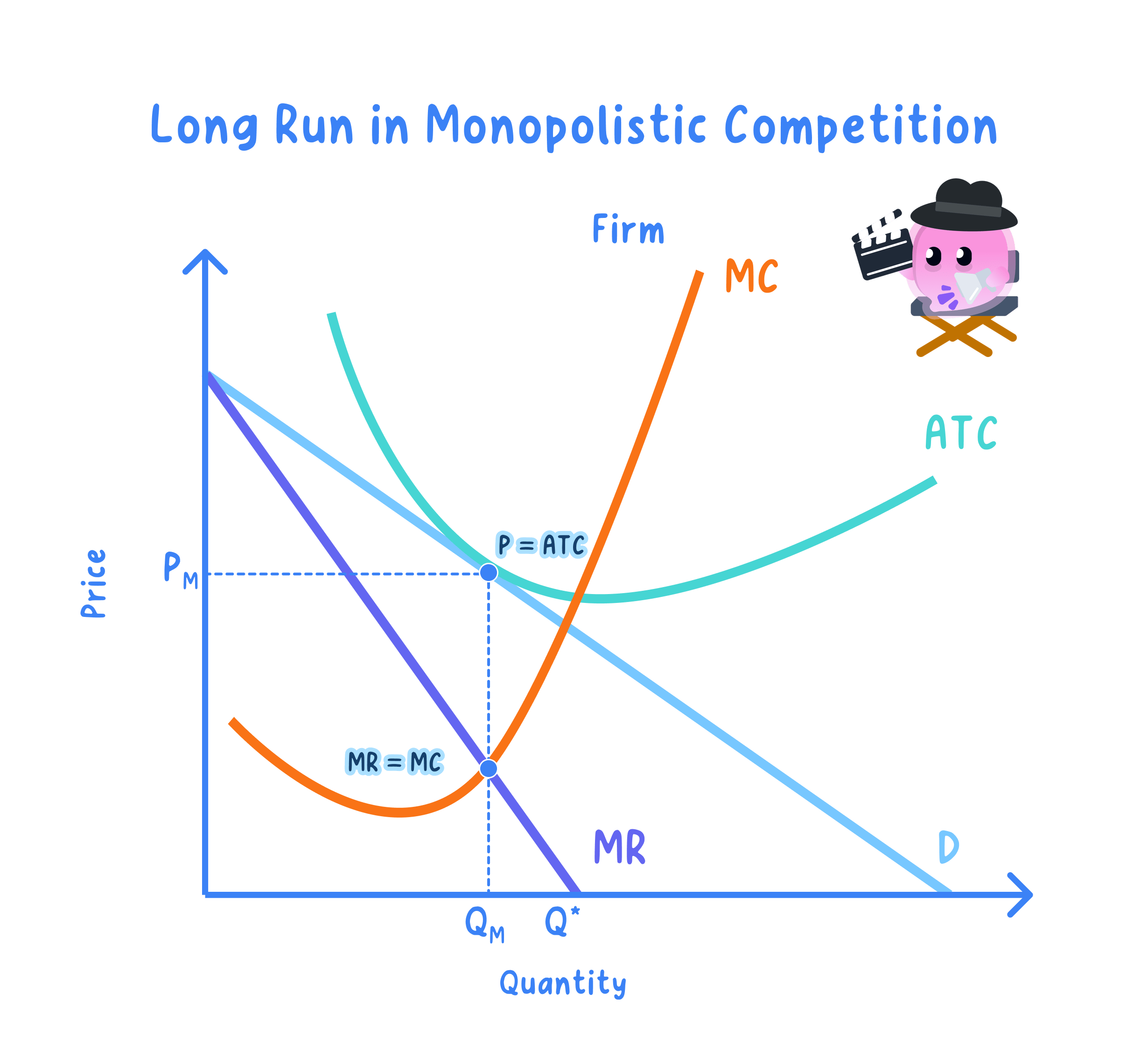
- In long-run equilibrium the demand curve is tangent to the average cost curve.
Price Exceeds Marginal Cost and Output Falls Short of Least Cost, Leaving Excess Capacity
- Price exceeds marginal cost, so the firm is allocatively inefficient.
- Output is below minimum average cost, so it is productively inefficient.
- This gap from the lowest-cost point is called excess capacity.
Example
- A high street has more coffee shops than least-cost production would need.
- Each shop runs below full capacity but offers consumers variety.
Firms Compete Mainly Through Branding and Differentiation, Not Price
- Firms rely heavily on branding and advertising.
- Differentiation, not price, is the main competitive weapon.
- Consumers gain choice and variety in return for the inefficiency.
Is Monopolistic Competition Bad for Welfare?
- On the standard static measures it wastes resources, being both allocatively inefficient (price above marginal cost) and productively inefficient (excess capacity).
- But the product differentiation that causes this also gives consumers real variety and choice, which the perfectly competitive ideal cannot offer.
- Low barriers to entry keep prices close to costs and compete supernormal profit away in the long run, so firms cannot exploit consumers for long.
- Against this, earning only normal profit in the long run leaves little to fund research, so dynamic efficiency may be weak.
- So whether the excess capacity is a genuine welfare loss depends on how much consumers value the extra variety relative to the higher price and unused capacity.
Place the Long-Run Tangency Above the Lowest Point of Average Cost
Exam technique
- Draw the long-run demand curve tangent to average cost above its lowest point.
- Show price above marginal cost to prove allocative inefficiency.
Common Mistake
- Do not draw the long-run tangency at the bottom of the average cost curve.
- It sits to the left of the minimum, leaving excess capacity.
Self review
- Define monopolistic competition and give its main characteristics.
- Why is each firm's demand curve downward-sloping?
- Where does the firm maximise profit, and what competes away short-run profit?
- Why is the firm allocatively and productively inefficient, and what is excess capacity?
- Why does non-price competition dominate in this market?
