2.3.2a Measures and types of unemployment
The UK Measures Unemployment in Two Ways, and Joblessness Comes in Four Main Types
Definition
Unemployment: a situation in which people who are willing and able to work at the current wage rate, and are actively seeking work, are unable to find a job.
- Unemployment is measured in two main ways in the UK.
- The claimant count records those claiming unemployment-related benefits, such as Universal Credit, who are required to look for work.
- The Labour Force Survey (LFS) measure uses the internationally agreed ILO definition to count everyone who is out of work, actively seeking a job and available to start.
Note
- The claimant count only captures eligible benefit claimants, so it usually gives a lower figure.
- The LFS measure captures anyone seeking and available for work, whether or not they claim benefits.
The Two UK Measures Rarely Give the Same Figure
- The claimant count changes whenever benefit rules change who is eligible to claim.
- The LFS measure includes people who are seeking work but do not claim benefits, so it is usually higher.
- Hidden unemployment and discouraged workers can be missed by both measures.
Example
- Worked example: the unemployment rate is the number unemployed as a percentage of the labour force, where the labour force is the employed plus the unemployed.
- Suppose 1.4 million are unemployed and 33.6 million are employed, so the labour force is 35 million.
- The unemployment rate is 1.435×100=4%\dfrac{1.4}{35}\times 100 = 4\%351.4×100=4%, so 4% of the labour force is out of work and seeking a job.
Unemployment Differs From Underemployment and Inactivity
- The unemployed are out of work but actively seeking and available for work.
- The underemployed are in work but want more hours or are working below their skill level.
- The economically inactive are of working age but neither working nor seeking work, so they are not counted as unemployed.
Common Mistake
- Do not treat everyone who is not in work as unemployed.
- The economically inactive are not seeking work, so they are not counted as unemployed.
Unemployment Can Be Voluntary or Involuntary
- Voluntary unemployment occurs when a worker is unwilling to accept a job at the going wage rate, for example while searching for a better offer or because the wage would not exceed their benefits.
- Involuntary unemployment occurs when a worker is willing and able to work at the going wage rate but cannot find a job.
The Four Types of Unemployment Each Have a Different Cause
- Frictional unemployment is short-term unemployment as people move between jobs and spend time searching for a suitable new post.
- Structural unemployment results from a long-term change in the pattern of demand or production, leaving workers' skills or location mismatched with the jobs available, for example after the decline of an industry.
- Cyclical unemployment, also called demand-deficient unemployment, arises during an economic downturn when a fall in aggregate demand reduces firms' demand for labour.
- Seasonal unemployment occurs when demand for certain workers falls at particular times of the year, for example in tourism, agriculture or construction.
Example
- Frictional: a graduate spending two months searching for a suitable first job.
- Structural: a former coal miner or steelworker whose skills no longer match the jobs available after the industry's decline.
- Cyclical: workers laid off across many industries during the 2008-09 recession as aggregate demand fell.
- Seasonal: seaside resort or ski-season staff who are not needed in the off-season.
Note
- Frictional and seasonal unemployment are usually short-term, whereas structural unemployment can persist for years.
- Cyclical unemployment rises in recessions and falls in booms, so it calls for demand-side policy.
Full Employment Does Not Mean Zero Unemployment
- Full employment is when all who are willing and able to work at the going wage rate can find a job.
- It does not mean zero unemployment, because some frictional, structural and seasonal unemployment always remains.
- Full employment is a key macroeconomic objective because it raises output and incomes and reduces the waste of idle labour.
Common Mistake
- Do not define full employment as zero unemployment.
- Some frictional, structural and seasonal unemployment always remains.
Self review
- What are the two main UK measures of unemployment?
- How does the claimant count differ from the LFS measure?
- Distinguish voluntary from involuntary unemployment.
- Define frictional, structural, cyclical and seasonal unemployment.
- Why does full employment not mean zero unemployment?
2.3.2b Causes and consequences of unemployment
Unemployment Comes in Several Types, Each With a Demand-Side or Supply-Side Cause
Definition
Natural rate of unemployment: the rate of unemployment that exists when the labour market is in equilibrium, made up of the frictional, structural and other voluntary unemployment that remains when the economy is producing at its potential output.
- Frictional unemployment is short-term joblessness while workers move between jobs.
- Structural unemployment is a lasting mismatch of skills or location.
- Cyclical unemployment is caused by a fall in aggregate demand during a downturn.
- Seasonal unemployment follows the time of year, for example in tourism or farming.
- Real wage unemployment arises when wages are held above the market-clearing level.
- Cyclical unemployment is a demand-side problem, while frictional, structural, seasonal and real wage unemployment are supply-side.
Note
- Structural unemployment is a lasting mismatch.
- Cyclical unemployment is a temporary shortfall in demand.
Employment and Unemployment Are Shaped by Both Demand-Side and Supply-Side Factors
- The demand for labour is derived from the demand for output.
- A rise in aggregate demand raises output and hiring, cutting cyclical unemployment.
- Supply-side unemployment comes from features of the labour market such as skills, mobility and wage-setting.
- It is not caused by a lack of total demand.
Note
- These causes persist even when aggregate demand is strong.
- So they need supply-side, not demand-side, remedies.
Real Wage Unemployment Occurs When Wages Are Stuck Above the Market-Clearing Level
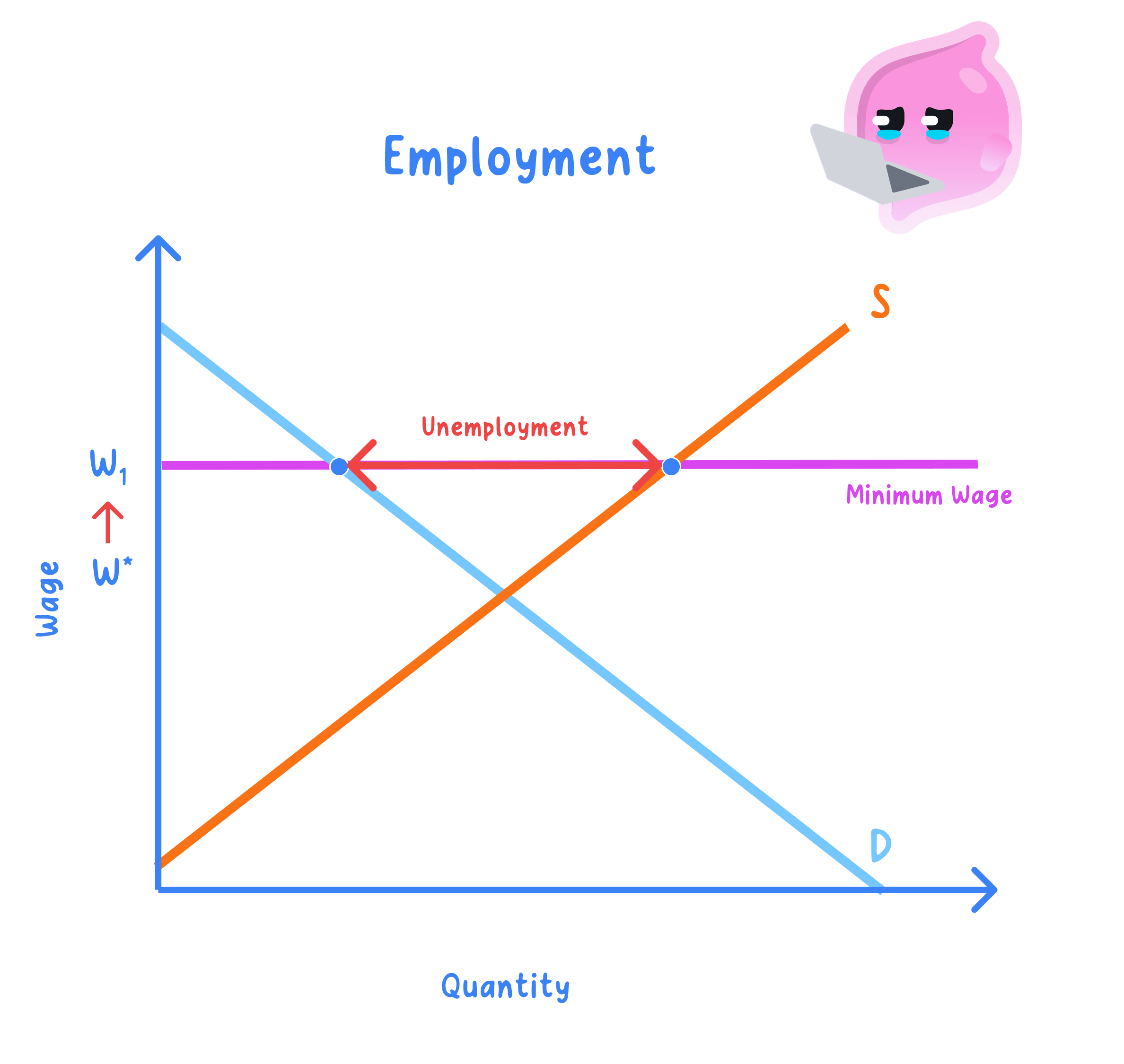
- Real wage unemployment is a form of disequilibrium unemployment, arising when the real wage is held above the market-clearing wage.
- The supply of labour then exceeds the demand for labour, leaving willing workers without jobs.
- Its main determinants are minimum wages set above the equilibrium wage and strong trade union bargaining that resists wage cuts.
Hint
- Picture a labour market diagram with the real wage on the vertical axis and quantity of labour on the horizontal, with a downward-sloping labour demand curve and an upward-sloping labour supply curve.
- If the wage is fixed above the equilibrium, the quantity of labour supplied exceeds the quantity demanded, and the horizontal gap between the two curves at that wage is the real wage unemployment.
Example
- A minimum wage set above the clearing wage can create excess supply of labour.
- Powerful trade unions can also push the wage above the clearing level.
The Natural Rate of Unemployment Is the Equilibrium Rate That Remains When the Labour Market Clears
- The natural rate of unemployment exists when the labour market is in equilibrium.
- It is made up of frictional and structural unemployment, the voluntary unemployment that remains when the labour market is in equilibrium.
- At this rate there is no excess demand for, or excess supply of, labour.
- Frictional unemployment comes from workers moving between jobs.
- Structural unemployment comes from skills and location mismatches.
- The rate is higher when workers are less occupationally or geographically mobile, when skills are poorly matched to vacancies, and when generous benefits weaken the incentive to work.
Case study
- The natural rate is closely related to the NAIRU, the non-accelerating inflation rate of unemployment, the rate below which inflation tends to accelerate.
- The decline of UK coal, steel and shipbuilding in the 1980s left large pockets of structural unemployment in regions where displaced workers' skills no longer matched local vacancies, raising the natural rate.
Note
- At the natural rate, inflation is stable.
- It matches the unemployment left at full-employment output.
- The natural rate sets a floor that demand-side policy cannot easily cross.
- Pushing unemployment below it tends to raise inflation.
- So it links unemployment to price stability.
Unemployment Imposes Costs on Individuals, Firms and the Whole Economy
- Unemployment carries costs for individuals, firms and the economy.
- For individuals it means lost income, deskilling and poorer health.
- For the economy it means lost output and higher benefit spending.
- Individuals lose income and can suffer hysteresis, where a long spell out of work erodes skills.
- Government loses tax revenue and pays more in benefits.
Note
- Unemployment is a private cost and a wider social cost.
- Its severity depends on the duration and type.
Example
- A long spell out of work can erode a worker's skills.
- Lost output leaves the economy inside its production possibility frontier.
Longer Spells of Unemployment Cause the Greatest Harm
- Short spells cause limited harm.
- Long spells cause deskilling and lasting damage.
- So the type and length shape the total cost.
How Damaging Is Unemployment? It Depends on the Type and How Long It Lasts
- Some unemployment is relatively benign, since frictional joblessness is short-lived and can even improve the economy by helping workers find jobs that better match their skills.
- Cyclical unemployment is often temporary and can be reversed by a recovery in aggregate demand, so in a short downturn its long-run costs may be contained.
- By contrast, long-term structural unemployment tends to be the most damaging, because hysteresis erodes skills and leaves workers stranded even after demand recovers.
- The wider cost also depends on scale, as widespread and persistent unemployment means large lost output and higher benefit spending, whereas low, short-term unemployment leaves the economy close to its potential.
- On balance, unemployment always imposes some cost, but the case for concern is greatest when it is involuntary, cyclical in a deep recession, or structural and long-lasting rather than brief and frictional.
Self review
- Name three types of unemployment and state whether each is demand-side or supply-side.
- What is real wage unemployment, and what determines it?
- What is the natural rate of unemployment made up of?
- Give two consequences of unemployment for individuals.
- How does unemployment affect the wider economy?
