Discrimination Pays Equally Productive Workers Differently
Definition
Wage discrimination: paying workers of equal productivity different wages because of characteristics such as gender or ethnicity rather than because of differences in the output they produce.
- Labour market discrimination pays or hires workers of equal productivity differently.
- It is based on gender, ethnicity, age or other characteristics, not ability.
- Employer prejudice can lower the demand for an affected group.
Note
- Discrimination treats equally productive workers unequally.
- It differs from a pay gap that reflects real productivity differences.
Prejudice Lowers the Group's Wage and Employment
- Prejudice shifts the labour demand curve for the group left.
- This lowers their wage and level of employment.
- It can also push them into lower-status jobs.
Example
- Two equally productive workers are paid differently by gender.
- An employer's prejudice cuts the jobs open to an ethnic group.
Conditions Necessary for Wage Discrimination to Persist
- An employer, co-workers or customers must hold a preference or prejudice against a group that is unrelated to that group's productivity.
- The labour market must be imperfectly competitive, with some employer market power or barriers to entry, since in a perfectly competitive market a non-discriminating firm could profit by hiring the same-productivity workers more cheaply, competing prejudiced firms out over time.
- Imperfect information allows statistical discrimination, where an employer judges an individual by the average characteristics of their group rather than their own productivity.
- Weak enforcement of anti-discrimination law lets these preferences and generalisations translate into unequal pay or hiring without a legal or reputational cost to the employer.
Discrimination Harms Workers and the Wider Economy
- The affected workers lose income and opportunities.
- The economy wastes talent, lowering output and efficiency.
- Anti-discrimination law and enforcement can reduce it, but gaps persist.
- On balance, discrimination harms both the individuals affected and the wider economy through the underuse of talent.
Hold Productivity Constant
Exam technique
- Stress that the workers are equally productive.
- Weigh the cost to individuals against the loss of talent to the economy.
Common Mistake
- Do not confuse discrimination with a productivity-based pay difference.
- Discrimination pays equally productive workers differently.
Worked Example: Calculating a Gender Pay Gap
- Suppose average hourly pay is £20.00\pounds 20.00£20.00 for men and £17.60\pounds 17.60£17.60 for women in a given occupation.
- The absolute pay gap is £20.00−£17.60\pounds 20.00 - \pounds 17.60£20.00−£17.60, i.e. £2.40\pounds 2.40£2.40.
- The percentage gender pay gap is £2.40£20.00=\dfrac{\pounds 2.40}{\pounds 20.00} =£20.00£2.40= 12%12\%12%.
Example
- This raw 12%12\%12% gap is not all discrimination: some reflects supply-side factors such as women working more part-time hours or taking career breaks for childcare, and occupational segregation into lower-paid roles.
- Economists try to isolate the 'unexplained' gap that remains after controlling for hours, occupation, experience and qualifications; this residual is a closer, though still imperfect, proxy for discrimination itself.
Describing the Discrimination Diagram
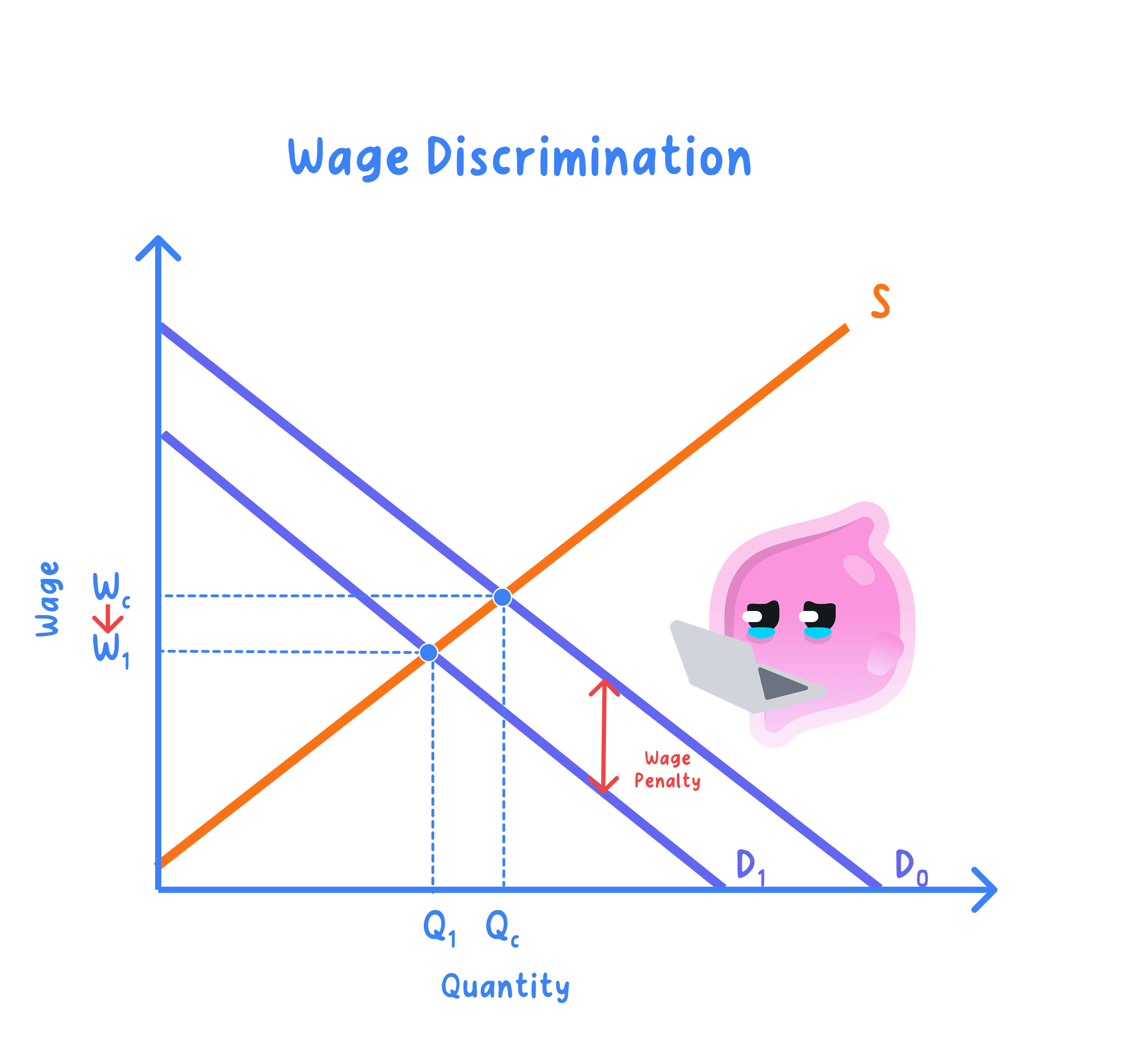
- The vertical axis measures the wage rate (W) and the horizontal axis measures the quantity of labour (QL) for the group being discriminated against.
- Without discrimination, the group's demand curve D0 and supply curve S would cross at the non-discriminatory wage Wc and employment Qc, matching what an equally productive comparison group would receive.
- Employer prejudice shifts the group's demand curve leftward to D1, since employers now value hiring this group as if its MRP were lower than it truly is.
- D1 crosses S at a lower wage W1 and lower employment Q1 than Wc and Qc, even though the group's actual productivity has not changed; the vertical gap between D0 and D1 at Qc represents the wage penalty from discrimination.
Case study
- UK law targets discrimination directly: the Equal Pay Act 1970 (now part of the Equality Act 2010) makes it illegal to pay men and women differently for equal work, and large employers (250+ staff) must publish gender pay gap data annually.
- Despite this, an unexplained gender pay gap persists in most occupations, and ethnicity pay gap reporting has been discussed as a further UK policy tool to expose and reduce discrimination-based differentials.
Self review
- Define labour market discrimination and the conditions needed for it.
- How does employer prejudice affect the demand for a group?
- What is the impact on the group's wages, employment levels and types of job?
- How does discrimination differ from a productivity-based pay gap?
- Why is a perfectly competitive labour market unlikely to sustain discrimination in the long run?
- In the pay gap worked example, recalculate the percentage gap if women's average pay were £18.40\pounds 18.40£18.40 instead of £17.60\pounds 17.60£17.60.
- Describe, in words, how employer prejudice shifts the demand curve in the discrimination diagram and what this does to the group's wage and employment.
