1.2.1a Rational choice and incentives
Rational Agents Weigh up Costs and Benefits to Pursue a Clear Objective
Definition
Rational decision making: the assumption that economic agents weigh up the costs and benefits of their options and choose the one that maximises their own net benefit, with consumers aiming to maximise utility and firms to maximise profit.
- Standard economic models assume agents are rational, weighing costs and benefits to pursue a clear objective.
- Consumers are assumed to maximise utility (satisfaction) and firms to maximise profit.
- Rational agents respond to incentives, so changing the costs or benefits of an action changes behaviour.
Note
- Rationality is a starting assumption, not a claim that people never make mistakes.
- It is what lets economists predict how agents react to a price change, a tax or a subsidy.
Consumers Maximise Utility, Firms Maximise Profit and Workers Maximise Net Benefit
- Consumers
- Choose the bundle of goods that gives the most utility within their budget.
- Firms
- Choose the output and methods that make the most profit.
- Workers
- Supply labour to get the best net benefit from wages set against their leisure.
Note
- Incentives are central: a higher price signals consumers to buy less and producers to supply more.
- This is why taxes, subsidies and prices can be used to change behaviour in predictable ways.
Example
- The 5p charge on single-use carrier bags introduced in England in 2015 is a clear incentive at work.
- Faced with a small extra cost, rational shoppers switched to reusable bags, and single-use bag sales at the major supermarkets fell by more than 80 percent within a few years.
- A tiny change in the private cost of an action produced a large and predictable change in behaviour, exactly as the rational model implies.
The Rational Assumption Gives Models Clear, Predictable Outcomes
- It gives models a clear, consistent prediction of how agents respond to a change.
- It underpins demand and supply, the foundation of almost all later analysis.
- It lets policymakers design incentives, such as a tax on cigarettes, to steer choices.
In Reality, Limited Information and Willpower Make Rationality Only an Approximation
- In reality people have limited information, time and willpower, so they use rules of thumb rather than full calculation.
- Behavioural economics (1.2.3) shows systematic biases, such as inertia and present bias, that break the assumption.
- Despite this, the rational model still predicts a great deal of behaviour well and remains the sensible baseline.
- The strongest answers treat rationality as a useful approximation to be qualified, not a fact to be assumed blindly.
Exam technique
- Start from the rational assumption, then bring in behavioural qualifications in evaluation.
- Link a change in incentives to a predictable change in behaviour.
- Be precise: consumers maximise utility, firms maximise profit.
Common Mistake
- Do not confuse rational with sensible or correct.
- Rational means pursuing an objective given the information available, even if the outcome turns out badly.
- Do not launch into detailed marginal utility analysis here.
- That belongs in consumer theory (covered in 1.2.1b); here the point is the assumption itself.
Self review
- What does it mean for an economic agent to be rational?
- What do consumers and firms respectively aim to maximise?
- How do rational agents respond to a change in incentives?
- Give one real example of an incentive changing behaviour.
- Name one way real behaviour departs from the rational model.
1.2.1b Utility theory and the margin
Total Utility Is Overall Satisfaction, Marginal Utility Is the Gain From One More Unit
Definition
Marginal utility: the additional satisfaction, or utility, a consumer gains from consuming one more unit of a good or service.
Total utility: the overall satisfaction a consumer gains from consuming a given quantity of a good or service.
- Marginal utility is the change in total utility as consumption rises by one unit.
- Rational decisions are made at the margin, one unit at a time.
Note
- Total utility is the satisfaction from all units together.
- Marginal utility is the satisfaction from the next unit.
- Decisions are made by weighing the next unit's benefit and cost.
Marginal Utility Is the Change in Total Utility From One Extra Unit
- Total utility usually rises as more is consumed, at least at first.
- Marginal utility is the addition each extra unit brings.
- Marginal utility is found from the change in total utility.
- Total utility can be found by adding up marginal utilities.
Example
- Suppose total utility for 1 to 5 units is 101010, 181818, 242424, 282828 and 303030.
- Marginal utility is then 101010, 888, 666, 444 and 222 (for example, 24−18=624 - 18 = 624−18=6).
- So total utility keeps rising while marginal utility falls.
Rational Consumers Decide One Unit at a Time, Weighing Its Benefit Against Its Price
- A consumer asks whether the next unit is worth its price.
- If the marginal benefit beats the cost, they buy it.
- If not, they stop.
- A consumer maximises utility by buying up to the point where marginal benefit no longer exceeds price.
Case study
- A second slice of pizza usually adds less than the first.
- Its marginal utility is lower, though total utility still rises.
- So the margin guides how much to consume.
Total Utility Peaks When Marginal Utility Reaches Zero
- Total utility rises while marginal utility is positive.
- It is highest when marginal utility reaches zero.
- It falls only once marginal utility turns negative.
- So a falling marginal utility does not mean total utility is falling.
Marginal Utility Tends to Diminish as More of a Good Is Consumed
- Diminishing marginal utility is the tendency for extra satisfaction to fall as consumption rises.
- As more of a good is consumed in a period, each extra unit adds less.
- It is a hypothesis about how satisfaction behaves.
- It is the key building block for the importance of the margin.
Note
- Each extra unit tends to add less satisfaction.
- Marginal utility falls as consumption rises.
- This underpins how consumers choose at the margin.
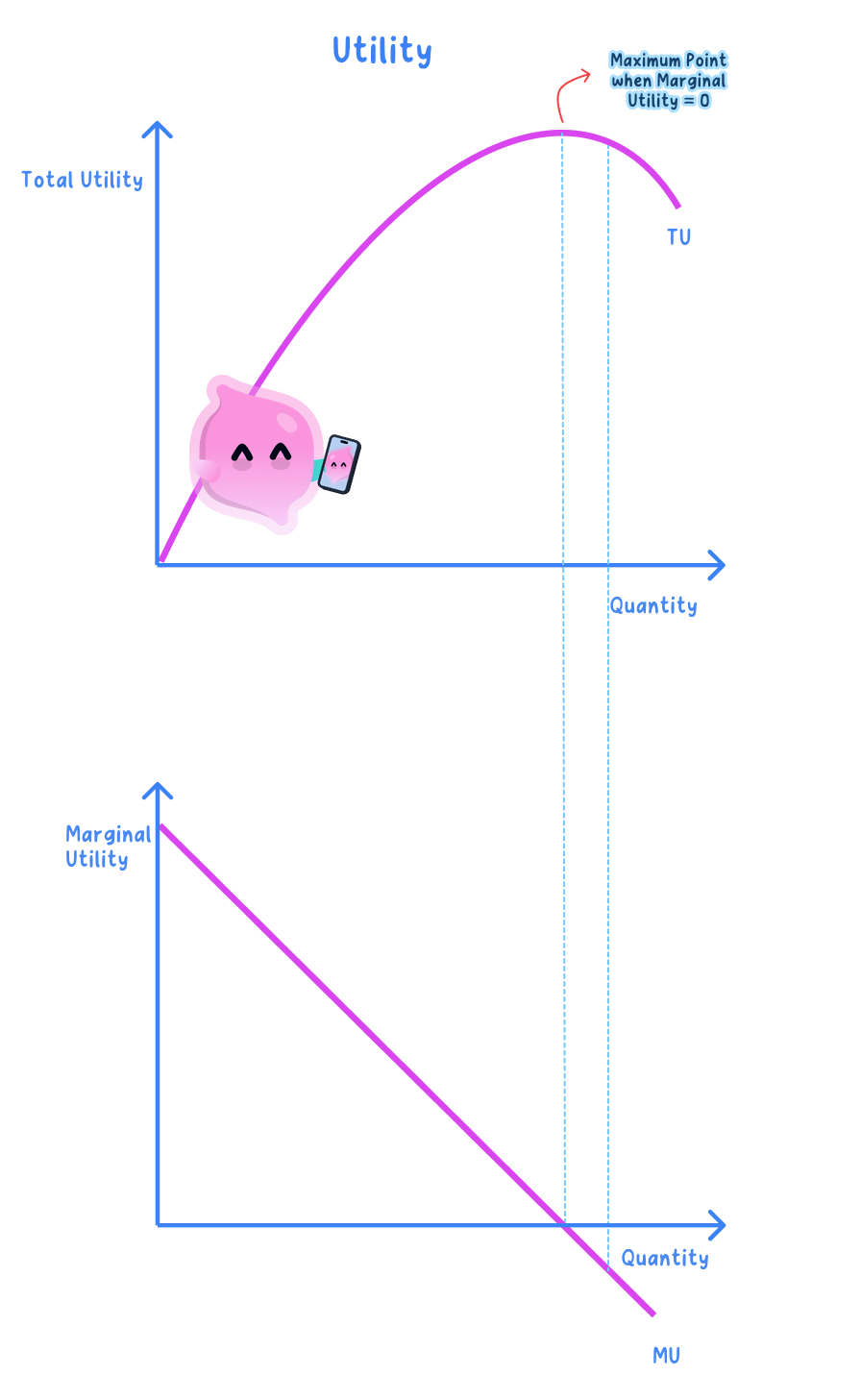
Each Successive Unit Adds Less Satisfaction Than the One Before
- The first unit of a good gives the most satisfaction.
- Each further unit gives a smaller addition.
- So marginal utility declines as quantity rises.
- This holds within a given time period.
Example
- The first glass of water on a hot day gives great satisfaction.
- The second adds less, and the third less again.
- So marginal utility falls with each glass.
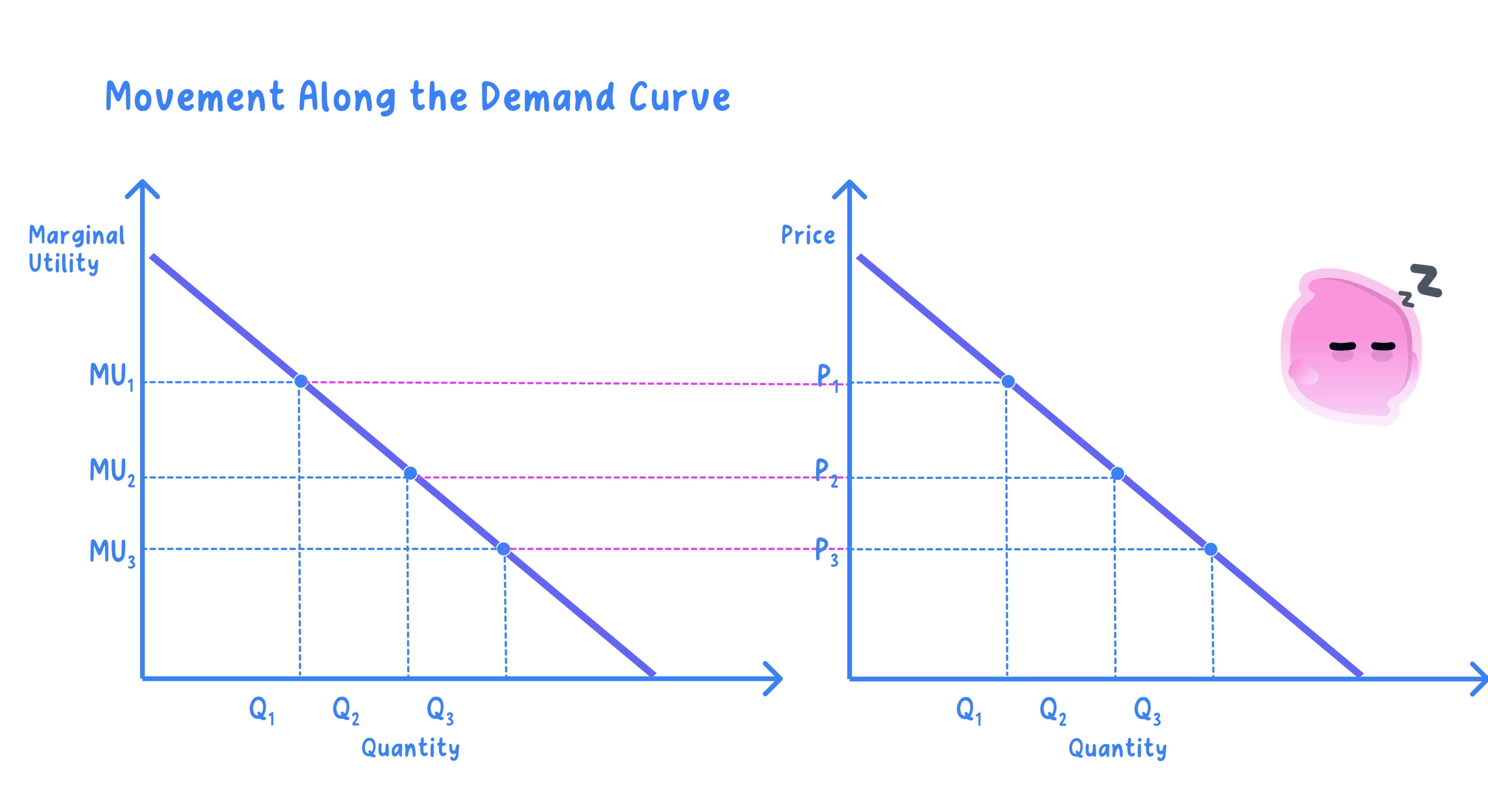
Diminishing Marginal Utility Explains the Downward-Sloping Demand Curve
- Because marginal utility falls as more is consumed, a consumer will only buy an extra unit if its price falls to match the smaller benefit it brings.
- A rational consumer keeps buying up to the point where marginal utility equals the price paid, so a lower price is needed to make additional units worthwhile.
- This is why the hypothesis of diminishing marginal utility supports a downward-sloping demand curve, with quantity demanded rising as price falls.
Exam technique
- Find marginal utility as the change in total utility.
- Set out a schedule to show the pattern.
- Note that total utility peaks when marginal utility is zero.
Common Mistake
- Do not mix up total and marginal utility.
- Do not assume marginal utility must be negative once total utility stops rising.
Self review
- What is total utility?
- What is marginal utility?
- How do you find marginal utility from a total utility schedule?
- What is the hypothesis of diminishing marginal utility?
- When is total utility at its highest?
- How does diminishing marginal utility explain the downward slope of the demand curve?
