Revision notes for AQA A Level Computer Science Individual (moral), social (ethical), legal and cultural issues and opportunities. Open the guide for explanations and worked examples. Written against the AQA A Level Computer Science specification, so the content matches what's examinable rather than general Computer Science background.
Individual (moral), social (ethical), legal and cultural issues and opportunities
What you'll learn
- How digital technologies have changed communication, monitoring and personal information flows.
- How to discuss individual, social, legal and cultural opportunities and risks.
- Why software engineers have power and responsibility through the algorithms and code they deploy.
- Why legislators find computing difficult to regulate in the digital age.
Why this topic matters
Computer Science is not just about making systems work. It is also about understanding what those systems do to people, communities and societies.
Modern computing has changed the shape of communication and information flows. Messages, images, location data, purchases, searches and social interactions can now be collected, copied, analysed and shared at huge speed and scale.
A decision made by a developer might affect a few users — or millions of people across the world. That creates opportunities for great benefit, but also risks of serious harm.
Definition
Algorithm
An algorithm is a finite sequence of clear, unambiguous steps used to solve a problem or make a decision. In this topic, you should think about not only whether an algorithm works, but also what consequences it has.
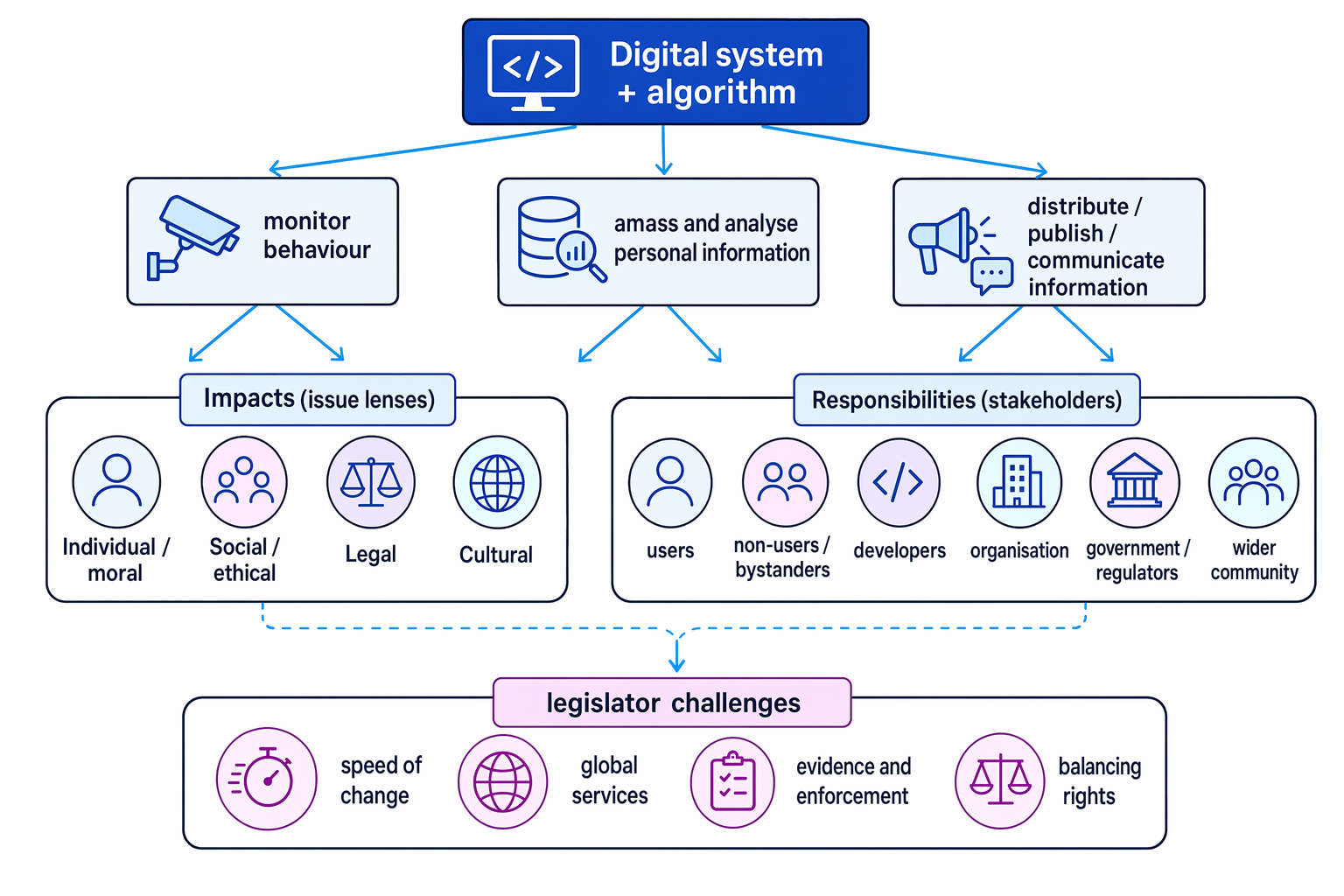
The four lenses: moral, ethical, legal and cultural
When you discuss consequences of computing, use several lenses. They overlap, but each asks a slightly different kind of question.
Individual and moral issues
An individual issue affects a person directly. A moral issue is about what is right or wrong for that person: privacy, consent, autonomy, safety, fairness and dignity.
For example, should an app track your location all day if it improves navigation? The benefit might be convenience, but the risk is loss of privacy and possible misuse.
Social and ethical issues
A social issue affects groups, communities or society as a whole. An ethical issue concerns principles about how people and organisations ought to behave.
For example, a recommendation algorithm might increase engagement, but also contribute to misinformation, polarisation or discrimination.
Legal issues
A legal issue concerns laws, regulations and legal responsibility. Computing raises legal questions around data protection, copyright, computer misuse, online harm, automated decisions and cross-border services.
A key point: law often moves more slowly than technology.
Cultural issues
A cultural issue concerns values, customs, languages, beliefs and expectations within a community. Software designed for one culture can affect another culture in unexpected ways.
For example, mapping, moderation or image-sharing systems may conflict with local expectations about privacy, sacred places, family, identity or public behaviour.
Definition
Stakeholder
A stakeholder is any person or group affected by a system, or able to affect it. In ethical analysis, include users, non-users, bystanders, developers, organisations, governments and wider communities.
Common Mistake
Legal is not the same as ethical
A system can be legal but still unfair, manipulative or culturally harmful. It can also be ethically desirable but difficult to allow under existing law.
The three big digital capabilities
The specification highlights three ways computing has transformed society:
- The ability to monitor behaviour.
- The ability to amass and analyse personal information.
- The ability to distribute, publish, communicate and disseminate personal information.
These are powerful because they can be automated, repeated, copied and scaled globally.
Monitoring behaviour
To monitor behaviour means to observe, record or track what people do. Examples include CCTV, facial recognition, app analytics, browser tracking, smart speakers, wearable devices and workplace monitoring.
Monitoring can create benefits: safety, fraud detection, medical alerts and better services. It can also create risks: surveillance, chilling effects, unfair profiling and loss of anonymity.
Amassing and analysing personal information
To amass personal information means to collect it in large quantities. Personal information is data that identifies, or can help identify, a person. This can include names, addresses, photos, location trails, search histories, device IDs and metadata.
Metadata is data about other data, such as the time, location and sender of a message. It may look harmless, but patterns in metadata can reveal sensitive details.
To analyse personal information means to process it to find patterns, make predictions or support decisions. Profiling is using data to infer characteristics about a person, such as interests, income, health risks or likely behaviour.
Distributing, publishing and disseminating information
To disseminate information means to spread it widely. Digital systems make this easy through social media, search engines, messaging platforms, cloud storage and websites.
This creates opportunities for education, journalism, collaboration and democratic participation. It also creates risks: doxxing, harassment, misinformation, copyright infringement and permanent reputational damage.
Key Idea
Information flow has changed
Digital technology makes information easier to collect, analyse, copy and share. The same capability can create both benefit and harm depending on context, safeguards and stakeholders.
Example
Evaluating Street View in a remote village
- Identify affected stakeholders: residents, visitors, local leaders, people who do not use the internet, the mapping company, emergency services and future viewers of the images.
- Compare possible benefits: maps could support tourism, navigation, emergency response, trade and visibility for local businesses or community projects.
- Analyse privacy and consent: residents may be photographed near homes, schools or sacred places. Informed consent is difficult if people do not understand how widely images will be published.
- Consider cultural expectations: what counts as public or private may differ from the company’s assumptions. Images could reveal practices, locations or identities that the community expects to keep local.
- Choose safeguards and trade-offs: the project might need consultation with local representatives, clear opt-out routes, blurring, restricted capture areas, delayed publication or cancellation if the risks outweigh the benefits.
Power, responsibility and embedded values
A software engineer designs, builds, tests and maintains software systems. Computer scientists and software engineers have power because their choices can affect what information people see, how decisions are made and which behaviours are encouraged.
This power creates responsibility. Developers should consider privacy, security, fairness, accessibility, transparency, testing, bias and unintended consequences.
Software embeds values
Software is not neutral just because it is technical. Algorithms and interfaces often embed moral and cultural values.
This can happen through:
- Data choices: what is collected, excluded, labelled or treated as “normal”.
- Objective choices: what the system is optimised for, such as profit, speed, safety, accuracy or engagement.
- Threshold choices: when a system approves, blocks, flags or recommends something.
- Default settings: whether privacy is opt-in or opt-out.
- Interface choices: what languages, names, identities or accessibility needs are supported.
- Moderation rules: what content is allowed, promoted, hidden or removed.
Example
Finding embedded values in a loan-scoring algorithm
- Assess the inputs: if the algorithm uses postcode, employment history and previous borrowing, these may act as proxies for social background even if protected characteristics are not used directly.
- Assess the objective: if the system only minimises lender risk, it values financial protection for the company more than access to credit for borderline applicants.
- Assess the training data: if past lending decisions were biased, the algorithm may learn and repeat those patterns.
- Assess accountability: a responsible design could include bias testing, human review, explanations for rejected applicants and an appeals process.
Tip
A useful discussion pattern
For any scenario, ask: Who is affected? What data is involved? What decision is automated? What benefit is claimed? What could go wrong? What safeguards would reduce the harm?
Scale: great good and great harm
The issue of scale is central. Software can be copied, deployed and updated across the world. A helpful system can benefit many people very quickly. A harmful system can also damage many people very quickly.
Opportunities include:
- assistive technologies that improve independence for disabled users;
- medical systems that detect patterns earlier than humans could;
- translation tools that help people communicate across languages;
- online education and remote work;
- platforms for civic participation, fundraising and emergency alerts.
Risks include:
- mass surveillance by states or companies;
- discrimination through biased automated decisions;
- misinformation spreading faster than corrections;
- data breaches affecting millions of people;
- cultural homogenisation, where global platforms push one set of norms onto many communities;
- a digital divide, where people without access or skills are excluded.
Key Idea
Scale changes responsibility
A small design decision can become a large social consequence when software is deployed to millions of people. Ethical reasoning must consider the size and reach of the system.
Challenges facing legislators in the digital age
A legislator is a person or body that makes laws, such as Parliament. Legislators face major challenges when trying to regulate computing.
Technology changes quickly
New platforms, data uses and algorithms can appear before laws have caught up. A law written for one technology may not fit a new one.
Services are global
A user may live in one country, the company may be based in another, and the data may be stored in several others. This makes jurisdiction, enforcement and accountability difficult.
Evidence can be hard to obtain
Algorithms may be complex, proprietary or constantly changing. Harm may be indirect, such as reduced opportunities or manipulation of behaviour. Regulators may struggle to prove exactly what caused the harm.
Rights must be balanced
Laws often need to balance competing values:
- privacy against security;
- freedom of expression against protection from harm;
- innovation against consumer protection;
- commercial secrecy against transparency;
- national law against international platforms.
Technical rules can have unintended consequences
A law that sounds simple may be difficult to implement. For example, requiring platforms to remove harmful content quickly might reduce harm, but it might also encourage over-removal of lawful speech.
Example
Explaining why facial recognition is hard to legislate
- Separate the possible uses: unlocking a phone, finding a missing person and tracking protesters are not ethically identical, even though all use facial recognition.
- Compare the rights involved: public safety may support some uses, but privacy, freedom of assembly and protection from discrimination may be threatened.
- Consider enforcement: a law must define who can use the technology, what evidence is needed, how accuracy is measured and what happens when the system makes a false match.
- Add safeguards: possible safeguards include warrants, public reporting, accuracy testing across demographic groups, human review and strict limits on storing biometric data.
Using hypotheticals and case studies
A hypothetical is a simplified imagined scenario. It helps isolate one ethical principle, such as consent or privacy.
A case study is a richer real or realistic example. It helps you discuss competing values in context. For example, a mapping service in a remote village involves individual privacy, cultural expectations, commercial value, public benefit and informed consent.
In an exam answer, you do not need to know every real-world case. You do need to reason clearly from the scenario you are given.
Exam technique
In the exam
- Use the scenario: name the specific technology, data, people and possible consequences rather than writing a generic paragraph about “privacy”.
- Cover both sides: explain at least one opportunity and one risk, then weigh them using stakeholders, consent, scale and safeguards.
- Separate the lenses: make it clear when you are discussing moral, social, legal or cultural issues, and do not treat “legal” as automatically “right”.
Self review
Check yourself
- How can the same data-collection feature create both an opportunity and a risk?
- Why might an algorithm embed moral or cultural values even if its code is technically correct?
- What makes it difficult for legislators to regulate global digital platforms?