

What you'll learn
- What lattice enthalpy means, and why it measures the strength of ionic bonding.
- How to build and use Born–Haber cycles for ionic solids such as NaCl and MgCl₂.
- How solution and hydration enthalpies fit into Hess cycles.
- How ionic charge and radius affect lattice enthalpy and hydration enthalpy.
The big idea: energy cycles for ionic compounds
Ionic compounds form giant ionic lattices: regular 3D arrangements of positive and negative ions held together by strong electrostatic attractions in all directions.
We cannot usually measure lattice enthalpy directly, because it involves isolated gaseous ions coming together to form a solid lattice. Instead, we use Hess’s law.
Hess’s law
The total enthalpy change for a reaction is independent of the route taken, as long as the initial and final states are the same. This is conservation of energy applied to chemical enthalpy cycles.
Lattice enthalpy
Lattice enthalpy
The lattice enthalpy, ΔLEH\Delta_\text{LE}HΔLEH, is the enthalpy change when 1 mol of an ionic lattice is formed from its gaseous ions under standard conditions.
For sodium chloride:
Na+(g)+Cl−(g)→NaCl(s)\text{Na}^+(g) + \text{Cl}^-(g) \to \text{NaCl}(s)Na+(g)+Cl−(g)→NaCl(s)Because attractions are made when the lattice forms, lattice enthalpy of formation is usually exothermic, so it is negative.
For magnesium chloride:
Mg2+(g)+2Cl−(g)→MgCl2(s)\text{Mg}^{2+}(g) + 2\text{Cl}^-(g) \to \text{MgCl}_2(s)Mg2+(g)+2Cl−(g)→MgCl2(s)“One mole of ionic lattice” means one mole of formula units, not one individual crystal.
Strength of ionic bonding
The more negative the lattice enthalpy, the stronger the ionic bonding in the giant lattice. The reverse process, breaking the lattice into gaseous ions, would require more energy.
Formation versus dissociation
OCR defines lattice enthalpy as formation from gaseous ions, so it is usually negative. Some data sources use lattice dissociation enthalpy, which is the reverse process and has the opposite sign.
Energy terms used in Born–Haber cycles
A Born–Haber cycle is a Hess cycle used to calculate lattice enthalpy by linking together measurable enthalpy changes.
You need to recognise these steps.
Enthalpy change of formation
The standard enthalpy change of formation, ΔfH∘\Delta_\text{f}H^\circΔfH∘, is the enthalpy change when 1 mol of a compound is formed from its elements in their standard states under standard conditions.
For NaCl:
Na(s)+12Cl2(g)→NaCl(s)\text{Na}(s) + \frac{1}{2}\text{Cl}_2(g) \to \text{NaCl}(s)Na(s)+21Cl2(g)→NaCl(s)First ionisation energy
The first ionisation energy is the energy required to remove one electron from each atom in 1 mol of gaseous atoms to form 1 mol of gaseous 1+ ions.
For sodium:
Na(g)→Na+(g)+e−\text{Na}(g) \to \text{Na}^+(g) + e^-Na(g)→Na+(g)+e−Other useful energy terms are:
- Enthalpy change of atomisation: enthalpy change when 1 mol of gaseous atoms is formed from an element in its standard state.
- Electron affinity: enthalpy change when 1 mol of gaseous atoms each gains one electron to form 1 mol of gaseous 1− ions.
For chlorine atomisation in a NaCl cycle:
12Cl2(g)→Cl(g)\frac{1}{2}\text{Cl}_2(g) \to \text{Cl}(g)21Cl2(g)→Cl(g)For first electron affinity of chlorine:
Cl(g)+e−→Cl−(g)\text{Cl}(g) + e^- \to \text{Cl}^-(g)Cl(g)+e−→Cl−(g)Signs to expect
Ionisation energies and atomisation enthalpies are endothermic, so positive. First electron affinities are often exothermic, so negative. Lattice enthalpy of formation is usually negative.
Constructing a Born–Haber cycle
A Born–Haber cycle starts with the elements in their standard states and ends with the ionic solid. The indirect route forms gaseous atoms, then gaseous ions, then the solid lattice.
This diagram shows the Born–Haber cycle for NaCl. The diagram labels lattice enthalpy as ΔHlatt\Delta H_\text{latt}ΔHlatt; in these notes we use OCR’s notation ΔLEH\Delta_\text{LE}HΔLEH.
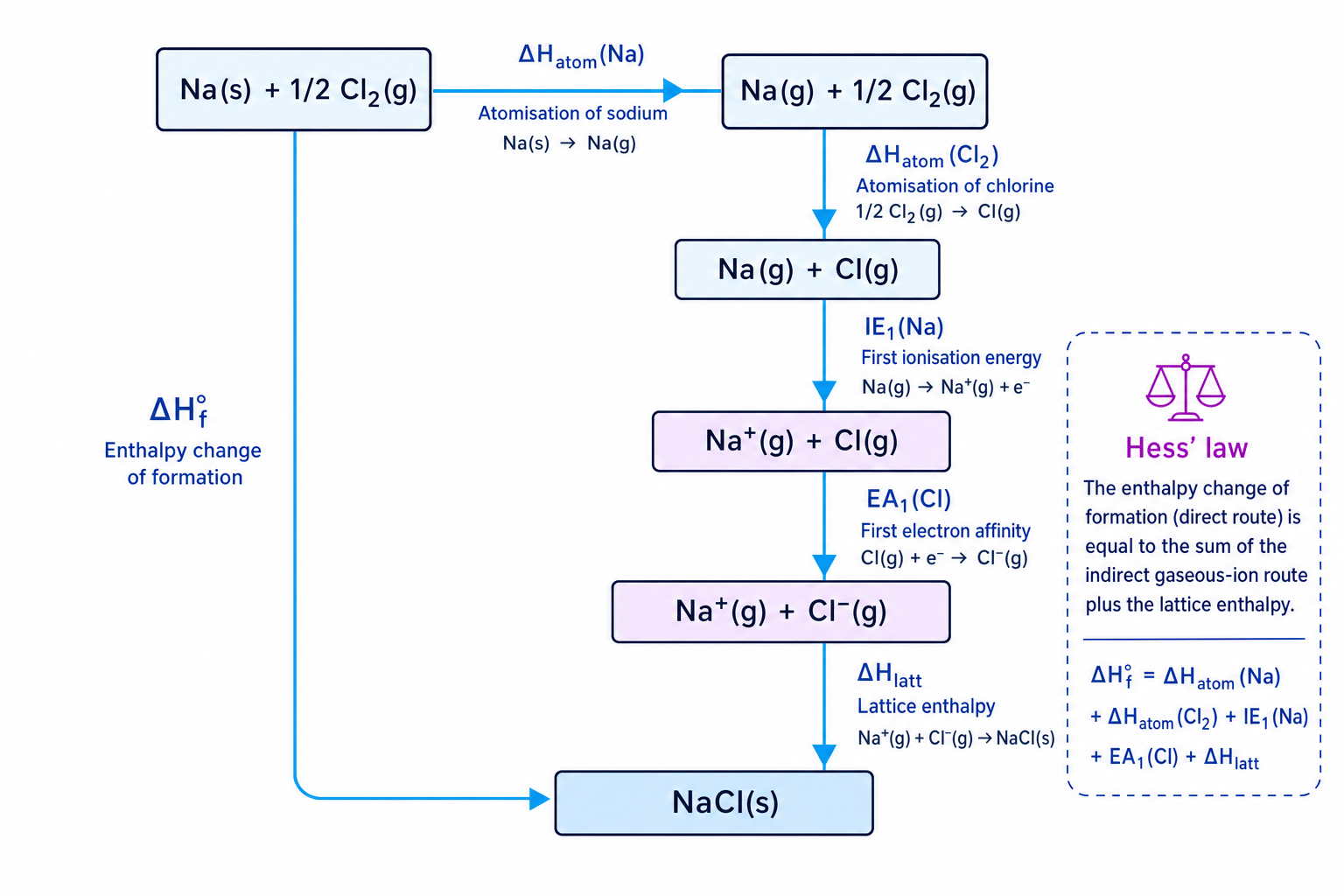
For NaCl, Hess’s law gives:
ΔfH=ΔatH(Na)+ΔatH(Cl)+IE1(Na)+EA1(Cl)+ΔLEH\Delta_\text{f}H = \Delta_\text{at}H(\text{Na}) + \Delta_\text{at}H(\text{Cl}) + \text{IE}_1(\text{Na}) + \text{EA}_1(\text{Cl}) + \Delta_\text{LE}HΔfH=ΔatH(Na)+ΔatH(Cl)+IE1(Na)+EA1(Cl)+ΔLEHCalculating the lattice enthalpy of NaCl
Use these data, in kJ mol⁻¹:
ΔfH(NaCl)=−411\Delta_\text{f}H(\text{NaCl}) = -411ΔfH(NaCl)=−411, ΔatH(Na)=+108\Delta_\text{at}H(\text{Na}) = +108ΔatH(Na)=+108, ΔatH(Cl)=+122\Delta_\text{at}H(\text{Cl}) = +122ΔatH(Cl)=+122, IE1(Na)=+496\text{IE}_1(\text{Na}) = +496IE1(Na)=+496, EA1(Cl)=−349\text{EA}_1(\text{Cl}) = -349EA1(Cl)=−349.
-
Write the Hess expression for forming NaCl by the indirect route:
ΔfH=ΔatH(Na)+ΔatH(Cl)+IE1(Na)+EA1(Cl)+ΔLEH\Delta_\text{f}H = \Delta_\text{at}H(\text{Na}) + \Delta_\text{at}H(\text{Cl}) + \text{IE}_1(\text{Na}) + \text{EA}_1(\text{Cl}) + \Delta_\text{LE}HΔfH=ΔatH(Na)+ΔatH(Cl)+IE1(Na)+EA1(Cl)+ΔLEH -
Substitute the values, keeping the sign of the electron affinity:
−411=108+122+496−349+ΔLEH-411 = 108 + 122 + 496 - 349 + \Delta_\text{LE}H−411=108+122+496−349+ΔLEH -
Add the known indirect steps:
108+122+496−349=377108 + 122 + 496 - 349 = 377108+122+496−349=377 -
Rearrange to find the lattice enthalpy:
ΔLEH=−411−377=−788 kJ mol−1\Delta_\text{LE}H = -411 - 377 = -788\ \text{kJ mol}^{-1}ΔLEH=−411−377=−788 kJ mol−1
Born–Haber cycles for compounds like MgCl₂
Magnesium chloride is more demanding because the formula is MgCl₂. That means:
- one Mg atom is atomised;
- one Cl₂ molecule forms two Cl atoms;
- magnesium loses two electrons, so you use first and second ionisation energies;
- two chlorine atoms each gain one electron, so you use two first electron affinities.
For MgCl₂:
Mg(s)+Cl2(g)→MgCl2(s)\text{Mg}(s) + \text{Cl}_2(g) \to \text{MgCl}_2(s)Mg(s)+Cl2(g)→MgCl2(s)and the lattice-forming step is:
Mg2+(g)+2Cl−(g)→MgCl2(s)\text{Mg}^{2+}(g) + 2\text{Cl}^-(g) \to \text{MgCl}_2(s)Mg2+(g)+2Cl−(g)→MgCl2(s)So the Hess expression is:
ΔfH=ΔatH(Mg)+2ΔatH(Cl)+IE1(Mg)+IE2(Mg)+2EA1(Cl)+ΔLEH\begin{aligned} \Delta_\text{f}H ={}& \Delta_\text{at}H(\text{Mg}) + 2\Delta_\text{at}H(\text{Cl}) + \text{IE}_1(\text{Mg}) + \text{IE}_2(\text{Mg}) \\ &+ 2\text{EA}_1(\text{Cl}) + \Delta_\text{LE}H \end{aligned}ΔfH=ΔatH(Mg)+2ΔatH(Cl)+IE1(Mg)+IE2(Mg)+2EA1(Cl)+ΔLEHForgetting the formula ratio
For MgCl₂, do not use only one chlorine atom. You need two Cl atoms and two Cl⁻ ions, so the chlorine atomisation and electron affinity terms are doubled.
Enthalpy change of solution
Enthalpy change of solution
The enthalpy change of solution, ΔsolH\Delta_\text{sol}HΔsolH, is the enthalpy change when 1 mol of solute dissolves in water.
For sodium chloride:
NaCl(s)→Na+(aq)+Cl−(aq)\text{NaCl}(s) \to \text{Na}^+(aq) + \text{Cl}^-(aq)NaCl(s)→Na+(aq)+Cl−(aq)OCR does not require details of infinite dilution here.
The enthalpy change of solution can be endothermic or exothermic. It depends on the balance between:
- energy required to separate the ions in the lattice;
- energy released when gaseous ions become hydrated by water.
Enthalpy change of hydration
Enthalpy change of hydration
The enthalpy change of hydration, ΔhydH\Delta_\text{hyd}HΔhydH, is the enthalpy change when 1 mol of gaseous ions dissolves in water to form aqueous ions.
For sodium ions:
Na+(g)→Na+(aq)\text{Na}^+(g) \to \text{Na}^+(aq)Na+(g)→Na+(aq)For chloride ions:
Cl−(g)→Cl−(aq)\text{Cl}^-(g) \to \text{Cl}^-(aq)Cl−(g)→Cl−(aq)Hydration enthalpies are usually negative because attractions form between ions and polar water molecules.
Solution enthalpy cycles
To dissolve an ionic solid, imagine two stages:
- Break the solid lattice into gaseous ions. This is lattice dissociation, the opposite of lattice enthalpy of formation.
- Hydrate the gaseous ions to form aqueous ions.
The cycle below shows how these terms link.
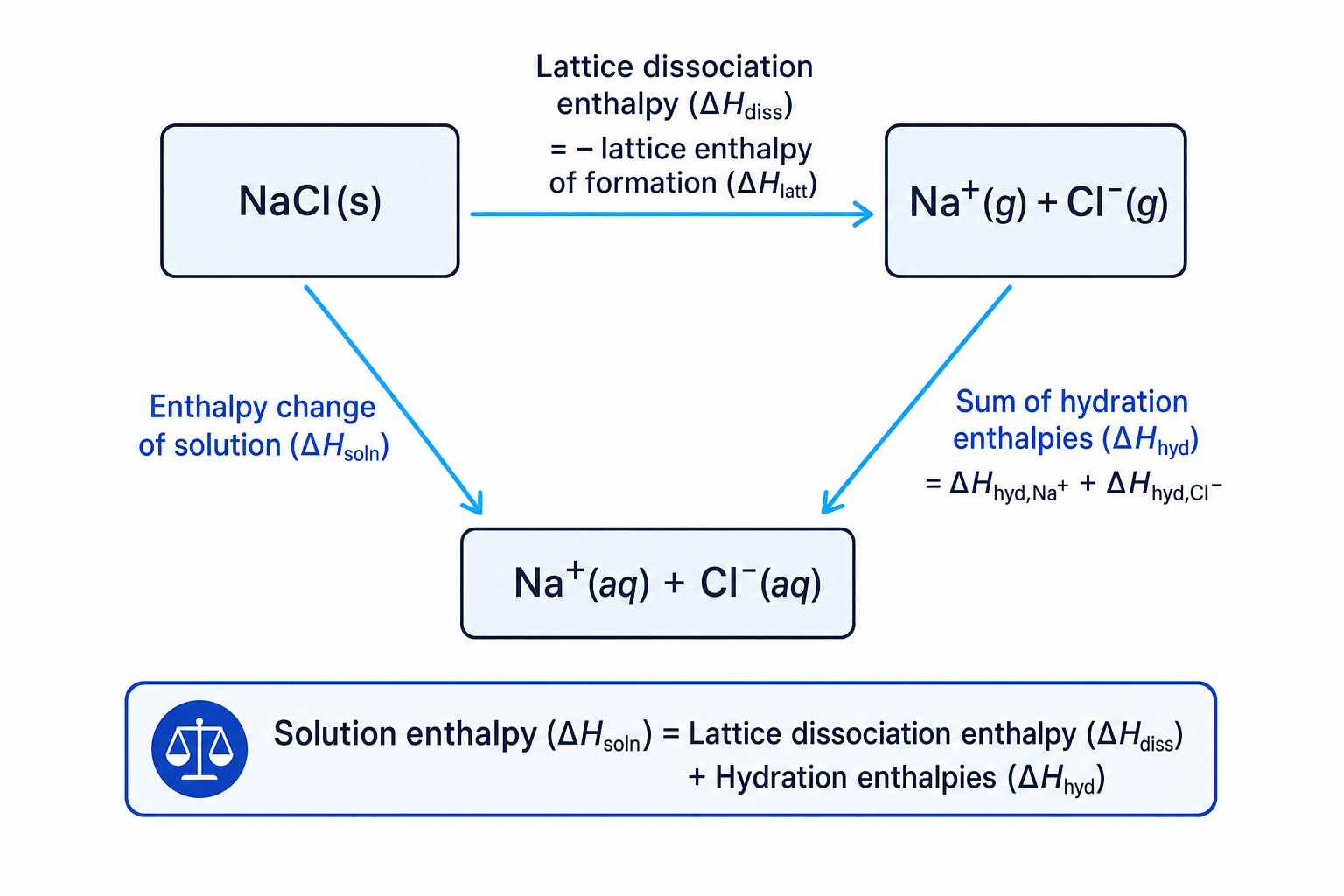
If ΔLEH\Delta_\text{LE}HΔLEH means lattice enthalpy of formation, then:
ΔsolH=−ΔLEH+∑ΔhydH\Delta_\text{sol}H = -\Delta_\text{LE}H + \sum \Delta_\text{hyd}HΔsolH=−ΔLEH+∑ΔhydHThe minus sign appears because dissolving first requires lattice dissociation, not lattice formation.
Calculating an enthalpy change of solution
Use these data for NaCl, in kJ mol⁻¹:
ΔLEH=−771\Delta_\text{LE}H = -771ΔLEH=−771, ΔhydH(Na+)=−406\Delta_\text{hyd}H(\text{Na}^+) = -406ΔhydH(Na+)=−406, ΔhydH(Cl−)=−363\Delta_\text{hyd}H(\text{Cl}^-) = -363ΔhydH(Cl−)=−363.
-
Convert lattice formation into lattice dissociation:
−ΔLEH=−(−771)=+771 kJ mol−1-\Delta_\text{LE}H = -(-771) = +771\ \text{kJ mol}^{-1}−ΔLEH=−(−771)=+771 kJ mol−1 -
Add the hydration enthalpies for all ions formed:
∑ΔhydH=−406−363=−769 kJ mol−1\sum \Delta_\text{hyd}H = -406 - 363 = -769\ \text{kJ mol}^{-1}∑ΔhydH=−406−363=−769 kJ mol−1 -
Combine the two parts of the Hess cycle:
ΔsolH=771−769=+2 kJ mol−1\Delta_\text{sol}H = 771 - 769 = +2\ \text{kJ mol}^{-1}ΔsolH=771−769=+2 kJ mol−1 -
Interpret the sign: the solution process is slightly endothermic because a little more energy is needed to separate the lattice than is released during hydration.
Effects of ionic charge and ionic radius
The strength of attraction between ions depends mainly on:
- ionic charge: higher charges give stronger electrostatic attractions;
- ionic radius: smaller ions allow opposite charges to get closer together.
For lattice enthalpy, stronger ion–ion attractions make the lattice enthalpy of formation more negative.
For hydration enthalpy, stronger ion–water attractions make hydration enthalpy more negative.
Charge density
Small, highly charged ions have high charge density. They strongly attract oppositely charged ions in a lattice and strongly attract polar water molecules during hydration.
Comparing exothermic values
Compare the lattice enthalpies of NaCl and MgO qualitatively.
-
Compare ionic charges: NaCl contains Na⁺ and Cl⁻, while MgO contains Mg²⁺ and O²⁻. The charge product is much larger in MgO, so electrostatic attraction is stronger.
-
Compare ion sizes: Mg²⁺ is smaller than Na⁺, and O²⁻ is smaller than Cl⁻. The ions in MgO can get closer together, strengthening attraction further.
-
Conclude that MgO has a much more exothermic lattice enthalpy than NaCl, so its giant ionic lattice is stronger.
Language for comparisons
Say “more exothermic” or “more negative” for lattice enthalpy of formation and hydration enthalpy. Avoid saying just “larger” unless you make clear whether you mean larger magnitude or a more positive number.
In the exam
- Draw the enthalpy cycle first, then write the Hess expression before substituting numbers.
- Check whether the lattice value given is formation or dissociation; reverse the sign only if needed.
- For formulae such as MgCl₂, multiply atomisation and electron affinity terms by the number of ions in the formula.
Check yourself
- Why is lattice enthalpy of formation usually negative?
- In a Born–Haber cycle for MgCl₂, which energy terms must be doubled?
- Why does Mg²⁺ have a more exothermic hydration enthalpy than Na⁺?
