

What you'll learn
By the end of these study notes, you will be able to:
- Identify Brønsted–Lowry acids, bases, and conjugate acid–base pairs in equilibria.
- Calculate the pH of strong acids, strong bases, weak acids, and buffer solutions.
- Explain buffer action qualitatively and quantitatively, including the carbonic acid–hydrogencarbonate blood buffer system.
- Sketch and interpret pH titration curves, choose suitable indicators, and describe pH meter calibration procedures.
1. Brønsted–Lowry Acids, Bases and Conjugate Pairs
In your earlier studies, you defined an acid simply as a substance that releases hydrogen ions, H+\text{H}^+H+, in solution. At A-Level, we use a more refined model called the Brønsted–Lowry theory to describe acid–base behaviour in aqueous systems.
Brønsted–Lowry Acid and Base
- Brønsted–Lowry Acid: A species that acts as a proton (H+\text{H}^+H+) donor.
- Brønsted–Lowry Base: A species that acts as a proton (H+\text{H}^+H+) acceptor.
Conjugate Acid–Base Pairs
When an acid loses a proton, it forms its conjugate base. When a base gains a proton, it forms its conjugate acid. These two species, which differ by exactly one proton (H+\text{H}^+H+), are called a conjugate acid–base pair.
Consider the equilibrium between ethanoic acid and water:
CH3COOH(aq)+H2O(l)⇌CH3COO−(aq)+H3O+(aq) \text{CH}_3\text{COOH(aq)} + \text{H}_2\text{O(l)} \rightleftharpoons \text{CH}_3\text{COO}^-\text{(aq)} + \text{H}_3\text{O}^+\text{(aq)} CH3COOH(aq)+H2O(l)⇌CH3COO−(aq)+H3O+(aq)In the forward reaction:
- CH3COOH\text{CH}_3\text{COOH}CH3COOH donates a proton to H2O\text{H}_2\text{O}H2O. Therefore, CH3COOH\text{CH}_3\text{COOH}CH3COOH is Acid 1, and CH3COO−\text{CH}_3\text{COO}^-CH3COO− is its Conjugate Base 1.
- H2O\text{H}_2\text{O}H2O accepts a proton from CH3COOH\text{CH}_3\text{COOH}CH3COOH. Therefore, H2O\text{H}_2\text{O}H2O is Base 2, and H3O+\text{H}_3\text{O}^+H3O+ (the hydronium ion) is its Conjugate Acid 2.
Identifying Conjugate Pairs
To find a conjugate pair, look for two species in the equation that differ only by a single H+\text{H}^+H+ ion.
- The acid has the extra H+\text{H}^+H+.
- The base has one fewer H+\text{H}^+H+.
Acid Classification: Monobasic, Dibasic, and Tribasic
Acids are classified by the number of protons they can donate per molecule:
- Monobasic acids can donate only one proton per molecule (e.g., HCl\text{HCl}HCl, HNO3\text{HNO}_3HNO3, CH3COOH\text{CH}_3\text{COOH}CH3COOH).
- Dibasic acids can donate two protons per molecule in two successive steps (e.g., H2SO4\text{H}_2\text{SO}_4H2SO4).
- Tribasic acids can donate three protons per molecule in three successive steps (e.g., H3PO4\text{H}_3\text{PO}_4H3PO4).
Reactions of Acids
The reactions of acids with metals and bases depend entirely on the active role of the hydrogen ion, H+(aq)\text{H}^+\text{(aq)}H+(aq). You must be able to write full balanced equations and simplified ionic equations for these reactions.
- Acid + Reactive Metal →\to→ Salt + Hydrogen
*Ionic Equation:*
- Acid + Alkali →\to→ Salt + Water
*Ionic Equation:*
- Acid + Metal Oxide →\to→ Salt + Water
*Ionic Equation:*
- Acid + Carbonate →\to→ Salt + Water + Carbon Dioxide
*Ionic Equation:*
2. The pH Scale and Strong Acids and Bases
Because the concentration of hydrogen ions, [H+(aq)][\text{H}^+\text{(aq)}][H+(aq)], in aqueous solutions can span many orders of magnitude (from over 1.0 mol dm⁻³ to less than 10−14 mol dm−310^{-14}\text{ mol dm}^{-3}10−14 mol dm−3), the Danish biochemist Søren Sørensen developed the pH scale as a convenient way to compare acidity.
pH
pH is defined as the negative logarithm to the base 10 of the hydrogen ion concentration:
pH=−log[H+(aq)] \text{pH} = -\log[\text{H}^+\text{(aq)}] pH=−log[H+(aq)]Conversely, the hydrogen ion concentration can be calculated from pH using:
[H+(aq)]=10−pH [\text{H}^+\text{(aq)}] = 10^{-\text{pH}} [H+(aq)]=10−pHStrong Monobasic Acids
A strong acid fully dissociates in aqueous solution. For a strong monobasic acid, HA\text{HA}HA, the acid dissociation is complete:
HA(aq)→H+(aq)+A−(aq) \text{HA(aq)} \to \text{H}^+\text{(aq)} + \text{A}^-\text{(aq)} HA(aq)→H+(aq)+A−(aq)Therefore, the concentration of hydrogen ions is equal to the initial concentration of the acid:
[H+(aq)]=[HA] [\text{H}^+\text{(aq)}] = [\text{HA}] [H+(aq)]=[HA]Dibasic Strong Acids
If you have a strong dibasic acid like H2SO4\text{H}_2\text{SO}_4H2SO4, assuming complete dissociation of both protons means [H+]=2×[H2SO4][\text{H}^+] = 2 \times [\text{H}_2\text{SO}_4][H+]=2×[H2SO4]. Always check the basicity of the acid before calculating pH!
The Ionic Product of Water, KwK_wKw
Water molecules dissociate slightly to establish a dynamic equilibrium:
H2O(l)⇌H+(aq)+OH−(aq) \text{H}_2\text{O(l)} \rightleftharpoons \text{H}^+\text{(aq)} + \text{OH}^-\text{(aq)} H2O(l)⇌H+(aq)+OH−(aq)The equilibrium constant for this reaction can be written as:
Kc=[H+][OH−][H2O] K_c = \frac{[\text{H}^+][\text{OH}^-]}{[\text{H}_2\text{O}]} Kc=[H2O][H+][OH−]Because water is in such a vast excess, its concentration [H2O][\text{H}_2\text{O}][H2O] is effectively constant (55.6 mol dm−355.6\text{ mol dm}^{-3}55.6 mol dm−3). We can multiply KcK_cKc by [H2O][\text{H}_2\text{O}][H2O] to define a new constant, the ionic product of water, KwK_wKw:
Ionic Product of Water,
At standard temperature (298 K / 25 °C), KwK_wKw has a constant value of 1.00×10⁻¹⁴ mol2 dm−61.00 \times 10^{-14}\text{ mol}^2\text{ dm}^{-6}1.00×10⁻¹⁴ mol2 dm−6.
- In pure water (or any neutral solution), [H+]=[OH−][\text{H}^+] = [\text{OH}^-][H+]=[OH−]. Therefore:
This gives pure water a pH of 7.00 at 298 K.
pH of Pure Water at Different Temperatures
The dissociation of water is an endothermic process. If you increase the temperature, the equilibrium shifts to the right, increasing both [H+][\text{H}^+][H+] and [OH−][\text{OH}^-][OH−]. Consequently, KwK_wKw increases, and the pH of pure water falls below 7.00. However, the water is still neutral because [H+]=[OH−][\text{H}^+] = [\text{OH}^-][H+]=[OH−] is maintained.
Strong Bases
A strong base fully dissociates in aqueous solution to release OH−\text{OH}^-OH− ions (e.g., NaOH\text{NaOH}NaOH, KOH\text{KOH}KOH). To find the pH of a strong base:
- Identify the hydroxide ion concentration, [OH−][\text{OH}^-][OH−], from the base concentration.
- Use KwK_wKw to calculate [H+][\text{H}^+][H+].
- Convert [H+][\text{H}^+][H+] into pH.
Calculating the pH of a strong base
Calculate the pH of a 0.0500 mol dm−30.0500\text{ mol dm}^{-3}0.0500 mol dm−3 solution of barium hydroxide, Ba(OH)2\text{Ba(OH)}_2Ba(OH)2, at 298 K.
- Determine the concentration of hydroxide ions: Ba(OH)2\text{Ba(OH)}_2Ba(OH)2 is a strong base containing two hydroxide ions per formula unit:
- Calculate the hydrogen ion concentration using KwK_wKw: At 298 K, Kw=1.00×10⁻¹⁴ mol2 dm−6K_w = 1.00 \times 10^{-14}\text{ mol}^2\text{ dm}^{-6}Kw=1.00×10⁻¹⁴ mol2 dm−6:
- Calculate pH:
3. Weak Acids and the Acid Dissociation Constant (KaK_aKa)
Unlike strong acids, weak acids only partially dissociate in aqueous solution:
HA(aq)⇌H+(aq)+A−(aq) \text{HA(aq)} \rightleftharpoons \text{H}^+\text{(aq)} + \text{A}^-\text{(aq)} HA(aq)⇌H+(aq)+A−(aq)We quantify the position of this equilibrium using the acid dissociation constant, KaK_aKa.
Acid Dissociation Constant, and
The units of KaK_aKa are mol dm−3\text{mol dm}^{-3}mol dm−3.
Because KaK_aKa values vary over many orders of magnitude, we often use the logarithmic term pKa\text{p}K_apKa:
pKa=−logKaandKa=10−pKa \text{p}K_a = -\log K_a \quad \text{and} \quad K_a = 10^{-\text{p}K_a} pKa=−logKaandKa=10−pKaA larger KaK_aKa (or a smaller pKa\text{p}K_apKa) indicates a stronger weak acid because the equilibrium lies further to the right.
Weak Acid pH Calculations and Approximations
To calculate the pH of a weak acid, we make two simplifying approximations to avoid solving a quadratic equation:
- Approximation 1: The dissociation of water is negligible, so all H+\text{H}^+H+ ions come solely from the dissociation of the weak acid HA\text{HA}HA. Therefore:
This simplifies the numerator of the expression:
- Approximation 2: The extent of dissociation is very small, so the equilibrium concentration of the undissociated acid is virtually identical to its initial concentration:
This gives the simplified expression:
We can rearrange this formula to find [H+][\text{H}^+][H+] directly:
[H+]≈Ka×[HA]initial [\text{H}^+] \approx \sqrt{K_a \times [\text{HA}]_{\text{initial}}} [H+]≈Ka×[HA]initialCalculating the pH of a weak acid
Calculate the pH of a 0.150 mol dm−30.150\text{ mol dm}^{-3}0.150 mol dm−3 solution of propanoic acid at 298 K. The pKa\text{p}K_apKa of propanoic acid is 4.87.
- Calculate KaK_aKa from pKa\text{p}K_apKa:
- Calculate [H+][\text{H}^+][H+] using weak acid approximations:
- Convert [H+][\text{H}^+][H+] to pH:
When Do These Approximations Fail?
As an A-Level chemist, you must understand the limitations of these approximations:
- Approximation 1 fails in extremely dilute solutions (e.g., concentrations below 10−6 mol dm−310^{-6}\text{ mol dm}^{-3}10−6 mol dm−3) because the dissociation of water becomes significant and contributes a non-negligible concentration of H+\text{H}^+H+ ions.
- Approximation 2 fails if the weak acid is relatively "strong" (having a high KaK_aKa value) or highly dilute. Under these conditions, a significant fraction of HA\text{HA}HA dissociates, making the assumption [HA]eq≈[HA]initial[\text{HA}]_{\text{eq}} \approx [\text{HA}]_{\text{initial}}[HA]eq≈[HA]initial invalid. Typically, if the dissociation is greater than 5%, you would need to use a quadratic equation to obtain an accurate pH.
4. Buffer Solutions
Buffer Solution
A buffer solution is a system that minimises pH changes when small amounts of an acid (H+\text{H}^+H+) or a base (OH−\text{OH}^-OH−) are added.
How Buffers Are Made
An acidic buffer solution contains a mixture of a weak acid (HA\text{HA}HA) and its conjugate base (A−\text{A}^-A−) in high concentrations. There are two chemical routes to prepare one:
- Direct Method: Mix a weak acid directly with a soluble salt of its conjugate base (e.g., ethanoic acid, CH3COOH\text{CH}_3\text{COOH}CH3COOH, and sodium ethanoate, CH3COONa\text{CH}_3\text{COONa}CH3COONa).
- Partial Neutralisation Method: Mix an excess of a weak acid with a strong alkali (e.g., reacting excess CH3COOH\text{CH}_3\text{COOH}CH3COOH with NaOH\text{NaOH}NaOH). The alkali completely reacts with some of the weak acid to produce the conjugate base CH3COO−\text{CH}_3\text{COO}^-CH3COO−, leaving a mixture of unreacted weak acid and its newly formed conjugate base.
Explanation of Buffer Action
The conjugate acid–base pair controls the pH by shifting the position of the equilibrium in response to external changes:
HA(aq)⇌H+(aq)+A−(aq) \text{HA(aq)} \rightleftharpoons \text{H}^+\text{(aq)} + \text{A}^-\text{(aq)} HA(aq)⇌H+(aq)+A−(aq)- When a small amount of acid (H+\text{H}^+H+) is added: The added H+\text{H}^+H+ ions react with the conjugate base A−\text{A}^-A− to form the weak acid molecules:
The equilibrium shifts to the left, removing the added H+\text{H}^+H+ ions and keeping the pH virtually constant.
- When a small amount of alkali (OH−\text{OH}^-OH−) is added: The added OH−\text{OH}^-OH− ions react with the small concentration of H+\text{H}^+H+ ions to form water:
To restore the lost H+\text{H}^+H+ ions, the weak acid HA\text{HA}HA dissociates:
HA(aq)→H+(aq)+A−(aq) \text{HA(aq)} \to \text{H}^+\text{(aq)} + \text{A}^-\text{(aq)} HA(aq)→H+(aq)+A−(aq)Overall, the added hydroxide ions are neutralised by the weak acid:
HA(aq)+OH−(aq)→A−(aq)+H2O(l) \text{HA(aq)} + \text{OH}^-\text{(aq)} \to \text{A}^-\text{(aq)} + \text{H}_2\text{O(l)} HA(aq)+OH−(aq)→A−(aq)+H2O(l)The equilibrium shifts to the right, maintaining a stable pH.
Controlling Blood pH
In human blood plasma, the pH must be maintained precisely between 7.35 and 7.45. This narrow range is controlled by the carbonic acid–hydrogencarbonate buffer system:
H2CO3(aq)⇌H+(aq)+HCO3−(aq) \text{H}_2\text{CO}_3\text{(aq)} \rightleftharpoons \text{H}^+\text{(aq)} + \text{HCO}_3^-\text{(aq)} H2CO3(aq)⇌H+(aq)+HCO3−(aq)- Carbonic acid, H2CO3\text{H}_2\text{CO}_3H2CO3, acts as the weak acid (proton donor).
- Hydrogencarbonate, HCO3−\text{HCO}_3^-HCO3−, acts as the conjugate base (proton acceptor).
- If blood becomes too acidic, the excess H+\text{H}^+H+ reacts with HCO3−\text{HCO}_3^-HCO3− to form H2CO3\text{H}_2\text{CO}_3H2CO3. The body converts excess carbonic acid into dissolved carbon dioxide, which is exhaled by the lungs:
- If blood becomes too alkaline, the carbonic acid dissociates to release more H+\text{H}^+H+, neutralising the added base.
Buffer Calculations
To calculate the pH of a buffer, we rearrange the KaK_aKa expression:
Ka=[H+][A−][HA] ⟹ [H+]=Ka×[HA][A−] K_a = \frac{[\text{H}^+][\text{A}^-]}{[\text{HA}]} \implies [\text{H}^+] = K_a \times \frac{[\text{HA}]}{[\text{A}^-]} Ka=[HA][H+][A−]⟹[H+]=Ka×[A−][HA]Take the negative logarithm of both sides to get the Henderson–Hasselbalch equation (which you can use, but OCR spec calculates via [H+][\text{H}^+][H+]):
pH=pKa+log([A−][HA]) \text{pH} = \text{p}K_a + \log\left(\frac{[\text{A}^-]}{[\text{HA}]}\right) pH=pKa+log([HA][A−])Calculating the pH of an acidic buffer
A buffer solution is prepared by mixing 50.0 cm350.0\text{ cm}^350.0 cm3 of 0.250 mol dm−30.250\text{ mol dm}^{-3}0.250 mol dm−3 methanoic acid (HCOOH\text{HCOOH}HCOOH) with 50.0 cm350.0\text{ cm}^350.0 cm3 of 0.150 mol dm−30.150\text{ mol dm}^{-3}0.150 mol dm−3 sodium methanoate (HCOONa\text{HCOONa}HCOONa). At 298 K, the KaK_aKa of methanoic acid is 1.78×10⁻⁴ mol dm−31.78 \times 10^{-4}\text{ mol dm}^{-3}1.78×10⁻⁴ mol dm−3. Calculate the pH of the buffer.
- Calculate the amounts (in mol) of the acid and salt:
- Calculate the concentrations of acid and conjugate base in the new total volume: The total volume is 50.0+50.0=100.0 cm3=0.100 dm350.0 + 50.0 = 100.0\text{ cm}^3 = 0.100\text{ dm}^350.0+50.0=100.0 cm3=0.100 dm3:
(Tip: Because the volumes cancel out in the ratio, you can also use moles directly!)
- Calculate the hydrogen ion concentration:
- Calculate pH:
5. pH Titration Curves and Indicators
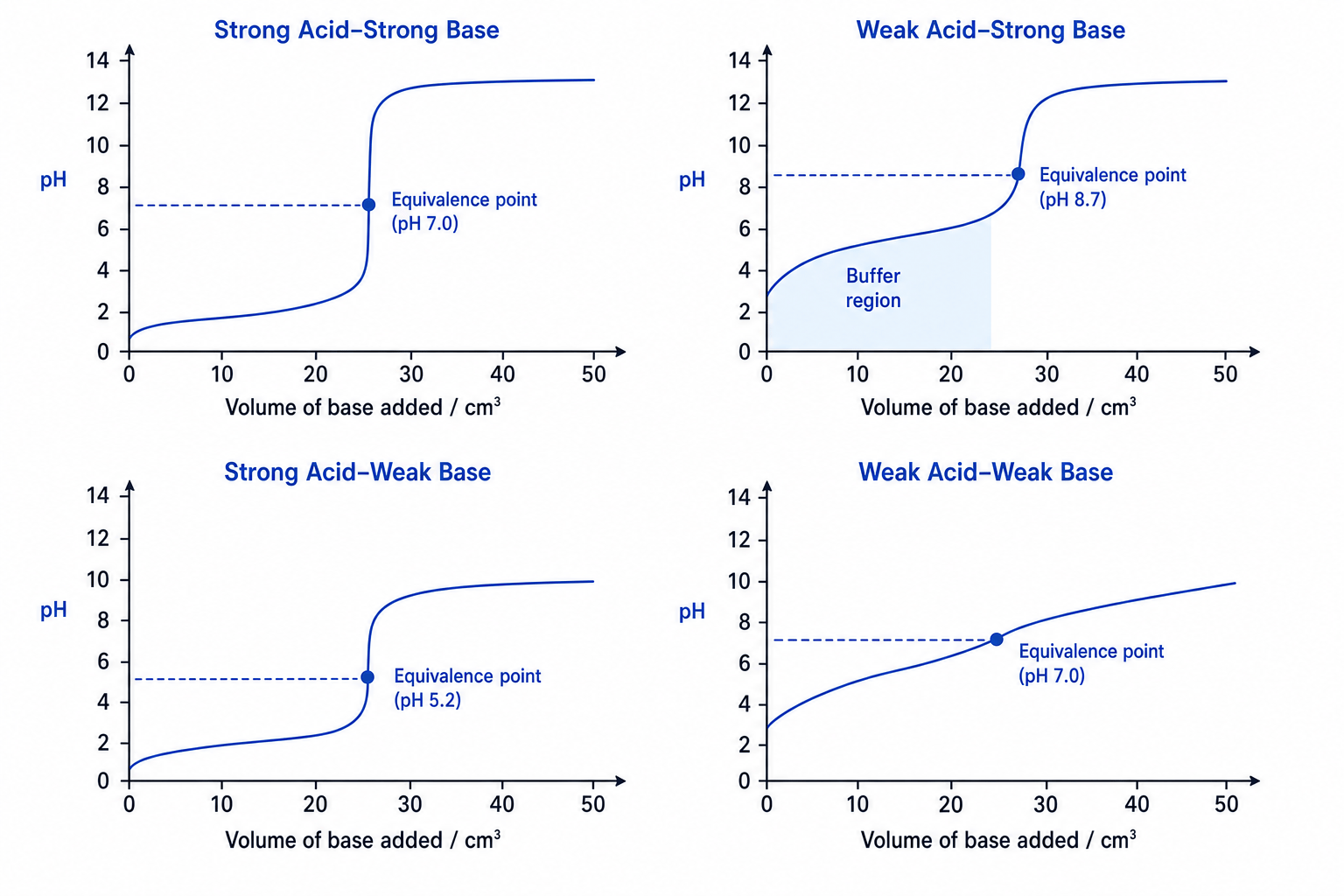
A pH titration curve tracks the pH of an acid as a base is progressively added (or vice versa).
Features of Titration Curves
- Starting pH: Tells you whether the substance in the flask is a strong acid (pH ~ 1), weak acid (pH ~ 3), weak base (pH ~ 11), or strong base (pH ~ 13).
- Buffer Region: For weak acid titrations, the initial rise is shallow because a buffer system (HA/A−\text{HA}/\text{A}^-HA/A−) forms dynamically as base is added.
- Equivalence Point: The center of the vertical section of the curve, representing the volume of base at which stoichiometric neutralisation is complete.
- Vertical Section: A region of rapid pH change.
- Strong Acid - Strong Base: Vertical section spans from pH ~ 3 to 11. Equivalence point is exactly at pH 7.0.
- Weak Acid - Strong Base: Vertical section spans from pH ~ 7 to 11. Equivalence point is >7> 7>7 (typically around pH 8.7).
- Strong Acid - Weak Base: Vertical section spans from pH ~ 3 to 7. Equivalence point is <7< 7<7 (typically around pH 5.2).
- Weak Acid - Weak Base: No sharp vertical section is observed. The pH changes gradually throughout.
Theory of Acid–Base Indicators
An indicator is itself a weak acid, which we can represent as HIn\text{HIn}HIn. It dissociates in aqueous solution to establish an equilibrium where the acid and conjugate base have distinctly different colours:
HIn(aq)⇌H+(aq)+In−(aq) \text{HIn(aq)} \rightleftharpoons \text{H}^+\text{(aq)} + \text{In}^-\text{(aq)} HIn(aq)⇌H+(aq)+In−(aq) (Colour A)(Colour B) \text{(Colour A)} \quad\quad\quad\quad\quad \text{(Colour B)} (Colour A)(Colour B)- When acid (H+\text{H}^+H+) is added: The equilibrium shifts to the left. The concentration of HIn\text{HIn}HIn increases, and the solution exhibits Colour A.
- When alkali (OH−\text{OH}^-OH−) is added: The added base reacts with H+\text{H}^+H+ to form water. This shifts the equilibrium to the right to replace the lost H+\text{H}^+H+. The concentration of In−\text{In}^-In− increases, and the solution exhibits Colour B.
Choosing a Suitable Indicator
An indicator changes colour over a specific range called its pH transition interval.
Indicator Rule
An indicator is suitable for a titration only if its entire pH transition interval falls completely within the vertical section of the titration curve.
- Methyl Orange (pH range 3.1–4.4) is suitable for titrations with a vertical section in the acidic region (Strong Acid–Strong Base, Strong Acid–Weak Base).
- Phenolphthalein (pH range 8.3–10.0) is suitable for titrations with a vertical section in the alkaline region (Strong Acid–Strong Base, Weak Acid–Strong Base).
- Weak Acid - Weak Base titrations have no sharp vertical section. Consequently, no indicator is suitable for a weak acid–weak base titration, and a pH meter must be used instead.
6. PAG 11: Calibration and Use of a pH Meter
Using a pH probe connected to a digital meter provides a more precise and continuous measurement of pH than universal indicator paper. However, pH meters must be calibrated before use to ensure accuracy.
Calibration Procedure
- Rinse the probe thoroughly with deionised water.
- Calibrate using buffer solutions of known, fixed pH.
- Dip the probe into a pH 7.00 buffer and adjust the reading on the meter to match.
- Rinse the probe and repeat this process with a second buffer (e.g., pH 4.00 for acidic titrations, or pH 10.00 for alkaline titrations). This calibration line corrects for systemic instrument drift (creating a calibration curve).
- Rinse the probe again with deionised water before taking measurements of your test solutions.
In the exam
- Never assume standard approximations in buffer questions: When calculating the pH of a buffer, do not write [H+]=Ka×[HA][\text{H}^+] = \sqrt{K_a \times [\text{HA}]}[H+]=Ka×[HA]. That approximation only works for a pure weak acid. For a buffer, you must use [H+]=Ka×[HA][A−][\text{H}^+] = K_a \times \frac{[\text{HA}]}{[\text{A}^-]}[H+]=Ka×[A−][HA].
- Watch the volumes in dilution: When two solutions are mixed together to form a buffer, their concentrations are halved if equal volumes are used. Work in moles first, then convert to concentration using the total combined volume.
- Be precise with state symbols: When writing ionic equations for reactions with acids, remember that acids are H+(aq)\text{H}^+\text{(aq)}H+(aq), group 1 and 2 oxides are solid or aqueous depending on solubility, and carbonates are often solids (MgCO3\text{MgCO}_3MgCO3) or aqueous (Na2CO3\text{Na}_2\text{CO}_3Na2CO3).
Check yourself
- Identify the conjugate acid of HPO42−\text{HPO}_4^{2-}HPO42−.
- Explain why the pH of pure water decreases as temperature rises, even though the water remains neutral.
- A weak acid HA\text{HA}HA has a concentration of 0.010 mol dm−30.010\text{ mol dm}^{-3}0.010 mol dm−3 and its Ka=1.0×10⁻² mol dm−3K_a = 1.0 \times 10^{-2}\text{ mol dm}^{-3}Ka=1.0×10⁻² mol dm−3. Why is the approximation [HA]eq≈0.010 mol dm−3[\text{HA}]_{\text{eq}} \approx 0.010\text{ mol dm}^{-3}[HA]eq≈0.010 mol dm−3 invalid for this specific solution?
- State which indicator, methyl orange or phenolphthalein, is suitable for a titration between ethanoic acid and sodium hydroxide, and explain your choice.
