

What you'll learn
- How equilibrium constants tell you the extent of a reversible reaction.
- How to calculate equilibrium amounts, concentrations, mole fractions and partial pressures.
- How to write and use KcK_cKc and KpK_pKp expressions, including units.
- Why temperature can change an equilibrium constant, but concentration, pressure and catalysts cannot.
The big idea: “how far” does the reaction go?
Many reactions are reversible: the products can react to reform the reactants.
For example:
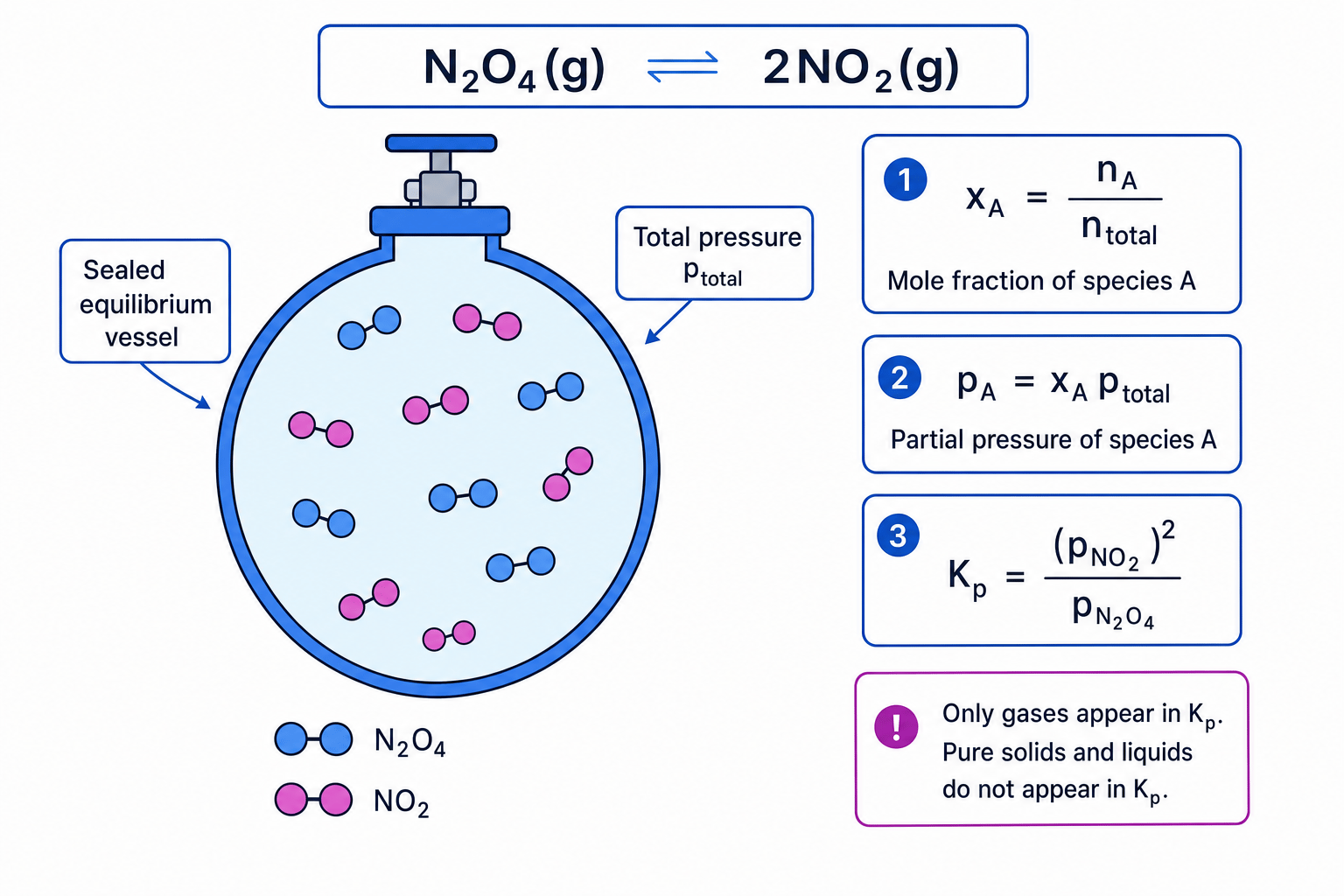
N₂O₄(g) ⇌ 2NO₂(g)
At first, the forward reaction may dominate. Eventually, in a closed system, the forward and reverse reactions happen at the same rate.
Dynamic equilibrium
A dynamic equilibrium is reached in a closed system when the forward and reverse reactions occur at equal rates, so the concentrations of reactants and products remain constant.
“Constant” does not mean “equal”. A mixture at equilibrium may contain mostly reactants, mostly products, or a significant amount of both.
What K tells you
An equilibrium constant measures the position of equilibrium at a fixed temperature. A large value means products are favoured; a small value means reactants are favoured.
Mole fraction and partial pressure
For gas equilibria, you often use partial pressures rather than concentrations.
Mole fraction and partial pressure
- The mole fraction, xAx_AxA, of gas A is the fraction of the total moles of gas particles that are A:
xA=nAntotalx_A = \frac{n_A}{n_\text{total}}xA=ntotalnA - The partial pressure, pAp_ApA, of gas A is the pressure it would exert if it alone occupied the container:
pA=xAptotalp_A = x_Ap_\text{total}pA=xAptotal
Mole fraction has no units. Partial pressure has the same units as the total pressure, usually kPa in A-Level calculations.
Calculating partial pressures and Kp
At equilibrium, a gas mixture contains 0.300 mol N₂O₄ and 0.200 mol NO₂. The total pressure is 150 kPa. For N₂O₄(g) ⇌ 2NO₂(g), calculate KpK_pKp.
-
Find the total amount of gas:
ntotal=0.300+0.200=0.500 moln_\text{total} = 0.300 + 0.200 = 0.500\ \text{mol}ntotal=0.300+0.200=0.500 mol -
Calculate mole fractions:
xNO2=0.2000.500=0.400x_{\text{NO}_2} = \frac{0.200}{0.500} = 0.400xNO2=0.5000.200=0.400
xN2O4=0.3000.500=0.600x_{\text{N}_2\text{O}_4} = \frac{0.300}{0.500} = 0.600xN2O4=0.5000.300=0.600 -
Convert mole fractions into partial pressures:
pNO2=0.400×150=60.0 kPap_{\text{NO}_2} = 0.400 \times 150 = 60.0\ \text{kPa}pNO2=0.400×150=60.0 kPa
pN2O4=0.600×150=90.0 kPap_{\text{N}_2\text{O}_4} = 0.600 \times 150 = 90.0\ \text{kPa}pN2O4=0.600×150=90.0 kPa -
Substitute into the KpK_pKp expression:
Kp=(pNO2)2pN2O4=60.0290.0=40.0 kPaK_p = \frac{\left(p_{\text{NO}_2}\right)^2}{p_{\text{N}_2\text{O}_4}} = \frac{60.0^2}{90.0} = 40.0\ \text{kPa}Kp=pN2O4(pNO2)2=90.060.02=40.0 kPa
Writing Kc and Kp expressions
For a general equilibrium:
aA + bB ⇌ cC + dD
the concentration equilibrium constant is:
Kc=[C]c[D]d[A]a[B]bK_c = \frac{[\text{C}]^c[\text{D}]^d}{[\text{A}]^a[\text{B}]^b}Kc=[A]a[B]b[C]c[D]dSquare brackets mean equilibrium concentration in mol dm⁻³.
The pressure equilibrium constant is:
Kp=(pC)c(pD)d(pA)a(pB)bK_p = \frac{\left(p_\text{C}\right)^c\left(p_\text{D}\right)^d}{\left(p_\text{A}\right)^a\left(p_\text{B}\right)^b}Kp=(pA)a(pB)b(pC)c(pD)dwhere the ppp values are equilibrium partial pressures.
Homogeneous and heterogeneous equilibria
A homogeneous equilibrium has all species in the same physical state. A heterogeneous equilibrium has species in different physical states.
Pure solids and pure liquids are left out of KcK_cKc and KpK_pKp expressions because their concentrations are effectively constant.
Writing expressions for heterogeneous equilibria
For CaCO₃(s) ⇌ CaO(s) + CO₂(g), write the KpK_pKp expression.
-
Identify the species that can appear in KpK_pKp: only gases are included.
-
Omit CaCO₃(s) and CaO(s) because they are pure solids.
-
Write the expression using the remaining gaseous species:
Kp=pCO2K_p = p_{\text{CO}_2}Kp=pCO2
Including solids or liquids
Do not put pure solids or pure liquids into equilibrium constant expressions. For example, CaCO₃(s) and CaO(s) are omitted from the expression above.
Calculating equilibrium amounts and Kc
A reliable method is to track:
- initial amount
- change in amount
- equilibrium amount
This is often called an ICE method: Initial, Change, Equilibrium.
Calculating Kc from equilibrium amounts
Hydrogen and iodine react as follows:
H₂(g) + I₂(g) ⇌ 2HI(g)
In a 1.00 dm³ container, 0.200 mol H₂ and 0.200 mol I₂ are mixed. At equilibrium, 0.240 mol HI is present. Calculate KcK_cKc.
-
Use the ratio in the equation. Forming 0.240 mol HI requires half as much H₂ and I₂ to react:
mol H2 reacted=mol I2 reacted=0.2402=0.120 mol\text{mol H}_2\ \text{reacted} = \text{mol I}_2\ \text{reacted} = \frac{0.240}{2} = 0.120\ \text{mol}mol H2 reacted=mol I2 reacted=20.240=0.120 mol -
Find equilibrium amounts:
nH2=0.200−0.120=0.0800 moln_{\text{H}_2} = 0.200 - 0.120 = 0.0800\ \text{mol}nH2=0.200−0.120=0.0800 mol
nI2=0.200−0.120=0.0800 moln_{\text{I}_2} = 0.200 - 0.120 = 0.0800\ \text{mol}nI2=0.200−0.120=0.0800 mol
nHI=0.240 moln_{\text{HI}} = 0.240\ \text{mol}nHI=0.240 mol -
Convert to concentrations using c=nVc = \frac{n}{V}c=Vn. Since the volume is 1.00 dm³, the concentrations are 0.0800 mol dm⁻³, 0.0800 mol dm⁻³ and 0.240 mol dm⁻³.
-
Substitute into the expression:
Kc=[HI]2[H2][I2]=0.24020.0800×0.0800=9.00K_c = \frac{[\text{HI}]^2}{[\text{H}_2][\text{I}_2]} = \frac{0.240^2}{0.0800 \times 0.0800} = 9.00Kc=[H2][I2][HI]2=0.0800×0.08000.2402=9.00 -
Work out the units. The expression has concentration squared divided by concentration squared, so the units cancel. KcK_cKc has no units here.
No quadratic solving required
For OCR H432, you are not expected to solve quadratic equations in these equilibrium calculations. If an unknown change is needed, the data will allow a non-quadratic route or a straightforward rearrangement.
Determining equilibrium concentrations experimentally
You may be asked how quantities present at equilibrium can be found experimentally. This applies to solution equilibria and KcK_cKc-type work, not experimental determination of KpK_pKp in this section.
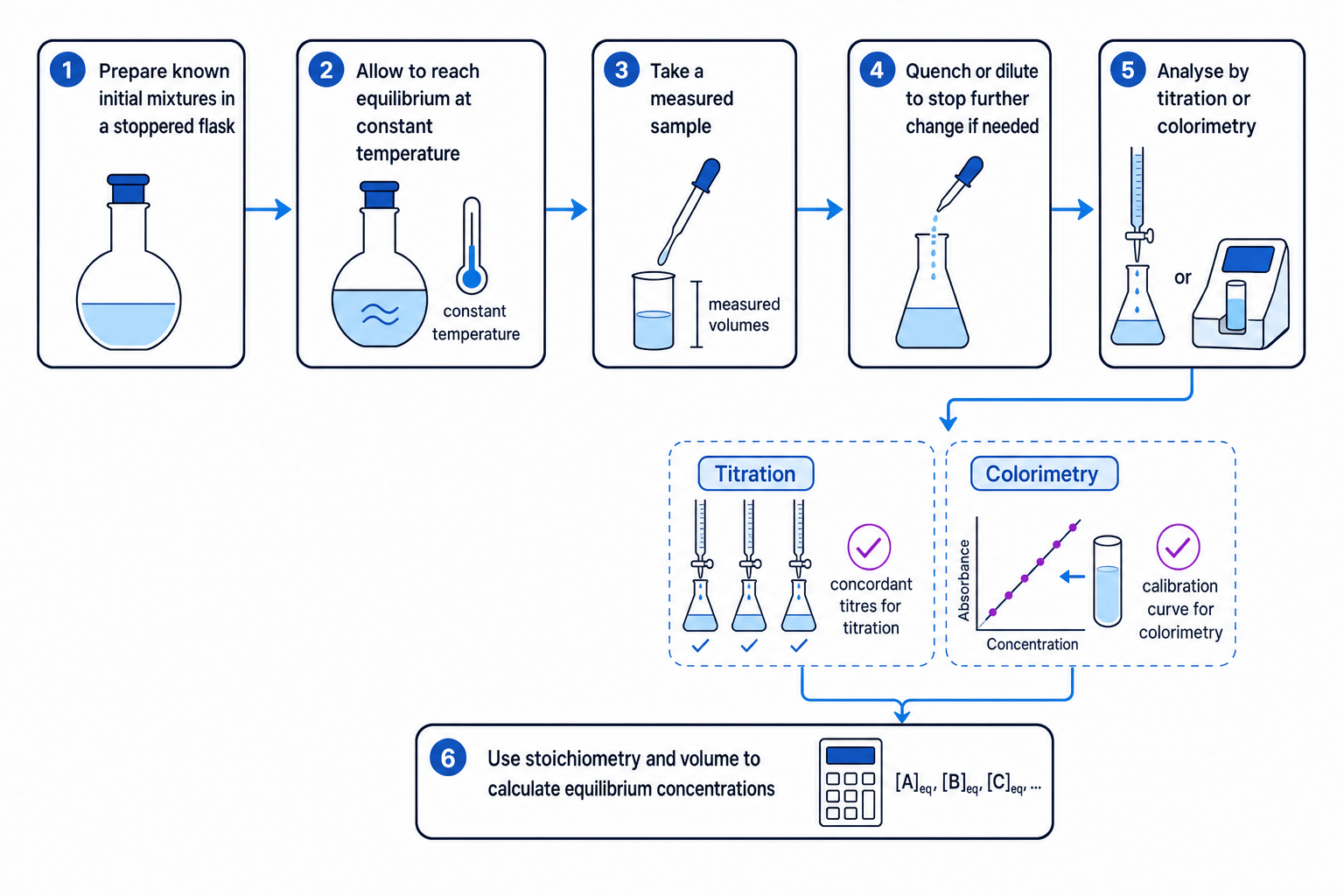
A typical approach is: prepare known starting mixtures, allow equilibrium to be reached at constant temperature, take a measured sample, then analyse it by titration or colorimetry.
Finding an equilibrium concentration from a titre
A 25.0 cm³ sample of an equilibrium mixture contains an acid. It is titrated with 0.100 mol dm⁻³ NaOH(aq). The mean titre is 18.60 cm³. The acid reacts 1:1 with NaOH. Calculate the acid concentration in the sample.
-
Convert the NaOH volume into dm³:
V=18.601000=0.01860 dm3V = \frac{18.60}{1000} = 0.01860\ \text{dm}^3V=100018.60=0.01860 dm3 -
Calculate moles of NaOH using n=cVn = cVn=cV:
n=0.100×0.01860=0.00186 moln = 0.100 \times 0.01860 = 0.00186\ \text{mol}n=0.100×0.01860=0.00186 mol -
Use the 1:1 ratio, so the sample contained 0.00186 mol acid.
-
Divide by the sample volume:
c=0.001860.0250=0.0744 mol dm−3c = \frac{0.00186}{0.0250} = 0.0744\ \text{mol dm}^{-3}c=0.02500.00186=0.0744 mol dm−3
Practical accuracy
Keep the temperature constant, use measured volumes carefully, and use concordant titres or a calibration curve. Temperature matters because equilibrium constants depend on temperature.
Units of Kc and Kp
The units come from the expression after substitution.
For KcK_cKc, use mol dm⁻³ for each concentration. For KpK_pKp, use the pressure unit given in the question, commonly kPa.
A quick way is to compare the total powers on the top and bottom:
- If the powers cancel, there are no units.
- If one pressure term remains overall, units may be kPa.
- If two concentration terms remain on the bottom overall, units may be dm⁶ mol⁻².
Always derive the units from the actual expression, especially for heterogeneous equilibria where solids and liquids are omitted.
What changes K?
Only temperature changes the value of an equilibrium constant.
For an exothermic forward reaction, increasing temperature favours the reverse reaction, so the value of K decreases.
For an endothermic forward reaction, increasing temperature favours the forward reaction, so the value of K increases.
Temperature versus other changes
Changing concentration, pressure or adding a catalyst can change the equilibrium position, but it does not change KcK_cKc or KpK_pKp at constant temperature.
A catalyst speeds up the forward and reverse reactions by the same factor. It helps equilibrium be reached faster, but it does not alter the equilibrium composition.
How K controls the position of equilibrium
To explain shifts precisely, it is helpful to use the reaction quotient, Q.
Reaction quotient
The reaction quotient, Q, has the same form as the equilibrium constant expression, but it is calculated using the current amounts, concentrations or partial pressures before equilibrium has been restored.
At equilibrium, Q = K.
If Q is smaller than K, the reaction moves forward to make more products. If Q is larger than K, the reaction moves backwards to make more reactants.
Explaining a pressure change using Kp
For the Haber equilibrium:
N₂(g) + 3H₂(g) ⇌ 2NH₃(g)
explain what happens when the pressure is increased at constant temperature.
-
Write the expression:
Kp=(pNH3)2pN2(pH2)3K_p = \frac{\left(p_{\text{NH}_3}\right)^2}{p_{\text{N}_2}\left(p_{\text{H}_2}\right)^3}Kp=pN2(pH2)3(pNH3)2 -
Imagine the container is compressed so every partial pressure initially doubles. The new reaction quotient is:
Qp=(2pNH3)2(2pN2)(2pH2)3=416Kp=Kp4Q_p = \frac{\left(2p_{\text{NH}_3}\right)^2}{\left(2p_{\text{N}_2}\right)\left(2p_{\text{H}_2}\right)^3} = \frac{4}{16}K_p = \frac{K_p}{4}Qp=(2pN2)(2pH2)3(2pNH3)2=164Kp=4Kp -
Since Qp<KpQ_p < K_pQp<Kp, the system must move forward to increase Q back to K.
-
The forward reaction forms NH₃, the side with fewer gas moles. This matches the usual rule: increasing pressure favours the side with fewer moles of gas.
The same logic works for concentration changes. If you add a reactant, the denominator of Q increases, so Q becomes smaller than K. The equilibrium shifts forward until Q equals K again.
For temperature changes, K itself changes. The system shifts to reach the new value of K at the new temperature.
Applying the idea to other equilibrium constants
The same principles apply to other equilibrium constants you meet later, such as acid dissociation constants and ionic product constants.
You still ask:
- What is the correct expression?
- Which species are included?
- Has temperature changed?
- Does the system need to shift so that Q returns to K?
In the exam
-
Write the balanced equilibrium equation first, then build the KcK_cKc or KpK_pKp expression from the stoichiometric numbers.
-
For gas mixtures, calculate mole fractions before partial pressures: pA=xAptotalp_A = x_Ap_\text{total}pA=xAptotal.
-
Always state units for K unless they cancel, and remember that changing concentration, pressure or catalyst does not change K at constant temperature.
Check yourself
- Why are pure solids and pure liquids omitted from equilibrium constant expressions?
- For an exothermic forward reaction, what happens to K when temperature is increased?
- How would you calculate partial pressure from amount of gas and total pressure?
