This question is about magnesium and magnesium halides.
Magnesium has metallic bonding and is a good conductor of electricity.
Describe, with the aid of a labelled diagram, the metallic bonding in magnesium and explain why magnesium conducts electricity. Include the correct charges on the particles in your diagram.
The first 11 successive ionisation energies of magnesium are shown in Table 16.1.
| Ionisation number | Ionisation energy / kJ mol−1\text{kJ mol}^{-1}kJ mol−1 |
|---|---|
| 1 | 738 |
| 2 | 1451 |
| 3 | 7733 |
| 4 | 10543 |
| 5 | 13630 |
| 6 | 18020 |
| 7 | 21711 |
| 8 | 25661 |
| 9 | 31653 |
| 10 | 35458 |
| 11 | 169988 |
Table 16.1
Write an equation to represent the third ionisation energy of magnesium. Include state symbols.
Explain how the successive ionisation energies provide evidence that magnesium is in Group 2 of the periodic table.
Electrons occupy orbitals. Below is Table 16.2. Identify which ionisation numbers are responsible for removing an electron from a full orbital in a magnesium atom.
| Ionisation number | 1 | 2 | 3 | 4 | 5 | 6 | 7 | 8 | 9 | 10 | 11 |
|---|
Table 16.2
The enthalpy change of solution for magnesium fluoride, MgF2\text{MgF}_2MgF2, can be determined indirectly using an energy cycle based on the enthalpy changes below.
| Enthalpy change | Energy / kJ mol−1\text{kJ mol}^{-1}kJ mol−1 |
|---|---|
| Lattice enthalpy of magnesium fluoride | -2957 |
| Hydration of magnesium ions | -1920 |
| Hydration of fluoride ions | -506 |
Explain what is meant by enthalpy change of solution.
On the dotted lines in the energy cycle below, add the species present, including state symbols.
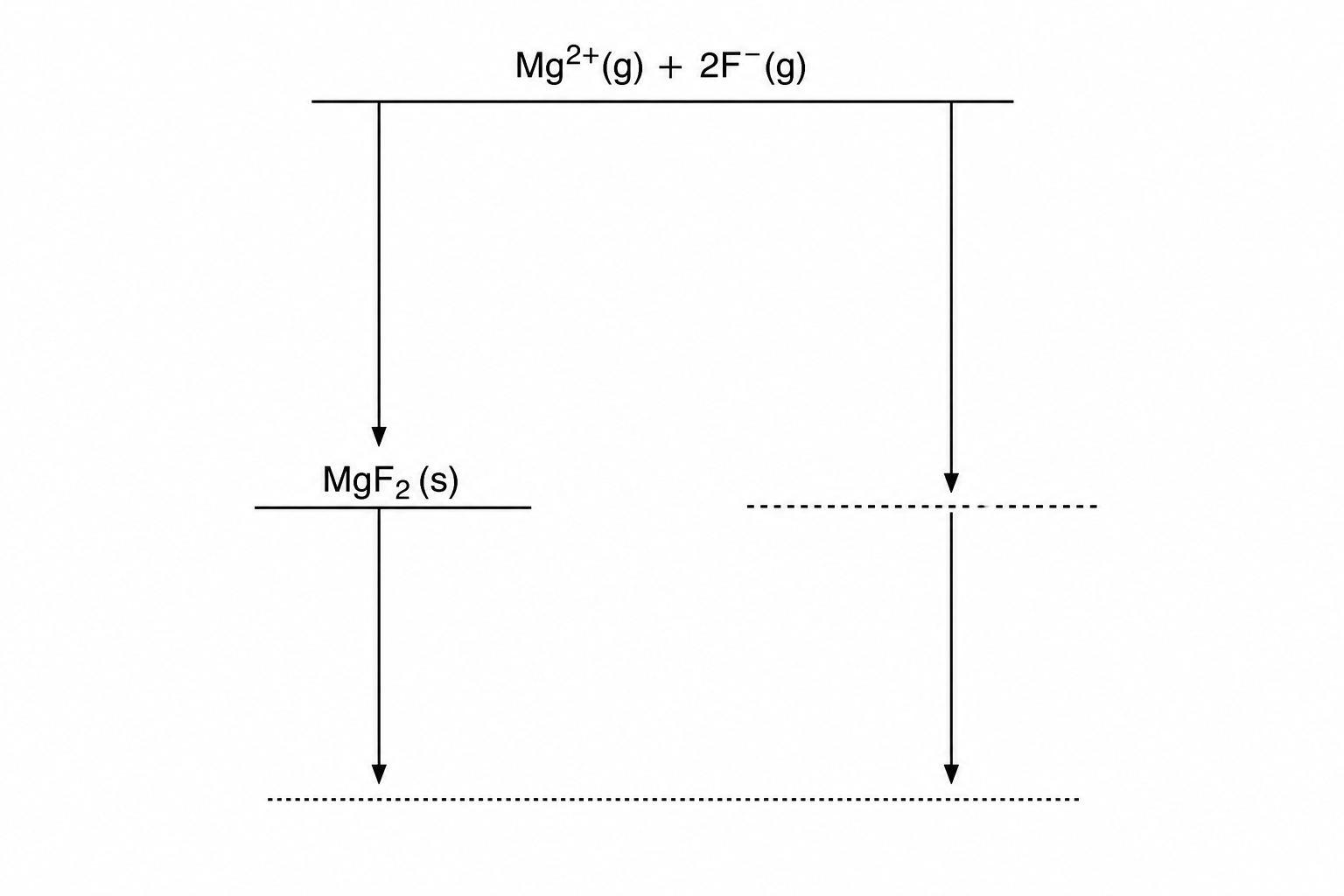
Calculate the enthalpy change of solution of MgF2\text{MgF}_2MgF2.
The enthalpy changes of solution of the magnesium halides show a trend from MgF2\text{MgF}_2MgF2 to MgI2\text{MgI}_2MgI2.
Explain why it is difficult to predict whether the enthalpy change of solution becomes more exothermic or less exothermic down the group from MgF2\text{MgF}_2MgF2 to MgI2\text{MgI}_2MgI2.