The temperature dependence of the Gibbs free energy change, ΔG\Delta GΔG, for a certain industrial reaction is shown in the graph below.
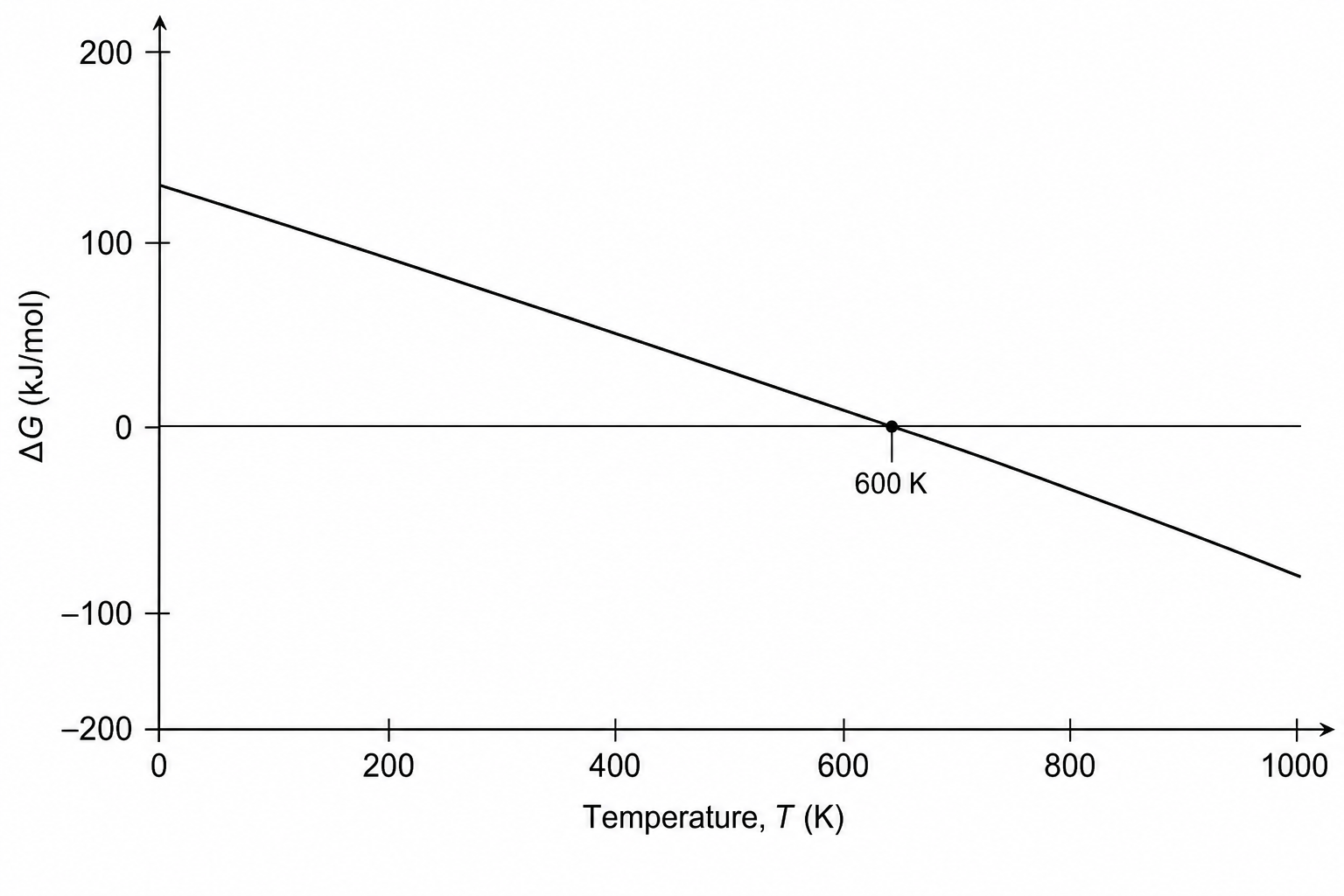
At T=0 KT = 0\text{ K}T=0 K, the Gibbs free energy change is ΔG=+120 kJ mol−1\Delta G = +120\text{ kJ mol}^{-1}ΔG=+120 kJ mol−1, and the reaction becomes thermodynamically feasible at temperatures above 600 K.
Which of the following correctly describes the signs of ΔH \Delta H\,ΔH and ΔS\Delta SΔS, along with the value of ΔS \Delta S\,ΔS for this reaction?
ΔH\Delta HΔH is positive, ΔS\Delta SΔS is positive, and ΔS=+200 J K−1 mol−1\Delta S = +200\text{ J K}^{-1}\text{ mol}^{-1}ΔS=+200 J K−1 mol−1
ΔH\Delta HΔH is positive, ΔS\Delta SΔS is negative, and ΔS=−200 J K−1 mol−1\Delta S = -200\text{ J K}^{-1}\text{ mol}^{-1}ΔS=−200 J K−1 mol−1
ΔH\Delta HΔH is negative, ΔS\Delta SΔS is positive, and ΔS=+0.20 J K−1 mol−1\Delta S = +0.20\text{ J K}^{-1}\text{ mol}^{-1}ΔS=+0.20 J K−1 mol−1
ΔH\Delta HΔH is positive, ΔS\Delta SΔS is positive, and ΔS=+0.20 J K−1 mol−1\Delta S = +0.20\text{ J K}^{-1}\text{ mol}^{-1}ΔS=+0.20 J K−1 mol−1

