Two structural isomers with the molecular formula C8H18\text{C}_8\text{H}_{18}C8H18, nnn-octane and 2,2,3,3-tetramethylbutane, have boiling points of 126∘C126^\circ\text{C}126∘C and 106∘C106^\circ\text{C}106∘C, respectively.
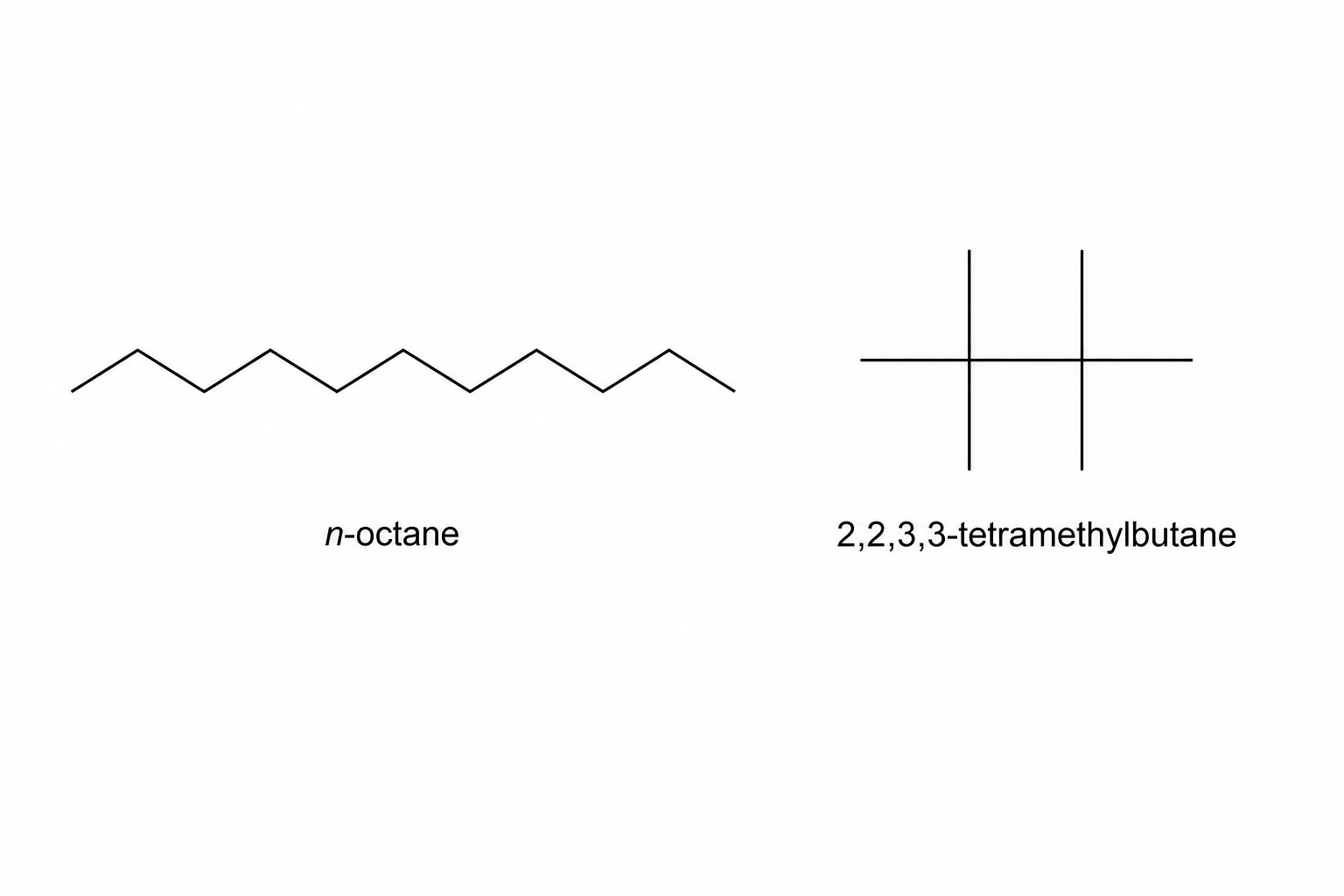
Which of the following statements correctly explains this difference in boiling points?
Branching in 2,2,3,3-tetramethylbutane results in a more spherical molecular shape and a smaller surface area of contact, weakening the induced dipole-dipole (London) forces between molecules.
The branched structure of 2,2,3,3-tetramethylbutane introduces steric hindrance that weakens the internal C−C\text{C}-\text{C}C−C covalent bonds, allowing them to be broken with less thermal energy during boiling.
The straight-chain nnn-octane has a higher boiling point because it has a greater molecular mass than 2,2,3,3-tetramethylbutane, which increases the total strength of the London forces.
The linear geometry of nnn-octane allows the carbon-hydrogen bonds to align symmetrically, creating a permanent molecular dipole that increases intermolecular attraction.

