This question is about two different types of halogenated organic acids: carboxylic acids and sulfonic acids.
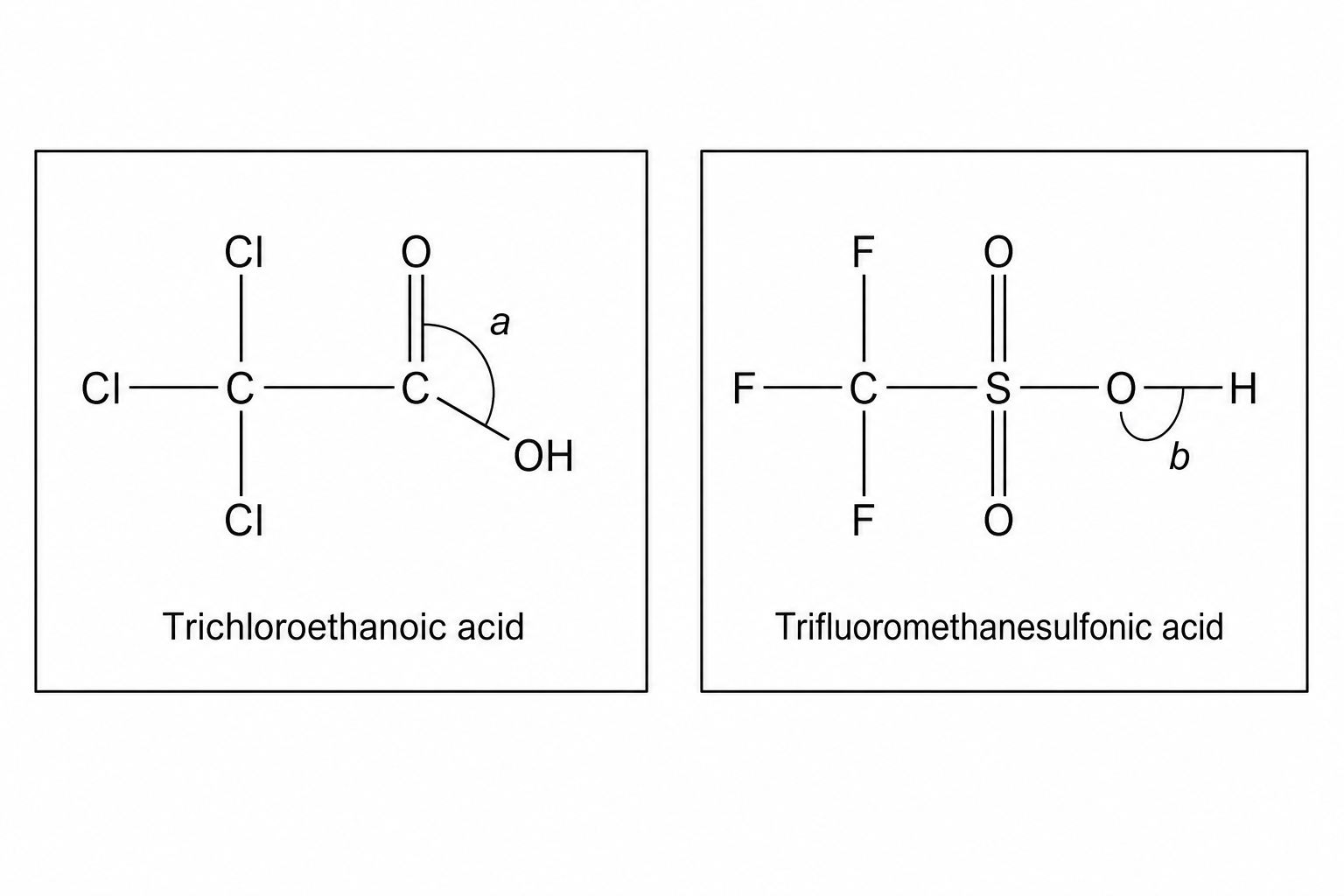
Predict the bond angles aaa and bbb and name the molecular shapes around the central atom for:
- The carbonyl carbon in trichloroethanoic acid, bond angle aaa.
- The oxygen atom of the hydroxyl group in trifluoromethanesulfonic acid, bond angle bbb.
Trichloroethanoic acid, CCl3COOH\text{CCl}_3\text{COOH}CCl3COOH, and trifluoromethanesulfonic acid, CF3SO2OH\text{CF}_3\text{SO}_2\text{OH}CF3SO2OH, are both monobasic acids. Their pKa\text{p}K_apKa values are shown in the table below:
| Acid | Formula | pKa\text{p}K_apKa |
|---|---|---|
| Trichloroethanoic acid | CCl3COOH\text{CCl}_3\text{COOH}CCl3COOH | 0.66 |
| Trifluoromethanesulfonic acid | CF3SO2OH\text{CF}_3\text{SO}_2\text{OH}CF3SO2OH | -14.0 |
A student claims that a 0.05 mol dm−30.05\text{ mol dm}^{-3}0.05 mol dm−3 solution of trifluoromethanesulfonic acid will have a lower pH\text{pH}pH value than a 0.05 mol dm−30.05\text{ mol dm}^{-3}0.05 mol dm−3 solution of trichloroethanoic acid.
Write an equation, showing conjugate acid–base pairs, for the equilibrium of CF3SO2OH\text{CF}_3\text{SO}_2\text{OH}CF3SO2OH with water, and explain with reasons whether the student's claim is correct. Label the conjugate acid–base pairs as A1, B1 and A2, B2.