Chlorocresol is an antiseptic and preservative with the structure shown below.
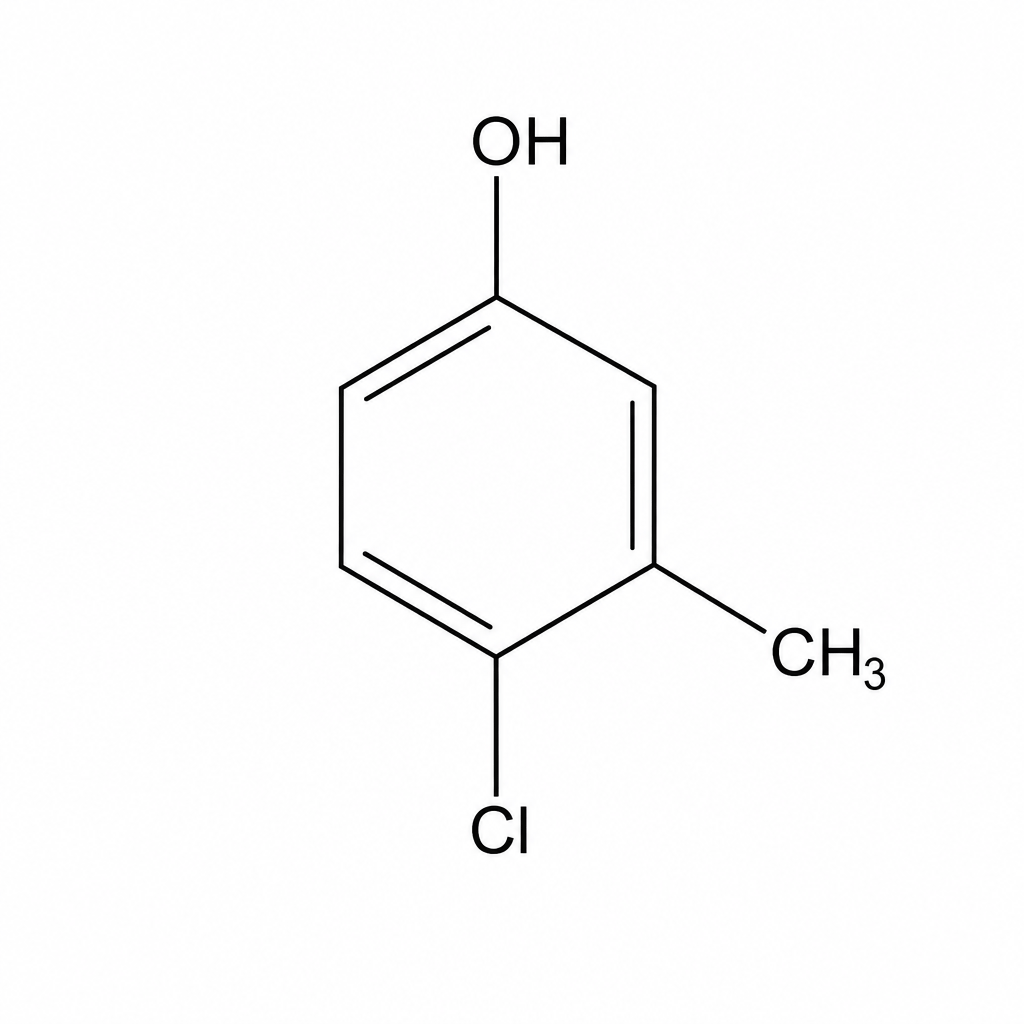
a.[1]
Chlorocresol is a weak Brønsted–Lowry acid.
What is the systematic name of chlorocresol?
b.[1]
Predict the number of peaks in a 13C^{13}\text{C}13C NMR spectrum of chlorocresol.
c.[5]
A student measures the pH of an antiseptic solution containing chlorocresol to be 5.35.
The label on the bottle shows the percentage of chlorocresol in the solution as 2.85% (weight/volume), meaning 100 cm3100\text{ cm}^3100 cm3 of the solution contains 2.85 g2.85\text{ g}2.85 g of chlorocresol.
Assume the following:
- Chlorocresol is the only acidic component in the solution.
- Chlorocresol is a weak monobasic acid.
- The density of the solution is 1.00 g cm−31.00\text{ g cm}^{-3}1.00 g cm−3.
Write the equation, using molecular formulae, for the acid dissociation of chlorocresol, and calculate the acid dissociation constant, KaK_{\text{a}}Ka, for chlorocresol.