

What you'll learn
- How to write ion/electron half-equations in acidic solution.
- How to combine half-equations into a full redox equation.
- How redox titrations are carried out, including self-indicating reactions.
- How copper(II) salts can be analysed using iodide and sodium thiosulfate.
Redox foundations
A redox reaction is a reaction involving transfer of electrons. One substance loses electrons while another gains them.
Oxidation and reduction
Oxidation is loss of electrons. Reduction is gain of electrons. A useful memory aid is OIL RIG: Oxidation Is Loss, Reduction Is Gain.
An oxidising agent causes another substance to be oxidised, so it gains electrons and is reduced. A reducing agent causes another substance to be reduced, so it loses electrons and is oxidised.
Oxidation states are a bookkeeping system for tracking electron transfer. In a simple ion, the oxidation state is the same as the ionic charge; for example, copper in Cu2+\text{Cu}^{2+}Cu2+ has oxidation state +2.
Identifying oxidation and reduction
For the reaction Zn(s)+Cu2+(aq)→Zn2+(aq)+Cu(s)\text{Zn}\text{(s)} + \text{Cu}^{2+}\text{(aq)} \to \text{Zn}^{2+}\text{(aq)} + \text{Cu}\text{(s)}Zn(s)+Cu2+(aq)→Zn2+(aq)+Cu(s):
- Compare oxidation states: zinc changes from 0 in Zn(s)\text{Zn}\text{(s)}Zn(s) to +2 in Zn2+\text{Zn}^{2+}Zn2+, so zinc has lost electrons.
- Copper changes from +2 in Cu2+\text{Cu}^{2+}Cu2+ to 0 in Cu(s)\text{Cu}\text{(s)}Cu(s), so copper ions have gained electrons.
- Therefore zinc is oxidised and is the reducing agent; copper(II) ions are reduced and are the oxidising agent.
Ion/electron half-equations
A half-equation shows either the oxidation part or the reduction part of a redox reaction. It includes electrons, so it makes the electron transfer explicit.
Half-equations in acidic solution
For acidic redox half-equations, balance atoms first, then balance oxygen with H2O\text{H}_2\text{O}H2O, hydrogen with H+\text{H}^+H+, and finally charge with electrons.
General method
- Write the main species changing.
- Balance all atoms except oxygen and hydrogen.
- Balance oxygen using H2O\text{H}_2\text{O}H2O.
- Balance hydrogen using H+\text{H}^+H+.
- Balance charge using electrons, e−e^-e−.
- Check atoms and total charge on both sides.
Constructing the dichromate(VI) reduction half-equation
Construct the half-equation for acidified dichromate(VI), Cr2O72−\text{Cr}_2\text{O}_7^{2-}Cr2O72−, being reduced to Cr3+\text{Cr}^{3+}Cr3+.
- Balance chromium atoms: Cr2O72−→2Cr3+\text{Cr}_2\text{O}_7^{2-} \to 2\text{Cr}^{3+}Cr2O72−→2Cr3+.
- Balance oxygen by adding seven water molecules to the right: Cr2O72−→2Cr3++7H2O\text{Cr}_2\text{O}_7^{2-} \to 2\text{Cr}^{3+} + 7\text{H}_2\text{O}Cr2O72−→2Cr3++7H2O.
- Balance hydrogen by adding 14 hydrogen ions to the left: Cr2O72−+14H+→2Cr3++7H2O\text{Cr}_2\text{O}_7^{2-} + 14\text{H}^+ \to 2\text{Cr}^{3+} + 7\text{H}_2\text{O}Cr2O72−+14H+→2Cr3++7H2O.
- Balance charge: the left side is +12 overall and the right side is +6 overall, so add six electrons to the left to reduce the charge: Cr2O72−+14H++6e−→2Cr3++7H2O\text{Cr}_2\text{O}_7^{2-} + 14\text{H}^+ + 6e^- \to 2\text{Cr}^{3+} + 7\text{H}_2\text{O}Cr2O72−+14H++6e−→2Cr3++7H2O.
Half-equations you should know
In acid solution:
-
Acidified manganate(VII) to manganese(II):
MnO4−+8H++5e−→Mn2++4H2O\text{MnO}_4^- + 8\text{H}^+ + 5e^- \to \text{Mn}^{2+} + 4\text{H}_2\text{O}MnO4−+8H++5e−→Mn2++4H2O -
Acidified dichromate(VI) to chromium(III):
Cr2O72−+14H++6e−→2Cr3++7H2O\text{Cr}_2\text{O}_7^{2-} + 14\text{H}^+ + 6e^- \to 2\text{Cr}^{3+} + 7\text{H}_2\text{O}Cr2O72−+14H++6e−→2Cr3++7H2O -
Thiosulfate to tetrathionate:
2S2O32−→S4O62−+2e−2\text{S}_2\text{O}_3^{2-} \to \text{S}_4\text{O}_6^{2-} + 2e^-2S2O32−→S4O62−+2e−
Putting electrons on the wrong side
Electrons go on the left for reduction because electrons are gained. They go on the right for oxidation because electrons are lost. Always check the total charge.
Combining half-equations
To make a full redox equation, the electrons lost in oxidation must equal the electrons gained in reduction. You multiply one or both half-equations so the number of electrons matches, then add and cancel the electrons.
Combining manganate(VII) and iron(II) half-equations
Acidified manganate(VII) ions oxidise iron(II) ions to iron(III) ions.
- Write the two half-equations: MnO4−+8H++5e−→Mn2++4H2O\text{MnO}_4^- + 8\text{H}^+ + 5e^- \to \text{Mn}^{2+} + 4\text{H}_2\text{O}MnO4−+8H++5e−→Mn2++4H2O and Fe2+→Fe3++e−\text{Fe}^{2+} \to \text{Fe}^{3+} + e^-Fe2+→Fe3++e−.
- Make the electrons equal by multiplying the iron half-equation by 5: 5Fe2+→5Fe3++5e−5\text{Fe}^{2+} \to 5\text{Fe}^{3+} + 5e^-5Fe2+→5Fe3++5e−.
- Add the two half-equations and cancel electrons: MnO4−+8H++5Fe2+→Mn2++4H2O+5Fe3+\text{MnO}_4^- + 8\text{H}^+ + 5\text{Fe}^{2+} \to \text{Mn}^{2+} + 4\text{H}_2\text{O} + 5\text{Fe}^{3+}MnO4−+8H++5Fe2+→Mn2++4H2O+5Fe3+.
Redox titrations
A titration is an analytical method where you measure the volume of one solution needed to react exactly with a known volume of another solution. In a redox titration, the reaction is an electron-transfer reaction.
Many d-block ions are coloured, so some redox titrations are self-indicating. For example, potassium manganate(VII) is purple, but Mn2+\text{Mn}^{2+}Mn2+ in dilute solution is very pale pink/almost colourless. The end-point is the first permanent pale pink colour from a tiny excess of MnO4−\text{MnO}_4^-MnO4−.
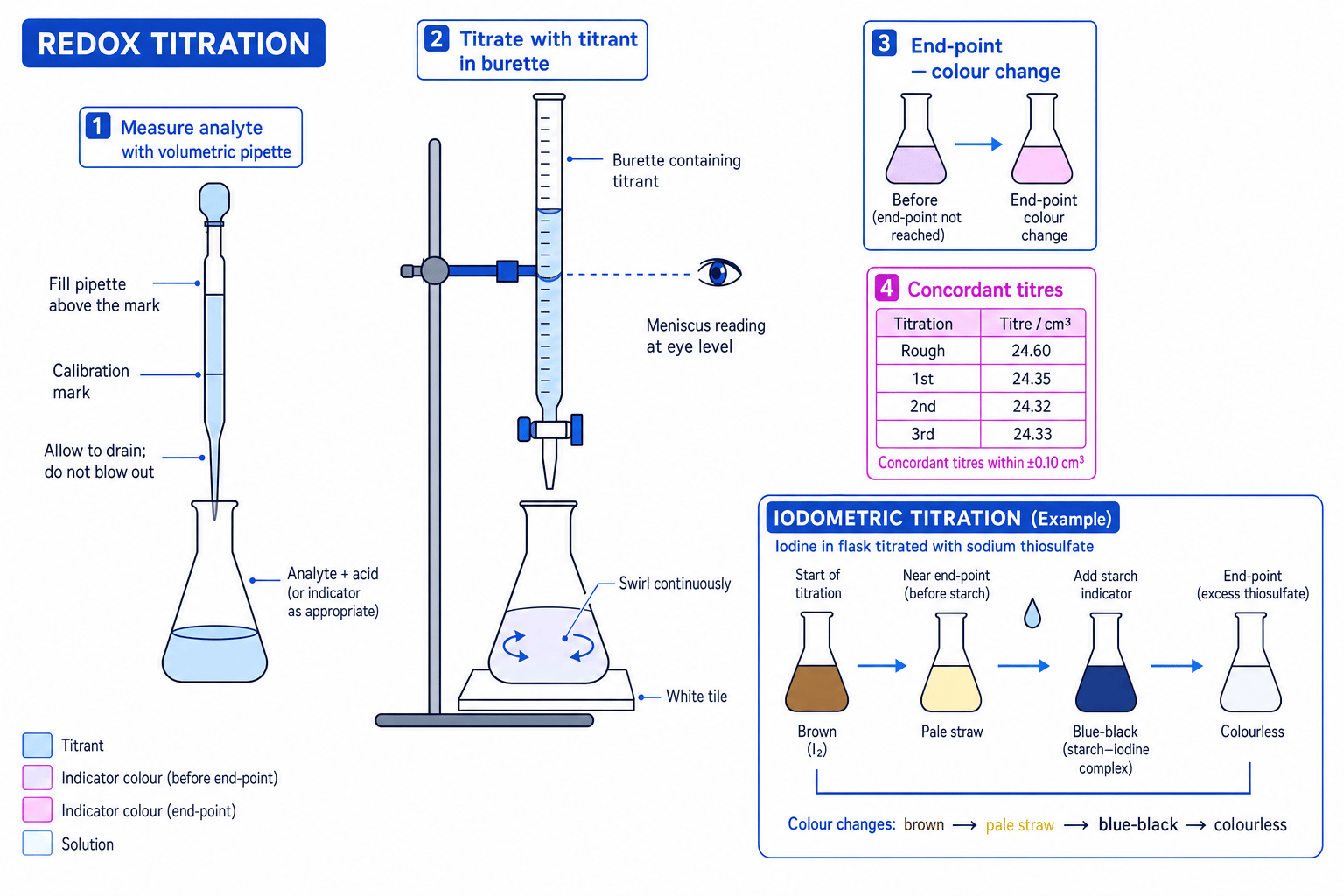
Practical method
- Rinse the burette with the titrant and fill it, making sure there is no air bubble in the jet.
- Use a volumetric pipette to transfer a fixed volume, often 25.00 cm³, of the analyte into a conical flask.
- Add any required acid or indicator. For manganate(VII) titrations, dilute sulfuric acid is commonly used.
- Do a rough titration first to find the approximate end-point.
- Repeat accurately until you obtain concordant titres, usually within 0.10 cm³.
- Calculate the mean titre using only concordant accurate titres, not the rough titre.
Choosing the acid
For manganate(VII) and dichromate(VI) titrations, use dilute sulfuric acid unless the method states otherwise. Hydrochloric acid can be oxidised, and nitric acid is itself an oxidising agent.
Estimating the titre
Before titrating, estimate the volume needed: find moles in the flask, use the balanced equation to convert to moles of titrant, then use V=ncV = \frac{n}{c}V=cn. A good accurate titre is often around 20–30 cm³.
Copper(II), iodide and thiosulfate analysis
Copper(II) ions react with iodide ions to form iodine. The copper(I) produced forms a precipitate of copper(I) iodide, CuI(s)\text{CuI}\text{(s)}CuI(s).
The redox reaction is:
2Cu2+(aq)+4I−(aq)→2CuI(s)+I2(aq)2\text{Cu}^{2+}\text{(aq)} + 4\text{I}^-\text{(aq)} \to 2\text{CuI}\text{(s)} + \text{I}_2\text{(aq)}2Cu2+(aq)+4I−(aq)→2CuI(s)+I2(aq)The liberated iodine is then titrated with standard sodium thiosulfate solution:
I2(aq)+2S2O32−(aq)→2I−(aq)+S4O62−(aq)\text{I}_2\text{(aq)} + 2\text{S}_2\text{O}_3^{2-}\text{(aq)} \to 2\text{I}^-\text{(aq)} + \text{S}_4\text{O}_6^{2-}\text{(aq)}I2(aq)+2S2O32−(aq)→2I−(aq)+S4O62−(aq)Combining the mole ratios shows that the amount of Cu2+\text{Cu}^{2+}Cu2+ in the aliquot equals the amount of S2O32−\text{S}_2\text{O}_3^{2-}S2O32− used.
In the lab, add excess potassium iodide to the copper(II) solution, then titrate the iodine formed with sodium thiosulfate. The solution changes brown to pale straw. Add starch only near the end-point; it turns blue-black with iodine. Continue until the blue-black colour just disappears.
Adding starch too early
Do not add starch at the start of an iodine/thiosulfate titration. At high iodine concentration, the starch–iodine complex can be too stable and the end-point becomes less sharp.
Calculating copper(II) concentration from a thiosulfate titre
A 25.00 cm³ aliquot of copper(II) solution is treated with excess iodide. The iodine formed is titrated with 0.1000 mol dm⁻³ sodium thiosulfate. Titres are: rough 24.80 cm³; accurate 24.35, 24.30 and 24.32 cm³. Calculate the concentration of Cu2+\text{Cu}^{2+}Cu2+.
- Select the concordant accurate titres: 24.35, 24.30 and 24.32 cm³. Their mean is 24.32 cm³, which is 0.02432 dm³.
- Calculate moles of thiosulfate used: n=cV=0.1000×0.02432=0.002432 moln = cV = 0.1000 \times 0.02432 = 0.002432\text{ mol}n=cV=0.1000×0.02432=0.002432 mol.
- Use the stoichiometry: 2 mol Cu2+\text{Cu}^{2+}Cu2+ forms 1 mol I2\text{I}_2I2, and 1 mol I2\text{I}_2I2 reacts with 2 mol S2O32−\text{S}_2\text{O}_3^{2-}S2O32−, so n(Cu2+)=n(S2O32−)=0.002432 moln(\text{Cu}^{2+}) = n(\text{S}_2\text{O}_3^{2-}) = 0.002432\text{ mol}n(Cu2+)=n(S2O32−)=0.002432 mol.
- Calculate concentration in the 25.00 cm³ aliquot: c=nV=0.0024320.02500=0.09728 mol dm−3c = \frac{n}{V} = \frac{0.002432}{0.02500} = 0.09728\text{ mol dm}^{-3}c=Vn=0.025000.002432=0.09728 mol dm−3.
- Estimate titre uncertainty if each burette reading is ±0.05 cm³: one titre uses two readings, so uncertainty is ±0.10 cm³. Percentage uncertainty is 0.1024.32×100=0.41%\frac{0.10}{24.32} \times 100 = 0.41\%24.320.10×100=0.41%.
Reliability, accuracy and recording
Record burette readings to the nearest 0.05 cm³, then calculate titres by subtracting initial readings from final readings. Use a calculator or spreadsheet for the mean, but choose the data chemically: exclude the rough titre and any non-concordant outlier.
Important sources of error include parallax when reading the meniscus, overshooting the end-point, failing to rinse the burette or pipette with the correct solution, an air bubble in the burette jet, and adding starch at the wrong time in iodometric titrations.
For risk assessment, remember that acids can be corrosive, iodine is irritant, and dichromate(VI) compounds are toxic and hazardous. Wear eye protection and follow your centre’s disposal instructions for transition-metal waste.
In the exam
- For half-equations, balance atoms first, then oxygen with H2O\text{H}_2\text{O}H2O, hydrogen with H+\text{H}^+H+, and charge with electrons.
- For titration calculations, write the balanced redox equations and mole ratios before using n=cVn = cVn=cV; always convert cm³ to dm³.
- For data questions, reject the rough titre and non-concordant results, quote a sensible mean, and comment on uncertainty or end-point judgement where relevant.
Check yourself
- Can you construct the half-equation for MnO4−\text{MnO}_4^-MnO4− being reduced to Mn2+\text{Mn}^{2+}Mn2+ in acid?
- In the copper(II)/iodide method, what is the mole relationship between Cu2+\text{Cu}^{2+}Cu2+ and S2O32−\text{S}_2\text{O}_3^{2-}S2O32−?
- Why is starch added only near the end-point in an iodine/thiosulfate titration?
