

What you'll learn
- How redox reactions involve electron transfer.
- How to write ion/electron half-equations and cell diagrams.
- What standard electrode potential, the standard hydrogen electrode, and cell EMF mean.
- How electrochemical cells and hydrogen fuel cells work, including practical measurement of EcellE_{\text{cell}}Ecell.
Redox: electrons moving between species
A redox reaction is a reaction where electrons are transferred from one species to another. The two processes always happen together: one species loses electrons while another gains them.
Oxidation and reduction
- Oxidation is loss of electrons.
- Reduction is gain of electrons.
- A species that is oxidised is acting as a reducing agent because it donates electrons.
- A species that is reduced is acting as an oxidising agent because it accepts electrons.
A useful memory aid is OIL RIG: Oxidation Is Loss, Reduction Is Gain.
For example, when zinc reacts with copper(II) ions:
Zn(s)+Cu2+(aq)→Zn2+(aq)+Cu(s)\mathrm{Zn(s) + Cu^{2+}(aq) \to Zn^{2+}(aq) + Cu(s)}Zn(s)+Cu2+(aq)→Zn2+(aq)+Cu(s)Zinc atoms lose electrons to form zinc ions, while copper(II) ions gain electrons to form copper metal.
Identifying oxidation and reduction
For the reaction:
Mg(s)+2Ag+(aq)→Mg2+(aq)+2Ag(s)\mathrm{Mg(s) + 2Ag^+(aq) \to Mg^{2+}(aq) + 2Ag(s)}Mg(s)+2Ag+(aq)→Mg2+(aq)+2Ag(s)- Compare magnesium before and after the reaction: Mg(s) becomes Mg2+(aq), so it has lost two electrons.
- Compare silver before and after the reaction: Ag+(aq) becomes Ag(s), so each silver ion has gained one electron.
- Therefore Mg is oxidised and Ag+ is reduced. Mg is the reducing agent; Ag+ is the oxidising agent.
Ion/electron half-equations
A half-equation shows either the oxidation part or the reduction part of a redox reaction. Electrons are included to show what is lost or gained.
For the zinc/copper reaction:
Oxidation:
Zn(s)→Zn2+(aq)+2e−\mathrm{Zn(s) \to Zn^{2+}(aq) + 2e^-}Zn(s)→Zn2+(aq)+2e−Reduction:
Cu2+(aq)+2e−→Cu(s)\mathrm{Cu^{2+}(aq) + 2e^- \to Cu(s)}Cu2+(aq)+2e−→Cu(s)The electrons lost must equal the electrons gained when the half-equations are combined.
Half-equations must conserve charge
A balanced half-equation balances both atoms and total charge. Electrons are placed on the left for reduction and on the right for oxidation.
Writing half-equations and the overall reaction
Magnesium reacts with silver ions.
-
Write the oxidation half-equation for magnesium losing electrons:
Mg(s)→Mg2+(aq)+2e−\mathrm{Mg(s) \to Mg^{2+}(aq) + 2e^-}Mg(s)→Mg2+(aq)+2e− -
Write the reduction half-equation for silver ions gaining electrons:
Ag+(aq)+e−→Ag(s)\mathrm{Ag^+(aq) + e^- \to Ag(s)}Ag+(aq)+e−→Ag(s) -
Multiply the silver half-equation by 2 so that two electrons are gained:
2Ag+(aq)+2e−→2Ag(s)\mathrm{2Ag^+(aq) + 2e^- \to 2Ag(s)}2Ag+(aq)+2e−→2Ag(s) -
Add the half-equations and cancel electrons:
Mg(s)+2Ag+(aq)→Mg2+(aq)+2Ag(s)\mathrm{Mg(s) + 2Ag^+(aq) \to Mg^{2+}(aq) + 2Ag(s)}Mg(s)+2Ag+(aq)→Mg2+(aq)+2Ag(s)
Half-cells and cell diagrams
A half-cell contains one redox system. A redox system is a pair of species that can be interconverted by electron transfer, such as Cu2+/Cu or Fe3+/Fe2+.
Half-cell
A half-cell is one electrode system containing the oxidised and reduced forms of a redox pair, connected to another half-cell to form an electrochemical cell.
There are two common types you need.
Metal/metal ion half-cells
These contain a metal electrode dipped into a solution of its ions.
Example:
Cu2+(aq)+2e−⇌Cu(s)\mathrm{Cu^{2+}(aq) + 2e^- \rightleftharpoons Cu(s)}Cu2+(aq)+2e−⇌Cu(s)Cell notation for this half-cell is:
Cu2+(aq) ∣ Cu(s)\mathrm{Cu^{2+}(aq) \, | \, Cu(s)}Cu2+(aq)∣Cu(s)or, when placed on the left as an oxidation half-cell:
Cu(s) ∣ Cu2+(aq)\mathrm{Cu(s) \, | \, Cu^{2+}(aq)}Cu(s)∣Cu2+(aq)Half-cells involving different oxidation states of the same element
Some redox systems have no solid metal electrode. For example, Fe3+(aq) and Fe2+(aq) are both ions in solution:
Fe3+(aq)+e−⇌Fe2+(aq)\mathrm{Fe^{3+}(aq) + e^- \rightleftharpoons Fe^{2+}(aq)}Fe3+(aq)+e−⇌Fe2+(aq)An inert platinum electrode is used to transfer electrons:
Pt(s) ∣ Fe2+(aq),Fe3+(aq)\mathrm{Pt(s) \, | \, Fe^{2+}(aq), Fe^{3+}(aq)}Pt(s)∣Fe2+(aq),Fe3+(aq)Platinum is used because it conducts electricity but does not usually react.
Reading cell diagrams
A single vertical line means a phase boundary, such as solid metal touching aqueous ions. A double vertical line means a salt bridge between two half-cells.
A full cell diagram is usually written with the oxidation half-cell on the left and the reduction half-cell on the right:
Zn(s) ∣ Zn2+(aq) ∣∣ Cu2+(aq) ∣ Cu(s)\mathrm{Zn(s) \, | \, Zn^{2+}(aq) \, || \, Cu^{2+}(aq) \, | \, Cu(s)}Zn(s)∣Zn2+(aq)∣∣Cu2+(aq)∣Cu(s)Writing a cell diagram
Construct the cell diagram for a spontaneous zinc/copper cell.
-
Compare the reactions: zinc is oxidised to Zn2+, while Cu2+ is reduced to copper.
-
Put the oxidation half-cell on the left:
Zn(s) ∣ Zn2+(aq)\mathrm{Zn(s) \, | \, Zn^{2+}(aq)}Zn(s)∣Zn2+(aq) -
Put the reduction half-cell on the right and separate the half-cells with a salt bridge:
Zn(s) ∣ Zn2+(aq) ∣∣ Cu2+(aq) ∣ Cu(s)\mathrm{Zn(s) \, | \, Zn^{2+}(aq) \, || \, Cu^{2+}(aq) \, | \, Cu(s)}Zn(s)∣Zn2+(aq)∣∣Cu2+(aq)∣Cu(s)
Standard electrode potential
The potential of one half-cell cannot be measured on its own. It must be measured against a reference half-cell.
Standard electrode potential
The standard electrode potential, E∘E^\circE∘, is the EMF of a half-cell measured against the standard hydrogen electrode under standard conditions: 298 K, solutions at 1.00 mol dm⁻³, and gases at 100 kPa.
The standard hydrogen electrode, often abbreviated to SHE, is assigned a value of exactly 0.00 V.
It consists of:
- hydrogen gas at 100 kPa
- H+(aq) at 1.00 mol dm⁻³
- a platinum electrode
- temperature of 298 K
The half-equation is:
2H+(aq)+2e−⇌H2(g)\mathrm{2H^+(aq) + 2e^- \rightleftharpoons H_2(g)}2H+(aq)+2e−⇌H2(g)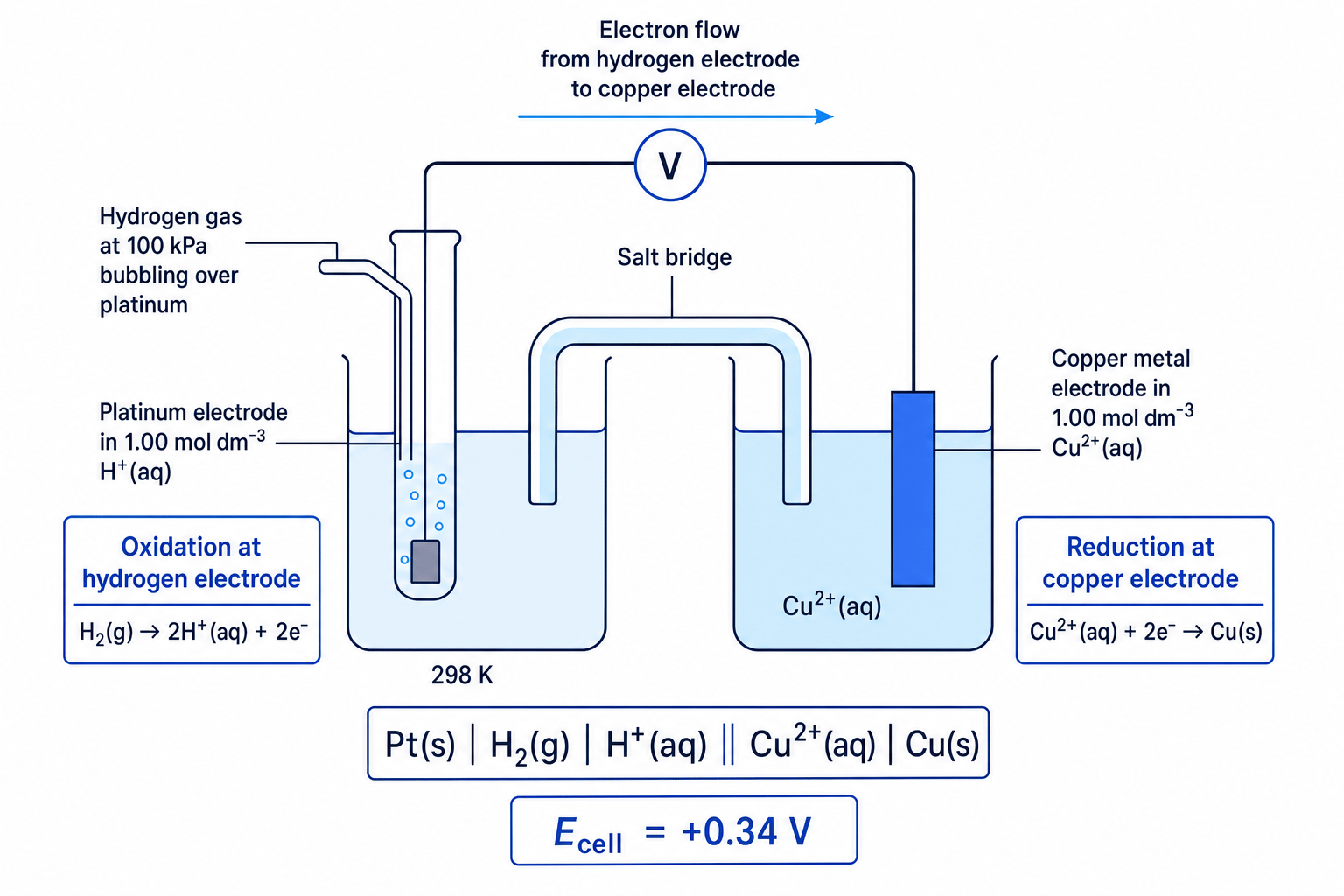
A more positive E∘E^\circE∘ means the species on the left of the reduction half-equation has a greater tendency to gain electrons.
More positive means easier reduction
The more positive the standard electrode potential, the stronger the oxidising agent and the more readily the half-cell undergoes reduction.
Cell EMF and feasibility
The cell EMF, written Ecell∘E^\circ_{\text{cell}}Ecell∘ under standard conditions, is the potential difference between two half-cells when no current is drawn. It is measured in volts, V.
For standard electrode potentials written as reduction potentials:
Ecell∘=Eright∘−Eleft∘E^\circ_{\text{cell}} = E^\circ_{\text{right}} - E^\circ_{\text{left}}Ecell∘=Eright∘−Eleft∘Equivalently:
Ecell∘=Ecathode∘−Eanode∘E^\circ_{\text{cell}} = E^\circ_{\text{cathode}} - E^\circ_{\text{anode}}Ecell∘=Ecathode∘−Eanode∘The cathode is where reduction happens. The anode is where oxidation happens.
Changing the sign twice
If you use data-book reduction potentials, do not reverse the sign just because a half-equation is reversed. Use Ecell∘=Ecathode∘−Eanode∘E^\circ_{\text{cell}} = E^\circ_{\text{cathode}} - E^\circ_{\text{anode}}Ecell∘=Ecathode∘−Eanode∘ with the tabulated values.
Calculating a standard cell EMF
Use these standard electrode potentials:
Ag+(aq)+e−⇌Ag(s)E∘=+0.80 VMg2+(aq)+2e−⇌Mg(s)E∘=−2.37 V\begin{aligned} \mathrm{Ag^+(aq) + e^-} &\mathrm{\rightleftharpoons Ag(s)} && E^\circ = +0.80\,\mathrm{V} \\ \mathrm{Mg^{2+}(aq) + 2e^-} &\mathrm{\rightleftharpoons Mg(s)} && E^\circ = -2.37\,\mathrm{V} \end{aligned}Ag+(aq)+e−Mg2+(aq)+2e−⇌Ag(s)⇌Mg(s)E∘=+0.80VE∘=−2.37V-
Identify the more positive reduction potential: Ag+/Ag is more positive, so Ag+ is reduced at the cathode.
-
Magnesium is therefore oxidised at the anode, using the Mg2+/Mg value as the anode potential.
-
Substitute into the EMF equation:
Ecell∘=+0.80−(−2.37)=+3.17 VE^\circ_{\text{cell}} = +0.80 - (-2.37) = +3.17\,\mathrm{V}Ecell∘=+0.80−(−2.37)=+3.17V -
Because Ecell∘E^\circ_{\text{cell}}Ecell∘ is positive, the reaction is feasible under standard conditions:
Mg(s)+2Ag+(aq)→Mg2+(aq)+2Ag(s)\mathrm{Mg(s) + 2Ag^+(aq) \to Mg^{2+}(aq) + 2Ag(s)}Mg(s)+2Ag+(aq)→Mg2+(aq)+2Ag(s)
Finding an unknown electrode potential
A cell is written:
Zn(s) ∣ Zn2+(aq) ∣∣ X+(aq) ∣ X(s)\mathrm{Zn(s) \, | \, Zn^{2+}(aq) \, || \, X^+(aq) \, | \, X(s)}Zn(s)∣Zn2+(aq)∣∣X+(aq)∣X(s)The measured Ecell∘E^\circ_{\text{cell}}Ecell∘ is +1.56 V. Given Zn2+/Zn has E∘=−0.76 VE^\circ = -0.76\,\mathrm{V}E∘=−0.76V, find E∘E^\circE∘ for X+/X.
-
Use the cell diagram order: zinc is the left half-cell and X+/X is the right half-cell.
-
Substitute into Ecell∘=Eright∘−Eleft∘E^\circ_{\text{cell}} = E^\circ_{\text{right}} - E^\circ_{\text{left}}Ecell∘=Eright∘−Eleft∘:
1.56=EX+/X∘−(−0.76)1.56 = E^\circ_{\text{X}^+/\text{X}} - (-0.76)1.56=EX+/X∘−(−0.76) -
Rearrange:
EX+/X∘=1.56−0.76=+0.80 VE^\circ_{\text{X}^+/\text{X}} = 1.56 - 0.76 = +0.80\,\mathrm{V}EX+/X∘=1.56−0.76=+0.80V
Feasible does not always mean fast
A positive Ecell∘E^\circ_{\text{cell}}Ecell∘ suggests a reaction is thermodynamically feasible under standard conditions, but it may still be very slow because of a high activation energy.
Specified practical: constructing electrochemical cells
To measure EcellE_{\text{cell}}Ecell in the lab:
- Clean metal electrodes with emery paper to remove oxide layers.
- Place each metal into a solution of its ions, usually around 1.00 mol dm⁻³ for standard conditions.
- Connect the solutions using a salt bridge, often filter paper soaked in potassium nitrate solution.
- Connect the electrodes to a high-resistance voltmeter.
- Record the voltage and sign, plus the temperature and concentrations used.
The salt bridge allows ions to move, completing the circuit and maintaining electrical neutrality. Electrons move through the wire, not through the salt bridge.
Practical reliability
Large errors often come from dirty electrodes, non-standard concentrations, temperature changes, poor electrical contact, or a salt bridge that reacts with the ions in solution.
Use eye protection. Many metal salt solutions are harmful or irritant, and acids used with hydrogen electrodes can be corrosive. Hydrogen gas is flammable, so it must be kept away from flames.
Hydrogen fuel cells
A fuel cell produces electricity from a continuous supply of fuel and oxidant. In a hydrogen fuel cell, hydrogen is the fuel and oxygen is the oxidant.
At the anode, hydrogen is oxidised:
H2(g)→2H+(aq)+2e−\mathrm{H_2(g) \to 2H^+(aq) + 2e^-}H2(g)→2H+(aq)+2e−At the cathode, oxygen is reduced:
O2(g)+4H+(aq)+4e−→2H2O(l)\mathrm{O_2(g) + 4H^+(aq) + 4e^- \to 2H_2O(l)}O2(g)+4H+(aq)+4e−→2H2O(l)Overall:
2H2(g)+O2(g)→2H2O(l)\mathrm{2H_2(g) + O_2(g) \to 2H_2O(l)}2H2(g)+O2(g)→2H2O(l)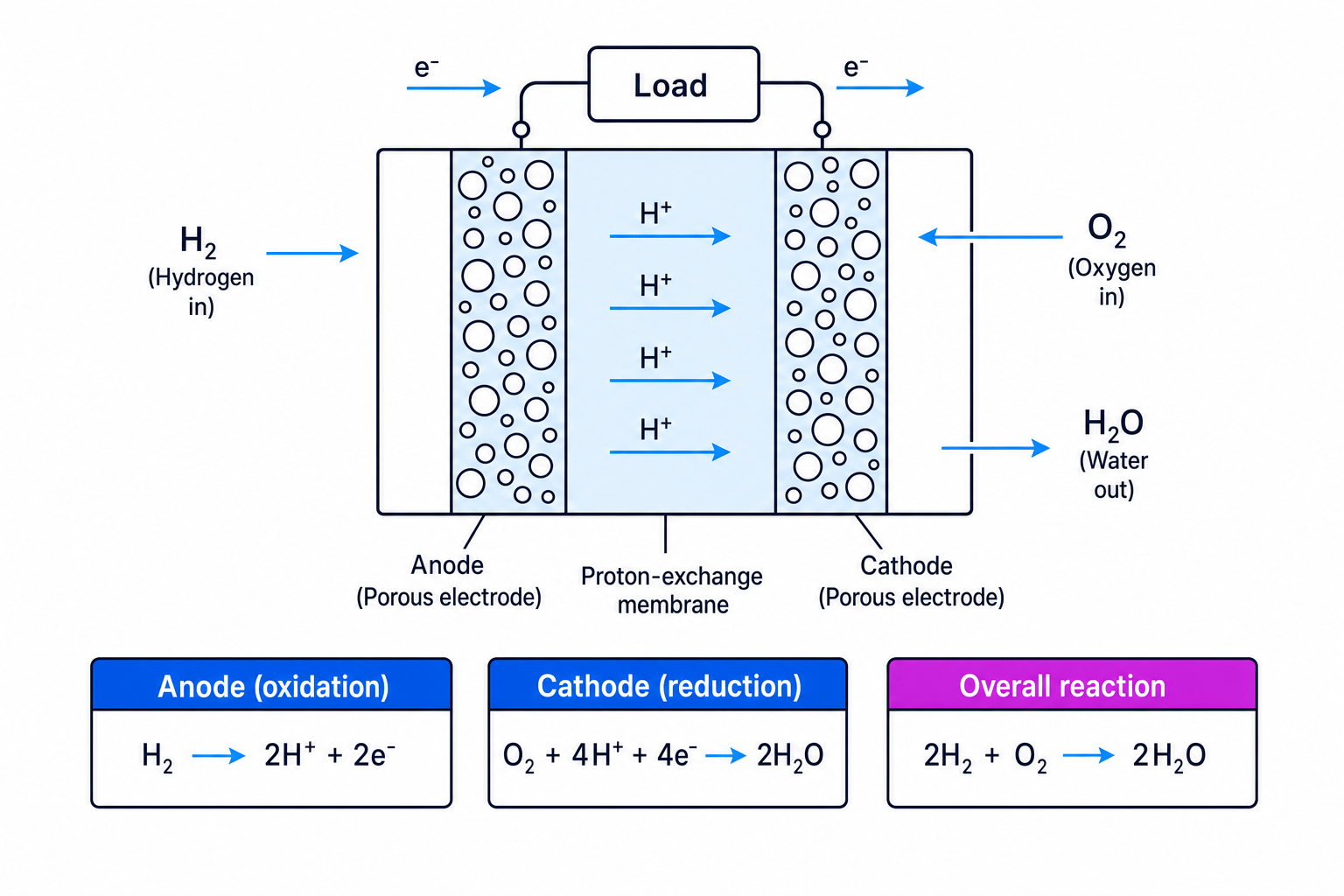
Benefits include high efficiency, water as the product at point of use, quiet operation, and continuous operation while fuel is supplied.
Drawbacks include the cost of catalysts such as platinum, difficulty storing hydrogen safely, lack of refuelling infrastructure, and the fact that hydrogen production may use fossil fuels unless renewable electricity is used.
In the exam
- For redox questions, explicitly state electron loss or gain, not just “oxidation number changes”.
- For EMF calculations, identify cathode and anode first, then use Ecell∘=Ecathode∘−Eanode∘E^\circ_{\text{cell}} = E^\circ_{\text{cathode}} - E^\circ_{\text{anode}}Ecell∘=Ecathode∘−Eanode∘.
- For practical questions, mention the salt bridge, high-resistance voltmeter, clean electrodes, concentrations, temperature, and sources of error.
Check yourself
- Why can a single half-cell potential not be measured on its own?
- What cell diagram would you write for a Zn/Zn2+ half-cell connected to an Fe3+/Fe2+ half-cell using platinum?
- Why might a reaction with a positive Ecell∘E^\circ_{\text{cell}}Ecell∘ not be observed immediately in the lab?
