

What you'll learn
- How to plan organic syntheses as sequences of reactions, not isolated facts.
- How to choose practical techniques for separation, purification and purity testing.
- How addition polymers, polyesters and polyamides are formed.
- How to combine chemical tests, high-resolution 1H^{1}\text{H}1H NMR and chromatography to identify unknowns.
1. Organic synthesis: building a route
Organic synthesis is the preparation of an organic compound from simpler starting materials. At A level, the key skill is recognising which functional group you have and which one you need.
Functional group
A functional group is the atom or group of atoms responsible for the characteristic reactions of an organic compound, such as –OH in alcohols, –COOH in carboxylic acids or –NH₂ in amines.
Synthetic sequence
A synthetic sequence is a planned series of reactions where the product of one step becomes the reactant for the next step.
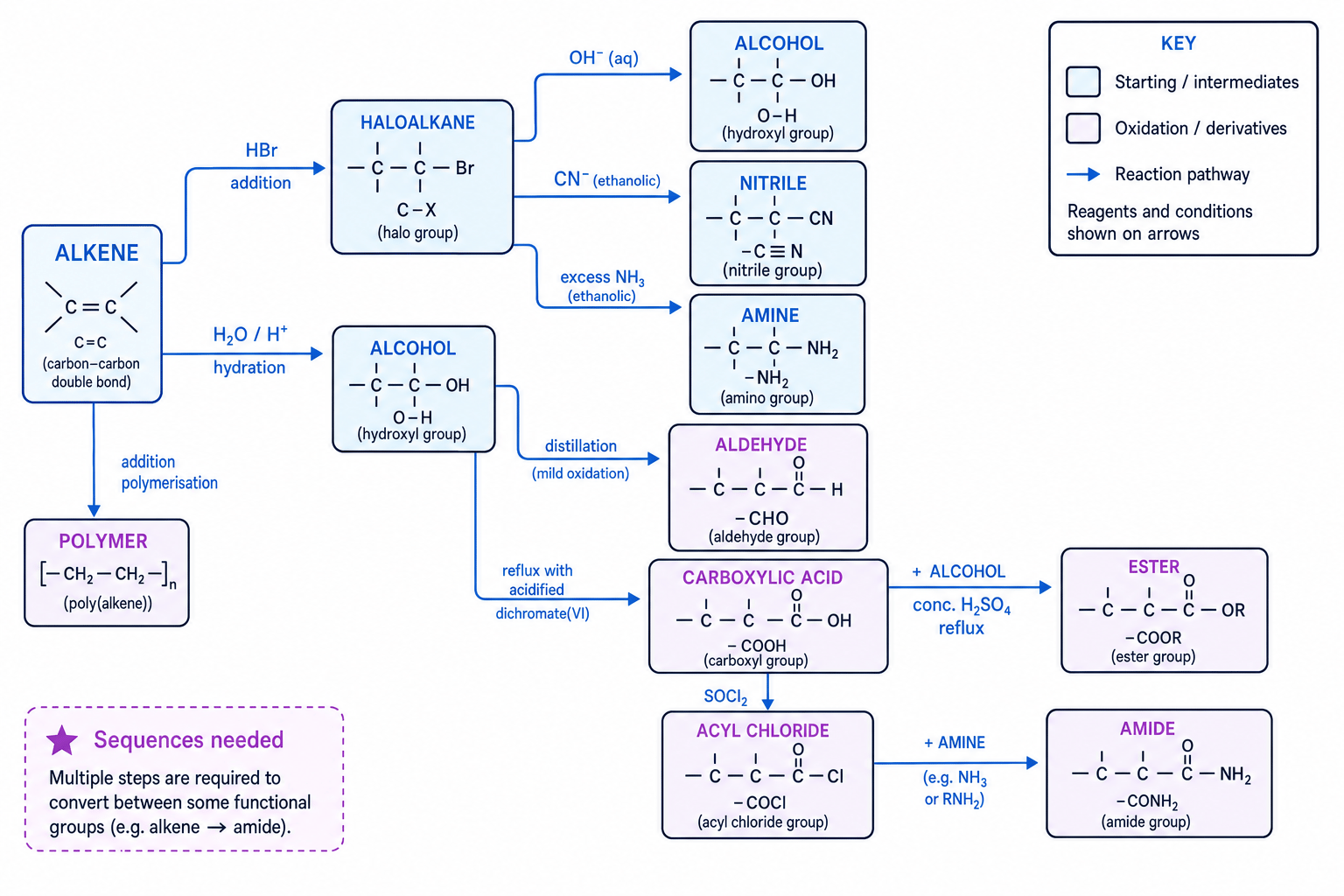
Useful reaction choices include:
- Haloalkane → alcohol: warm with aqueous OH⁻, usually under reflux.
- Haloalkane → nitrile: warm with ethanolic CN⁻; this extends the carbon chain by one carbon.
- Primary alcohol → aldehyde: acidified dichromate(VI), distil off the aldehyde.
- Primary alcohol → carboxylic acid: acidified dichromate(VI), reflux.
- Carboxylic acid + alcohol → ester: concentrated H₂SO₄ catalyst, reflux.
- Carboxylic acid → acyl chloride: SOCl₂.
- Acyl chloride + amine → amide: room temperature, often producing HCl.
Think backwards
A good synthesis often starts by working backwards from the target molecule: identify the target functional group, then choose a known reaction that makes it.
Planning a two-step ester synthesis
You need to make butyl ethanoate from 1-bromobutane.
- Compare the target with the starting material: butyl ethanoate contains a butyl group attached through oxygen, so you first need butan-1-ol from 1-bromobutane.
- Choose the first reaction: heat 1-bromobutane with aqueous OH⁻ under reflux to give butan-1-ol by nucleophilic substitution.
- Choose the second reaction: react butan-1-ol with ethanoic acid using concentrated H₂SO₄ and reflux to form butyl ethanoate and water.
- Write the overall route in order: 1-bromobutane → butan-1-ol → butyl ethanoate.
Curly-arrow thinking in synthesis
Curly arrow
A curly arrow shows the movement of a pair of electrons. It must start at a lone pair or bond and point to where the electron pair moves.
For example, in the reaction of bromoethane with cyanide ions:
CH₃CH₂Br + CN⁻ → CH₃CH₂CN + Br⁻
The mechanism is nucleophilic substitution. The cyanide ion attacks using the lone pair on the carbon atom of CN⁻. A curly arrow goes from that lone pair to the carbon bonded to bromine. At the same time, a curly arrow goes from the C–Br bond to Br, forming Br⁻.
Wrong end of cyanide
In A-level mechanisms, CN⁻ usually attacks through its carbon atom, giving a nitrile and increasing the carbon chain length by one.
2. Manipulation, separation and purification
Organic products are rarely obtained pure straight from the reaction mixture. You must be able to explain how to handle them.
Key practical techniques
- Reflux heats a reaction mixture without losing volatile reactants or products; vapour condenses and returns to the flask.
- Distillation separates liquids using different boiling temperatures.
- A separating funnel separates immiscible liquid layers, often an organic layer and an aqueous layer.
- A drying agent, such as anhydrous MgSO₄, removes traces of water from an organic liquid.
- Recrystallisation purifies a solid by dissolving it in minimum hot solvent, then allowing pure crystals to form on cooling.
- Melting temperature helps assess the purity of a solid.
For a liquid organic product, a typical method is: reflux the reaction mixture, transfer it to a separating funnel, wash with suitable aqueous solutions, run off the layers carefully, dry the organic layer, then distil the product.
For a solid organic product, a typical method is: collect the crude solid by filtration, recrystallise from a suitable solvent, filter the crystals under reduced pressure, wash with cold solvent, dry, then measure the melting temperature.
Separating funnel safety
Always vent a separating funnel regularly when shaking, especially if gas may be produced during washing.
Melting temperature and purity
A pure solid has a sharp melting range, usually within about 1–2 °C, close to the data-book value. Impurities usually make the melting range lower and broader because they disrupt the regular crystal lattice.
Judging purity from melting temperature
A compound has a literature melting temperature of 122 °C. Your product melts from 115 °C to 120 °C.
- Compare the sample range with the literature value: the sample starts melting well below 122 °C.
- Judge the sharpness: a 5 °C range is broad, not sharp.
- Conclude that the sample is impure and should be recrystallised again before relying on its identity or yield.
Two-step practicals
In a two-step synthesis, purify or at least isolate the intermediate before the second step. Impurities carried forward can reduce yield and complicate melting temperature or spectra.
3. Addition and condensation polymerisation
Polymer
A polymer is a large molecule made from many smaller molecules called monomers joined together.
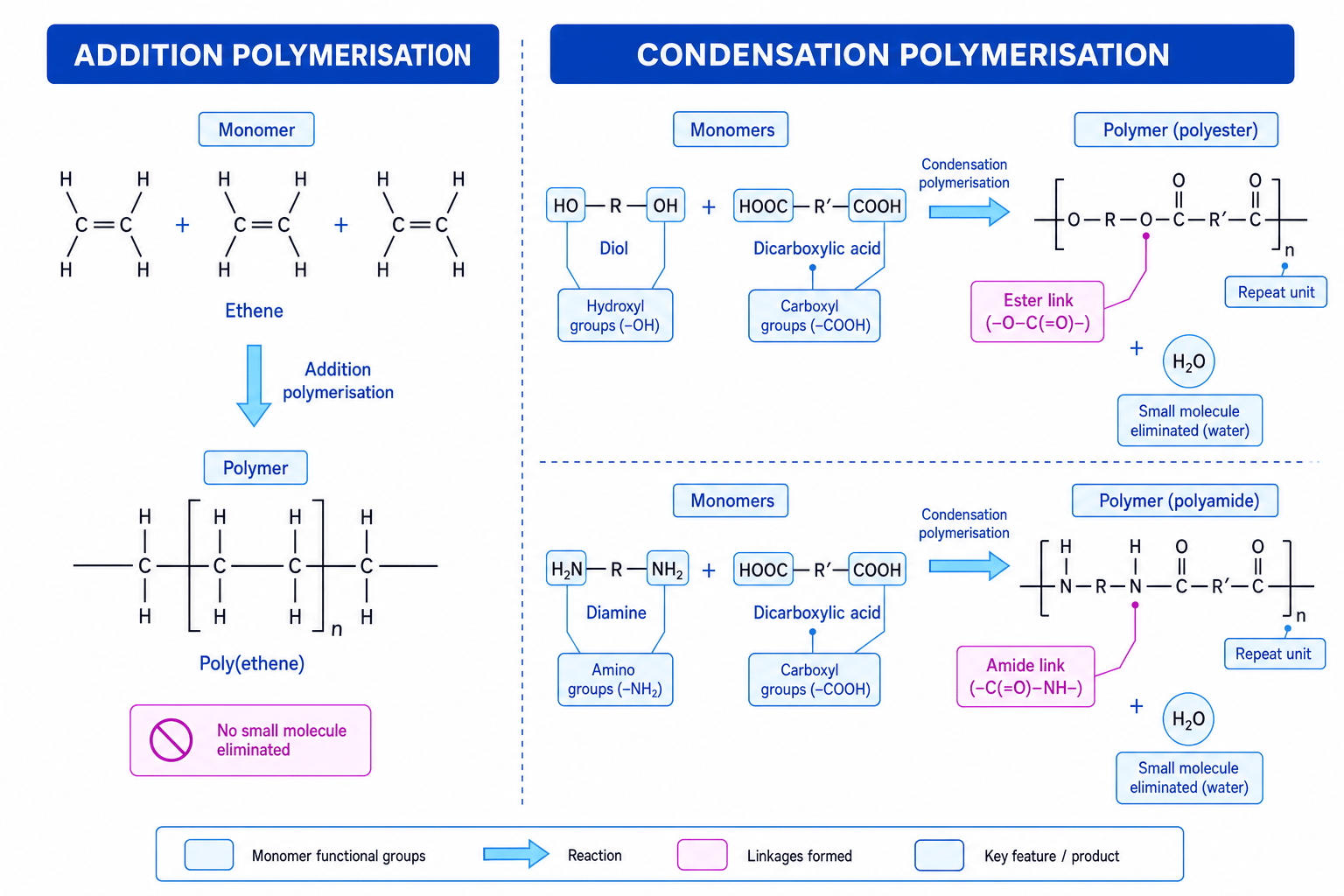
In addition polymerisation, monomers with C=C bonds join without losing any atoms. The double bond opens and forms a saturated polymer chain.
In condensation polymerisation, monomers join together while eliminating a small molecule, usually water or HCl.
Polyesters
A polyester contains ester links, –COO–. It can form from:
- a diol and a dicarboxylic acid, eliminating water
- a diol and a diacyl chloride, eliminating HCl
General idea:
HO–R–OH + HOOC–R′–COOH → polyester + water
Polyamides
A polyamide contains amide links, –CONH–. It can form from:
- a diamine and a dicarboxylic acid, eliminating water
- a diamine and a diacyl chloride, eliminating HCl
Nylon is an important example. Condensation polymers are industrially useful in fibres, packaging and engineering materials, but their persistence in the environment raises recycling and disposal issues.
Identifying the polymer type
A polymer is made from HOOC–(CH₂)₄–COOH and H₂N–(CH₂)₆–NH₂.
- Identify the functional groups: the first monomer is a dicarboxylic acid and the second is a diamine.
- Decide the link formed: –COOH and –NH₂ combine to form an amide link, –CONH–.
- State the polymer type: it is a condensation polymer, specifically a polyamide, with water eliminated.
4. Identifying unknown organic compounds
When identifying an unknown, do not rely on one test alone. Build evidence from chemical tests and spectra.
Planning chemical tests
A sensible test sequence uses small samples and separates possibilities logically:
- Bromine water decolourises with many alkenes.
- Sodium carbonate gives effervescence with carboxylic acids due to CO₂.
- 2,4-dinitrophenylhydrazine gives an orange precipitate with aldehydes and ketones.
- Tollens’ reagent or Fehling’s solution distinguishes aldehydes from ketones.
- Iodoform testing can identify CH₃CO– groups or CH₃CH(OH)– groups.
- Iron(III) chloride can give a coloured complex with phenols.
Use evidence together
A positive chemical test suggests a functional group, but spectra help confirm the whole structure.
High-resolution 1H^{1}\text{H}1H NMR
High-resolution proton NMR gives four main types of information:
- Chemical shift, measured in ppm, suggests the proton environment.
- Integration gives the relative number of protons in each environment.
- Splitting shows neighbouring equivalent protons, using the n+1n + 1n+1 rule.
- Number of peaks shows the number of different proton environments.
You should combine this with other data, such as IR absorptions, mass spectrometry molecular ion peaks, and carbon-13 NMR environments.

Using proton NMR to identify ethyl ethanoate
A compound has three proton environments with integrations 3H, 2H and 3H. The 2H signal is a quartet at about 4.1 ppm, one 3H signal is a triplet at about 1.2 ppm, and the other 3H signal is a singlet at about 2.0 ppm.
- Use the quartet and triplet together: a 2H quartet next to a 3H triplet suggests an ethyl group, –CH₂CH₃.
- Use the chemical shift of the quartet: about 4.1 ppm suggests –O–CH₂– rather than a simple alkyl CH₂.
- Use the singlet at about 2.0 ppm: a 3H singlet near a carbonyl suggests CH₃CO– with no neighbouring hydrogens across the carbonyl.
- Combine the fragments: CH₃COOCH₂CH₃ is ethyl ethanoate.
Splitting across the wrong atoms
In simple A-level NMR interpretation, do not count neighbouring protons through oxygen or across a carbonyl carbon for splitting.
5. Chromatography and mixture composition
Chromatography
Chromatography separates substances because they distribute differently between a stationary phase and a mobile phase.
In paper chromatography and TLC, the stationary phase is the paper or coated plate, and the mobile phase is the solvent. The RfR_fRf value is:
Rf=distance moved by spotdistance moved by solvent frontR_f = \frac{\text{distance moved by spot}}{\text{distance moved by solvent front}}Rf=distance moved by solvent frontdistance moved by spotIn two-way paper chromatography, the chromatogram is run in one solvent, dried, rotated by 90°, then run in a second solvent. This improves separation when spots overlap.
In GC and HPLC, each component has a retention time. Comparing retention times with standards helps identify compounds. Peak area is proportional to amount, so composition can be found using peak areas or calibration data.
Calculating an Rf value
A spot moves 3.6 cm from the baseline. The solvent front moves 6.0 cm.
- Substitute into the expression: Rf=3.66.0R_f = \frac{3.6}{6.0}Rf=6.03.6.
- Calculate the value: Rf=0.60R_f = 0.60Rf=0.60.
- Compare with standards run under the same conditions, because RfR_fRf values depend on the solvent, stationary phase and temperature.
In the exam
- For synthesis routes, state the reagent and conditions for every arrow, not just the product.
- For practical questions, link each technique to its purpose: separating layers, removing water, purifying crystals or checking purity.
- For structure determination, combine evidence: molecular formula, IR, NMR integration/splitting and chromatography should all agree.
Check yourself
- Why does a broad, low melting range suggest an impure solid?
- What monomers would you need to make a polyester rather than a polyamide?
- How do retention time and peak area give different information in GC or HPLC?

