What you'll learn
- How to turn a temperature change into heat energy using q=mcΔTq = mc\Delta Tq=mcΔT.
- How to calculate molar enthalpy changes from calorimetry experiments.
- How to estimate reaction enthalpies using mean bond enthalpies.
- How to spot the common sign, unit and “heat loss” traps in exam questions.
The big idea: energy changes in reactions
Chemical reactions involve energy changes because chemical bonds are broken and formed. At A-Level, we usually discuss these changes using enthalpy, a measure of heat energy content at constant pressure.
The system is the reacting chemicals. The surroundings are everything else, such as the solution, water, beaker, thermometer and air.
Enthalpy change
The enthalpy change, ΔH\Delta HΔH, is the heat energy change for a reaction at constant pressure. It is usually quoted in kJ mol⁻¹ for the reaction as written in the balanced equation.
A standard enthalpy change, written ΔH∘\Delta H^\circΔH∘, refers to substances in their standard states at 100 kPa and usually 298 K.
Exothermic and endothermic reactions
An exothermic reaction transfers heat energy from the system to the surroundings. The surroundings get warmer, and ΔH\Delta HΔH is negative.
An endothermic reaction absorbs heat energy from the surroundings. The surroundings get cooler, and ΔH\Delta HΔH is positive.
Temperature change and sign
If the solution or water warms up, the reaction has released heat, so the reaction enthalpy is negative. If the solution or water cools down, the reaction has absorbed heat, so the reaction enthalpy is positive.
Calorimetry: measuring heat transfers
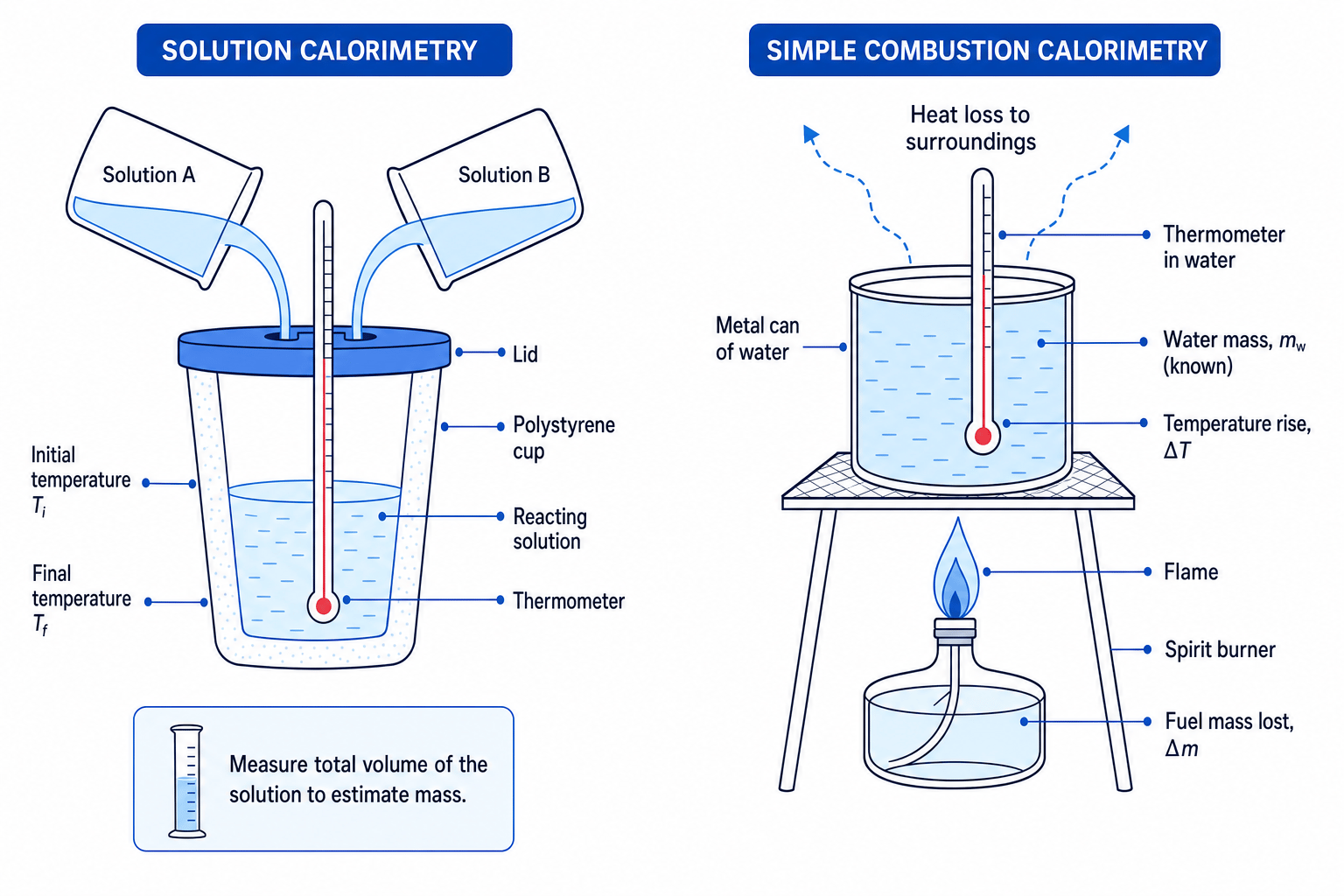
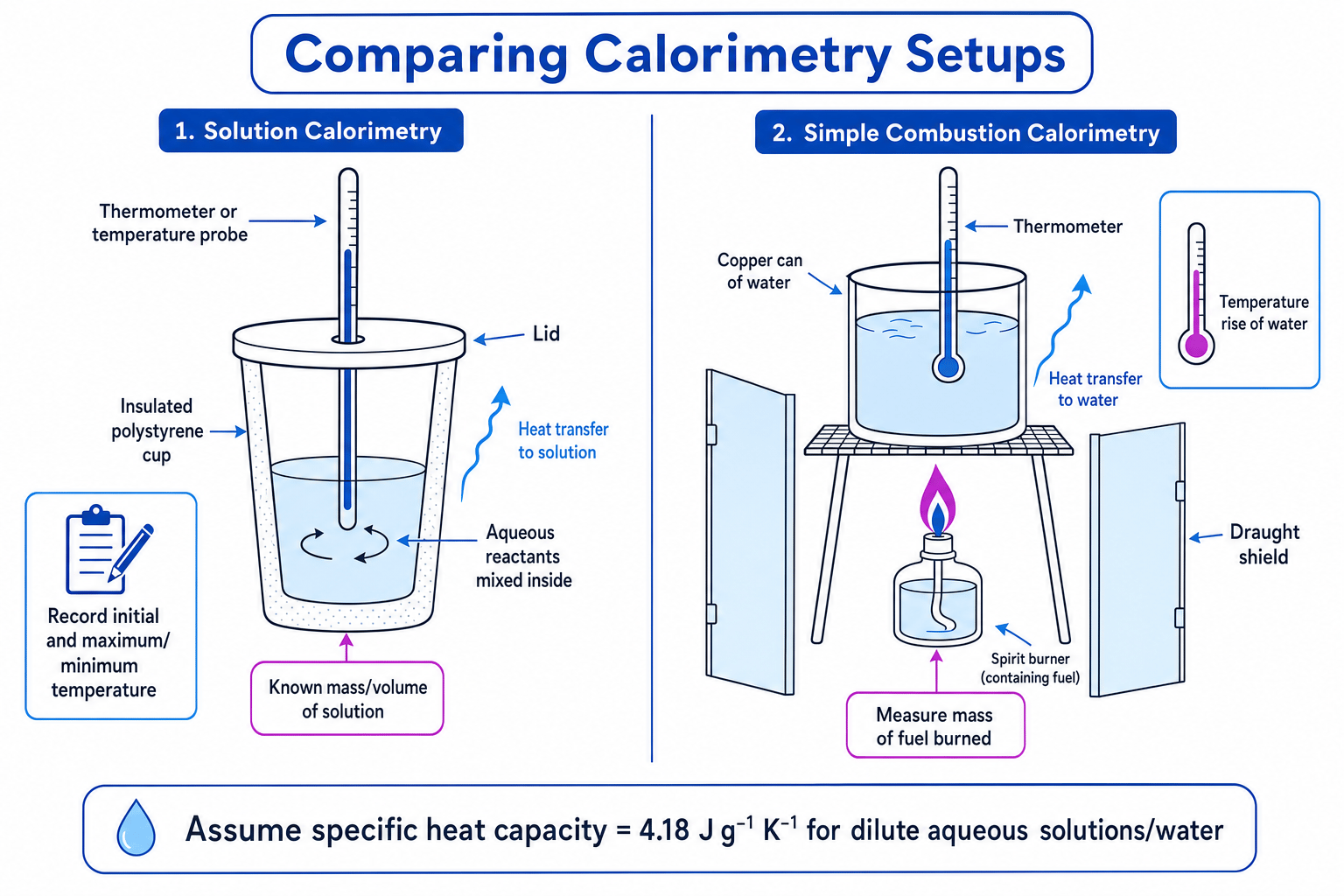
Calorimetry is the experimental measurement of heat energy changes. In this topic, you usually meet two simple types: solution calorimetry in an insulated cup, and combustion calorimetry using a burning fuel to heat water.
The diagram shows the two common setups and what you measure in each one.
The calorimetry equation
For the water or solution being heated or cooled:
q=mcΔTq = mc\Delta Tq=mcΔTwhere:
- qqq is the heat energy transferred, in J
- mmm is the mass of water or solution heated, in g
- ccc is the specific heat capacity, usually 4.18 J g−1K−14.18\ \text{J g}^{-1}\text{K}^{-1}4.18 J g−1K−1 for water or dilute aqueous solutions
- ΔT\Delta TΔT is the temperature change, in K
Specific heat capacity
The specific heat capacity of a substance is the energy needed to raise the temperature of 1 g of that substance by 1 K.
A temperature change of 6.5 °C has the same size as a temperature change of 6.5 K, so you can use the numerical temperature difference directly.
Solution calorimetry
In solution calorimetry, you mix reacting solutions in an insulated cup, measure the temperature change, then calculate the heat transferred to or from the solution.
For dilute aqueous solutions, you normally assume:
- density is 1.00 g cm⁻³, so 50.0 cm³ has a mass of 50.0 g
- specific heat capacity is 4.18 J g⁻¹ K⁻¹
- heat lost to the cup and air is negligible
To convert the heat change into a molar enthalpy change:
ΔH=−qsolutionn\Delta H = \frac{-q_{\text{solution}}}{n}ΔH=n−qsolutionUse qqq in kJ and nnn in mol.
Calculating an enthalpy change from a temperature rise
25.0 cm³ of 1.00 mol dm⁻³ hydrochloric acid is mixed with 25.0 cm³ of 1.00 mol dm⁻³ sodium hydroxide. The temperature rises from 20.5 °C to 27.2 °C. Calculate the enthalpy change for:
HCl(aq)+NaOH(aq)→NaCl(aq)+H2O(l)\text{HCl(aq)} + \text{NaOH(aq)} \to \text{NaCl(aq)} + \text{H}_2\text{O(l)}HCl(aq)+NaOH(aq)→NaCl(aq)+H2O(l)
-
Find the mass and temperature change of the solution. The total volume is 50.0 cm³, so the mass is assumed to be 50.0 g. The temperature change is ΔT=27.2−20.5=6.7 K\Delta T = 27.2 - 20.5 = 6.7\ \text{K}ΔT=27.2−20.5=6.7 K.
-
Calculate the heat gained by the solution.
qsolution=50.0×4.18×6.7=1400.3 J=1.40 kJq_{\text{solution}} = 50.0 \times 4.18 \times 6.7 = 1400.3\ \text{J} = 1.40\ \text{kJ}qsolution=50.0×4.18×6.7=1400.3 J=1.40 kJ -
Find the reacting amount. For the acid, n=cV=1.00×0.0250=0.0250 moln = cV = 1.00 \times 0.0250 = 0.0250\ \text{mol}n=cV=1.00×0.0250=0.0250 mol. The alkali has the same amount, so 0.0250 mol of water forms.
-
Apply the sign convention. The solution warmed up, so the reaction released heat:
ΔH=−1.400.0250=−56.0 kJ mol−1\Delta H = \frac{-1.40}{0.0250} = -56.0\ \text{kJ mol}^{-1}ΔH=0.0250−1.40=−56.0 kJ mol−1
Using cm³ in n = cV
When using n=cVn = cVn=cV, volume must be in dm³. So 25.0 cm³ is 0.0250 dm³, not 25.0 dm³.
Improving temperature data
For more accurate calorimetry, record temperature at regular time intervals before and after mixing. A cooling-curve extrapolation can estimate the temperature change at the instant of mixing, reducing the effect of heat loss.
Combustion calorimetry
In simple combustion calorimetry, a fuel burns and heats a known mass of water. You measure the temperature rise of the water and the mass of fuel burned.
The calculation follows the same pattern:
- Use q=mcΔTq = mc\Delta Tq=mcΔT for the water.
- Use n=mMn = \frac{m}{M}n=Mm for the fuel burned.
- Calculate ΔHc=−qn\Delta H_c = \frac{-q}{n}ΔHc=n−q.
The symbol ΔHc\Delta H_cΔHc means enthalpy change of combustion: the enthalpy change when 1 mol of a substance burns completely in oxygen under stated conditions.
Calculating an enthalpy change of combustion
A spirit burner containing ethanol is used to heat 200.0 g of water. The temperature of the water rises from 18.4 °C to 46.8 °C. The burner loses 0.920 g of ethanol. Calculate the experimental enthalpy change of combustion of ethanol. Use Methanol=46.0 g mol−1M_{\text{ethanol}} = 46.0\ \text{g mol}^{-1}Methanol=46.0 g mol−1.
-
Calculate the heat gained by the water. The temperature rise is ΔT=46.8−18.4=28.4 K\Delta T = 46.8 - 18.4 = 28.4\ \text{K}ΔT=46.8−18.4=28.4 K.
q=200.0×4.18×28.4=23742.4 J=23.7 kJq = 200.0 \times 4.18 \times 28.4 = 23742.4\ \text{J} = 23.7\ \text{kJ}q=200.0×4.18×28.4=23742.4 J=23.7 kJ -
Calculate the amount of ethanol burned.
n=0.92046.0=0.0200 moln = \frac{0.920}{46.0} = 0.0200\ \text{mol}n=46.00.920=0.0200 mol -
Calculate the molar enthalpy change. The water warmed, so combustion released heat.
ΔHc=−23.70.0200=−1190 kJ mol−1\Delta H_c = \frac{-23.7}{0.0200} = -1190\ \text{kJ mol}^{-1}ΔHc=0.0200−23.7=−1190 kJ mol−1
Assuming all the heat reaches the water
Simple combustion calorimetry often gives a value that is less exothermic than the data book value because heat is lost to the air, the can and the surroundings. Incomplete combustion and fuel evaporation can also affect the result.
Bond enthalpies
A covalent reaction can be imagined in two stages:
- Break bonds in the reactants.
- Form bonds in the products.
Breaking bonds always requires energy. Forming bonds always releases energy.
Mean bond enthalpy
A mean bond enthalpy is the average enthalpy change needed to break 1 mol of a particular covalent bond in gaseous molecules, averaged over a range of compounds.
Because mean bond enthalpies are averages, calculations using them give estimates rather than exact experimental enthalpy changes.
The diagram shows the energy logic behind bond enthalpy calculations.
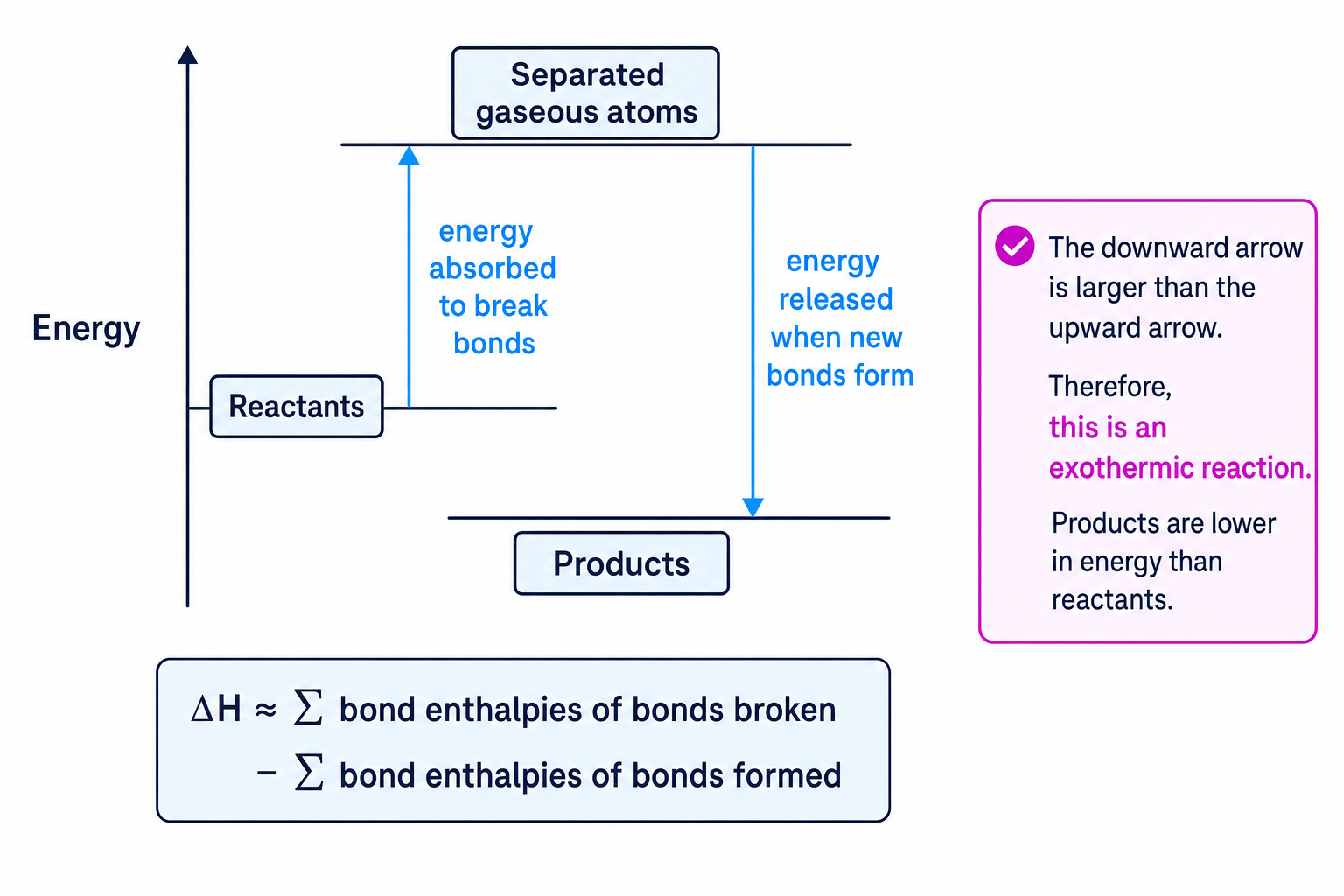
The key formula is:
ΔH≈∑E(bonds broken)−∑E(bonds formed)\Delta H \approx \sum E(\text{bonds broken}) - \sum E(\text{bonds formed})ΔH≈∑E(bonds broken)−∑E(bonds formed)Broken minus formed
Bond breaking is endothermic, so it is counted as positive. Bond forming is exothermic, so it is subtracted.
Estimating enthalpy change using bond enthalpies
Estimate the enthalpy change for methane combustion:
CH4(g)+2O2(g)→CO2(g)+2H2O(g)\text{CH}_4\text{(g)} + 2\text{O}_2\text{(g)} \to \text{CO}_2\text{(g)} + 2\text{H}_2\text{O(g)}CH4(g)+2O2(g)→CO2(g)+2H2O(g)
Use mean bond enthalpies: C-H 413, O=O 498, C=O in CO₂ 805, O-H 464 kJ mol⁻¹.
-
Count the bonds broken in the reactants. One methane molecule contains 4 C-H bonds. Two oxygen molecules contain 2 O=O bonds.
-
Count the bonds formed in the products. One carbon dioxide molecule contains 2 C=O bonds. Two water molecules contain 4 O-H bonds.
-
Substitute into broken minus formed.
Ebroken=(4×413)+(2×498)=2648 kJ mol−1Eformed=(2×805)+(4×464)=3466 kJ mol−1ΔH≈2648−3466=−818 kJ mol−1\begin{aligned} E_{\text{broken}} &= (4 \times 413) + (2 \times 498) = 2648\ \text{kJ mol}^{-1}\\ E_{\text{formed}} &= (2 \times 805) + (4 \times 464) = 3466\ \text{kJ mol}^{-1}\\ \Delta H &\approx 2648 - 3466 = -818\ \text{kJ mol}^{-1} \end{aligned}EbrokenEformedΔH=(4×413)+(2×498)=2648 kJ mol−1=(2×805)+(4×464)=3466 kJ mol−1≈2648−3466=−818 kJ mol−1 -
Interpret the sign. The estimate is negative, so the reaction is exothermic.
Using bond enthalpies with liquids or aqueous substances
Mean bond enthalpies apply to gaseous molecules. If the real reaction involves liquids, solids or aqueous ions, the calculation ignores extra energy changes such as vaporisation, condensation or hydration, so the answer is only an approximation.
Why calorimetry and bond enthalpies can give different values
Calorimetry measures a real experiment, but it suffers from practical errors such as heat loss, apparatus heating, incomplete combustion and uncertainty in temperature readings.
Bond enthalpy calculations use averaged gas-phase bond data, so they are theoretical estimates. They are useful for predicting whether a reaction is likely to be exothermic or endothermic, but they are not usually as accurate as carefully measured enthalpy data.
In the exam
- Identify what is being heated or cooled before using q=mcΔTq = mc\Delta Tq=mcΔT: usually the solution or water, not the reaction itself.
- Convert carefully: cm³ to dm³ for n=cVn = cVn=cV, J to kJ before calculating kJ mol⁻¹, and use the limiting reagent if amounts are not equal.
- For bond enthalpies, draw or imagine the structures, count every bond, then use bonds broken minus bonds formed.
Check yourself
- Why does a temperature rise in the solution usually mean the reaction has a negative ΔH\Delta HΔH?
- In a neutralisation calorimetry experiment, why is the total solution volume used to estimate the mass?
- Why are mean bond enthalpy calculations only approximate?