What you'll learn
- How to name and classify halogenoalkanes.
- Why the carbon–halogen bond makes them reactive.
- How to predict products of substitution and elimination reactions.
- How to compare hydrolysis rates and explain ozone depletion by CFCs.
What is a halogenoalkane?
A halogenoalkane is an alkane in which at least one hydrogen atom has been replaced by a halogen atom: fluorine, chlorine, bromine or iodine. The halogen is often written as X, so a simple monohalogenoalkane has the general formula CnH2n+1X\mathrm{C_nH_{2n+1}X}CnH2n+1X.
Halogenoalkane
A halogenoalkane is a saturated organic compound containing at least one carbon–halogen bond, such as C–Cl, C–Br or C–I.
Common examples are chloromethane, CH₃Cl, bromoethane, CH₃CH₂Br, and 2-iodopropane, CH₃CHICH₃.
Primary, secondary and tertiary halogenoalkanes
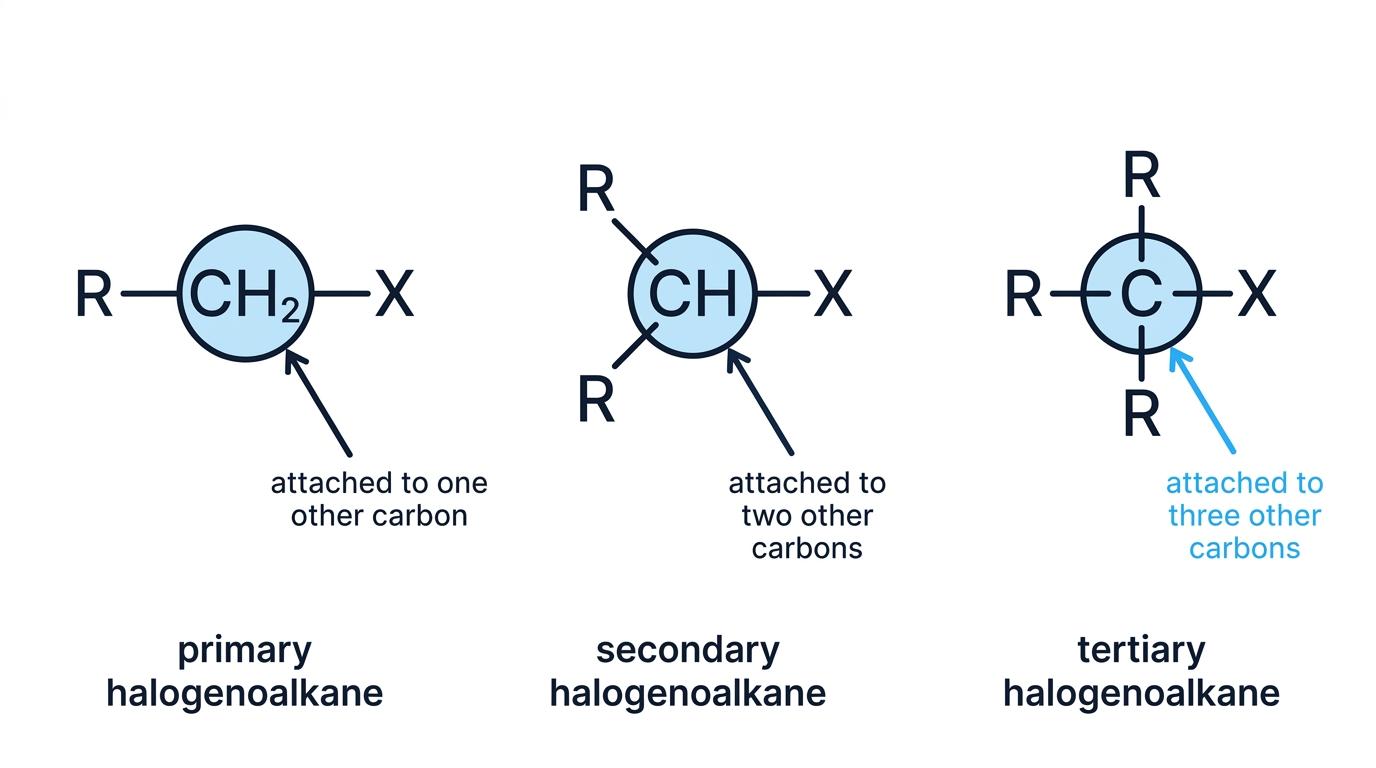
Halogenoalkanes are classified by looking at the carbon atom directly bonded to the halogen.
- Primary: that carbon is bonded to one other carbon atom, or none in CH₃X.
- Secondary: that carbon is bonded to two other carbon atoms.
- Tertiary: that carbon is bonded to three other carbon atoms.
Naming and classifying a halogenoalkane
Name and classify CH₃CHBrCH₂CH₃.
- The longest carbon chain has four carbon atoms, so the parent alkane is butane.
- Number the chain so the bromine atom gets the lowest possible locant: bromine is on carbon 2, not carbon 3.
- The name is 2-bromobutane. The carbon bonded to Br is attached to two other carbon atoms, so it is a secondary halogenoalkane.
Classifying the wrong carbon
Do not classify a halogenoalkane by the number of halogen atoms. “Secondary” means the carbon attached to the halogen is bonded to two other carbons.
Why halogenoalkanes react
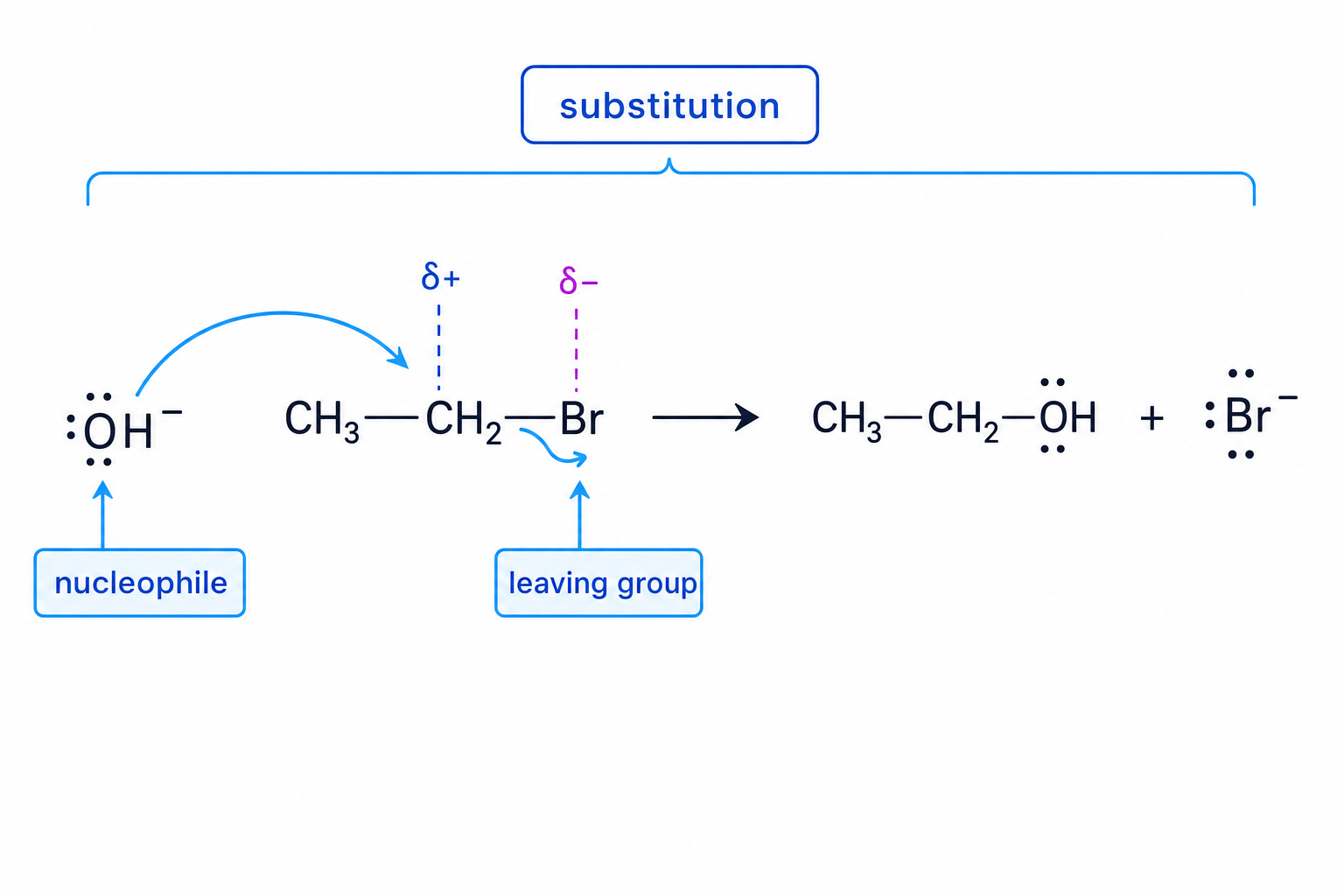
Halogens are more electronegative than carbon, so the carbon–halogen bond is polar. The halogen is δ− and the carbon bonded to it is δ+.
That δ+ carbon can be attacked by a nucleophile.
Nucleophile
A nucleophile is an electron-pair donor. It is attracted to electron-deficient, δ+ or positively charged atoms.
Common nucleophiles in this topic include OH⁻, CN⁻ and NH₃. The halogen atom leaves as a halide ion, X⁻, so it is called the leaving group.
The curly arrow in a mechanism shows the movement of an electron pair. It must start from a lone pair or a bond, not from an atom label or a charge.
The reactive bond
Halogenoalkanes react because the C–X bond is polar. Nucleophiles attack the δ+ carbon, and the halogen leaves as X⁻.
Nucleophilic substitution
In nucleophilic substitution, a nucleophile replaces the halogen atom. “Substitution” means one group is swapped for another.
Making alcohols
A halogenoalkane reacts with aqueous hydroxide ions to form an alcohol.
General reaction:
R–X + OH⁻ → R–OH + X⁻
Typical conditions:
- Aqueous potassium hydroxide, KOH(aq), or sodium hydroxide, NaOH(aq)
- Warmed, often under reflux
Reflux means heating a reaction mixture while vapours condense and return to the flask, so volatile reactants are not lost.
For example:
CH₃CH₂Br + OH⁻ → CH₃CH₂OH + Br⁻
Making nitriles
Halogenoalkanes react with cyanide ions, CN⁻, to form nitriles.
Typical conditions:
- Potassium cyanide, KCN
- Ethanol as solvent
- Heat under reflux
For example:
CH₃CH₂Br + CN⁻ → CH₃CH₂CN + Br⁻
This is useful because it increases the carbon chain length by one carbon atom.
Nitrile
A nitrile is an organic compound containing the –C≡N functional group. The carbon of the –C≡N group counts as part of the main carbon chain when naming.
Predicting a substitution product
Predict the product when 1-bromopropane reacts with ethanolic KCN under reflux.
- The reagent KCN provides CN⁻, so this is nucleophilic substitution: Br is replaced by CN.
- Starting compound: CH₃CH₂CH₂Br. Replacing Br gives CH₃CH₂CH₂CN.
- The nitrile carbon is included in the chain, so the product has four carbon atoms and is named butanenitrile.
Forgetting the extra carbon in nitriles
CH₃CH₂CH₂CN is butanenitrile, not propanenitrile, because the carbon in the –C≡N group is counted in the parent chain.
Making amines
Halogenoalkanes react with ammonia, NH₃, to form amines.
Typical conditions:
- Excess ammonia in ethanol
- Heat, often in a sealed tube
Overall:
R–X + 2NH₃ → R–NH₂ + NH₄X
For example:
CH₃CH₂Br + 2NH₃ → CH₃CH₂NH₂ + NH₄Br
Excess ammonia helps favour the primary amine rather than further substitution products.
Elimination: making alkenes
Halogenoalkanes can also undergo elimination. In elimination, a small molecule is removed from an organic molecule, and a double bond forms.
With halogenoalkanes, hydrogen halide, HX, is removed. The hydroxide ion acts as a base, meaning it accepts a proton, H⁺.
Typical conditions:
- Ethanolic KOH or ethanolic NaOH
- Heat
- Often concentrated alkali
For example:
CH₃CHBrCH₃ + OH⁻ → CH₃CH=CH₂ + H₂O + Br⁻
The H removed must come from a carbon atom next to the carbon bonded to the halogen. This neighbouring hydrogen is often called a β-hydrogen.
Choosing substitution or elimination
2-bromopropane is heated with ethanolic potassium hydroxide. Predict the organic product.
- Ethanolic KOH with heat favours elimination, not substitution.
- Br leaves from the middle carbon, while OH⁻ removes a hydrogen from a neighbouring carbon.
- A C=C bond forms between those two carbon atoms, so the product is propene, CH₃CH=CH₂.
Conditions decide the pathway
Aqueous hydroxide usually gives substitution to form an alcohol. Hot ethanolic hydroxide favours elimination to form an alkene.
Hydrolysis and comparing C–X bond strength
Hydrolysis means reaction with water, or with aqueous hydroxide, which breaks a bond and introduces an –OH group. Halogenoalkanes hydrolyse to form alcohols.
The rate of hydrolysis depends strongly on the strength of the carbon–halogen bond.
Bond strength decreases down Group 7:
C–Cl stronger than C–Br stronger than C–I
So the hydrolysis rate increases:
chloroalkane slowest, then bromoalkane, then iodoalkane fastest.
Bond strength controls hydrolysis rate
Iodoalkanes hydrolyse fastest because the C–I bond is weakest. Fluoroalkanes are very unreactive because the C–F bond is very strong.
Testing hydrolysis rates with silver nitrate
A common practical compares how quickly different halogenoalkanes produce a silver halide precipitate.
The halogenoalkane is usually mixed with ethanol, water and silver nitrate solution. Ethanol helps dissolve the organic halogenoalkane. As hydrolysis produces halide ions, they react with silver ions:
Ag⁺ + X⁻ → AgX(s)
Observations:
- Cl⁻ forms white AgCl
- Br⁻ forms cream AgBr
- I⁻ forms yellow AgI
To make the comparison fair, use the same temperature, same volumes, same concentrations and similar halogenoalkane structures. A water bath gives better temperature control than direct heating.
Explaining hydrolysis rate order
Three test tubes contain 1-chlorobutane, 1-bromobutane and 1-iodobutane under identical hydrolysis conditions. Predict the order in which precipitates appear.
- Hydrolysis requires the C–X bond to break, so a weaker C–X bond gives a faster reaction.
- Down Group 7, the carbon–halogen bond gets longer and weaker: C–Cl is stronger than C–Br, which is stronger than C–I.
- The yellow AgI precipitate appears first, then cream AgBr, then white AgCl last.
Polarity is not the main trend here
The C–F bond is very polar, but fluoroalkanes react very slowly because the C–F bond is extremely strong. For hydrolysis rates, bond enthalpy dominates.
Environmental issue: CFCs and ozone depletion
Some halogenoalkanes are chlorofluorocarbons, or CFCs. These contain carbon, chlorine and fluorine, for example CCl₂F₂.
CFCs were useful because they are unreactive, non-flammable and volatile, so they were used as refrigerants and aerosol propellants. The problem is that they are stable enough to reach the stratosphere.
High-energy ultraviolet radiation causes homolytic fission of a C–Cl bond. Homolytic fission means each atom takes one electron from the bond, forming radicals.
Radical
A radical is a species with an unpaired electron, shown using a dot, such as Cl•.
Example initiation step:
CCl₂F₂ → CClF₂• + Cl•
The chlorine radical then catalyses ozone decomposition:
Cl• + O₃ → ClO• + O₂
ClO• + O → Cl• + O₂
Finding the overall ozone reaction
Use the two propagation steps above to find the overall reaction.
- Add the reactants from both steps: Cl• + O₃ + ClO• + O.
- Add the products from both steps: ClO• + O₂ + Cl• + O₂.
- Cancel Cl• and ClO• because they appear on both sides. The overall reaction is O₃ + O → 2O₂.
Because Cl• is regenerated, one chlorine radical can destroy many ozone molecules.
In the exam
- For mechanisms, draw curly arrows from a lone pair or bond: nucleophile to δ+ carbon, and C–X bond to the halogen.
- Always state conditions: aqueous hydroxide for alcohols, ethanolic KCN for nitriles, excess ethanolic NH₃ for amines, hot ethanolic KOH for alkenes.
- When comparing hydrolysis rates, explain using C–X bond strength, not just bond polarity.
Check yourself
- Why is the carbon atom in a C–Br bond attacked by nucleophiles?
- What product forms when CH₃CH₂CH₂Br reacts with ethanolic KCN?
- Why does 1-iodobutane hydrolyse faster than 1-chlorobutane?