

What you'll learn
- How to accurately define ionic bonding at A-Level.
- How to predict the charge of simple ions using the Periodic Table.
- The chemical formulas of five essential compound ions.
- How to systematically construct formulas for ionic compounds.
What is ionic bonding?
When metals react with non-metals, electrons are transferred. The metal atoms lose electrons to become positive ions (cations), and the non-metal atoms gain electrons to become negative ions (anions).
Because these newly formed ions have opposite electrical charges, they attract one another strongly.
Ionic bonding
Ionic bonding is the electrostatic attraction between oppositely charged ions in a lattice.
Notice the phrase "in a lattice". Unlike simple molecules (like water or carbon dioxide) that exist as distinct, isolated units, ionic compounds form vast, highly regular 3D structures. In this giant ionic lattice, every single positive ion is surrounded by negative ions, and every negative ion is surrounded by positive ions.
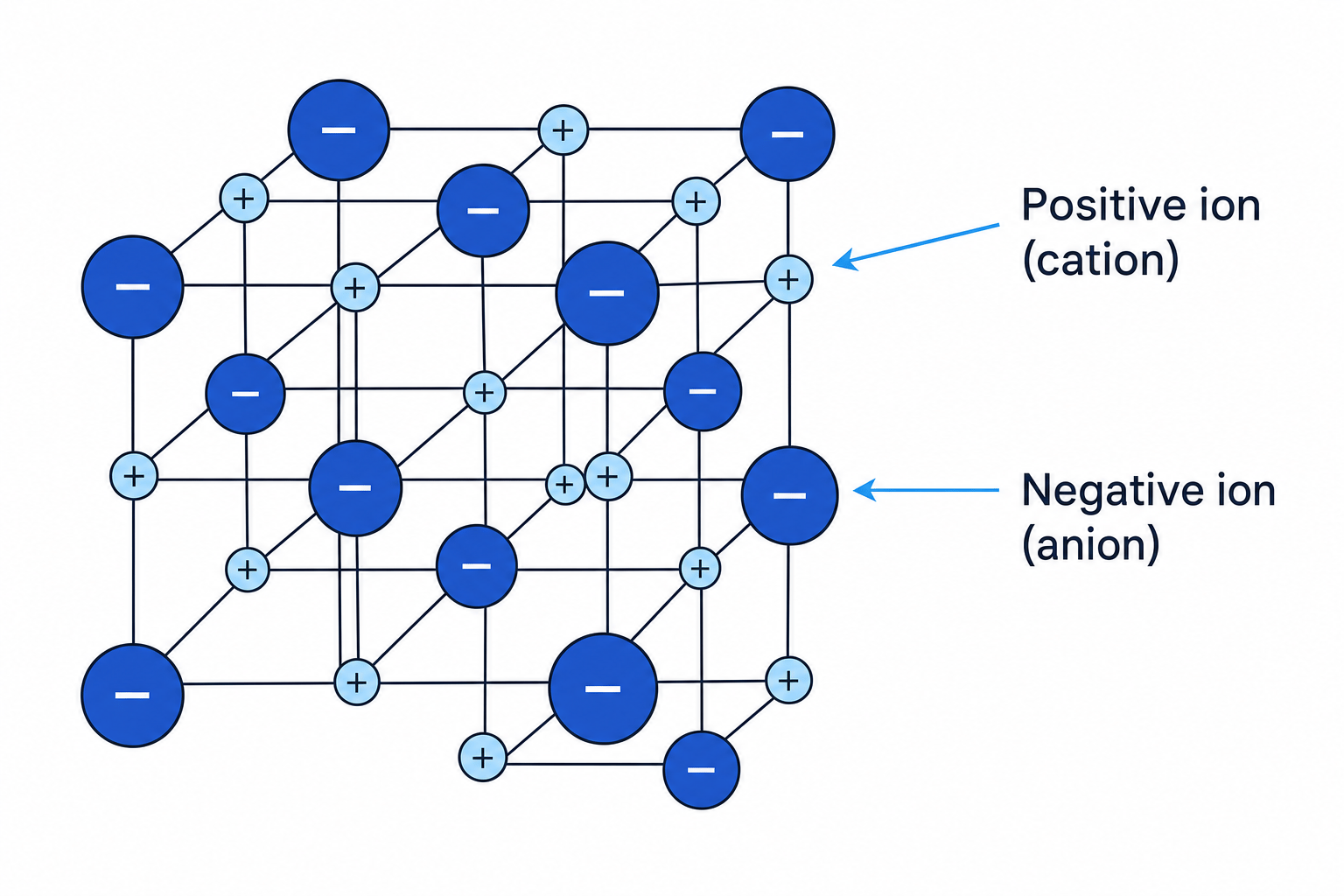
This mutual attraction acts in all directions throughout the crystal, making the ionic bond incredibly strong and requiring a lot of energy to overcome.
Predicting the charge on simple ions
To write the formula of an ionic compound, you first need to know the charges of the ions involved. For simple, monatomic ions (ions made of just one atom), you can predict the charge simply by looking at the element's position in the Periodic Table.
Elements form ions by gaining or losing electrons to achieve a full outer energy level (often a stable "octet"). The Group number tells you how many electrons are in the outer shell.
- Group 1 elements (like Li\text{Li}Li, Na\text{Na}Na, K\text{K}K) have one outer electron. They lose it to form +1+1+1 ions (e.g., Na+\text{Na}^+Na+).
- Group 2 elements (like Mg\text{Mg}Mg, Ca\text{Ca}Ca) have two outer electrons. They lose both to form +2+2+2 ions (e.g., Mg2+\text{Mg}^{2+}Mg2+).
- Group 3 metals (like Al\text{Al}Al) have three outer electrons. They lose them to form +3+3+3 ions (e.g., Al3+\text{Al}^{3+}Al3+).
- Group 5 non-metals (like N\text{N}N, P\text{P}P) have five outer electrons. They need three more to complete their shell, so they gain three electrons to form −3-3−3 ions (e.g., N3−\text{N}^{3-}N3−).
- Group 6 non-metals (like O\text{O}O, S\text{S}S) have six outer electrons. They gain two to form −2-2−2 ions (e.g., O2−\text{O}^{2-}O2−).
- Group 7 non-metals (like F\text{F}F, Cl\text{Cl}Cl, Br\text{Br}Br) have seven outer electrons. They gain one to form −1-1−1 ions (e.g., Cl−\text{Cl}^-Cl−).
Missing the sign
Always include the sign of the charge. Writing that an oxygen ion is 222 is incorrect; it is 2−2-2−. The standard convention is to write the number before the sign as a superscript, e.g. O2−\text{O}^{2-}O2−, rather than O−2\text{O}^{-2}O−2.
Transition metals (the block between Groups 2 and 3) don't follow these simple rules because they can form stable ions with different charges. For example, iron can form Fe2+\text{Fe}^{2+}Fe2+ or Fe3+\text{Fe}^{3+}Fe3+. In these cases, the charge is usually given to you in Roman numerals in the name (e.g. Iron(III) chloride contains Fe3+\text{Fe}^{3+}Fe3+).
Compound ions
Some ions are made up of groups of covalently bonded atoms that have an overall electrical charge. These are called compound ions (or polyatomic ions).
There are five specific compound ions that you must memorise for your A-Level. You need to know their names, their chemical formulas, and their exact charges:
- Sulfate: SO42−\text{SO}_4^{2-}SO42−
- Hydroxide: OH−\text{OH}^-OH−
- Nitrate: NO3−\text{NO}_3^-NO3−
- Carbonate: CO32−\text{CO}_3^{2-}CO32−
- Ammonium: NH4+\text{NH}_4^+NH4+
Memorise these five
You will not be given the formulas of sulfate, hydroxide, nitrate, carbonate, or ammonium in the exam. Commit them to memory immediately, as they appear constantly in calculations, equations, and titrations.
Constructing formulas for ionic compounds
Any solid ionic compound is electrically neutral. This means that the total positive charge from the cations must perfectly cancel out the total negative charge from the anions.
To deduce the formula of an ionic compound, you need to find the correct ratio of positive to negative ions that results in a net charge of zero.
Constructing an ionic formula
Determine the chemical formula for aluminium sulfate.
- Identify the constituent ions and their individual charges. Aluminium is in Group 3, so it forms Al3+\text{Al}^{3+}Al3+. Sulfate is a compound ion you have memorised: SO42−\text{SO}_4^{2-}SO42−.
- Determine the lowest common multiple (LCM) of the numerical charge values (333 and 222) to balance the total charge. The LCM of 333 and 222 is 666.
- Calculate how many of each ion are needed to reach the LCM. To get a +6+6+6 charge, we need two Al3+\text{Al}^{3+}Al3+ ions (2×3=62 \times 3 = 62×3=6). To get a −6-6−6 charge, we need three SO42−\text{SO}_4^{2-}SO42− ions (3×2=63 \times 2 = 63×2=6).
- Combine into the final formula. Because we need multiple compound ions, place brackets around the SO4\text{SO}_4SO4 before adding the subscript 333. The final formula is Al2(SO4)3\text{Al}_2(\text{SO}_4)_3Al2(SO4)3.
The cross-over method
A quick shortcut for step 2 and 3 is the "cross-over" method. Take the numerical value of the cation's charge and make it the subscript of the anion. Take the anion's charge and make it the subscript of the cation. For Al3+\text{Al}^{3+}Al3+ and SO42−\text{SO}_4^{2-}SO42−, the 333 goes to the sulfate and the 222 goes to the aluminium, directly giving Al2(SO4)3\text{Al}_2(\text{SO}_4)_3Al2(SO4)3. Always simplify the ratio if possible (e.g. Mg2+\text{Mg}^{2+}Mg2+ and O2−\text{O}^{2-}O2− becomes MgO\text{MgO}MgO, not Mg2O2\text{Mg}_2\text{O}_2Mg2O2).
When to use brackets
Only use brackets around compound ions, and only when there is more than one of them in the formula. For sodium hydroxide, the formula is NaOH\text{NaOH}NaOH (no brackets needed since there is only one hydroxide). For magnesium hydroxide, you need two hydroxides to balance the Mg2+\text{Mg}^{2+}Mg2+, so the formula is Mg(OH)2\text{Mg}(\text{OH})_2Mg(OH)2. Writing MgOH2\text{MgOH}_2MgOH2 is wrong, as it implies one oxygen and two hydrogens.
In the exam
- If asked to define ionic bonding, do not just write "the transfer of electrons". The exact marking point you need is "electrostatic attraction between oppositely charged ions".
- Never include charges in your final chemical formula. Na+Cl−\text{Na}^+\text{Cl}^-Na+Cl− will lose you marks. The correct answer is simply NaCl\text{NaCl}NaCl.
- When interpreting a name, watch out for the endings -ide and -ate. An -ide ending usually means a simple monatomic ion (e.g. sulfide is S2−\text{S}^{2-}S2−), while an -ate ending implies oxygen is present (e.g. sulfate is SO42−\text{SO}_4^{2-}SO42−).
Check yourself
- Predict the charge of the ion formed by a Group 2 metal.
- Write down the formula, including the charge, of the nitrate ion.
- Construct the chemical formula for calcium carbonate.
- Construct the chemical formula for ammonium sulfate.
