

What you'll learn
- What cisplatin is, including why it is called a Pt(II) complex.
- How cisplatin reacts with DNA by ligand replacement.
- Why bonding to guanine prevents DNA replication in cancer cells.
- Why anticancer drugs such as cisplatin can cause adverse effects.
Big picture: why target DNA?
An anticancer drug is a medicine used to kill cancer cells or slow down their division. Cancer cells divide uncontrollably, so they need to copy their DNA very frequently.
DNA replication
DNA replication is the process where a cell copies its DNA before cell division. The two DNA strands separate, and each strand is used as a template to make a new complementary strand.
If a drug can stop DNA replication, it can stop cells from dividing. This is useful against cancer cells because they are dividing rapidly — but it also explains why side effects can happen.
Cisplatin: the platinum complex
Cisplatin is the anticancer drug cis-[Pt(NH3)2Cl2]. It contains platinum in the +2 oxidation state, so it is a Pt(II) complex.
Complex and ligand
A complex is a species with a central metal ion surrounded by ligands. A ligand is an ion or molecule that donates a lone pair of electrons to the metal ion to form a coordinate bond.
In cisplatin:
- the central metal ion is Pt(II)
- the ligands are two ammonia molecules, NH3, and two chloride ions, Cl−
- the shape is square planar, meaning the four ligands lie in one plane around the platinum
- cis means the two chloride ligands are next to each other, not opposite each other
Finding the oxidation state of platinum
-
Assign oxidation states to the ligands: NH3 is neutral, so each ammonia ligand is 0; each chloride ligand is Cl−, so each is −1.
-
Let the oxidation state of platinum be xxx. Cisplatin is neutral overall, so:
x+2(0)+2(−1)=0x + 2(0) + 2(-1) = 0x+2(0)+2(−1)=0 -
Solve for xxx:
x−2=0⇒x=+2x - 2 = 0 \Rightarrow x = +2x−2=0⇒x=+2
So the platinum is in the +2 oxidation state: Pt(II).
Ammonia is neutral
Do not treat NH3 as NH4+. In cisplatin, ammonia is a neutral ligand, so it contributes 0 to the overall charge.
How cisplatin reacts with DNA
DNA contains four different bases, which are nitrogen-containing parts of DNA nucleotides. One of these bases is guanine. Guanine contains nitrogen atoms with lone pairs of electrons, so it can act as a ligand.
Ligand replacement reaction
A ligand replacement reaction is a reaction where one ligand attached to a metal ion is replaced by a different ligand.
In cisplatin, chloride ligands can be replaced by nitrogen atoms from guanine bases in DNA. A coordinate bond forms between platinum and nitrogen: a Pt-N bond.
In shorthand, the key idea is:
cis-[Pt(NH3)2Cl2]+2 DNA-G→[Pt(NH3)2(DNA-G)2]2++2 Cl−\text{cis-}[\text{Pt}(\text{NH}_3)_2\text{Cl}_2] + 2\,\text{DNA-G} \to [\text{Pt}(\text{NH}_3)_2(\text{DNA-G})_2]^{2+} + 2\,\text{Cl}^-cis-[Pt(NH3)2Cl2]+2DNA-G→[Pt(NH3)2(DNA-G)2]2++2Cl−Here, DNA-G means a guanine base within DNA. The exact biological process is more complex, but for A-Level Chemistry the essential point is: chloride ligands are replaced, and Pt-N bonds form to guanine.
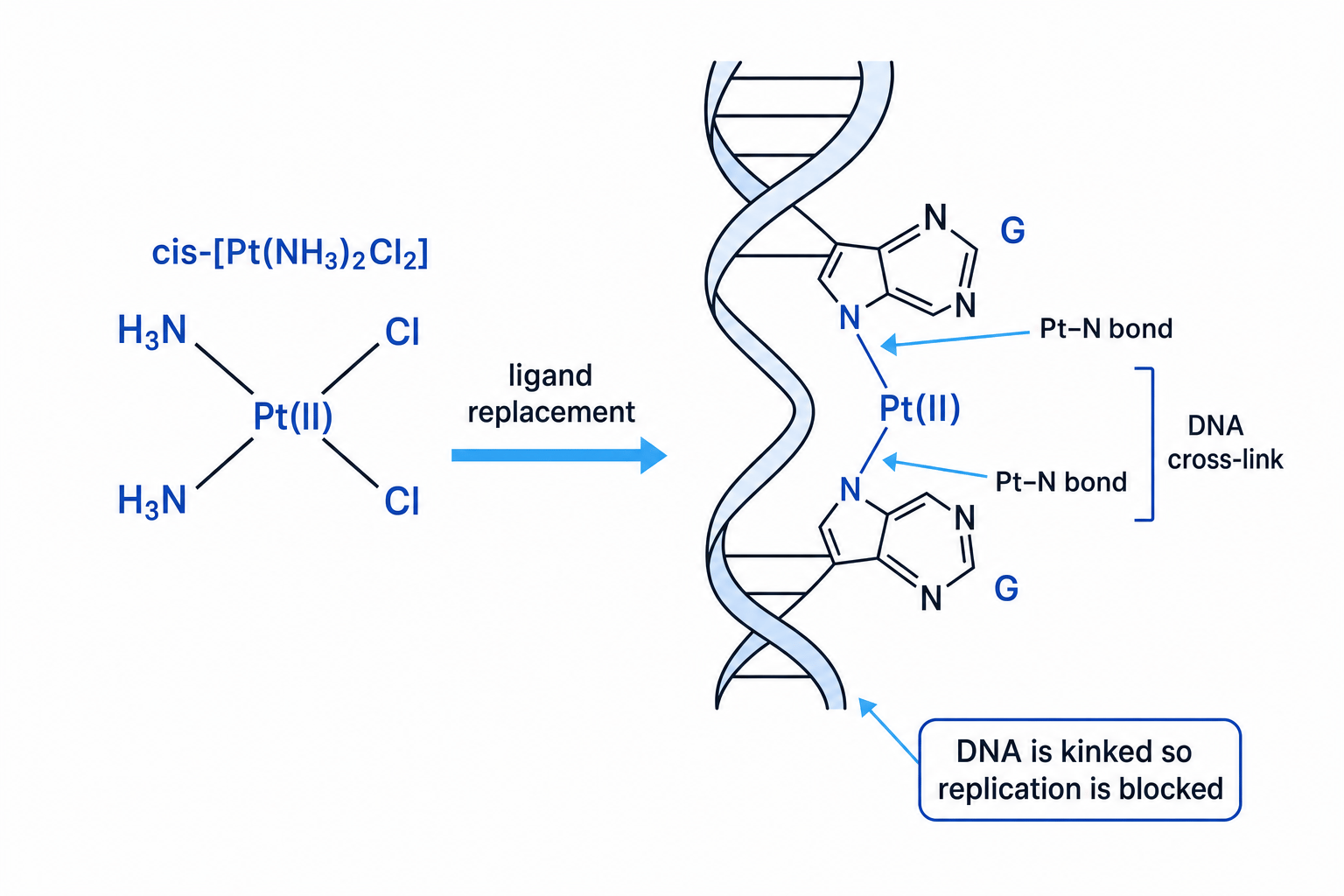
Cisplatin’s target
Cisplatin prevents DNA replication by bonding to nitrogen atoms on guanine bases in DNA, forming Pt-N bonds.
Why the cis shape matters
Because the two chloride ligands in cisplatin are next to each other, both can be replaced in positions that are close together. This allows the platinum to bond to two guanine bases nearby in the DNA.
A bond connecting two parts of a molecule is called a cross-link. Cisplatin can form DNA cross-links, especially between nearby guanine bases on the same DNA strand.
Remember the role of cis
The word cis is not just decoration: it tells you the replaceable chloride ligands are adjacent, helping cisplatin form DNA cross-links that distort the helix.
The trans isomer, where the chloride ligands are opposite each other, is much less effective as an anticancer drug because it does not form the same damaging DNA structures.
How DNA cross-linking stops replication
For DNA replication to happen, the two DNA strands must separate so each can act as a template. An enzyme called DNA polymerase then helps build the new complementary strands.
When cisplatin forms Pt-N bonds to guanine bases, it can kink or distort the DNA helix. This makes it difficult for the strands to separate properly and can block DNA polymerase from copying the DNA.
Linking Pt-N bonding to blocked replication
-
Cisplatin undergoes ligand replacement: chloride ligands are replaced by nitrogen atoms from guanine bases in DNA.
-
The platinum forms Pt-N coordinate bonds to guanine. If two guanine bases become linked to the same platinum, a DNA cross-link forms.
-
The cross-link distorts the DNA helix and prevents the strands from separating normally.
-
If the DNA cannot separate and be copied, DNA replication is prevented, so the cancer cell cannot divide successfully.
Saying cisplatin simply breaks DNA
Cisplatin is not usually described as “destroying” DNA. The A-Level explanation is more specific: it forms Pt-N bonds to guanine, causing cross-links or distortion that prevent DNA replication.
Why this affects cancer cells strongly
Cancer cells divide rapidly, so they rely heavily on DNA replication. If replication is blocked, the cell may stop dividing or undergo apoptosis, which is programmed cell death.
This is why cisplatin can be effective against some cancers: it targets a process that cancer cells need again and again.
Why cisplatin has adverse effects
An adverse effect is an unwanted harmful effect of a drug. Cisplatin can have adverse effects because it is not perfectly selective.
Selectivity
Selectivity is the ability of a drug to affect its target cells more than other cells. A less selective drug is more likely to damage healthy cells too.
Cisplatin targets DNA replication, but normal healthy cells also replicate DNA when they divide. This means cisplatin can affect healthy rapidly dividing cells, such as:
- cells in hair follicles
- cells lining the gut
- cells in bone marrow, which produces blood cells
This can lead to adverse effects such as hair loss, nausea, vomiting, increased infection risk, tiredness, and other serious side effects. Cisplatin can also cause kidney and nerve damage.
Explaining an adverse effect from the mechanism
-
Cisplatin prevents DNA replication by forming Pt-N bonds to guanine in DNA.
-
This mechanism is not unique to cancer cells because healthy cells also contain DNA and must replicate it before they divide.
-
Rapidly dividing healthy tissues, such as gut lining or bone marrow, are especially vulnerable because they need frequent DNA replication.
-
Therefore cisplatin can treat cancer but also cause adverse effects by damaging healthy dividing cells.
Balancing benefits and risks
Society needs to assess whether the benefits of a drug outweigh its adverse effects. For cisplatin, the benefit may be shrinking a tumour, slowing cancer progression, or improving survival. The risks include serious side effects and reduced quality of life during treatment.
This balance depends on factors such as:
- the type and stage of cancer
- how effective cisplatin is likely to be
- the severity of side effects
- whether alternative treatments are available
- the patient’s informed choice
Benefit versus harm
A powerful anticancer drug can be worth using even if it has serious adverse effects, but only when the expected medical benefit justifies the risk to the patient.
In the exam
-
For cisplatin’s action, always include the chemistry: ligand replacement, Pt-N bond formation, and nitrogen on guanine.
-
For why replication stops, link structure to function: Pt-N bonding forms cross-links or distorts DNA, so the strands cannot separate properly and DNA polymerase cannot copy the DNA.
-
For adverse effects, say that cisplatin is not perfectly selective: it can also affect healthy cells, especially rapidly dividing cells, because they also need DNA replication.
Check yourself
- Why can guanine act as a ligand towards platinum in cisplatin?
- How does a DNA cross-link prevent DNA replication?
- Why can cisplatin damage healthy cells as well as cancer cells?
