What you'll learn
- How to turn a biological question into a testable practical investigation.
- How to identify independent, dependent and control variables.
- How to choose suitable apparatus, equipment and techniques.
- How to judge whether a method is appropriate for the expected outcome.
Why planning matters
In OCR A-Level Biology A, planning is not just “writing a method”. It is the skill of designing an investigation that can actually answer the biological question being asked.
A good plan shows that you can:
- apply biological knowledge to a practical context
- choose sensible equipment and techniques
- control variables fairly
- collect data that can be analysed
- evaluate whether the method is valid and reliable
This is part of Module 1, so it can appear in written papers in almost any practical-flavoured question.
Experimental design
Experimental design means planning how an investigation will be carried out so that the data collected can be used to answer the research question fairly and scientifically.
The overall planning sequence
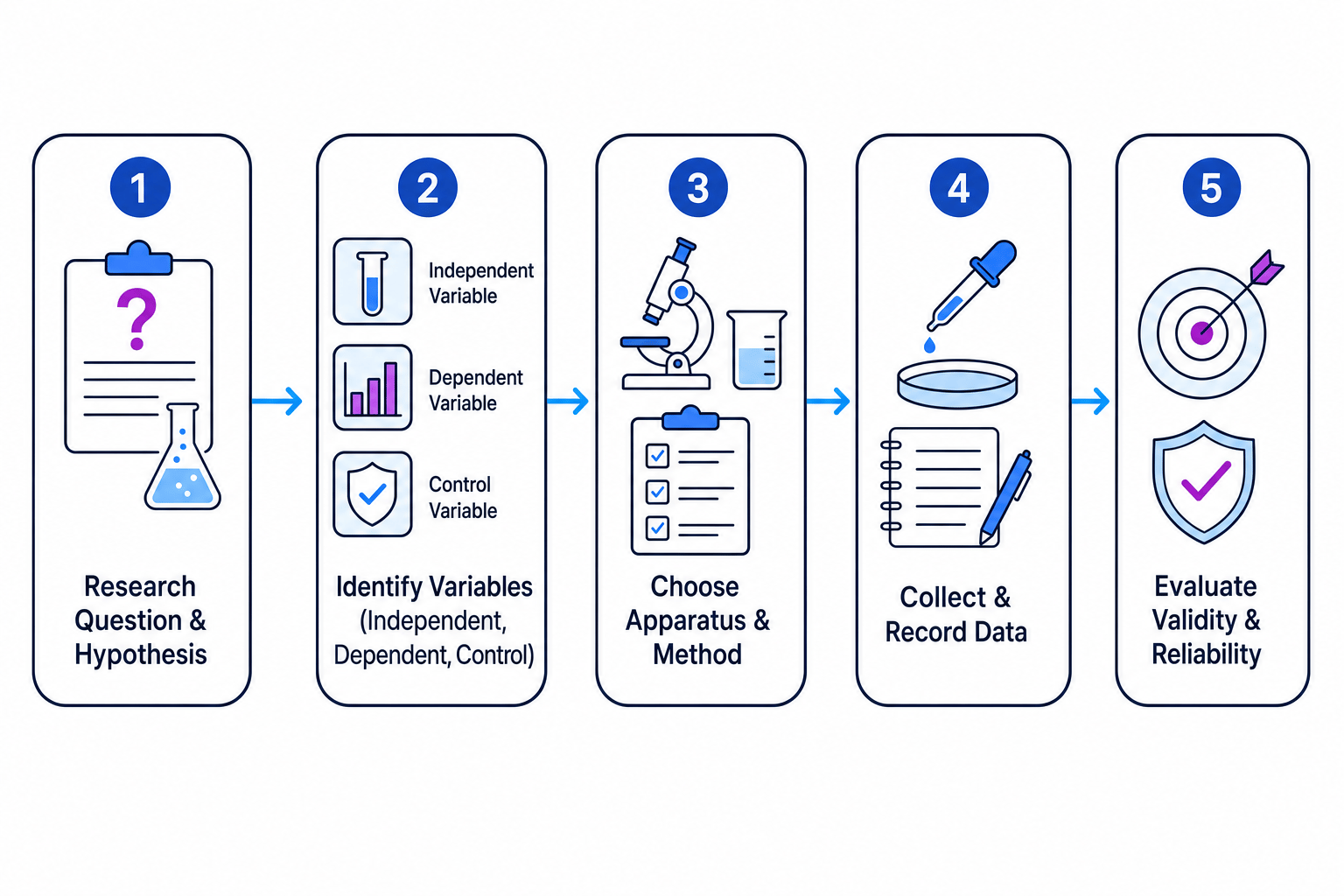
A practical plan usually follows a logical order: question → prediction → variables → method → data → evaluation.
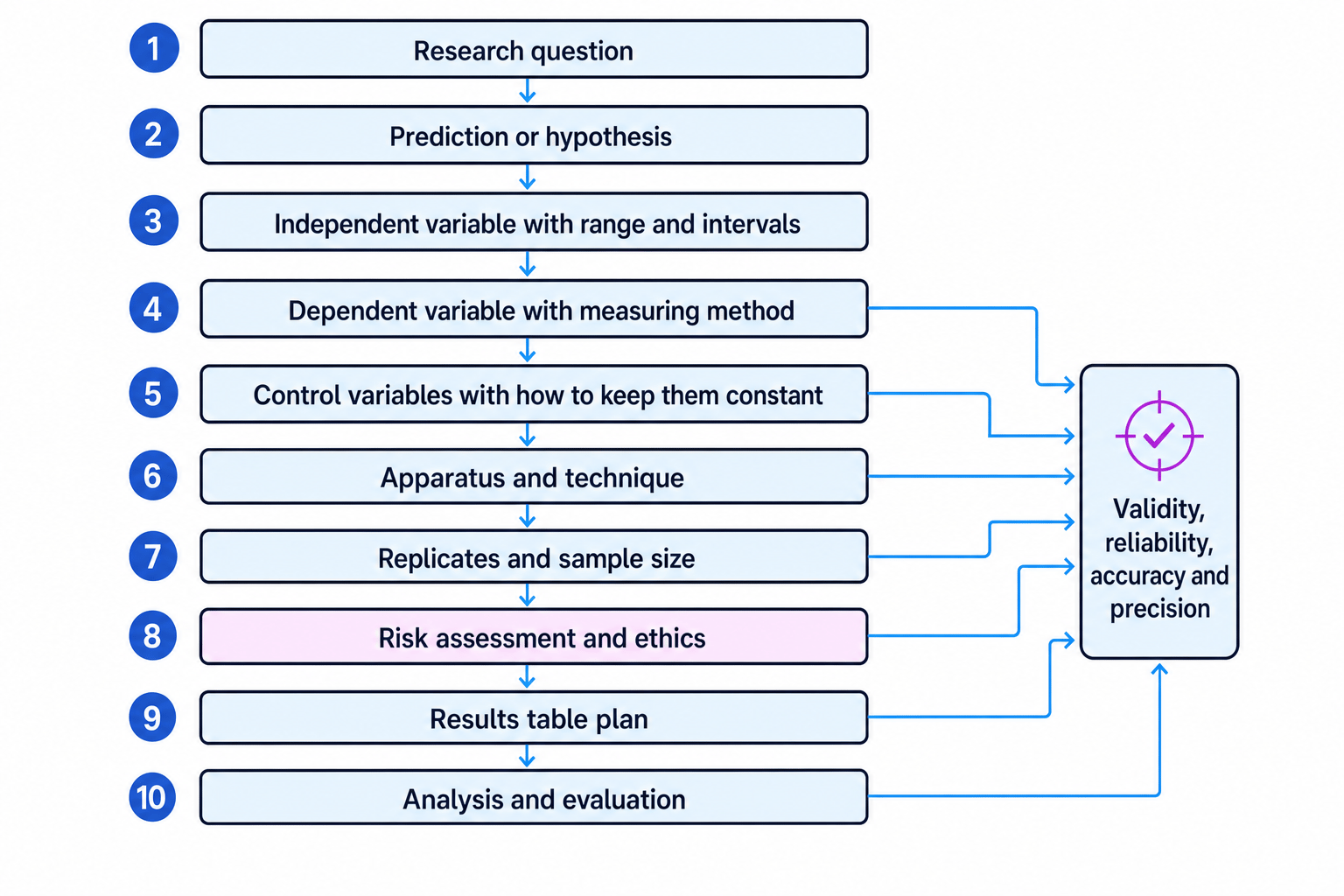
The big planning idea
Every decision in your method should link back to the question: “Will this help me collect valid data to test the biological idea?”
Starting with a research question
A research question is the specific question your investigation aims to answer. It should name the factor being changed and the outcome being measured.
Weak question:
“How does temperature affect enzymes?”
Better question:
“How does temperature affect the rate of amylase-catalysed starch breakdown?”
The better version is clearer because it names:
- the independent variable: temperature
- the dependent variable: rate of starch breakdown
- the biological system: amylase acting on starch
Prediction and hypothesis
A prediction is what you expect to happen. A hypothesis is a scientific explanation for that prediction.
For example:
- Prediction: As temperature increases from 10 °C to 40 °C, the rate of amylase activity increases.
- Hypothesis: Higher temperature increases kinetic energy, causing more frequent enzyme-substrate collisions, until the enzyme begins to denature at higher temperatures.
Hypothesis
A hypothesis is a testable scientific explanation based on biological knowledge.
Identifying variables
Variables are the factors in an investigation that can change.
Independent variable
The independent variable is the factor you deliberately change.
Examples:
- temperature in °C
- pH
- light intensity in lux
- substrate concentration in mol dm⁻³
- time in s
Dependent variable
The dependent variable is the factor you measure as the outcome.
Examples:
- rate of reaction in cm³ s⁻¹
- change in mass in g
- length of root growth in mm
- number of bubbles per minute
- absorbance using a colorimeter
Control variables
A control variable is a factor that must be kept constant so that it does not affect the dependent variable.
For example, if you investigate the effect of temperature on amylase activity, you should control:
- pH, using a buffer solution
- enzyme concentration
- substrate concentration
- volume of enzyme and substrate
- time allowed for the reaction, if measuring endpoint colour change
Control variable
A control variable is a factor kept constant to prevent it influencing the dependent variable and reducing the validity of the investigation.
Confounding variables
A confounding variable is an uncontrolled factor that affects the dependent variable, making it harder to tell whether the independent variable caused the result.
For example, if you compare plant growth in different light intensities but also give the plants different volumes of water, water availability becomes a confounding variable.
Vague control variables
Do not just write “keep everything else the same”. Name the specific variable and say how you would control it, such as “use the same volume of enzyme solution, measured with a pipette”.
Planning variables for osmosis
A student investigates how sucrose concentration affects water movement in potato cylinders.
-
Identify the factor deliberately changed: sucrose concentration. This is the independent variable, so the student might use 0.0, 0.2, 0.4, 0.6 and 0.8 mol dm⁻³ sucrose solutions.
-
Identify the measurable outcome: change in mass of potato tissue. This is the dependent variable, measured using a balance before and after immersion.
-
Choose control variables that could affect osmosis: potato cylinder length, diameter, surface area, immersion time, temperature and volume of sucrose solution.
-
State how to control them: use a cork borer for equal diameter, cut cylinders to the same length, immerse all cylinders for the same time, use a water bath or same room conditions, and use the same solution volume in each tube.
Choosing apparatus, equipment and techniques
When selecting equipment, ask: “Is this apparatus suitable for the measurement I need?”
Important features include:
- range: the values the apparatus can measure
- resolution: the smallest change the apparatus can detect
- precision: how close repeated measurements are to each other
- accuracy: how close a measurement is to the true value
Resolution
Resolution is the smallest interval that a measuring instrument can distinguish, such as 0.01 g on a balance or 1 mm on a ruler.
Examples of suitable choices
For volume:
- measuring cylinder: suitable for approximate volumes
- pipette or burette: better for accurate volumes
For mass:
- two-decimal-place balance: suitable for changes in potato mass
- top-pan balance with low resolution may be unsuitable for very small samples
For colour change:
- visual judgement may be subjective
- colorimeter gives quantitative absorbance data
For temperature:
- water bath is usually better than leaving tubes on a bench
- thermometer or temperature probe checks actual temperature
Apparatus choice shortcut
In planning questions, always connect the apparatus to the variable: “Use a thermostatically controlled water bath to maintain temperature at 35 °C” is much stronger than “use a water bath”.
Choosing apparatus for enzyme rate data
You are planning an investigation into the effect of substrate concentration on catalase activity, using hydrogen peroxide and measuring oxygen produced.
-
The dependent variable is oxygen production, so gas volume must be measured quantitatively rather than estimated from foam height.
-
A gas syringe is suitable because it measures gas volume directly in cm³ and can be read at regular time intervals.
-
The rate can be calculated using:
For example, if 24 cm³ of oxygen is produced in 60 s:
rate=24 cm360 s=0.40 cm3 s−1 \text{rate} = \frac{24\ \text{cm}^3}{60\ \text{s}} = 0.40\ \text{cm}^3\ \text{s}^{-1} rate=60 s24 cm3=0.40 cm3 s−1- Temperature should be controlled using a water bath, because catalase activity is temperature-dependent.
Designing a method that answers the question
A practical method should be detailed enough that another student could repeat it and collect comparable data.
You should include:
- the range of independent variable values
- the intervals between values
- the number of repeats
- how control variables are maintained
- how the dependent variable is measured
- any safety or ethical considerations
- the planned results table or graph
Range and intervals
The range is the spread between the lowest and highest value of the independent variable.
The interval is the gap between each value.
For example, if testing temperature, 10 °C, 20 °C, 30 °C, 40 °C and 50 °C gives:
- range: 10 °C to 50 °C
- interval: 10 °C
A wider range may reveal a trend, but intervals must be close enough to show important changes.
Repeats and reliability
A repeat is when you carry out the same measurement again under the same conditions.
Repeats help you identify anomalies and calculate a mean.
Reliability
Reliability means the results are consistent when the method is repeated under the same conditions.
If one result is very different from the others, it may be an anomalous result. You should not automatically delete it; you need a valid reason, such as a clear procedural error.
Repeats are not control variables
Repeating measurements improves reliability. It does not control a variable. Control variables are factors kept constant, such as temperature or pH.
Planning the results and analysis
A strong plan thinks ahead to the data.
Before starting, ask:
- What raw data will be recorded?
- What units are needed?
- Will a mean be calculated?
- Will a rate or percentage change be calculated?
- What graph will best show the relationship?
For many investigations, the independent variable goes in the first column of a results table, and the dependent variable goes in the later columns.
For a graph:
- independent variable usually goes on the x-axis
- dependent variable usually goes on the y-axis
- include units in axis labels
- use a line graph when both variables are continuous
- use a bar chart when the independent variable is categoric
Plan the table before the method
If you cannot design a results table for the investigation, the method is probably not specific enough yet.
Evaluating whether the method is appropriate
To evaluate a method, you judge whether it can meet the expected outcome. This is not the same as just listing “good” and “bad” points.
A method is appropriate if it:
- tests the stated independent variable
- measures the dependent variable validly
- controls important variables
- uses apparatus with suitable resolution and range
- includes repeats
- produces quantitative data where needed
- allows a clear conclusion to be drawn
Validity
Validity means the investigation actually measures what it claims to measure.
For example, counting bubbles from pondweed can estimate photosynthesis rate, but bubble size may vary. Measuring oxygen volume with a gas syringe or oxygen probe would usually be more valid.
Accuracy and precision in evaluation
A method may be precise but not accurate.
For example, a balance may give repeated readings close together, but if it is not zeroed first, all readings may be inaccurate.
Validity
Validity means the method tests the intended relationship and avoids other factors causing the observed change.
Evaluating a photosynthesis method
A student investigates the effect of light intensity on photosynthesis by placing pondweed at different distances from a lamp and counting bubbles for one minute.
-
The method does vary light intensity, because moving the lamp changes the light reaching the pondweed. However, distance is only an indirect measure of light intensity.
-
The dependent variable, bubbles per minute, is easy to measure but not very accurate because bubbles may differ in volume.
-
Temperature is a likely confounding variable because the lamp may heat the water, affecting enzyme-controlled reactions in photosynthesis.
-
A better method would use a light meter to measure light intensity in lux, a water bath or heat filter to control temperature, and an oxygen probe or gas syringe to measure oxygen production quantitatively.
Safety and ethics
Planning also includes safe and responsible practical work.
You may need to consider:
- wearing eye protection when using enzymes, acids or alkalis
- avoiding skin contact with biological stains
- using low-risk microorganisms and aseptic technique where relevant
- disinfecting benches after microbial work
- minimising harm to living organisms
- safely disposing of biological material
You do not need to write a full risk assessment every time, but if a hazard is relevant, include a sensible precaution.
Do not ignore context
Safety points should match the practical. “Wear goggles” may be sensible for chemicals, but it is not a complete answer if the main risk is contamination from microorganisms.
Applying biological knowledge to practical contexts
Planning questions often test whether you can use biology from the specification in a new situation.
For example:
- If enzymes are involved, consider temperature, pH, substrate concentration and enzyme concentration.
- If osmosis is involved, consider water potential, tissue size and surface area.
- If photosynthesis is involved, consider light intensity, carbon dioxide concentration and temperature.
- If microorganisms are involved, consider aseptic technique and incubation conditions.
- If sampling organisms, consider random sampling, sample size and avoiding bias.
Use the biology to choose controls
The most important control variables usually come from the biological process itself: enzymes need controlled pH and temperature; plants need controlled light, carbon dioxide and water availability.
In the exam
-
Name the independent and dependent variables clearly, with units where appropriate.
-
For each control variable, state both what is controlled and how it is controlled.
-
When evaluating a method, link each weakness to its effect on validity, reliability, accuracy or precision, then suggest a specific improvement.
Check yourself
-
Can you explain the difference between a control variable and a control experiment?
-
Why is a water bath often better than leaving test tubes at room temperature?
-
How would you decide whether a method is appropriate for testing a biological hypothesis?