

What you'll learn
- How genetic and environmental factors produce phenotypic variation.
- How to use genetic diagrams for monogenic, dihybrid, codominant, multiple-allele and sex-linked inheritance.
- How to use phenotypic ratios, chi-squared and Hardy–Weinberg calculations.
- How selection, drift, isolation and artificial selection can change populations over time.
Variation: what differs, and why?
Phenotype and genotype
An organism’s phenotype is its observable characteristics, such as height, blood group or flower colour. Its genotype is the alleles it has for one or more genes. An allele is a version of a gene.
Phenotypic variation can be caused by:
- Genetic factors — different alleles inherited from parents, for example alleles affecting ABO blood group.
- Environmental factors — conditions during life, for example diet affecting body mass in animals.
- Both together — many traits, such as human height, depend on genes and environment.
In plants, etiolation is a useful environmental example: plants grown in darkness often become tall, pale and weak because low light affects chlorophyll production and shoot growth.
Phenotype is not just genotype
A genotype sets the potential range for many characteristics, but the environment can influence where within that range the phenotype falls.
How sexual reproduction creates genetic variation
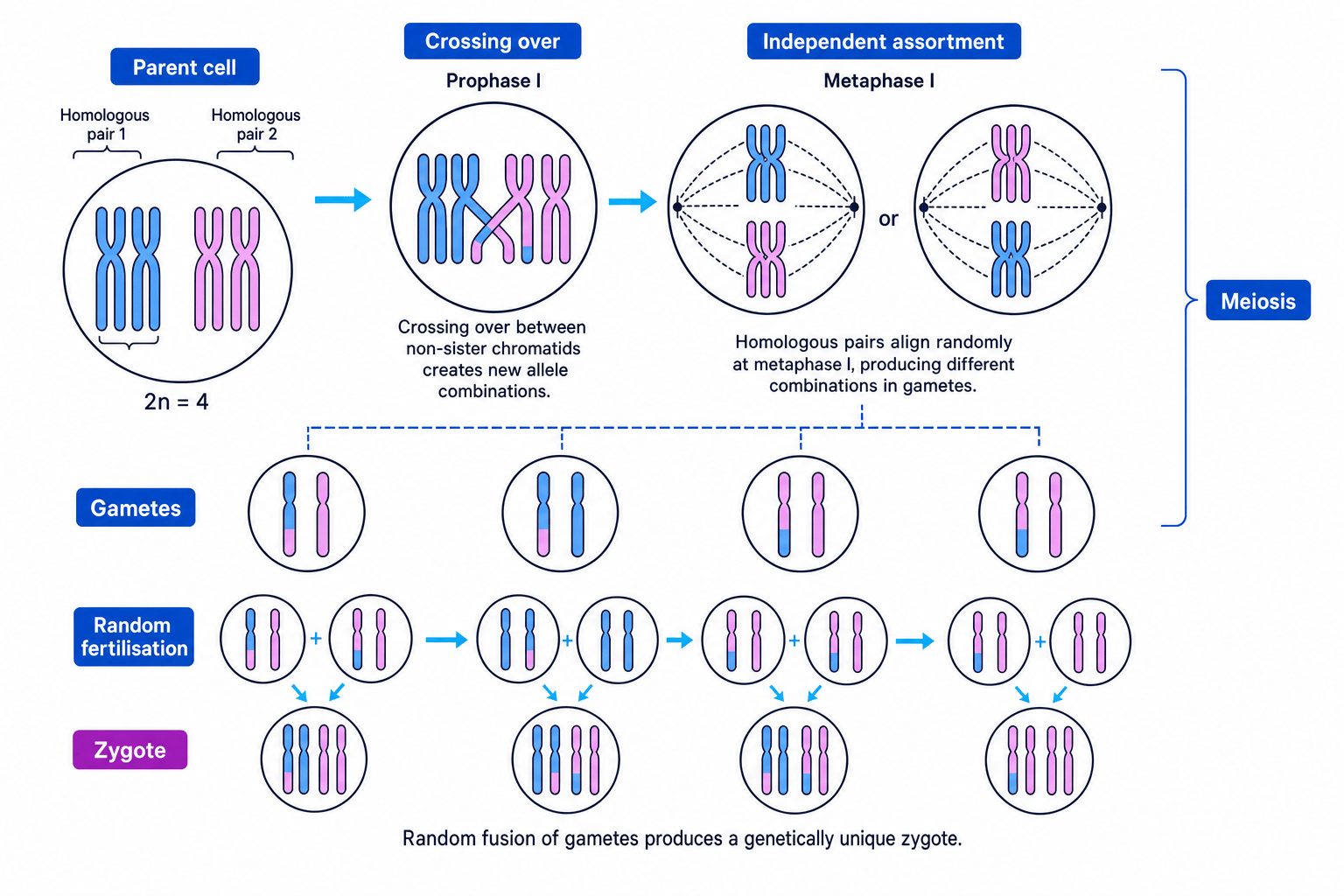
Sexual reproduction involves meiosis to make gametes, followed by fertilisation. It creates genetic variation within a species because:
- Crossing over in prophase I of meiosis swaps sections between homologous chromosomes.
- Independent assortment means homologous chromosome pairs line up randomly in meiosis I.
- Random fertilisation means any one male gamete can fuse with any one female gamete.
Genetic diagrams: the core vocabulary
Inheritance terms
A gene locus is the position of a gene on a chromosome. An organism is homozygous if it has two identical alleles at a locus, and heterozygous if it has two different alleles. A dominant allele is expressed in a heterozygote; a recessive allele is only expressed when no dominant allele is present.
When you draw a genetic diagram:
- Define the allele symbols.
- State parental genotypes.
- Work out gametes.
- Combine gametes.
- State offspring genotypes and phenotypes.
- Give the phenotypic ratio or probability.
Monogenic and dihybrid inheritance
Monogenic inheritance is inheritance controlled by one gene. A classic heterozygous monohybrid cross, such as Aa × Aa, gives a 3:1 phenotypic ratio if A is completely dominant over a.
Dihybrid inheritance follows two genes at once. If the genes are unlinked and do not interact, a cross between two double heterozygotes usually gives a 9:3:3:1 phenotypic ratio.
Predicting a dihybrid ratio
Suppose seed shape is controlled by R/r, where R gives round seeds, and seed colour is controlled by Y/y, where Y gives yellow seeds. Cross RrYy × RrYy.
-
Each parent can produce four gamete types because each gamete receives one allele from each gene:
RY,Ry,rYandry. -
Combining the four gametes from one parent with the four from the other gives 16 possible fertilisation outcomes.
-
Apply dominance separately for each gene: any genotype with
Ris round, and any genotype withYis yellow. -
Count the phenotype groups: 9 round yellow, 3 round green, 3 wrinkled yellow and 1 wrinkled green.
-
The expected phenotypic ratio is therefore 9:3:3:1, assuming the genes are unlinked and there is no epistasis.
Multiple alleles and codominance
Multiple alleles means there are more than two allele versions of a gene in the population, although each diploid individual still only has two alleles for that gene.
A good example is ABO blood group. The alleles IAI^AIA, IBI^BIB and IOI^OIO exist in the population. IAI^AIA and IBI^BIB are codominant, meaning both are expressed in a heterozygote, so genotype IAIBI^A I^BIAIB gives blood group AB. IOI^OIO is recessive.
Codominance
Codominance occurs when both alleles in a heterozygote are expressed in the phenotype.
Sex linkage
A sex-linked gene is found on a sex chromosome. In humans, many examples are X-linked. Males usually have one X chromosome and one Y chromosome, so a recessive allele on the X chromosome is expressed in males if it is present.
Tracing an X-linked recessive allele
Haemophilia can be modelled as an X-linked recessive condition. Let XHX^HXH be the normal allele and XhX^hXh be the haemophilia allele. Cross a carrier female, XHXhX^H X^hXHXh, with an unaffected male, XHYX^H YXHY.
-
The female can produce eggs carrying XHX^HXH or XhX^hXh; the male can produce sperm carrying XHX^HXH or YYY.
-
Daughters must receive the father’s XHX^HXH, so they are either XHXHX^H X^HXHXH unaffected or XHXhX^H X^hXHXh carriers.
-
Sons receive the father’s YYY, so their phenotype depends on the mother’s X chromosome: XHYX^H YXHY is unaffected, while XhYX^h YXhY has haemophilia.
-
The expected outcome is 50% of sons affected and 50% of daughters carriers.
Treating X-linked inheritance like autosomal inheritance
For sex-linked crosses, always include the sex chromosomes in the genotype. Do not write just Hh, because males may only have one copy of an X-linked allele.
Using ratios: linkage and epistasis
Autosomal linkage occurs when genes are on the same non-sex chromosome. Linked genes do not assort independently, so parental combinations of alleles appear more often than recombinant combinations. Crossing over can still produce recombinants, but usually fewer.
Sex linkage can be spotted when inheritance patterns differ between males and females, or when reciprocal crosses give different results.
Epistasis occurs when one gene affects or masks the expression of another gene. This changes expected dihybrid ratios. For example, recessive epistasis can give a 9:3:4 ratio instead of 9:3:3:1.
Using ratios to spot linkage or epistasis
-
In a dihybrid test cross, unlinked genes usually give a 1:1:1:1 phenotypic ratio. If the observed offspring are 46, 4, 5 and 45 in the four phenotype classes, two classes are much more common than the other two.
-
The two common classes are likely to be the parental combinations, while the rare classes are recombinants produced by crossing over. This suggests autosomal linkage.
-
In an F2 dihybrid cross, a result close to 90:30:40 out of 160 simplifies to about 9:3:4. Because two expected categories appear merged, this suggests epistasis rather than simple independent inheritance.
-
If the ratio also differs between male and female offspring, consider sex linkage as well as dominance.
Chi-squared: is the difference significant?
The chi-squared test compares observed results with expected results to see whether the difference is likely to be due to chance.
χ2=∑(fo−fe)2fe\chi^2 = \sum \frac{(f_o - f_e)^2}{f_e}χ2=∑fe(fo−fe)2Here, fof_ofo is the observed frequency and fef_efe is the expected frequency.
Testing a dihybrid ratio with chi-squared
A dihybrid cross gives four phenotypes with observed frequencies 91, 29, 32 and 8. The expected ratio is 9:3:3:1, and the total number of offspring is 160.
-
Convert the expected ratio into expected frequencies: 9:3:3:1 has 16 parts, so the expected frequencies are 90, 30, 30 and 10.
-
Substitute into the chi-squared formula:
-
There are four categories, so the degrees of freedom are
4 - 1 = 3. -
At the 5% significance level, the critical value for 3 degrees of freedom is 7.82. Since 0.58 is less than 7.82, the difference is not significant.
-
The observed results are consistent with the expected 9:3:3:1 ratio; you do not reject the hypothesis.
Chi-squared wording
If χ2\chi^2χ2 is greater than the critical value, the difference is significant and you reject the null hypothesis. If it is smaller, the difference is not significant.
Continuous and discontinuous variation
Discontinuous variation has distinct categories with no intermediates. It is usually controlled by one gene or a small number of genes, with little environmental effect. ABO blood group is a good example.
Continuous variation shows a range of values with many intermediates. It is usually polygenic, meaning controlled by many genes, and is often affected by the environment. Human height, body mass and leaf length are examples.
Number of genes matters
One or a few genes tend to produce discontinuous categories. Many genes, often combined with environmental effects, tend to produce continuous variation.
Evolution: changing allele frequencies
Evolution is the change in allele frequencies in a population over generations. An allele frequency is the proportion of all copies of a gene in a population that are a particular allele.
Natural selection acts on phenotypes, but it changes allele frequencies because individuals with advantageous alleles are more likely to survive, reproduce and pass those alleles on.
Stabilising and directional selection
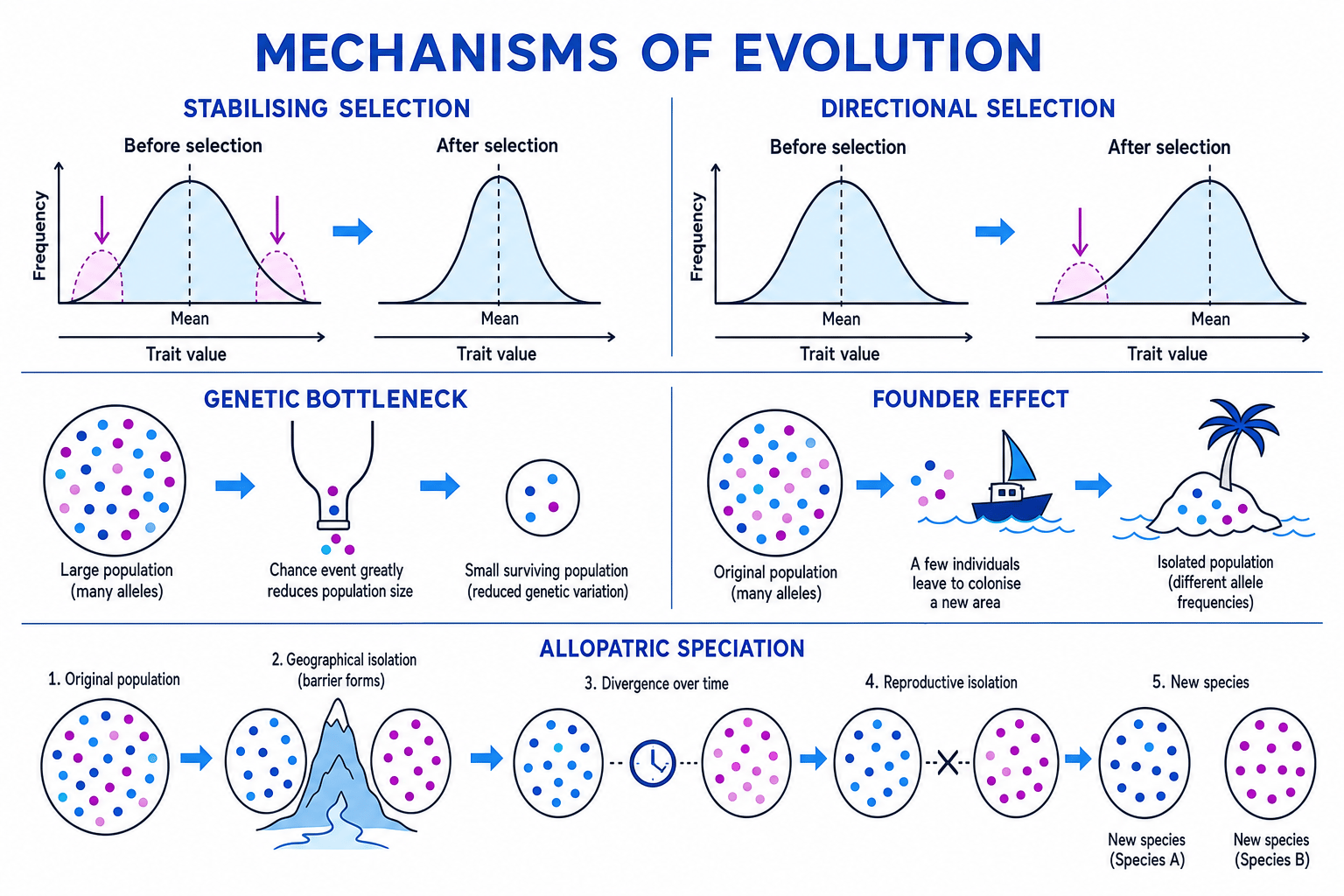
Stabilising selection favours intermediate phenotypes and selects against extremes. The mean usually stays similar, but variation decreases.
Directional selection favours one extreme phenotype, so the mean shifts over generations. This can happen when the environment changes.
Genetic drift, bottlenecks and founder effects
Genetic drift is a change in allele frequency due to chance. It has the strongest effect in small populations.
A genetic bottleneck occurs when a population is drastically reduced in size, leaving a small surviving group with a non-representative sample of alleles.
The founder effect occurs when a few individuals colonise a new area. Their allele frequencies may differ from the original population by chance.
Identifying the type of selection
A bird population has a range of beak sizes. After several dry years, only birds with larger beaks can crack the remaining hard seeds.
-
The environmental change creates a selection pressure: food is harder to access.
-
Larger-beaked birds are more likely to survive and reproduce, so alleles associated with larger beaks become more frequent.
-
Because one extreme phenotype is favoured and the mean beak size shifts upward, this is directional selection.
Hardy–Weinberg principle
The Hardy–Weinberg principle predicts allele and genotype frequencies in an ideal population where there is random mating, a large population size, no mutation, no migration and no selection.
For two alleles:
p+q=1p + q = 1p+q=1 p2+2pq+q2=1p^2 + 2pq + q^2 = 1p2+2pq+q2=1Here, ppp and qqq are allele frequencies. The genotype frequencies are p2p^2p2 for homozygous dominant, 2pq2pq2pq for heterozygous and q2q^2q2 for homozygous recessive.
Calculating carrier frequency with Hardy–Weinberg
A recessive disorder affects 1 in 2500 individuals. Estimate the carrier frequency.
- The affected individuals are homozygous recessive, so:
- Take the square root to find qqq:
- Use p+q=1p + q = 1p+q=1:
- Carriers are heterozygotes, so calculate 2pq2pq2pq:
- The carrier frequency is 0.0392, or 3.92%.
Isolating mechanisms and speciation
A species is often defined as a group of organisms that can interbreed to produce fertile offspring. Speciation is the formation of a new species.
Isolating mechanisms reduce or stop gene flow between populations. Over time, separate populations can accumulate different genetic information.
Allopatric speciation happens when a geographical barrier separates populations. Examples include rivers, mountains, islands or habitat fragmentation.
Sympatric speciation happens without geographical separation. Reproductive isolating mechanisms arise within the same area, such as differences in courtship behaviour, breeding season or, in plants, chromosome number.
Explaining allopatric speciation
-
A geographical barrier splits one population into two, so individuals from the two groups no longer interbreed.
-
Mutation, natural selection and genetic drift change allele frequencies differently in each population.
-
Over many generations, the populations become genetically and phenotypically different.
-
If they can no longer produce fertile offspring even if reunited, reproductive isolation has evolved and they are now separate species.
Artificial selection
Artificial selection is selective breeding by humans. Individuals with desired characteristics are chosen as parents, then their offspring are screened and the process is repeated over many generations.
Uses include:
- Crop plants with higher yield, disease resistance or improved nutritional content.
- Farm animals with increased milk yield, faster growth or better meat production.
- Domestic animals with particular appearance or behaviour.
Artificial selection can produce rapid changes, but it often reduces genetic diversity and increases homozygosity. This can increase the risk of inherited disorders.
Wild type
A wild type is the form of an organism, allele or trait commonly found in natural populations. Wild types can be valuable sources of genetic material for future selective breeding.
Maintaining genetic resources matters because wild relatives and traditional breeds may contain alleles for disease resistance, drought tolerance or climate resilience. Seed banks, rare-breed conservation and protected habitats help preserve this variation.
Ethical issues include animal welfare, reduced quality of life and increased disease risk. Extreme dog breeding is a clear example: selection for very short faces can cause breathing problems, while selection for unusual body shape can cause joint, spine or birthing difficulties.
Artificial selection is not genetic engineering
Artificial selection changes allele frequencies by choosing which organisms breed. It does not directly edit DNA.
In the exam
- For genetic crosses, always define allele symbols, show gametes and finish with phenotypes as well as genotypes.
- For ratio questions, compare with expected ratios first: 3:1, 1:1, 9:3:3:1, 1:1:1:1 or modified epistasis ratios.
- For chi-squared and Hardy–Weinberg, write the formula, substitute numbers clearly, then interpret the result in biological words.
- For evolution questions, link selection pressure to differential survival, reproduction and allele frequency change.
Check yourself
- How would you tell the difference between autosomal linkage and sex linkage from offspring data?
- Why does recessive epistasis modify a dihybrid ratio such as 9:3:3:1?
- In Hardy–Weinberg questions, why is the recessive phenotype usually represented by q2q^2q2?
