

What you'll learn
- How your genotype and the environment interact to produce a phenotype.
- What epigenetic changes are, and how DNA methylation and histone modification affect gene expression.
- Why many biological traits show continuous variation rather than clear categories.
- How to describe and analyse continuous data using means and standard deviation.
Starting point: genes, genotype and phenotype
A gene is a length of DNA with a base sequence that codes for a polypeptide or functional RNA. An allele is a version of a gene. For example, different alleles may code for slightly different versions of the same protein.
Gene expression means using the information in a gene to make its product. In protein-coding genes, this involves transcription, where DNA is copied into messenger RNA, and usually translation, where a polypeptide is made at a ribosome.
Genotype and phenotype
Your genotype is the genetic constitution of an organism, including the alleles it has. Your phenotype is the observable set of characteristics produced by the interaction between genotype and environment.
The same genotype can produce different phenotypes in different environments. For example, plants with the same alleles for height may grow to different heights if one has more light, water and mineral ions.
Genotype is not destiny
Genes provide the instructions and potential, but the phenotype depends on which genes are expressed and how environmental conditions affect cells.
Explaining different phenotypes in cloned plants
Two genetically identical plant cuttings are grown. Plant A receives high light intensity and enough nitrate ions; Plant B receives low light intensity and few nitrate ions. Plant A grows taller and has darker green leaves.
- Use the genetic information. Because the plants are clones, they have the same genotype, so differences in alleles are not the best explanation for the different phenotypes.
- Apply the environmental factors. Light affects the rate of photosynthesis, and nitrate ions are needed to make amino acids, proteins and chlorophyll.
- Link cause to phenotype. The different phenotypes are most likely due to environmental conditions affecting growth and gene expression, not due to inherited genetic differences.
What epigenetics adds
Epigenetics
Epigenetics is the study of heritable changes in gene expression that occur without changing the DNA base sequence.
An epigenetic change does not alter the order of bases in DNA. Instead, it affects whether particular genes are switched on, switched off, or expressed at a different rate.
This is important because most specialised cells in your body contain the same genome, but they express different sets of genes. A liver cell and a neurone contain the same DNA, but they have different proteins, structures and functions because different genes are active.
Epigenetic change is not mutation
A mutation changes the DNA base sequence. An epigenetic change changes gene expression without changing the base sequence.
Chromatin: DNA packaging affects gene expression
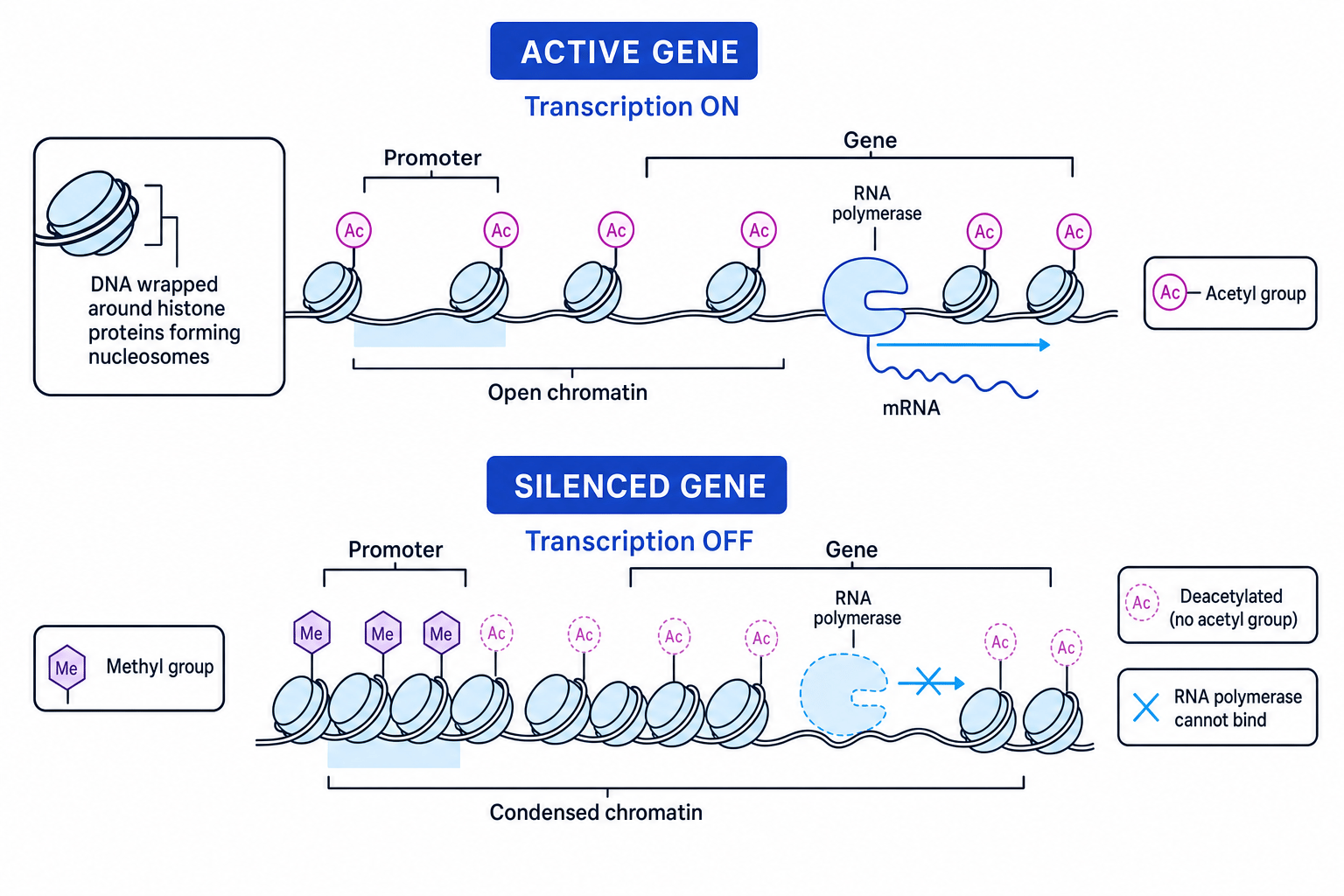
In eukaryotic cells, DNA is associated with histone proteins. DNA wrapped around histones forms structures called nucleosomes. The DNA and protein together are called chromatin.
A promoter is a DNA region near the start of a gene where RNA polymerase and regulatory proteins can bind. RNA polymerase is the enzyme that catalyses transcription. Transcription factors are regulatory proteins that bind to DNA and affect transcription.
If chromatin is loosely packed, RNA polymerase and transcription factors can usually reach the gene more easily. If chromatin is tightly packed, transcription is usually reduced.
Two important epigenetic mechanisms
DNA methylation
DNA methylation is the addition of a methyl group, a small chemical group, to DNA. In many eukaryotes this often occurs at cytosine bases, especially near gene promoters.
High methylation near a promoter usually reduces transcription. It can block transcription factors from binding or attract proteins that make chromatin more condensed.
Histone modification
Histone modification means adding or removing chemical groups from histone proteins. A key example is histone acetylation, where acetyl groups are added to histones.
Histones are positively charged, while DNA is negatively charged. Acetylation reduces the attraction between histones and DNA, so the chromatin becomes more open. This usually increases transcription. Removing acetyl groups often makes chromatin more condensed and reduces transcription.
Predicting gene expression from epigenetic marks
A cell has high DNA methylation at the promoter of gene X and low histone acetylation around gene X. Predict the effect on protein X production.
- Connect methylation to transcription. High methylation at the promoter makes it harder for transcription factors and RNA polymerase to bind, so less messenger RNA is made from gene X.
- Connect histone acetylation to chromatin structure. Low acetylation means DNA is held more tightly around histones, so chromatin is more condensed and the gene is less accessible.
- Connect transcription to protein synthesis. Less messenger RNA means fewer templates for translation, so the cell is likely to produce less protein X.
Epigenetics, environment and inheritance
Environmental factors can influence epigenetic marks. Examples include diet, toxins, smoking, stress, temperature, light in plants, and exposure to hormones during development. These factors may affect enzymes that add or remove methyl groups or histone modifications.
Epigenetic marks can be copied during mitosis, the cell division that produces genetically identical cells. This helps maintain cell identity: when a skin cell divides, its daughter cells keep a skin-cell pattern of gene expression.
Epigenetic changes may sometimes be passed between generations, but this is not guaranteed. During formation of gametes by meiosis, and during early embryo development, many epigenetic marks are reset.
Be careful with inheritance claims
Do not write that all epigenetic changes are automatically passed to offspring. Many are stable through mitosis within an organism, but only some may survive resetting between generations.
Continuous variation
Continuous variation
Continuous variation is variation in which individuals show a range of phenotypes with many intermediate values, rather than falling into distinct categories.
Examples include human height, body mass, leaf length, milk yield in cattle and enzyme activity. These traits are often polygenic, meaning they are influenced by many genes. Each gene may have a small effect, and the combined effects produce a smooth range of values.
Continuous variation is also strongly affected by the environment. For example, height is influenced by alleles, but also by nutrition, illness and hormone levels during development.
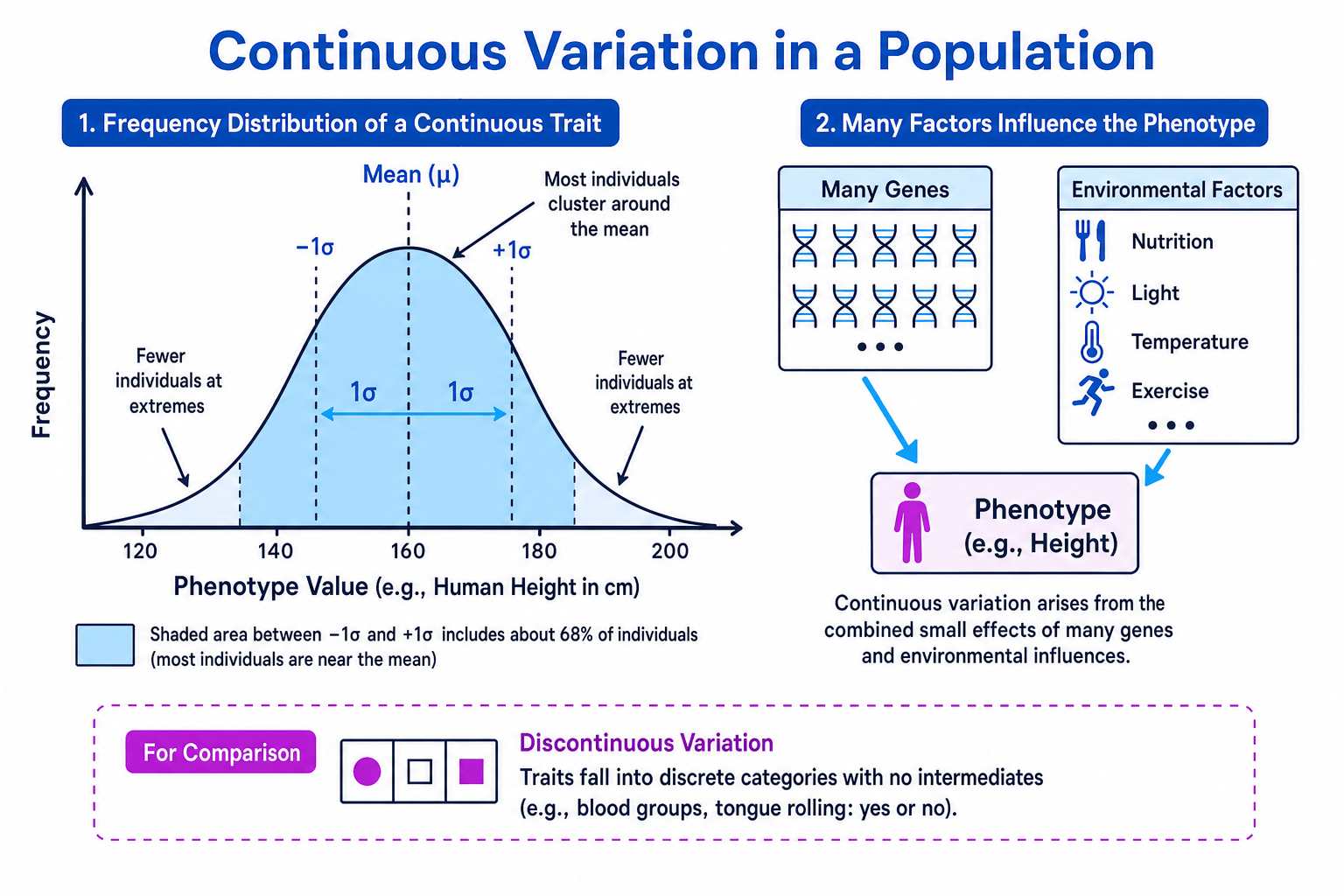
By contrast, discontinuous variation has clear categories with no intermediates, such as ABO blood group. These traits are often controlled by one gene or a small number of genes, with little environmental influence.
Continuous does not mean environmental only
Continuous variation usually results from both many genes and environmental effects. Do not describe it as being caused only by the environment.
Epigenetics and continuous variation together
Epigenetics helps explain how the environment can influence phenotype at the molecular level. For example, if nutrition or stress changes methylation patterns near genes involved in growth, the amount of certain proteins made by cells may change.
So, for a continuous trait such as height or plant biomass, variation can come from:
- different alleles inherited from parents
- different combinations of many genes
- environmental factors affecting growth and development
- epigenetic changes altering gene expression
This is why continuous traits often show a bell-shaped distribution: most individuals are near the mean, while fewer individuals have very high or very low values.
Measuring continuous variation
When investigating continuous variation, you usually collect numerical data. Good practical design matters.
You should aim to use a large, representative sample. You should also control relevant variables where possible. For example, if comparing plant height, keep species, age, light intensity, water availability and mineral ion concentration consistent unless one is the independent variable.
Standard deviation, symbol sss, measures the spread of values around the mean. A larger standard deviation means the data are more spread out.
The sample standard deviation is:
s=∑(x−xˉ)2n−1s=\sqrt{\frac{\sum(x-\bar{x})^2}{n-1}}s=n−1∑(x−xˉ)2where xxx is each value, xˉ\bar{x}xˉ is the mean, and nnn is the number of values.
Calculating standard deviation for plant height
Five seedlings have heights of 42 mm, 47 mm, 45 mm, 50 mm and 46 mm.
-
Calculate the mean height.
xˉ=42+47+45+50+465=46 mm\bar{x}=\frac{42+47+45+50+46}{5}=46\ \text{mm}xˉ=542+47+45+50+46=46 mm -
Find the squared deviations from the mean and add them.
∑(x−xˉ)2=16+1+1+16+0=34 mm2\sum(x-\bar{x})^2=16+1+1+16+0=34\ \text{mm}^2∑(x−xˉ)2=16+1+1+16+0=34 mm2 -
Substitute into the sample standard deviation formula.
s=345−1=8.5=2.9 mms=\sqrt{\frac{34}{5-1}}=\sqrt{8.5}=2.9\ \text{mm}s=5−134=8.5=2.9 mm -
Interpret the value biologically. The seedling heights typically vary by about 3 mm from the mean; a larger sss would indicate more variation in height.
Describing variation in words
Use mean for the central value and standard deviation for spread. Avoid saying “the results vary a lot” unless you support it with the data.
In the exam
- State clearly whether a feature is caused by genotype, environment, or both; for continuous traits, “both” is often the safest starting point.
- For epigenetics, always say that gene expression changes without a change in the DNA base sequence.
- When using data, compare means and spread using units, and link your comparison back to the biological context.
Check yourself
- How does DNA methylation near a promoter usually affect transcription?
- Why can two genetically identical organisms have different phenotypes?
- What makes a trait such as height an example of continuous variation?
