What you'll learn
- What biodiversity means at genetic, species and ecosystem levels.
- How species richness and species evenness affect diversity.
- Why endemic species are important in conservation.
- How to calculate and interpret Simpson’s diversity index from field data.
Biodiversity: the big idea
Biodiversity is about variety in living systems. It is not just “how many species are present” — although that is part of it.
Biodiversity
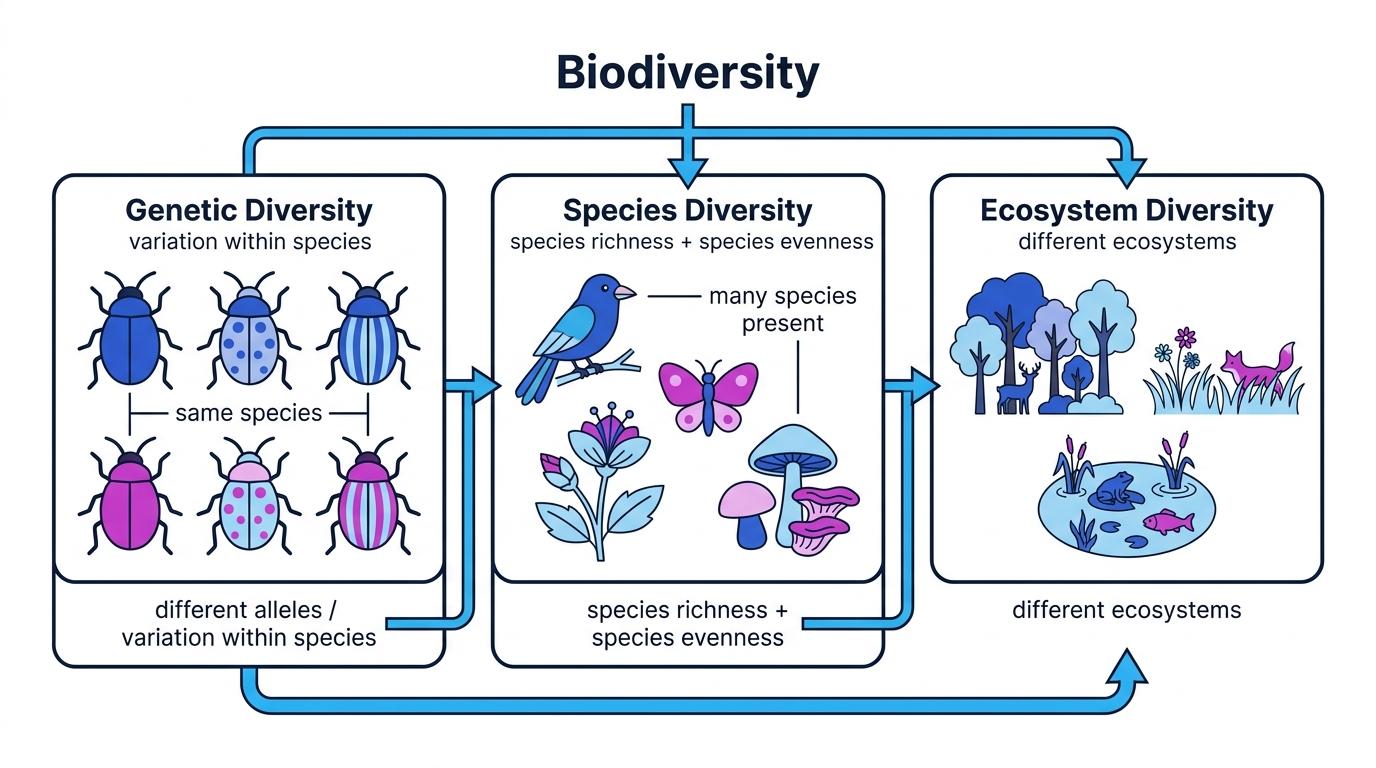
Biodiversity is the variety of living organisms in an area, usually considered at three levels: genetic diversity, species diversity and ecosystem diversity.
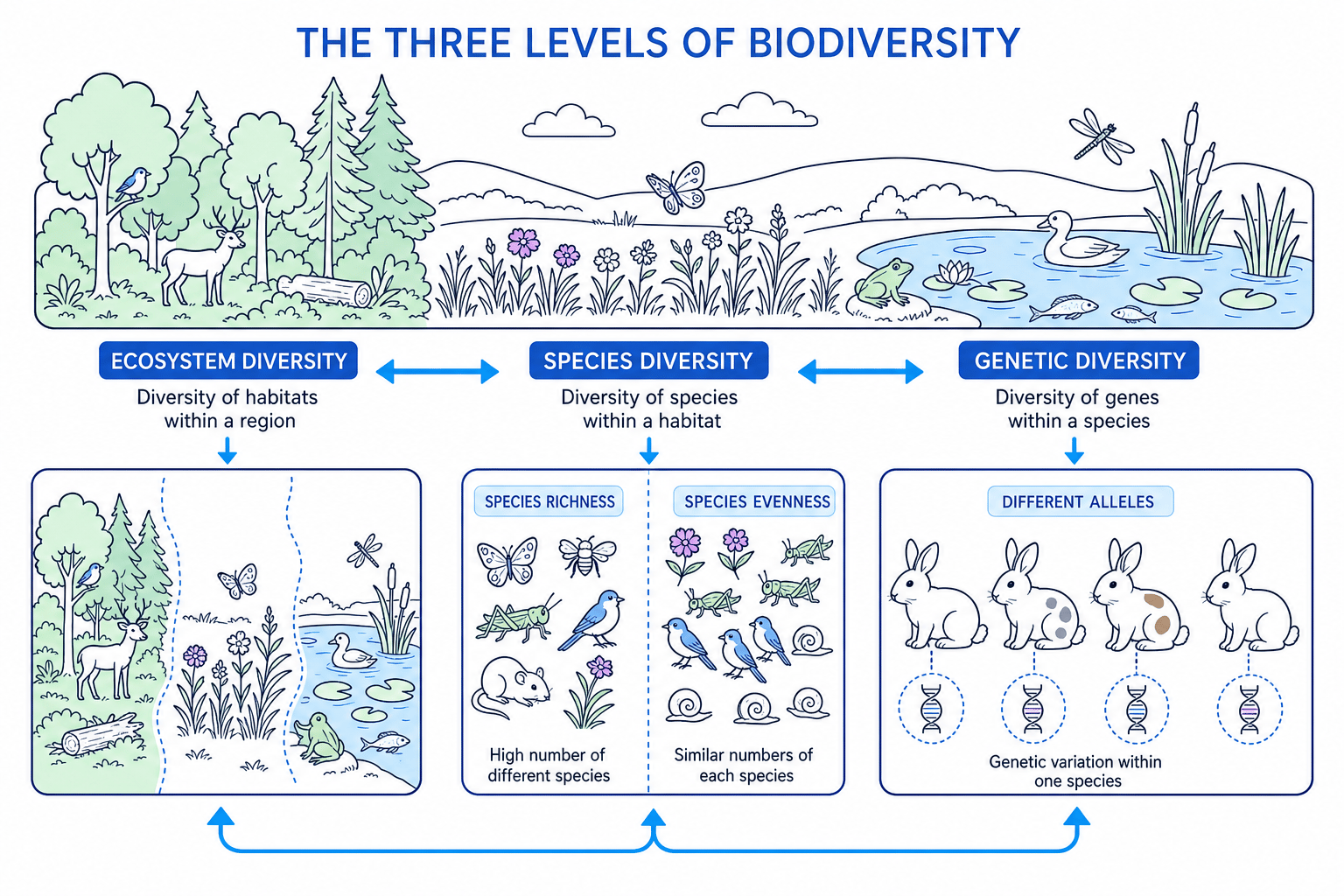
The diagram shows how these three levels fit together: variation within one species, variation between species, and variation between habitats or ecosystems.
Genetic diversity
Genetic diversity is variation in the genetic material of individuals within a species. At A-level, this usually means variation in alleles, which are different versions of the same gene.
High genetic diversity gives a population more chance of containing individuals with alleles that help them survive a change, such as a new disease or a warmer climate.
Species diversity
Species diversity describes the variety of species in a community, but it has two parts.
Species richness and species evenness
Species richness is the number of different species present. Species evenness is how evenly individuals are distributed between those species.
A habitat with 10 species is not automatically very diverse if almost every individual belongs to just one of those species. A highly diverse habitat usually has many species and no single species completely dominates.
Comparing richness and evenness
Two ponds each contain 40 invertebrates from four species.
Pond A contains 10 of each species. Pond B contains 37 of one species and 1 of each of the other three species.
-
Compare species richness: both ponds contain four species, so their richness is the same.
-
Compare species evenness: Pond A has individuals spread equally across the four species, while Pond B is dominated by one species.
-
Decide which is more diverse: Pond A has greater species diversity because it has the same richness but much higher evenness.
Diversity is not just a species list
For species diversity, always think about both how many species are present and how many individuals of each species are present.
Ecosystem diversity
An ecosystem includes all the organisms in an area plus the abiotic, or non-living, factors they interact with, such as light intensity, soil pH, water availability and temperature.
Ecosystem diversity is the variety of ecosystems or habitats in a region. For example, one nature reserve might contain woodland, grassland, heathland and freshwater ponds.
Endemism
Some species are especially important because they occur in only one place.
Endemic species
An endemic species is a species found naturally in only one particular geographical area, such as one island, lake, mountain range or country.
Endemism often develops where populations are isolated for long periods. For example, islands can have many endemic species because populations are separated from mainland populations, so gene flow is reduced and evolution can follow a different path.
Endemic species are vulnerable because if their local habitat is destroyed, the species may become extinct globally. This is why areas with many endemic species are often conservation priorities.
Endemic does not just mean native
A native species occurs naturally in an area, but it may also occur naturally elsewhere. An endemic species is naturally found only in that area.
Measuring biodiversity in the field
You usually cannot count every organism in a habitat, so you collect a sample.
Sampling
Sampling means collecting data from a smaller part of a population or habitat, then using it to estimate patterns in the whole area.
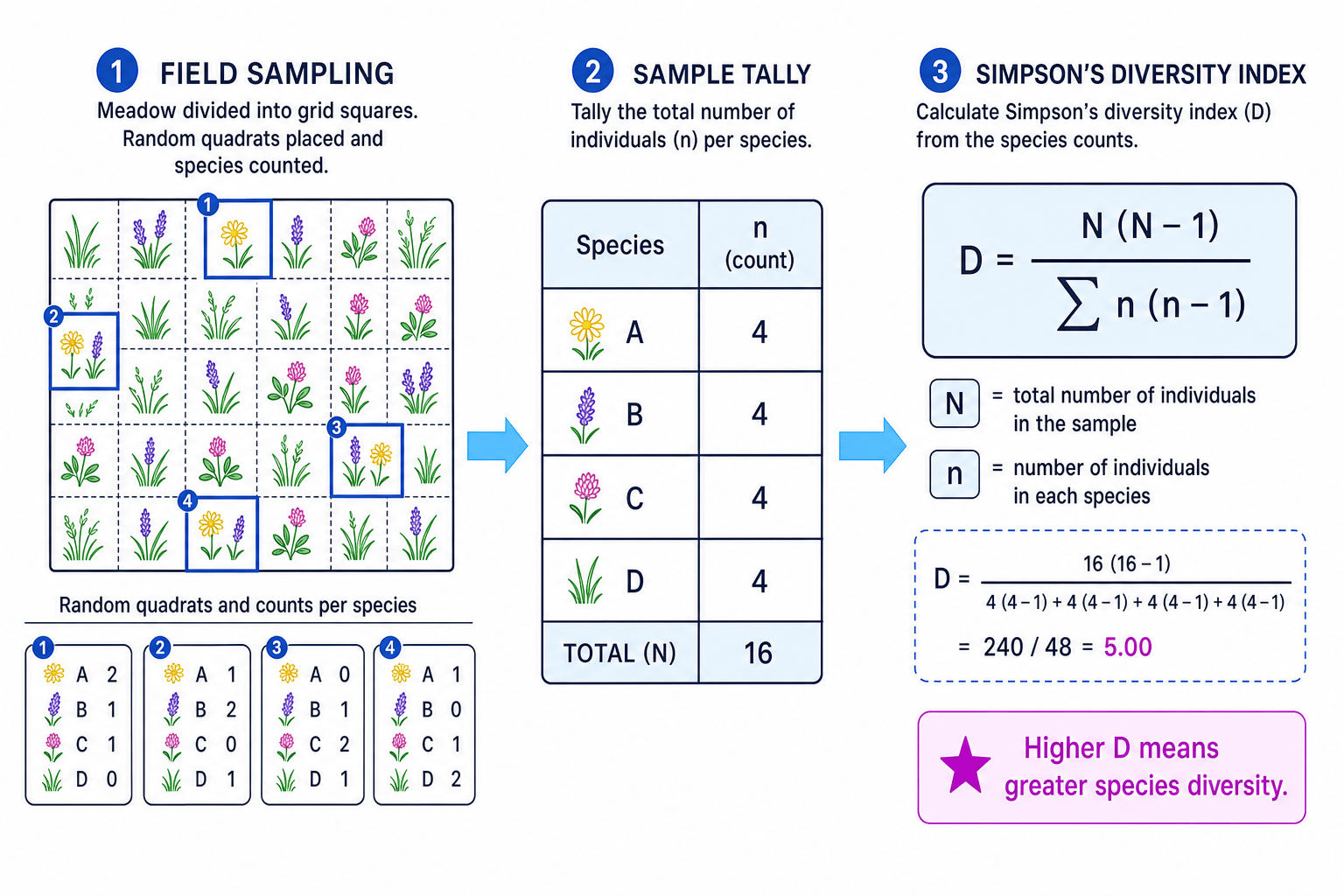
For plants or slow-moving organisms, you might use a quadrat, which is a square frame placed on the ground so you can record organisms within a known area.
If there is no obvious environmental gradient, use random sampling. For example, divide the field into a grid and use random numbers to choose coordinates for quadrat positions. This reduces bias.
If there is a clear gradient, such as distance from a path, light intensity from a woodland edge, or height on a rocky shore, use systematic sampling, often with a transect. A transect is a line along which samples are taken.
A field investigation often moves from quadrat sampling, to species counts, to a diversity index.
Choosing a sampling method
You want to investigate how plant species change from the edge of a woodland into open grassland.
-
Identify the pattern being tested: distance from the woodland edge is an environmental gradient, so purely random quadrats might miss the trend.
-
Choose a suitable method: place a tape measure from the woodland into the grassland and sample at regular distances using quadrats along a transect.
-
Control the sampling effort: use the same quadrat size, the same distance intervals and the same method of recording abundance at each point.
-
Link method to conclusion: if species composition changes consistently with distance, you can relate biodiversity to the woodland-edge gradient.
Presence is not abundance
Simply ticking whether a species is present can estimate species richness, but it cannot properly measure evenness or Simpson’s diversity index. You need counts or a consistent abundance estimate.
Simpson’s diversity index
A diversity index combines species richness and evenness into one number. Pearson Edexcel A commonly uses this form:
D=N(N−1)∑n(n−1)D = \frac{N(N - 1)}{\sum n(n - 1)}D=∑n(n−1)N(N−1)Where:
- DDD is Simpson’s diversity index.
- NNN is the total number of individuals of all species.
- nnn is the number of individuals of one species.
- ∑\sum∑ means “add up” the values for all species.
Simpson’s diversity index
Simpson’s diversity index is a numerical measure of species diversity calculated from the abundance of each species in a sample. With the Edexcel formula above, a higher value of DDD means greater species diversity.
The denominator means: calculate n(n−1)n(n - 1)n(n−1) for each species separately, then add all those values together.
Calculating Simpson’s diversity index
A set of quadrats gives these counts: species A 20, species B 15, species C 10 and species D 5.
-
Find the total number of individuals: N=20+15+10+5=50N = 20 + 15 + 10 + 5 = 50N=20+15+10+5=50 individuals.
-
Calculate the denominator by adding each n(n−1)n(n - 1)n(n−1) value: ∑n(n−1)=20(19)+15(14)+10(9)+5(4)=700\sum n(n - 1) = 20(19) + 15(14) + 10(9) + 5(4) = 700∑n(n−1)=20(19)+15(14)+10(9)+5(4)=700.
-
Substitute into the formula: D=50(50−1)700=2450700=3.5D = \frac{50(50 - 1)}{700} = \frac{2450}{700} = 3.5D=70050(50−1)=7002450=3.5.
-
Interpret the result: D=3.5D = 3.5D=3.5 has no units because it is calculated from counts. It can be compared with another value calculated using the same sampling method.
Interpreting the value
With this version of the formula, higher DDD means greater species diversity.
A habitat can have a higher value because it has:
- more species present;
- a more even distribution of individuals between species;
- or both.
You should only compare diversity indices fairly if the samples were collected in comparable ways. For example, using the same quadrat size, similar total area sampled, similar time of year and the same identification method makes the comparison more valid.
Different Simpson formulae
Some resources use different forms of Simpson’s index. In an Edexcel question, use the formula given in the question or specification. For D=N(N−1)∑n(n−1)D = \frac{N(N - 1)}{\sum n(n - 1)}D=∑n(n−1)N(N−1), higher DDD means higher diversity.
Why biodiversity matters
Biodiversity has practical and ecological value. Diverse ecosystems can be more stable because if one species declines, other species may still carry out similar roles.
Biodiversity also supports natural resources and ecosystem services, including food production, pollination, soil formation, nutrient cycling, water purification and potential sources of medicines or useful genes.
Loss of biodiversity can reduce ecosystem resilience, especially if genetic diversity is low or if endemic species are lost.
In the exam
-
When defining biodiversity, mention variety at genetic, species and ecosystem levels.
-
For species diversity, always refer to both richness and evenness, not just the number of species.
-
For Simpson’s index, find NNN, calculate each n(n−1)n(n - 1)n(n−1), add the denominator, substitute carefully, and state that DDD has no units.
-
When evaluating field data, discuss sampling method, sample size, random or systematic placement, season, identification accuracy and whether the methods were comparable.
Check yourself
- What is the difference between a native species and an endemic species?
- Why can two habitats with the same species richness have different species diversity?
- When would a transect be more suitable than random quadrats?