What you'll learn
- What makes a cell eukaryotic rather than prokaryotic.
- The structure and function of the key organelles in animal, plant, algal and fungal cells.
- How organelles work together, especially in protein synthesis and secretion.
- How to explain adaptations of specialised eukaryotic cells.
Starting point: what is a eukaryotic cell?
A cell is the basic unit of life. A eukaryotic cell is more complex than a prokaryotic cell because it contains a nucleus and many specialised internal structures.
Eukaryotic cell and organelle
A eukaryotic cell is a cell with its genetic material enclosed in a nucleus. An organelle is a specialised structure inside a cell that carries out a particular function.
The cytoplasm is the material inside the cell-surface membrane, excluding the nucleus, where many metabolic reactions take place and organelles are suspended.
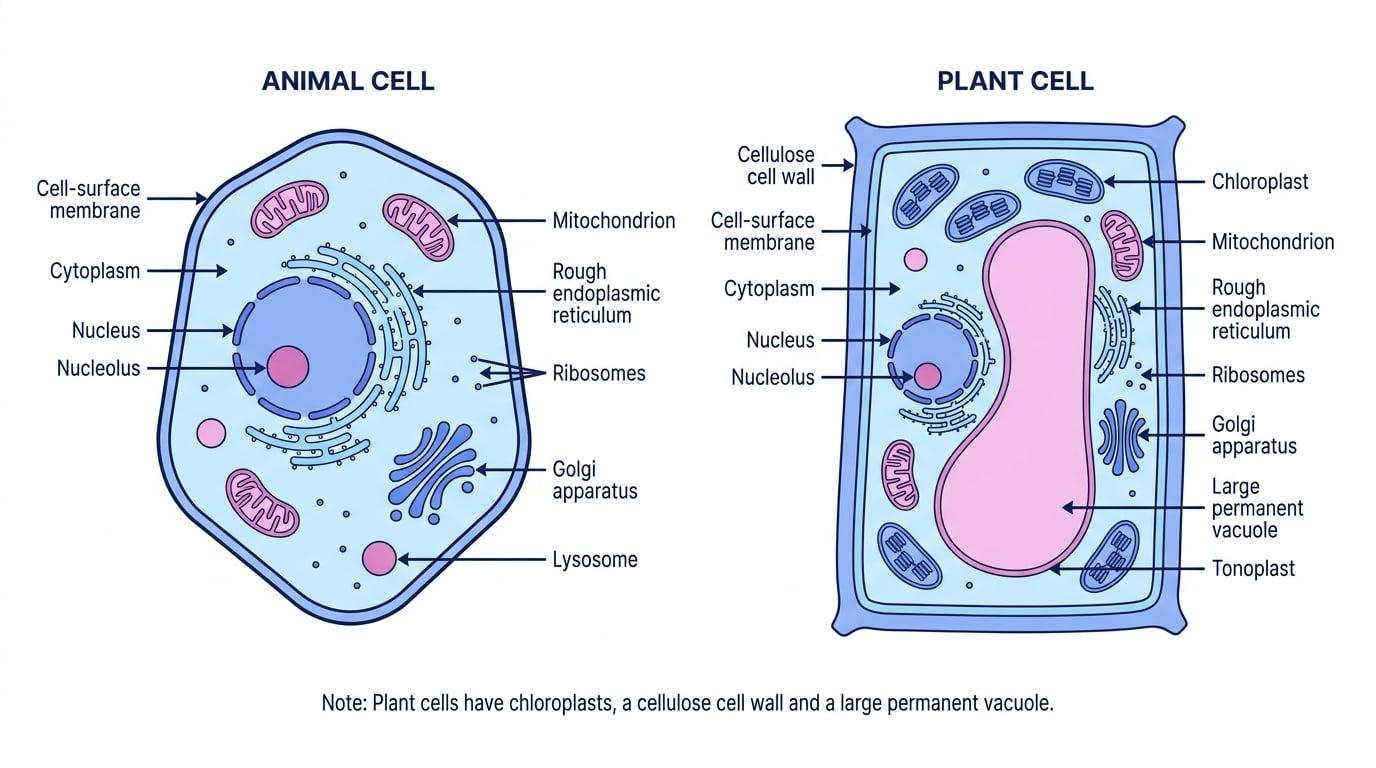
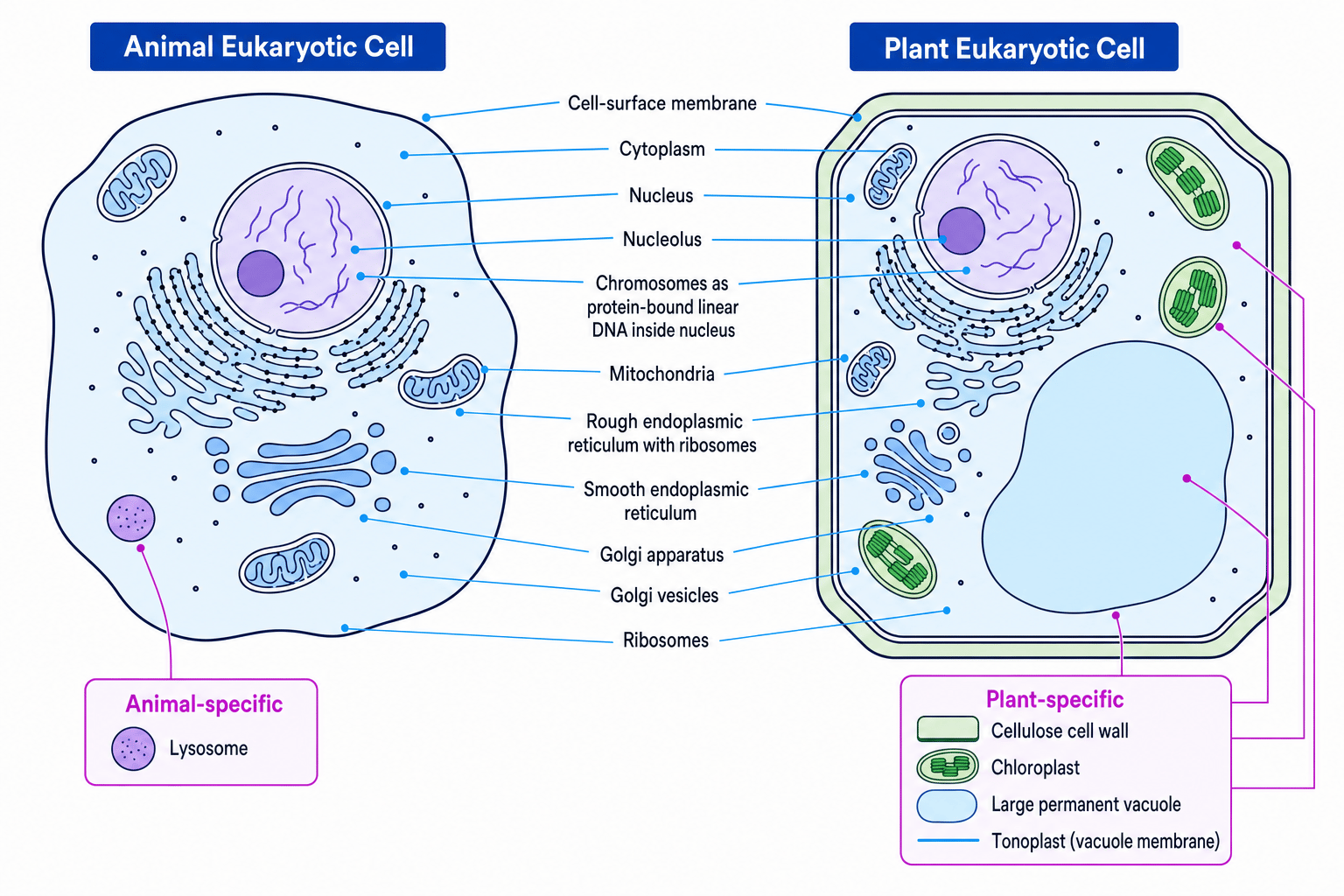
The diagram below gives you the big picture before we zoom in on each structure.
Structure links to function
In A-Level Biology, you are rarely expected to just name an organelle. You usually need to link its structure to the process it carries out and then to the function of the whole cell.
The cell-surface membrane: the boundary
The cell-surface membrane is the thin, partially permeable membrane surrounding the cell. “Partially permeable” means it allows some substances through more easily than others.
Its main functions are to:
- control movement of substances into and out of the cell
- separate the cell contents from the external environment
- allow cell signalling and recognition through membrane proteins
Many organelles also have membranes. These internal membranes create separate compartments, so different reactions can happen in different conditions inside the same cell.
The nucleus: genetic control centre
The nucleus is a large membrane-bound organelle that contains the cell’s genetic material. It is surrounded by a nuclear envelope, which has nuclear pores that allow some molecules to move between the nucleus and cytoplasm.
Inside the nucleus are chromosomes. A chromosome is a long molecule of DNA associated with protein. In eukaryotic cells, chromosomes consist of protein-bound, linear DNA. “Linear” means each DNA molecule has ends, unlike circular DNA found in many prokaryotes. “Protein-bound” means the DNA is associated with proteins such as histones.
The nucleus also contains one or more nucleoli. A nucleolus is a region where ribosomal RNA is made and ribosome subunits begin to be assembled.
The nucleus controls cell activities because genes in DNA contain instructions for making proteins.
Mitochondria: ATP production
A mitochondrion is a membrane-bound organelle where aerobic respiration takes place. Aerobic respiration is the process that releases energy from respiratory substrates, such as glucose, using oxygen.
The useful energy-transfer molecule made is ATP, short for adenosine triphosphate. ATP is used for energy-requiring processes such as active transport, movement and building large molecules.
Mitochondria have:
- a double membrane
- a highly folded inner membrane, forming cristae
- a fluid-filled matrix inside
The folds increase the surface area for reactions involved in aerobic respiration.
Plant cells still respire
Plant cells can contain both chloroplasts and mitochondria. Chloroplasts carry out photosynthesis, but mitochondria are still needed to make ATP by aerobic respiration.
Chloroplasts: photosynthesis in plants and algae
Chloroplasts are organelles found in plants and algae. They are the site of photosynthesis, the process that uses light energy to make organic molecules such as glucose.
Chloroplasts contain the green pigment chlorophyll, which absorbs light energy. They also contain internal membranes arranged as flattened sacs called thylakoids, often stacked into grana. The fluid inside the chloroplast is called the stroma.
Not every plant cell has chloroplasts. For example, many root cells do not photosynthesise because they are not exposed to light.
Ribosomes, endoplasmic reticulum and Golgi apparatus
Some organelles work as a connected production and transport system.
Ribosomes
Ribosomes are small structures that are not membrane-bound. They are the site of protein synthesis. Some ribosomes are free in the cytoplasm, while others are attached to rough endoplasmic reticulum.
Rough endoplasmic reticulum
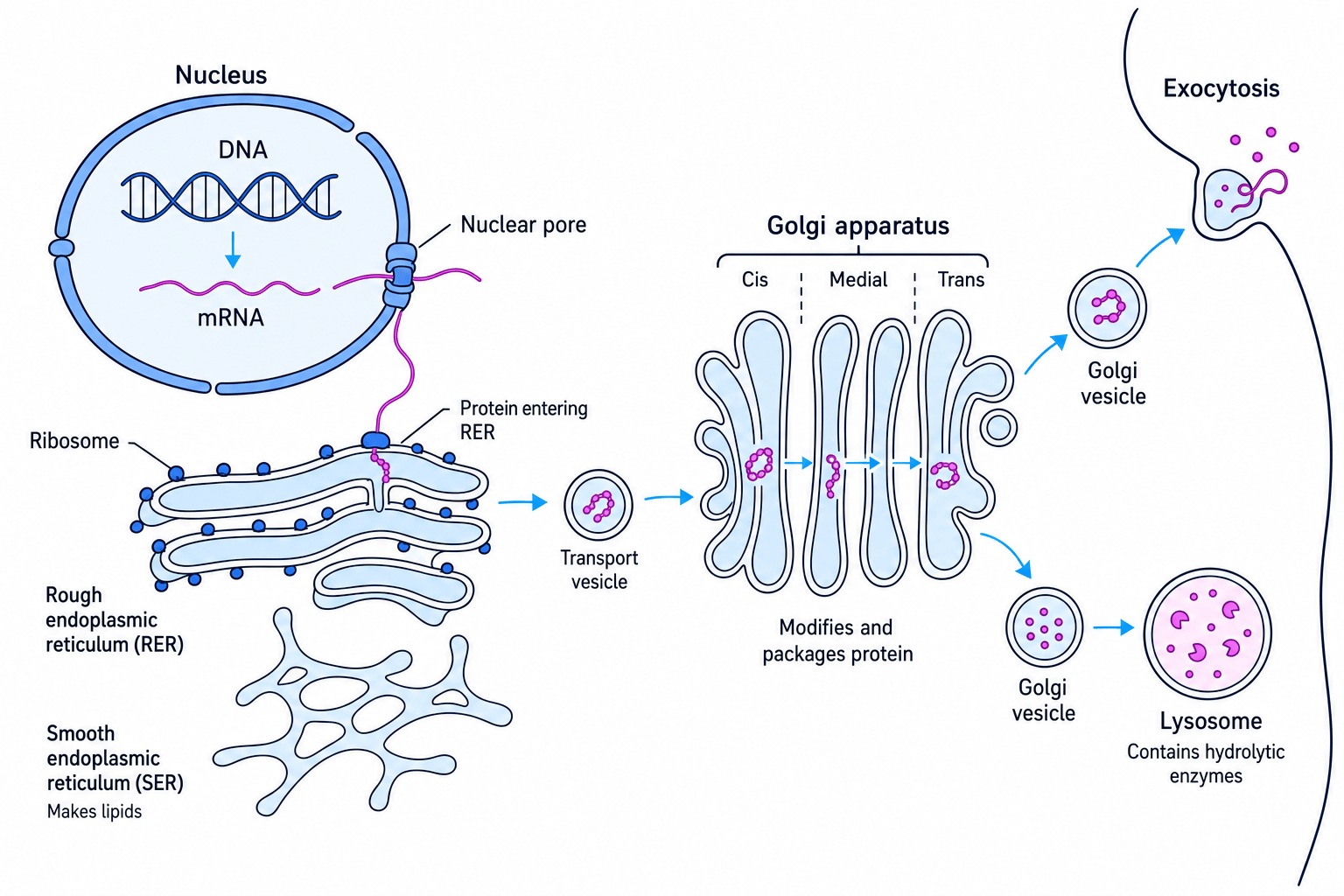
The rough endoplasmic reticulum, often shortened to RER, is a network of membranes with ribosomes attached to its surface. It is involved in making and transporting proteins, especially proteins that will be secreted from the cell or inserted into membranes.
Smooth endoplasmic reticulum
The smooth endoplasmic reticulum, or SER, is a network of membranes without ribosomes. It is involved in lipid synthesis and, in some cells, detoxification of harmful substances.
Golgi apparatus and Golgi vesicles
The Golgi apparatus is a stack of flattened membrane-bound sacs. It modifies proteins and lipids, then packages them into Golgi vesicles. A vesicle is a small membrane-bound sac used for transport or storage.
Golgi vesicles may move to the cell-surface membrane and release their contents by exocytosis, where a vesicle fuses with the membrane. Some Golgi vesicles become lysosomes.
Lysosomes
A lysosome is a membrane-bound organelle that releases hydrolytic enzymes. Hydrolytic enzymes catalyse hydrolysis reactions, which break down large molecules using water.
Lysosomes are important in digesting worn-out organelles, breaking down material taken into the cell, and destroying pathogens inside some immune cells.
The pathway below shows how several organelles cooperate when a cell makes and secretes a protein.
Explaining a secretory cell
A cell in the pancreas secretes digestive enzymes. Explain why it contains many ribosomes, lots of rough endoplasmic reticulum, a large Golgi apparatus and many mitochondria.
- Digestive enzymes are proteins, so the cell needs many ribosomes to synthesise large quantities of protein.
- Because the enzymes are secreted, much of this protein is made on ribosomes attached to rough endoplasmic reticulum, which helps transport the proteins through the cell.
- The Golgi apparatus modifies and packages the enzymes into vesicles, so a large Golgi apparatus supports high rates of secretion.
- Vesicle movement, protein synthesis and exocytosis all require ATP, so many mitochondria are needed to supply ATP by aerobic respiration.
Cell walls and vacuoles
Some eukaryotic cells have structures outside the usual animal-cell plan.
Cell wall
A cell wall is a rigid layer outside the cell-surface membrane. Plant and algal cell walls are made mainly of cellulose. Fungal cell walls are made mainly of chitin.
Cell walls:
- provide support
- maintain cell shape
- prevent cells bursting when water enters by osmosis
The cell wall is freely permeable to many substances, so it is not the main structure controlling entry and exit from the cell.
Cell wall is not the membrane
Do not say the cell wall controls what enters and leaves the cell. The cell-surface membrane is partially permeable and controls exchange; the cell wall mainly provides support.
Cell vacuole
A plant cell vacuole is a large, permanent, fluid-filled compartment surrounded by a membrane called the tonoplast. The fluid inside is cell sap, which contains water, ions, sugars and other solutes.
The vacuole helps maintain turgor pressure. Turgor pressure is the pressure of the cell contents against the cell wall, helping plant tissues stay firm.
Specialised eukaryotic cells
In complex multicellular organisms, cells become specialised, meaning they are adapted to carry out particular functions.
A tissue is a group of similar cells working together. An organ is a structure made from different tissues working together. An organ system is a group of organs working together to perform a major function.
For example:
- muscle cells form muscle tissue
- muscle tissue, nervous tissue and blood vessels help form organs
- organs such as the stomach and intestines form part of the digestive system
Specialised cells often have unusually high numbers of particular organelles.
| Specialised cell | Useful adaptations |
|---|---|
| Palisade mesophyll cell | Many chloroplasts for photosynthesis; large vacuole helps push chloroplasts towards the cell edge |
| Secretory cell | Many ribosomes, RER, Golgi apparatus and vesicles for producing and releasing proteins |
| Muscle cell | Many mitochondria to supply ATP for contraction |
| Root hair cell | Large surface area and many mitochondria to support uptake of mineral ions |
Linking organelles to a palisade mesophyll cell
A palisade mesophyll cell in a leaf has many chloroplasts and a large permanent vacuole. Explain how these features help its function.
- The function of a palisade mesophyll cell is mainly photosynthesis, so having many chloroplasts increases the amount of chlorophyll available to absorb light.
- More light absorption can increase the rate at which light-dependent reactions occur, provided other factors are not limiting.
- The large permanent vacuole helps keep the cell turgid and can push chloroplasts closer to the cell edge, shortening the diffusion pathway for carbon dioxide inside the cell.
Writing adaptation answers
Use this pattern: feature → process → advantage. For example, “many mitochondria → more ATP produced by aerobic respiration → supports active transport.”
In the exam
- If asked to explain an adaptation, do not stop at naming an organelle; link it to the process and the cell’s function.
- Be precise with plant cells: chloroplasts are found in photosynthetic plant and algal cells, while mitochondria are still needed for respiration.
- Keep the hierarchy clear: specialised cells form tissues, tissues form organs, and organs form organ systems.
Check yourself
- Which organelles would be especially abundant in a cell that secretes protein, and why?
- What is the difference between the nucleus, nucleolus and chromosomes?
- Why is it incorrect to say that the cell wall controls what enters and leaves a plant cell?