Regulation of transcription and translation (A-level only)
What you'll learn
- How transcription factors can switch target genes on or off in eukaryotic cells.
- How oestrogen, a steroid hormone, can initiate transcription.
- How epigenetic changes alter gene expression without changing the DNA base sequence.
- How RNA interference can stop mRNA being translated into protein.
The big picture: controlling gene expression
A cell does not use every gene all the time. Different cell types contain the same DNA, but they express different genes, so they make different proteins.
Gene expression
Gene expression is the process by which information in a gene is used to make a functional product, usually a protein. It includes transcription of DNA into mRNA and often translation of mRNA into a polypeptide.
A target gene is a gene whose expression is being controlled by a particular signal, transcription factor, epigenetic mark, or RNA molecule.
There are two important control points in this topic:
- Before mRNA is made: control of transcription.
- After mRNA is made: control of translation, for example by RNA interference.
Two main control points
If less mRNA is produced, regulation is happening at transcription or mRNA stability. If mRNA is present but less protein is made, regulation may be happening at translation.
Transcription factors: proteins that control transcription
Transcription factor
A transcription factor is a protein that affects whether a target gene is transcribed. It may bind directly to DNA or interact with other proteins involved in transcription.
In eukaryotic cells, DNA is inside the nucleus, but many signalling molecules and inactive transcription factors may be in the cytoplasm. Some transcription factors only affect genes after they move into the nucleus through nuclear pores.
Transcription factors can:
- Stimulate transcription by helping RNA polymerase bind to the promoter.
- Inhibit transcription by blocking RNA polymerase or preventing other transcription factors from binding.
Promoter
A promoter is a DNA sequence near the start of a gene where RNA polymerase and transcription factors bind to begin transcription.
Oestrogen and initiation of transcription
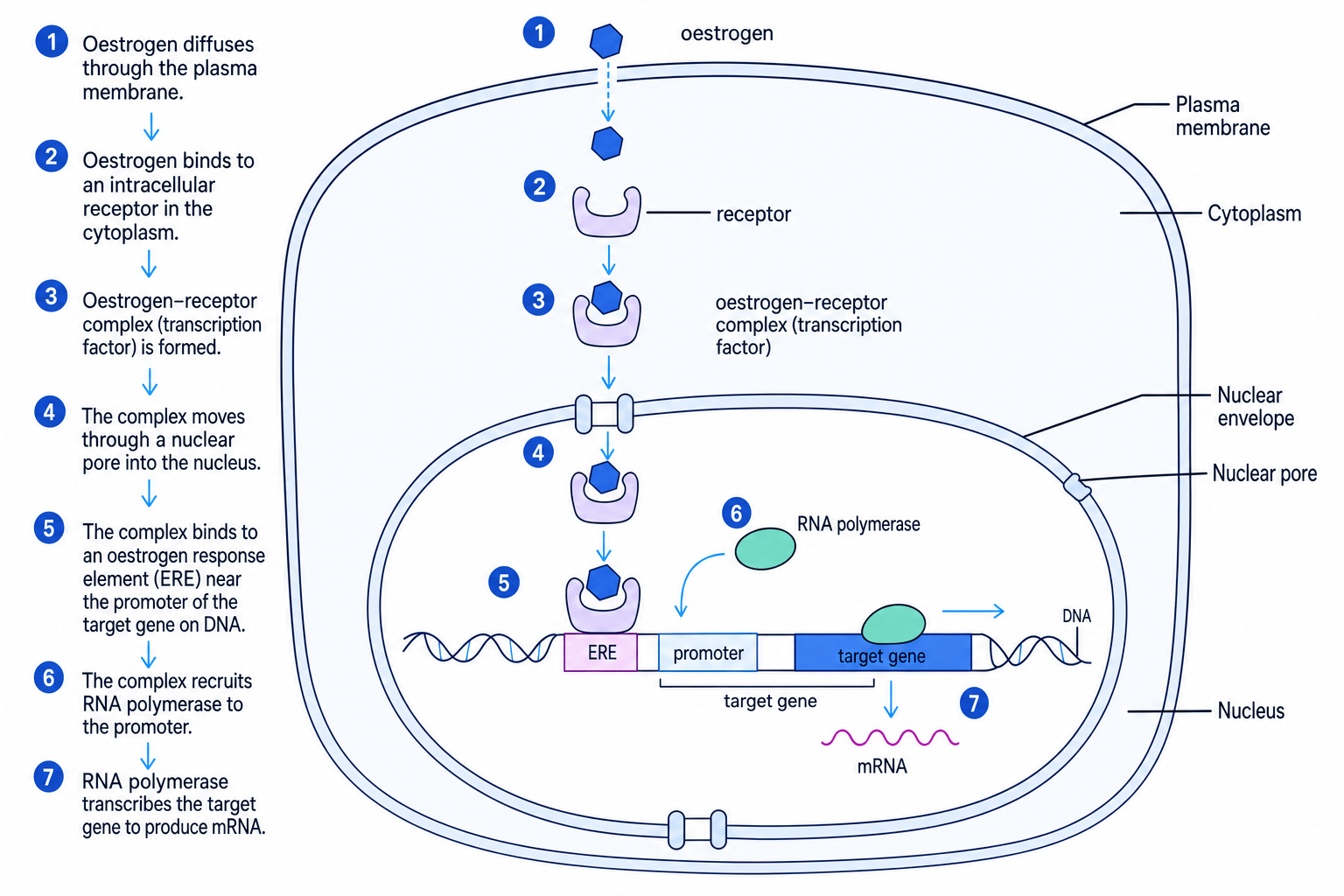
Oestrogen is a steroid hormone. Steroid hormones are lipid-soluble, so they can diffuse through the phospholipid bilayer of the cell-surface membrane.
In a target cell, oestrogen can initiate transcription like this:
- Oestrogen diffuses through the cell-surface membrane.
- It binds to an intracellular oestrogen receptor in the cytoplasm.
- The receptor changes shape, forming an oestrogen–receptor complex.
- The complex moves into the nucleus.
- It binds to a specific DNA sequence near the target gene.
- This helps RNA polymerase bind and transcribe the target gene into mRNA.
- The mRNA can then be translated into a protein.
Do not put the receptor on the cell surface
For this A-level mechanism, oestrogen binds to an intracellular receptor because it is lipid-soluble. This is different from many peptide hormones, which bind to receptors on the cell-surface membrane.
Interpreting oestrogen response data
A culture of target cells has relative mRNA abundance of 12 units without oestrogen and 48 units after oestrogen treatment.
-
Calculate the fold change by comparing treated cells with control cells:
fold change=4812=4.0\text{fold change} = \frac{48}{12}=4.0fold change=1248=4.0 -
A 4.0-fold increase in mRNA suggests more transcription of the target gene occurred after oestrogen was added.
-
Link this to the mechanism: oestrogen forms an oestrogen–receptor complex, which acts as a transcription factor in the nucleus and stimulates transcription of the target gene.
Epigenetic control of gene expression
Epigenetics
Epigenetics involves heritable changes in gene function without changes to the DNA base sequence. In this topic, “heritable” usually means passed on when cells divide.
Epigenetic changes affect how easily transcription machinery can access DNA. They can be influenced by environmental factors, such as diet, toxins, smoking, hormones, or stress.
The DNA sequence stays the same, but the gene may be more or less likely to be transcribed.
DNA, histones and chromatin
In eukaryotes, DNA is wrapped around proteins called histones. DNA plus histone proteins forms chromatin.
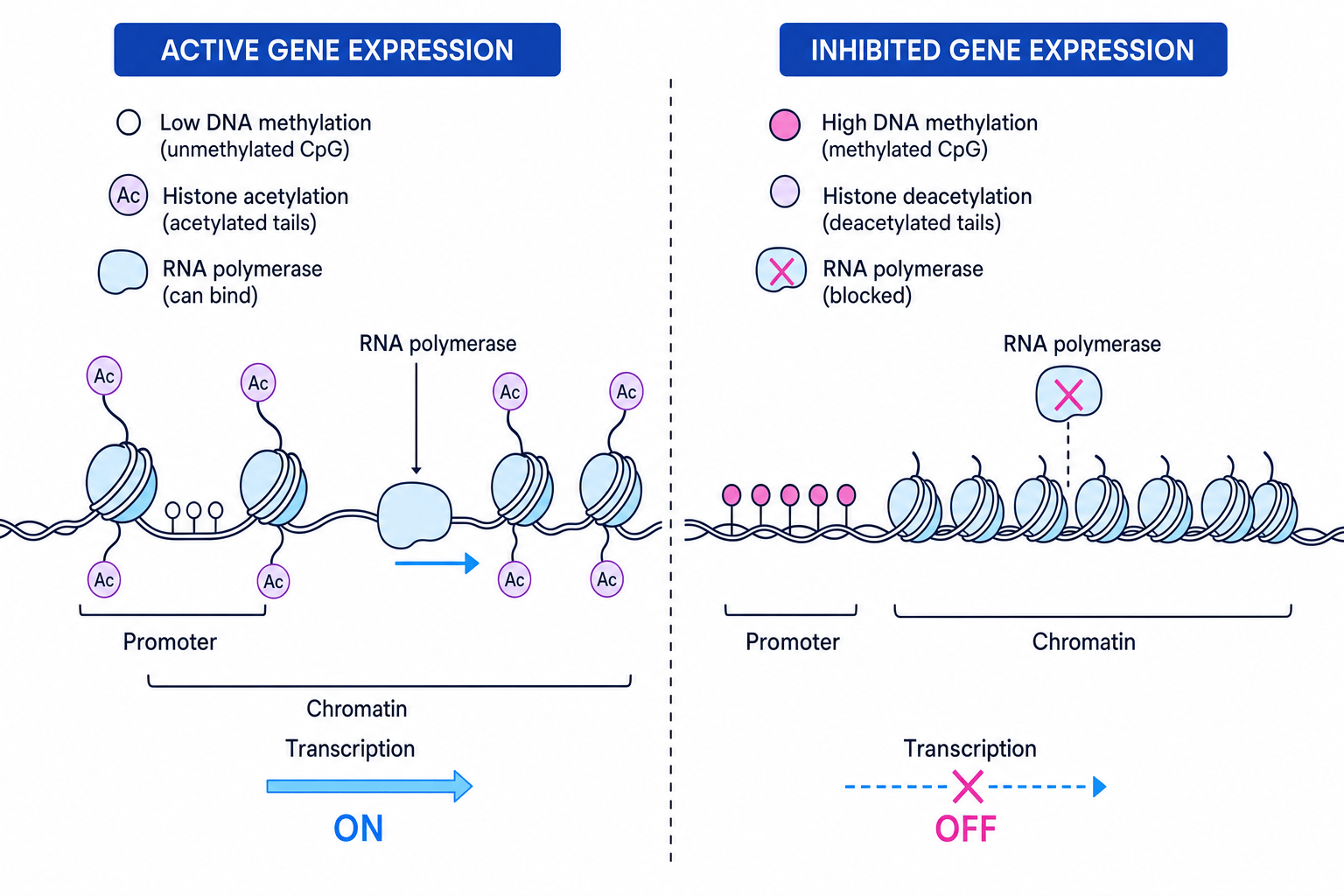
If chromatin is loose and open, transcription factors and RNA polymerase can reach the DNA more easily. If chromatin is tightly packed, transcription is usually reduced.
DNA methylation
DNA methylation
DNA methylation is the addition of methyl groups to DNA, often to cytosine bases near a gene promoter.
Increased methylation near a promoter usually inhibits transcription because it can prevent transcription factors from binding or attract proteins that make chromatin more condensed.
Histone acetylation
Histone acetylation
Histone acetylation is the addition of acetyl groups to histone proteins. It usually makes chromatin more open, increasing transcription.
So, decreased histone acetylation tends to inhibit transcription. Less acetylation means DNA is held more tightly around histones, so RNA polymerase has less access to the gene.
Methylation and acetylation have opposite effects here
For this specification: increased DNA methylation inhibits transcription, and decreased histone acetylation inhibits transcription.
Predicting transcription from epigenetic marks
A gene has high promoter methylation and low histone acetylation in diseased cells, but low methylation and high acetylation in healthy cells.
-
High promoter methylation makes it harder for transcription factors and RNA polymerase to access or bind the promoter.
-
Low histone acetylation means chromatin is more tightly packed, further reducing access to the DNA.
-
Therefore, the gene is likely to be transcribed less in the diseased cells than in the healthy cells.
Epigenetics, disease and cancer
Cancer involves uncontrolled cell division. Two gene types are especially important:
- Tumour suppressor genes slow the cell cycle, repair DNA, or trigger apoptosis.
- Oncogenes stimulate cell division when active.
Epigenetic changes can contribute to cancer. For example, if a tumour suppressor gene becomes highly methylated, it may be switched off even though its DNA base sequence has not changed. The cell may then divide when it should not.
Epigenetic treatments aim to reverse harmful gene silencing. Examples include:
- Drugs that reduce DNA methylation, potentially reactivating silenced genes.
- Histone deacetylase inhibitors, which increase histone acetylation and make chromatin more open.
Evaluating disease data
When you see data on methylation, acetylation, cancer risk, or gene expression, separate correlation from causation. A pattern may suggest a mechanism, but extra evidence is needed to prove that the epigenetic change caused the disease.
RNA interference: blocking translation
RNA interference
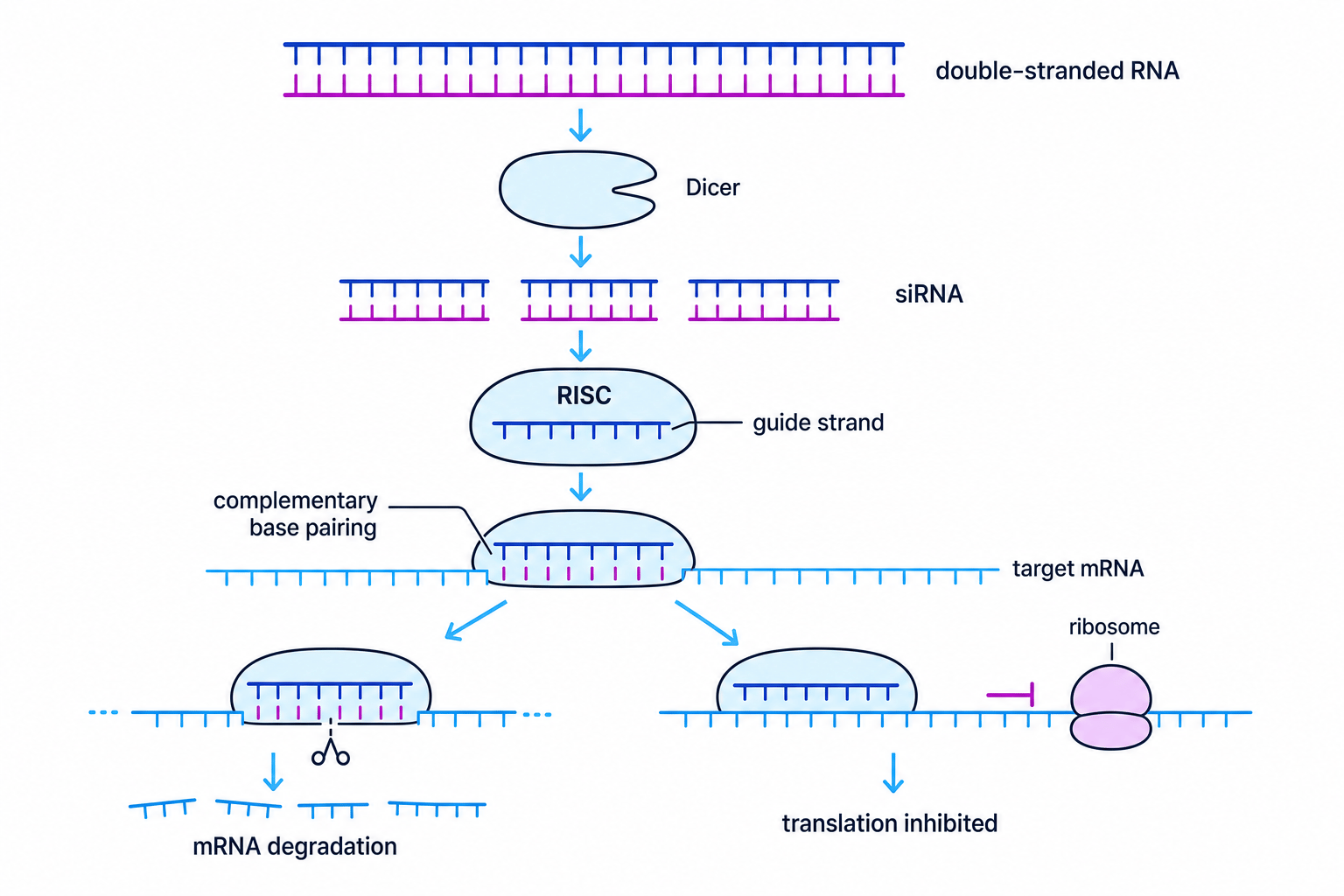
RNA interference, or RNAi, is a process where small RNA molecules inhibit gene expression by binding to complementary mRNA. This can cause mRNA degradation or prevent translation.
RNAi occurs in eukaryotes and some prokaryotes. It is a form of post-transcriptional control because the mRNA has already been produced.
A simplified RNAi pathway:
- Double-stranded RNA is cut into short fragments, often called small interfering RNA, or siRNA.
- One RNA strand becomes a guide strand in a protein complex called RISC.
- The guide strand binds to a complementary sequence on the target mRNA.
- The target mRNA is degraded or translation by the ribosome is blocked.
- Less protein is produced from that target gene.
Distinguishing transcriptional control from RNAi
A treatment causes protein concentration from a target gene to fall, but the amount of target mRNA stays almost the same.
-
If transcription had been inhibited, you would usually expect less mRNA to be produced from the gene.
-
Here, mRNA abundance is almost unchanged, so the treatment is probably not mainly reducing transcription.
-
The fall in protein despite similar mRNA suggests post-transcriptional control, such as RNAi blocking translation of the existing mRNA.
Evaluating genetic and environmental influences
A phenotype is an observable characteristic, such as disease status, height, or enzyme activity. Many phenotypes are affected by both genes and environment.
Useful evidence includes:
- Identical twin data: identical twins share almost all their DNA.
- Non-identical twin data: non-identical twins share about half their DNA.
- Adoption studies: these can help separate inherited genes from shared environment.
- Epigenetic data: this may show how environment affects gene expression.
Evaluating twin data
For a disease, concordance is 80% in identical twins raised together, 45% in non-identical twins raised together, and 55% in identical twins raised apart.
-
Identical twins raised together have higher concordance than non-identical twins raised together, suggesting a genetic influence.
-
Identical twins raised apart have lower concordance than identical twins raised together, suggesting the shared environment also affects the phenotype.
-
Identical twins raised apart still do not have 100% concordance, so non-shared environment or epigenetic differences may also be involved.
In the exam
-
Always state where regulation happens: transcription in the nucleus, or translation at ribosomes in the cytoplasm.
-
For epigenetics, explicitly say that the DNA base sequence is unchanged.
-
When interpreting data, describe the trend, compare with a control, and link the pattern to a mechanism such as methylation, acetylation, transcription factors, or RNAi.
Check yourself
- How does an oestrogen–receptor complex increase transcription of a target gene?
- Why does increased DNA methylation near a promoter usually reduce transcription?
- How could mRNA abundance stay the same while protein production decreases?