Most of a cell's DNA is not translated (A-level only)
What you'll learn
- Why cells with the same DNA can become very different specialised cells.
- The difference between totipotent, pluripotent, multipotent and unipotent cells.
- How induced pluripotent stem cells are made from adult body cells.
- How to evaluate stem cell treatments for human disorders.
The starting point: same DNA, different cells
Nearly all cells in your body contain the same genome, meaning the complete set of DNA in that organism. A neurone, a muscle cell and a pancreatic beta cell usually contain the same genes.
So why are they different?
Because they do not express all of those genes. A cell only uses part of its DNA at any one time. Genes that are needed are switched on; many others are switched off.
Gene expression
Gene expression is the process where information in a gene is used to make a functional product, usually a protein. This involves transcription, where DNA is copied into mRNA, followed by translation, where the mRNA is used to build a polypeptide at a ribosome.
Strictly, DNA itself is not translated directly. The gene is first transcribed into messenger RNA, then the mRNA is translated. In this topic, “most DNA is not translated” means most genes are not being used to make proteins in that particular cell.
Selective gene expression
Cell specialisation happens because different cells express different genes, producing different proteins, which give each cell its structure and function.
Linking gene expression to specialisation
A pancreatic beta cell secretes insulin, but a neurone transmits nerve impulses. Explain why the two cells can be different even though they contain the same DNA.
- The beta cell must express genes coding for proteins involved in insulin production and secretion, because insulin is a protein hormone.
- The neurone must express genes coding for proteins such as membrane ion channels, receptors and enzymes involved in neurotransmitter production.
- Because different genes are transcribed and translated in each cell, different proteins are produced.
- These different proteins give the cells different structures and functions, so the cells become specialised.
Thinking specialised cells have lost most genes
In most cases, specialised cells have not lost unwanted genes. The genes are still present in the DNA, but many are switched off and are not expressed. Mature red blood cells are an exception because they lose their nucleus, so do not use them as your default example.
Stem cells: cells that can become other cell types
A stem cell is an unspecialised cell that can divide and give rise to other cells. Some stem cells can produce many different cell types, while others are much more restricted.
Potency
Potency describes the range of different cell types that a stem cell can produce. A cell with high potency can produce a wider range of specialised cells.
The main idea is that, during development, potency generally decreases. Early embryo cells can form many cell types, but later stem cells become more restricted.
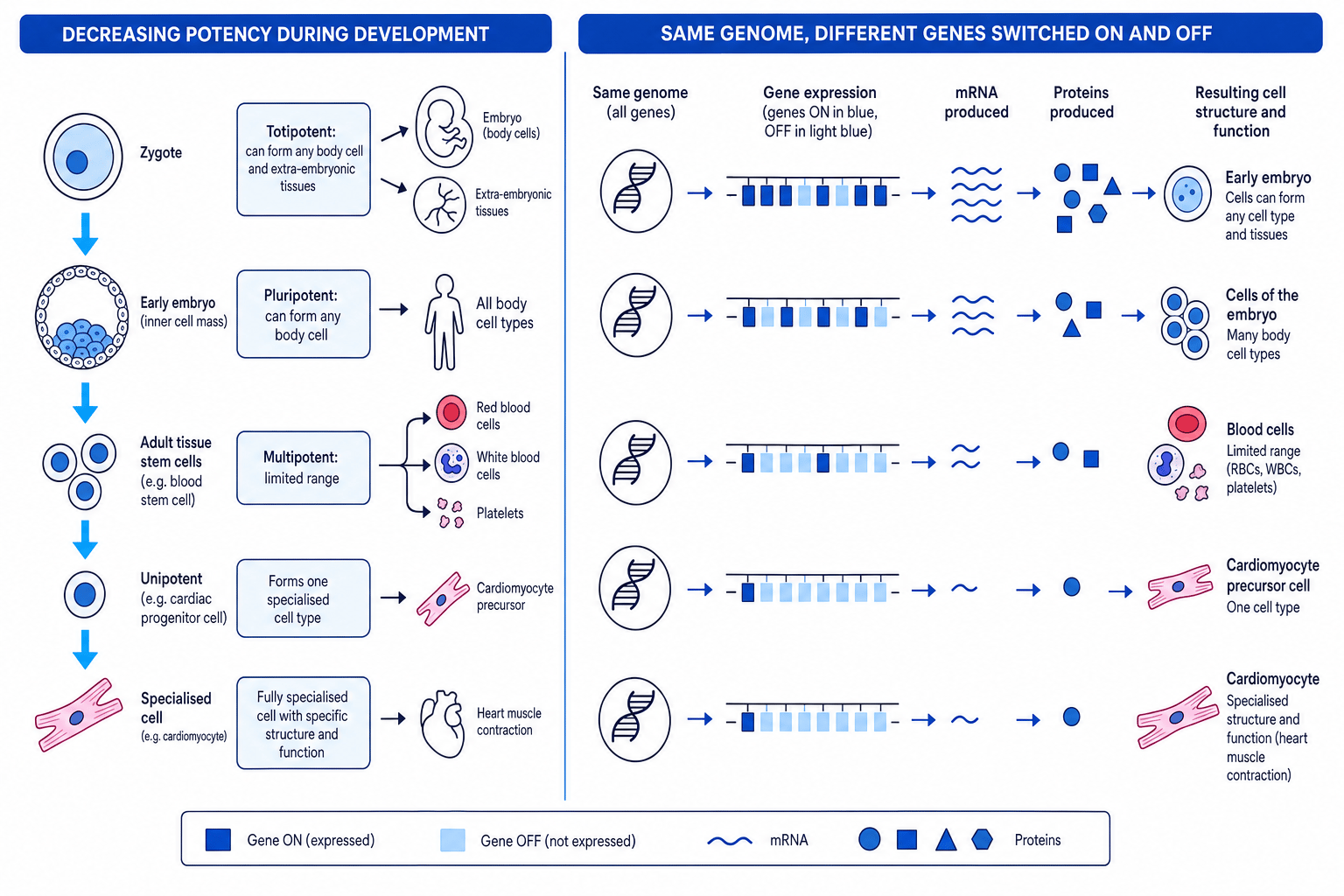
The diagram below shows how potency decreases during development, and how different patterns of gene expression lead to different specialised cells.
Totipotent cells
Totipotent cells can divide and produce any type of body cell. In mammals, they occur only for a limited time in the very early embryo.
During development, totipotent cells do not translate all of their DNA into proteins. Instead, only some genes are expressed. This selective gene expression leads to cell specialisation.
Pluripotent cells
Pluripotent cells are found in embryos. They can divide in unlimited numbers and can produce many different types of body cell.
They cannot produce every structure needed for a whole organism in the same way as totipotent cells, but they are still extremely useful because they can potentially form many specialised tissues.
Multipotent cells
Multipotent cells are found in mature mammals. They can divide to produce a limited number of different cell types.
For example, a blood stem cell in bone marrow can produce several blood cell types, such as red blood cells, white blood cells and platelets. It cannot produce neurones or muscle cells.
Unipotent cells
Unipotent cells are also found in mature mammals. They can divide to form only one specialised cell type.
A key example is the formation of cardiomyocytes, which are heart muscle cells that contract to help the heart pump blood.
| Cell type | Where found | What it can form |
|---|---|---|
| Totipotent | Very early mammalian embryo | Any type of body cell |
| Pluripotent | Embryos | Many body cell types |
| Multipotent | Mature mammals | A limited range of related cell types |
| Unipotent | Mature mammals | One specialised cell type |
Classifying stem cell potency
A researcher studies four cell samples:
- Cell A can form any type of body cell in an early mammalian embryo.
- Cell B can form neurones, muscle cells and epithelial cells, and can divide many times in culture.
- Cell C is from bone marrow and forms red blood cells, white blood cells and platelets.
- Cell D is a cardiac progenitor cell that forms cardiomyocytes only.
Classify each cell.
- Cell A has the widest developmental potential because it can form any type of body cell, so it is totipotent.
- Cell B can form many body cell types and divide repeatedly, but it is described as an embryonic cell rather than a whole-embryo-forming cell, so it is pluripotent.
- Cell C forms several related blood cell types, but not unrelated cells such as neurones or muscle cells, so it is multipotent.
- Cell D forms only cardiomyocytes, so it is unipotent.
How selective gene expression causes specialisation
As an embryo develops, cells receive signals from surrounding cells and from their environment. These signals affect which genes are switched on or off.
A very important group of regulatory proteins are transcription factors. These proteins bind to DNA and affect whether particular genes are transcribed into mRNA.
Transcription factor
A transcription factor is a protein that controls the transcription of genes by binding to specific regions of DNA and increasing or decreasing gene expression.
Once a cell starts expressing a certain combination of genes, it produces a certain set of proteins. Those proteins may include enzymes, receptors, structural proteins, transport proteins and more transcription factors. This can lock the cell into a particular developmental pathway.
For example, a developing heart muscle cell expresses genes for proteins involved in contraction. These proteins allow the cell to become a functioning cardiomyocyte.
A good exam phrase
Use this wording: “Cells become specialised because only some genes are expressed, so different proteins are produced.” This links DNA, gene expression, protein synthesis and cell function in one clear sentence.
Induced pluripotent stem cells
This is an A-level-only idea that exam questions often link to medicine.
A somatic cell is a normal body cell, not a gamete. Scientists can take adult somatic cells, such as skin cells, and reprogram them to behave like pluripotent stem cells.
Induced pluripotent stem cell
An induced pluripotent stem cell, or iPS cell, is a pluripotent cell produced from an adult somatic cell using appropriate protein transcription factors.
The protein transcription factors switch on genes associated with pluripotency. This changes the pattern of gene expression so that the adult cell behaves more like an embryonic pluripotent stem cell.
The sequence below summarises how adult somatic cells can be reprogrammed into iPS cells and then used to produce specialised cells.
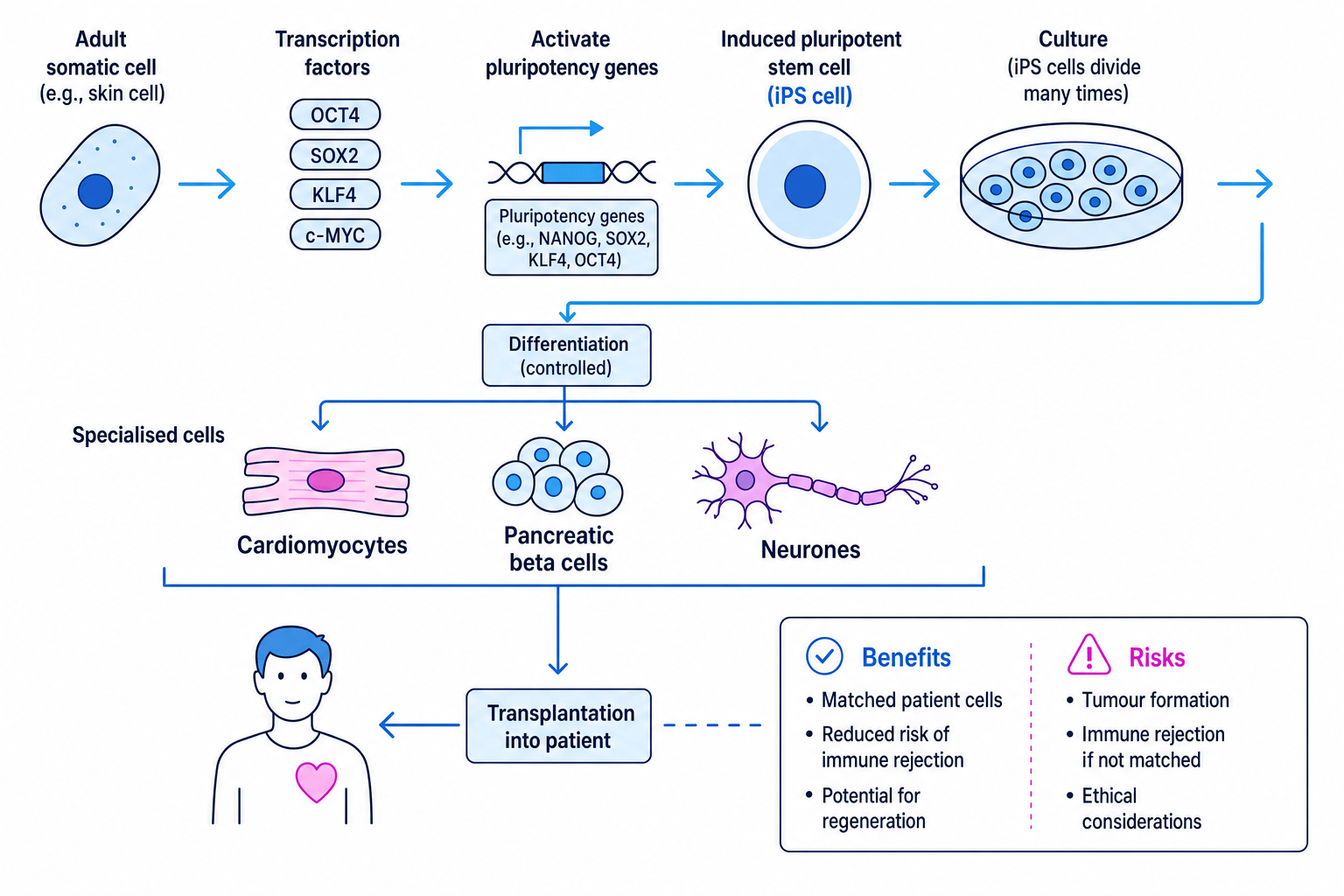
iPS cells are useful because they can divide many times and can be directed to differentiate into specialised cells, such as neurones, pancreatic beta cells or cardiomyocytes.
Using stem cells to treat human disorders
Stem cells may be used to replace damaged or missing cells. This is why pluripotent stem cells and iPS cells are important in medicine.
Possible uses include:
- replacing insulin-producing pancreatic beta cells in diabetes
- producing cardiomyocytes after damage to heart muscle
- replacing certain neurones in nervous system disorders
- growing tissue for research and drug testing
But you must be able to evaluate stem cell treatments, not just describe them.
Benefits
Stem cell treatments could replace cells that the body cannot easily replace itself. Pluripotent cells can divide in unlimited numbers, so they could provide a large supply of cells.
iPS cells may be made from the patient’s own cells. This could reduce the risk of immune rejection because the new cells are genetically similar to the patient.
Risks and limitations
Pluripotent cells can keep dividing, so if they are not controlled properly they may form tumours. There is also a risk that cells may differentiate into the wrong type of cell.
Embryonic stem cells can raise ethical concerns because embryos are destroyed when the stem cells are collected. iPS cells avoid some of these concerns, but they still need careful testing for safety.
Evaluating an iPS cell treatment for heart damage
A patient has damaged heart muscle after a heart attack. Scientists suggest making iPS cells from the patient’s skin cells, then differentiating them into cardiomyocytes for transplantation.
- The treatment matches the biology of the disorder because heart damage involves loss or damage of cardiomyocytes, so replacing cardiomyocytes could improve contraction of heart muscle.
- iPS cells are a suitable starting point because they can divide many times and are pluripotent, so they can potentially be directed to become cardiomyocytes.
- Using the patient’s own skin cells could reduce immune rejection compared with using donor cells, because the transplanted cells are more likely to have the patient’s own antigens.
- The treatment still has risks because any undifferentiated iPS cells might keep dividing and form tumours, and differentiation must be carefully controlled.
- A balanced conclusion is that the treatment has strong potential, but it would only be acceptable if safety, tumour risk and correct differentiation were carefully controlled.
Only giving advantages
Evaluation means weighing up both sides. If a question says “evaluate”, include benefits, risks or limitations, and a justified overall judgement.
A practical link: tissue culture of cauliflower explants
You may meet this topic through tissue culture of plant material, such as cauliflower, Brassica oleracea.
An explant is a small piece of tissue taken from an organism and grown in culture. In plant tissue culture, explants are placed on a sterile nutrient medium containing suitable growth substances.
This links to potency because many plant cells can be encouraged to divide and produce new tissues under the right conditions. Mature mammalian cells are generally much more restricted, which is why the stem cell potency terms in this topic matter.
Tissue culture
Tissue culture is the growth of cells or tissues outside the organism on a nutrient medium, usually under sterile conditions.
Plant versus mammal comparison
Do not assume mammalian adult cells behave like plant cells in tissue culture. In mature mammals, stem cells are usually multipotent or unipotent, not totipotent.
In the exam
- Use precise potency words: totipotent means any body cell; pluripotent means many body cell types; multipotent means a limited range; unipotent means one cell type.
- Link specialisation to selective gene expression, not loss of genes: different genes are expressed, so different proteins are made.
- For stem cell treatments, balance promise against risk: mention cell replacement and unlimited division, but also tumour formation, immune rejection, ethical issues and controlled differentiation.
Check yourself
- Why can two specialised cells contain the same DNA but produce different proteins?
- How would you distinguish between pluripotent, multipotent and unipotent cells?
- What are two advantages and two risks of using iPS cells in medical treatment?