What you'll learn
- How benign and malignant tumours differ.
- How oncogenes and tumour suppressor genes affect the cell cycle.
- How abnormal DNA methylation and oestrogen can contribute to cancer.
- How to evaluate evidence linking genetic and environmental factors with cancer risk.
Starting point: gene expression and cell division
Gene expression means using the information in a gene to make a functional product, usually a protein. In this topic, the important proteins are those that help control the cell cycle, the ordered sequence of events by which a cell grows, replicates its DNA and divides by mitosis.
Normal cells do not divide continuously. They respond to signals such as growth factors, check whether DNA is damaged, and may stop dividing or undergo apoptosis, which is programmed cell death.
Cancer is loss of control
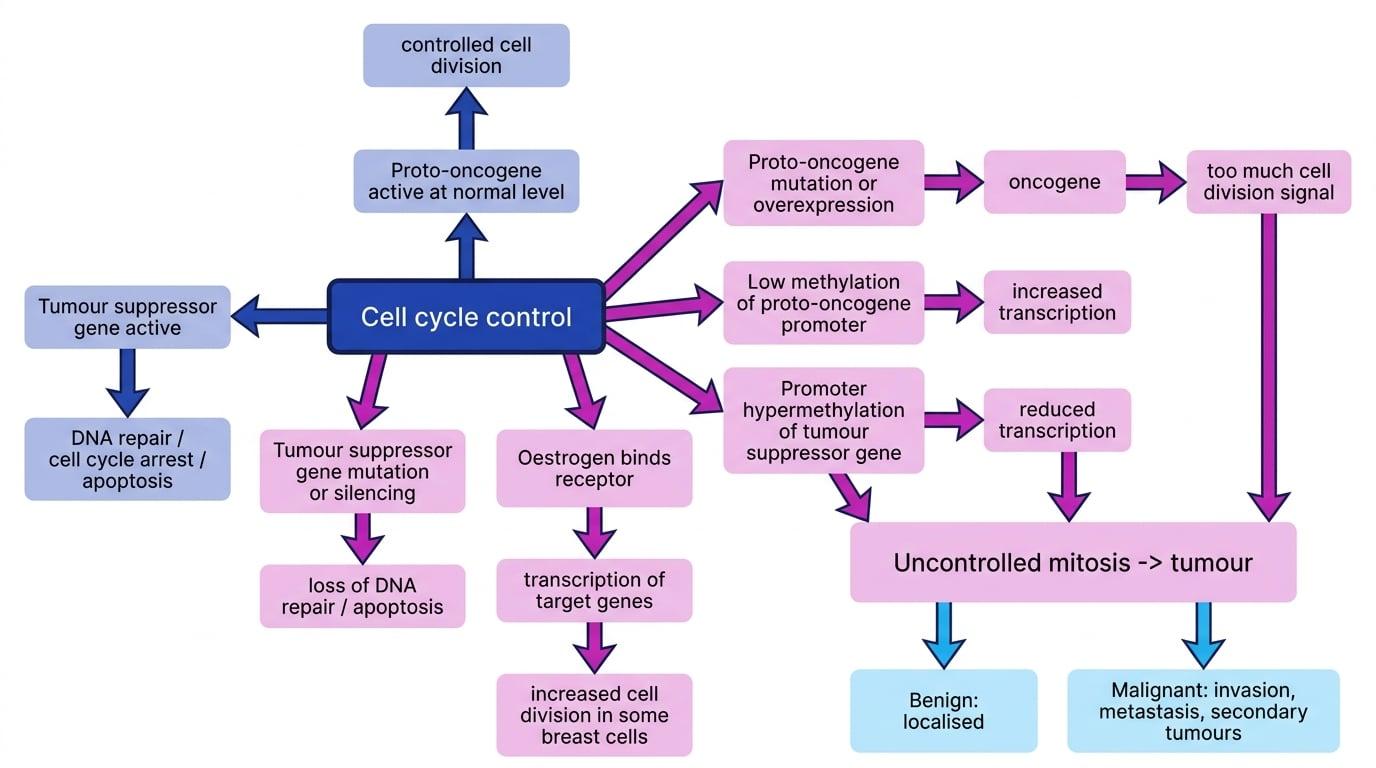
Cancer develops when genetic and epigenetic changes cause cells to divide when they should not, fail to repair DNA properly, or avoid apoptosis.
The overview below links the main A-level ideas: oncogenes, tumour suppressor genes, abnormal methylation and tumour formation.
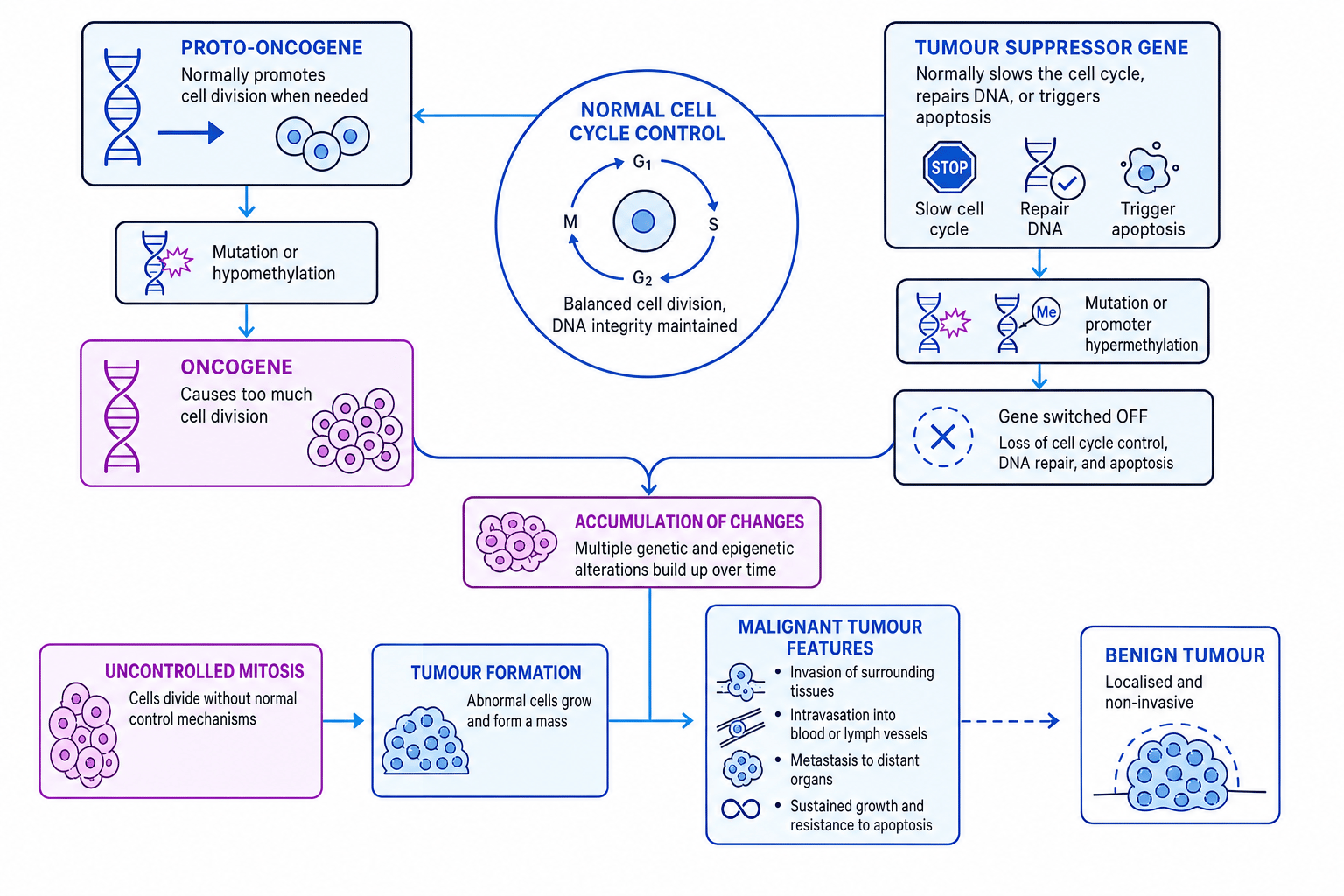
Tumours: benign and malignant
A tumour is a mass of abnormal cells produced by uncontrolled cell division. Not all tumours are cancerous.
Benign and malignant tumours
A benign tumour is a non-cancerous mass of cells that remains localised and does not invade surrounding tissues. A malignant tumour is cancerous: it can invade surrounding tissues and spread to other parts of the body.
Benign tumours
Benign tumours usually:
- grow relatively slowly
- stay in one place
- are often surrounded by a capsule of tissue
- are less likely to be life-threatening
- do not form secondary tumours elsewhere
They can still cause problems if they press on organs, block ducts, or release hormones.
Malignant tumours
Malignant tumours usually:
- grow more rapidly
- are less well differentiated, meaning the cells look and behave less like specialised normal cells
- invade surrounding tissues
- can enter the blood or lymph
- can spread and form secondary tumours
Metastasis is the spread of cancer cells from the original tumour to other parts of the body, where they may form new tumours.
Benign does not mean harmless
Benign means non-invasive and non-metastatic. It does not always mean the tumour has no effect on the body.
Mutations and tumour development
A mutation is a change in the DNA base sequence. Some mutations affect genes that control the cell cycle, DNA repair or apoptosis. These mutations can give a cell a growth advantage, so it divides more than neighbouring cells.
A mutagen is an agent that increases the rate of mutation. Examples include tobacco smoke chemicals, ultraviolet radiation and ionising radiation.
Tumours usually develop after several mutations or epigenetic changes have accumulated. This is why cancer risk often increases with age: there has been more time for changes to build up in dividing cells.
Explaining why cancer often needs several changes
A cell has one mutation that slightly increases cell division. Explain why this may not immediately produce a malignant tumour.
- The mutation may affect only one control pathway, while other checkpoints can still slow the cell cycle or trigger apoptosis.
- If DNA repair genes and tumour suppressor genes are still functioning, damaged cells may be repaired or destroyed before a tumour forms.
- A malignant tumour usually requires further changes, such as activation of oncogenes and inactivation of tumour suppressor genes, so that cells both divide excessively and avoid normal controls.
Proto-oncogenes and oncogenes
A proto-oncogene is a normal gene that codes for a protein involved in stimulating cell division. Proto-oncogenes are not “bad” genes — you need them for growth, tissue repair and normal development.
If a proto-oncogene is mutated or expressed too much, it can become an oncogene.
Oncogene
An oncogene is an altered or overactive gene that stimulates cell division too much, increasing the chance of tumour formation.
Oncogenes are often described as gain-of-function changes: the gene product becomes too active, is made in too large an amount, or is produced at the wrong time.
Common effects include:
- growth factor receptors being active without a growth factor
- signalling proteins staying switched on
- transcription factors increasing expression of genes needed for mitosis
- cyclins being produced in excess, pushing cells through the cell cycle
Because oncogenes involve extra activity, one altered copy of the gene can sometimes be enough to affect the cell.
Oncogene shortcut
Think of an oncogene as an accelerator pedal stuck down: the cell receives too much “divide” signal.
Tumour suppressor genes
A tumour suppressor gene is a normal gene that helps prevent uncontrolled cell division.
Tumour suppressor genes may code for proteins that:
- slow or stop the cell cycle
- check for DNA damage
- repair damaged DNA
- trigger apoptosis if the damage is too severe
If tumour suppressor genes are inactivated, the cell loses important safety mechanisms. This makes tumour formation more likely.
Examples you may meet include TP53, which is involved in stopping the cell cycle and triggering apoptosis, and BRCA1/BRCA2, which are involved in DNA repair.
Tumour suppressor gene changes are often loss-of-function changes. Often both copies of the gene must be inactivated before the protective effect is lost.
Tumour suppressor shortcut
Think of tumour suppressor genes as the brakes. Cancer is more likely if the accelerator is stuck down and the brakes fail.
Comparing oncogenes and tumour suppressor genes
A cancer cell has one overactive allele of gene A and two inactive alleles of gene B. Gene A normally promotes mitosis; gene B normally repairs DNA. Identify which gene is likely to be an oncogene and which is likely to be a tumour suppressor gene.
- Gene A normally promotes mitosis, so overactivity would increase cell division. That matches a proto-oncogene becoming an oncogene.
- Gene B normally repairs DNA, so inactivation would remove protection against mutation accumulation. That matches a tumour suppressor gene.
- The pattern also fits the usual allele behaviour: one overactive copy can be enough for an oncogene effect, while tumour suppressor genes often require loss of both copies.
Abnormal methylation and cancer
DNA methylation is the addition of a methyl group to DNA. It is an epigenetic change, meaning it affects gene expression without changing the DNA base sequence.
Methylation often reduces transcription of a gene, especially when it occurs near a gene’s promoter region. A promoter is a DNA sequence where RNA polymerase binds to begin transcription.
Methylation of tumour suppressor genes
If the promoter of a tumour suppressor gene becomes abnormally methylated, transcription may be reduced or stopped. Less mRNA is produced, so less tumour suppressor protein is made.
This can have the same effect as a mutation that inactivates the gene: the cell loses control over division, DNA repair or apoptosis.
Methylation of oncogenes
Oncogenes can also be affected by abnormal methylation. If a proto-oncogene becomes abnormally hypomethylated, meaning it has less methylation than normal, it may be transcribed more often.
That can lead to overproduction of proteins that stimulate cell division.
Methylation is not always a mutation
Methylation changes gene expression but does not change the base sequence. So it is epigenetic, not a DNA mutation.
Oestrogen and some breast cancers
Oestrogen is a steroid hormone involved in the menstrual cycle and development of female secondary sexual characteristics. Some breast cells have oestrogen receptors.
Because oestrogen is lipid-soluble, it can pass through the cell surface membrane and bind to an intracellular receptor. The oestrogen-receptor complex can act as a transcription factor, affecting transcription of target genes.
In some breast cancers, increased oestrogen concentration can increase the rate of cell division in breast tissue. More cell division means more DNA replication, which increases the opportunity for mutations to occur and accumulate. If breast cancer cells have oestrogen receptors, oestrogen may also stimulate the tumour to grow.
This is why some treatments aim to reduce oestrogen signalling. For example, anti-oestrogen drugs can block oestrogen receptors, and aromatase inhibitors can reduce oestrogen production.
Why hormones matter
Oestrogen does not have to be a mutagen to increase cancer risk. By stimulating cell division, it can increase the number of DNA replications and the chance that mutations become fixed in cells.
Evaluating evidence for cancer risk
You need to be able to evaluate evidence showing correlations between genetic and environmental factors and different forms of cancer.
A correlation is a relationship between two variables. For example, as exposure to tobacco smoke increases, lung cancer risk also increases. However, correlation alone does not prove causation.
When evaluating evidence, ask:
- Is the sample size large enough?
- Was the study repeated by different researchers?
- Are there confounding variables, such as age, sex, diet, smoking or occupation?
- Is there a dose-response relationship?
- Is there a plausible biological mechanism?
- Does the exposure happen before the cancer develops?
- Are the data about relative risk or absolute risk?
Genetic factors include inherited alleles that increase cancer risk, such as some BRCA1 or BRCA2 variants. Environmental factors include smoking, ultraviolet radiation, ionising radiation, alcohol, some viruses such as HPV, and exposure to asbestos.
Evaluating a breast cancer risk correlation
A study finds that people carrying a particular BRCA1 allele have a lifetime breast cancer risk of 65%, compared with 12% in people without the allele. Explain how you would evaluate this evidence.
- Compare the risks: the carrier group has a much higher risk. The relative increase is approximately 65÷12≈5.465 \div 12 \approx 5.465÷12≈5.4, so the association is strong.
- Consider biological plausibility: BRCA1 is involved in DNA repair, so a faulty allele could allow mutations to accumulate, increasing tumour risk.
- Check whether the study controlled for confounding variables, such as age, family history, reproductive history, hormone exposure and lifestyle.
- Avoid overclaiming: the allele increases risk but does not guarantee cancer, because environmental factors and additional mutations also affect whether a tumour develops.
Using gene knowledge in prevention and treatment
Understanding oncogenes and tumour suppressor genes can help with prevention, treatment and possible cures.
Prevention
Prevention may involve reducing exposure to mutagens. For example, avoiding tobacco smoke reduces exposure to chemicals that damage DNA. Using protection against ultraviolet radiation reduces DNA damage in skin cells.
Genetic screening can identify people with inherited high-risk alleles. This does not mean they definitely have cancer, but it can guide monitoring, lifestyle choices or preventative treatment.
Vaccination can also reduce cancer risk when infection is involved. For example, HPV vaccination reduces the risk of cervical cancer because some HPV proteins interfere with tumour suppressor pathways.
Treatment
Cancer treatment can be more targeted if doctors know which genes or proteins are abnormal in the tumour.
Examples include:
- drugs that inhibit overactive signalling proteins produced by oncogenes
- drugs that block oestrogen receptors in oestrogen-receptor-positive breast cancers
- drugs that reduce oestrogen production
- treatments that aim to reactivate silenced tumour suppressor genes, although this is difficult
- sequencing tumours to choose drugs most likely to work
Cure
A cure requires removal or destruction of all malignant cells. This is challenging because cancer cells in the same tumour can have different mutations. Some cells may be resistant to a drug, survive treatment and later divide again.
Cancer is not one disease
Different cancers involve different tissues, mutations and environmental factors. Do not write as if one gene, one treatment or one cause explains every cancer.
In the exam
- When comparing tumours, use the key words benign, malignant, invasion, metastasis and secondary tumours accurately.
- For oncogenes, explain increased stimulation of cell division; for tumour suppressor genes, explain loss of inhibition, DNA repair or apoptosis.
- When evaluating evidence, separate correlation from causation, then discuss sample size, confounding variables, strength of association and biological mechanism.
Check yourself
- Why can abnormal methylation of a tumour suppressor gene have a similar effect to a mutation in that gene?
- How does a malignant tumour differ from a benign tumour?
- Why can increased oestrogen concentration increase the risk or growth of some breast cancers?