Recombinant DNA technology (A-level only)
What you'll learn
- Why a gene from one organism can often work inside another organism.
- How DNA fragments are obtained using cDNA, restriction enzymes or a gene machine.
- How DNA fragments are amplified by PCR or by culturing transformed host cells.
- How vectors, ligases, promoter regions, terminator regions and marker genes are used to make and identify GM cells.
The big idea: moving DNA between organisms
Recombinant DNA technology involves transferring a fragment of DNA from one organism, or species, into another. The recipient organism is then genetically modified.
Recombinant DNA
Recombinant DNA is DNA made by joining DNA fragments from two or more different sources, often from different organisms or species.
A genetically modified organism that contains DNA from another species is often called a transgenic organism. For example, a bacterium can be given a human gene so that it produces a human protein, such as insulin.
This works because the genetic code is universal: the same DNA triplets, called codons, code for the same amino acids in almost all organisms. The basic processes of transcription and translation are also shared by cells.
Why transferred genes can work
If the recipient cell can transcribe the inserted DNA into mRNA and translate that mRNA at ribosomes, it can make the protein coded for by the transferred gene.
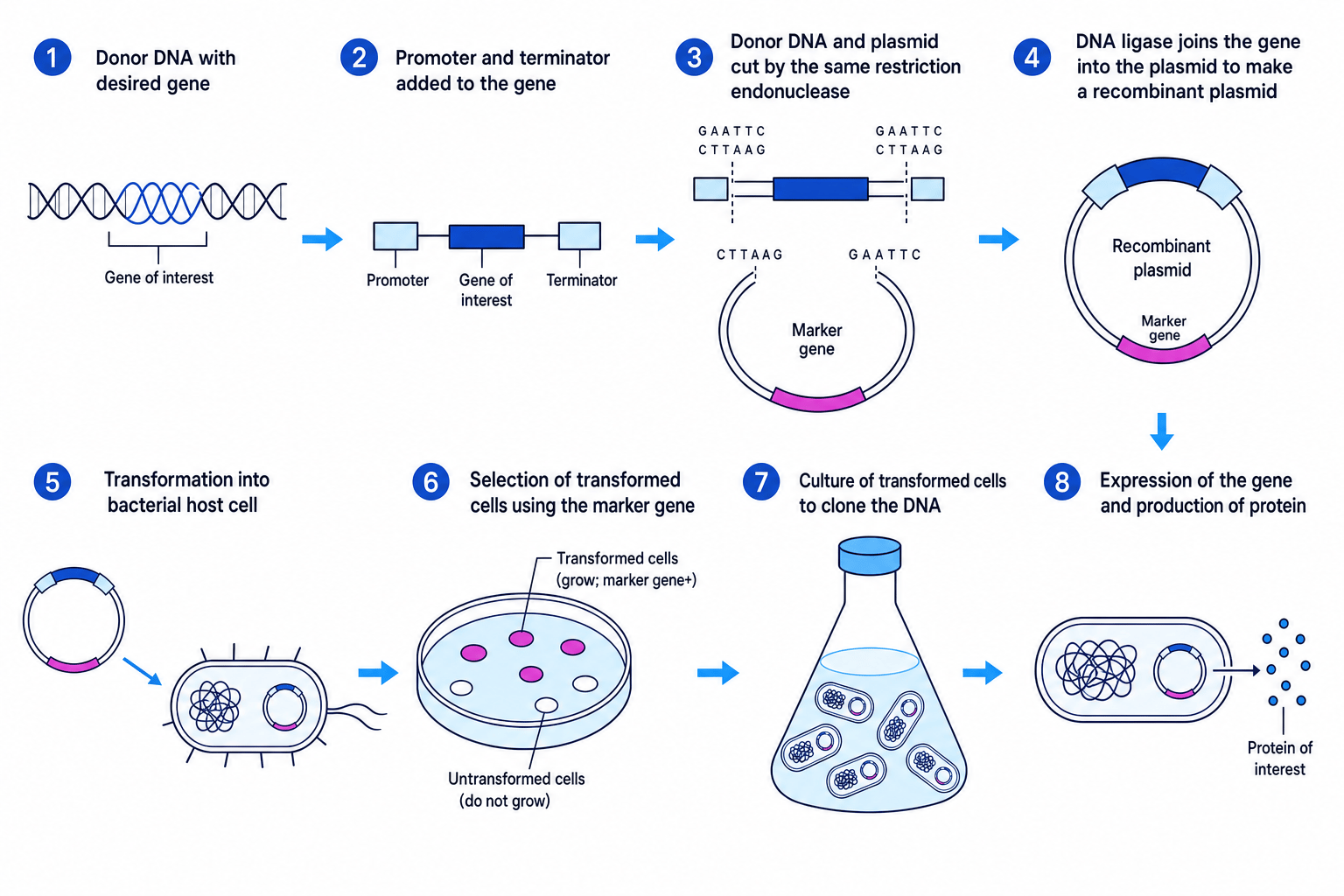
Here is the overall logic of a typical recombinant DNA process using a bacterial plasmid.
Step 1: obtaining the DNA fragment
Before DNA can be inserted into a host cell, you need the correct DNA fragment. This is usually the gene you want, plus any extra DNA needed to control its expression.
There are three main A-level methods.
Method 1: making cDNA from mRNA
A eukaryotic gene in the nucleus often contains introns, which are non-coding sections removed during RNA processing. Bacteria cannot remove introns, so if you want a bacterial cell to express a human gene, it is often better to start with mature mRNA.
cDNA
Complementary DNA, or cDNA, is DNA made from an mRNA template using the enzyme reverse transcriptase.
The steps are:
- Isolate mature mRNA from cells where the gene is being expressed.
- Use reverse transcriptase to make a complementary DNA strand.
- Use DNA polymerase to make a double-stranded cDNA copy.
Because mature mRNA has already had introns removed, cDNA usually contains only the coding sequence needed to make the protein.
Choosing a source of a human gene
A scientist wants bacteria to produce a human protein.
- The scientist must consider that bacteria do not process eukaryotic pre-mRNA, so they cannot remove introns from a human genomic DNA sequence.
- Mature human mRNA from a cell expressing the protein has already been spliced, so it contains the coding sequence without introns.
- Reverse transcriptase can be used to make cDNA from this mRNA, giving a DNA version that bacteria are more likely to express successfully.
Method 2: cutting DNA with restriction enzymes
Restriction enzymes, also called restriction endonucleases, are enzymes that cut DNA at specific base sequences called recognition sequences.
Some restriction enzymes make a staggered cut, leaving short unpaired sections of DNA called sticky ends. Sticky ends can base pair with complementary sticky ends cut by the same enzyme.
Restriction endonuclease
A restriction endonuclease is an enzyme that cuts DNA at a specific recognition sequence.
This method is useful when the desired gene can be cut out of a larger DNA molecule. The same restriction enzyme is often used to cut both the donor DNA and the vector, so their sticky ends are complementary.
Method 3: using a gene machine
A gene machine is an automated DNA synthesiser. It builds a DNA sequence from nucleotides in a chosen order.
This is useful if the base sequence of the gene is already known. Scientists can also design helpful extra sequences, such as restriction sites, into the synthetic gene.
Step 2: adding control sequences
A gene does not automatically get expressed just because it is present in a cell. It needs regulatory DNA sequences.
A promoter is a DNA sequence where RNA polymerase binds to start transcription. A terminator is a DNA sequence that causes transcription to stop.
Forgetting control regions
Do not describe inserting only “the gene” and then assume protein production. For expression, the DNA fragment usually needs a suitable promoter and terminator that work in the host cell.
Step 3: inserting the gene into a vector
A vector is a carrier used to transfer DNA into a host cell. In bacteria, the vector is often a plasmid, which is a small circular DNA molecule separate from the main bacterial chromosome.
Vector
A vector is a DNA molecule used to carry a gene or DNA fragment into a host cell.
The typical sequence is:
- Cut the plasmid vector with a restriction endonuclease.
- Cut the DNA fragment with the same restriction endonuclease.
- Allow complementary sticky ends to base pair.
- Use DNA ligase to join the sugar-phosphate backbones.
DNA ligase is the enzyme that catalyses the formation of phosphodiester bonds between DNA fragments. Once the gene is joined into the plasmid, the plasmid is called a recombinant plasmid.
Step 4: transformation of host cells
Transformation is the uptake of foreign DNA by a cell. In this topic, it usually means bacterial cells taking up recombinant plasmids.
Not every bacterial cell takes up a plasmid. Some cells may take up no plasmid, and some plasmids may not contain the desired insert. This is why scientists need a way to identify the cells that have been successfully genetically modified.
Step 5: using marker genes
A marker gene is a gene that allows scientists to identify cells that have taken up a vector. You do not need to recall specific marker genes for the written A-level paper, but you do need to understand the principle.
Marker genes may allow transformed cells to survive under particular conditions or produce an easily detected product. Cells showing the marker phenotype are likely to contain the vector.
Marker gene versus desired gene
The marker gene is not usually the gene you want to express. It is a tool for detecting cells that have taken up the vector.
Amplifying DNA fragments
Once the correct DNA fragment exists, scientists often need many copies. This can be done in vitro or in vivo.
In vitro and in vivo
In vitro means outside living organisms, usually in a test tube or machine. In vivo means inside living cells or organisms.
PCR: in vitro amplification
The polymerase chain reaction, or PCR, is an in vitro method for amplifying a specific DNA fragment.
PCR needs:
- the DNA sample containing the target sequence
- short DNA primers that bind to either side of the target sequence
- free DNA nucleotides
- Taq DNA polymerase, a heat-stable enzyme
- a suitable buffer and controlled temperature cycling
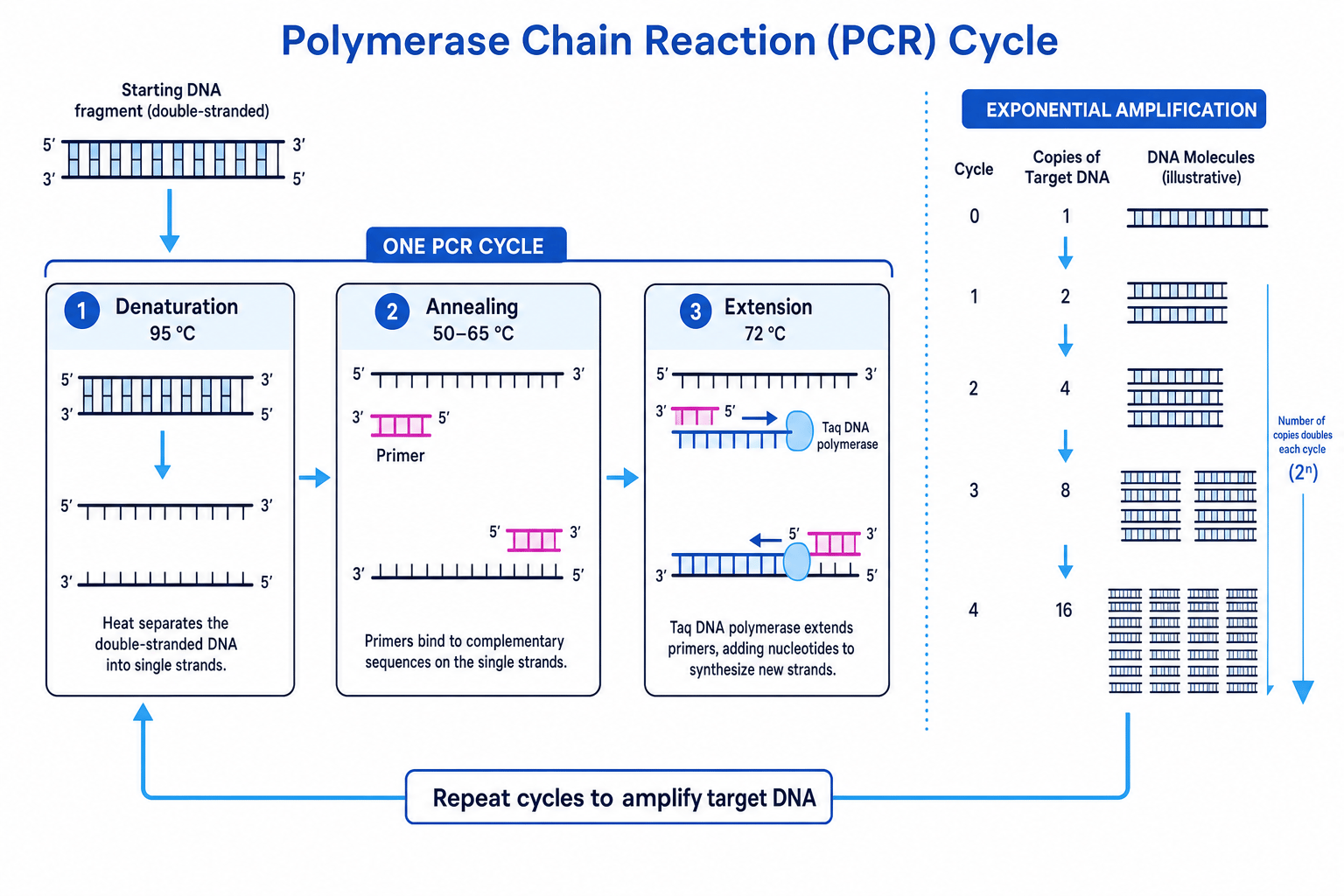
PCR repeats three main stages: denaturation, annealing and extension.
The PCR cycle
During denaturation, the DNA is heated to about 95 °C. Hydrogen bonds between complementary bases break, separating the two strands.
During annealing, the temperature is lowered to about 50–65 °C so primers can bind to complementary base sequences on the single-stranded DNA.
During extension, the temperature is raised to about 72 °C. Taq DNA polymerase extends the primers by joining free nucleotides, making new DNA strands.
In ideal conditions, the number of target DNA molecules doubles each cycle:
number of copies after n cycles=starting copies×2n\text{number of copies after } n \text{ cycles} = \text{starting copies} \times 2^nnumber of copies after n cycles=starting copies×2nCalculating PCR amplification
A PCR starts with 5 copies of a DNA fragment. Estimate the number of copies after 25 ideal cycles.
- Use the doubling rule because each ideal PCR cycle doubles the number of target DNA molecules:
- Calculate the power term:
- Multiply by the starting number of copies:
- Give the answer in standard form:
Ideal PCR doubling
The formula assumes perfect doubling every cycle. In real PCR, amplification may become less efficient later because reagents become limiting or enzyme activity falls.
In vivo amplification: culturing transformed cells
In vivo amplification uses living host cells. Once a host cell has taken up a recombinant vector, the cell is cultured so it divides. Each time the cell divides, the recombinant DNA is copied too.
In bacteria, this can rapidly produce many genetically identical cells, called clones, each containing the recombinant plasmid. If the inserted gene is expressed, the culture can also produce the protein of interest.
| Feature | PCR amplification | In vivo amplification |
|---|---|---|
| Where it happens | Outside cells, in a thermal cycler | Inside living host cells |
| What is copied | A selected DNA fragment | The vector and host cell DNA during cell division |
| Main purpose | Rapidly produce many DNA copies | Produce many GM cells and often a useful protein |
| Needs cells? | No | Yes |
Practical link: restriction enzymes and electrophoresis
You may meet this through apparatus technique AT g: investigating the specificity of restriction enzymes using extracted DNA and electrophoresis.
In this type of practical, DNA samples are cut using different restriction enzymes. The fragments are separated by gel electrophoresis, where smaller DNA fragments move further through the gel. Different banding patterns show that restriction enzymes cut at specific recognition sequences.
Interpreting gel bands
More bands usually mean more cuts. A band further from the well usually represents a smaller DNA fragment.
Applications and evaluation
Recombinant DNA technology is used in agriculture, industry and medicine. You should be able to interpret information about unfamiliar examples and evaluate benefits and risks.
Medicine
Recombinant bacteria or yeast can produce human proteins such as hormones, vaccines or blood-clotting factors. Recombinant DNA technology also links directly to gene therapy, where a functional allele is introduced into a patient’s cells to treat a genetic disorder.
Gene therapy may be somatic, affecting body cells only, or germline, affecting gametes or embryos. Germline changes raise greater ethical concerns because they could be inherited by future generations.
Agriculture
GM crops may be designed for pest resistance, herbicide tolerance, improved nutrition or increased yield. This could improve food security and reduce crop losses.
However, concerns include gene flow to wild relatives, effects on biodiversity, increased dependence on particular herbicides, and ownership of seeds by large companies.
Industry and ownership
GM microorganisms can produce enzymes, fuels, medicines and other useful products. This can be efficient and reduce waste.
Financial and social issues include patents, licensing costs, access for poorer countries, and whether companies should be able to control important genetic technologies.
Balanced evaluation
Strong answers consider both humanitarian benefits, such as treating disease or improving food supply, and objections from environmentalists or anti-globalisation groups, such as ecological risk and corporate control.
Recombinant DNA and gene therapy
Gene therapy uses the same core idea: transfer DNA into cells so the cells express a useful gene product.
A vector, often viral or plasmid-based depending on the context, carries a functional allele into target cells. If the gene is expressed, the cell may produce a functional protein that reduces symptoms of the disorder.
The challenge is delivery: enough target cells must receive and express the gene, without causing harmful immune responses, insertional mutations or unintended effects.
In the exam
- When describing recombinant DNA, use enzyme names precisely: restriction endonuclease cuts DNA; DNA ligase joins DNA fragments.
- If a question asks about expression, mention promoter and terminator regions, not just insertion of the gene.
- For PCR, name the three stages in order: denaturation, annealing, extension.
- For evaluation questions, balance benefits against ethical, financial, social and environmental concerns.
- If marker genes are mentioned, explain their purpose; you do not need to recall specific examples.
Check yourself
- Why is cDNA often used instead of the original eukaryotic gene when producing a human protein in bacteria?
- What is the difference between amplifying DNA by PCR and amplifying DNA by culturing transformed host cells?
- How do marker genes help scientists identify genetically modified cells?