Differences in DNA between individuals of the same species can be exploited for identification and diagnosis of heritable conditions (A-level only)
What you'll learn
- Why people of the same species can have different DNA sequences.
- How labelled DNA probes and DNA hybridisation can detect specific alleles.
- How probe-based screening can be used for heritable conditions, drug responses and health risks.
- How to evaluate genetic screening information in counselling and personalised medicine.
1. Why DNA differences matter
A gene is a length of DNA that codes for a polypeptide or functional RNA. At a particular position on a chromosome, called a locus, different people may have slightly different versions of the same gene.
These different versions are called alleles. Alleles may differ by one base, by a small insertion or deletion, or by a larger sequence difference.
Allele
An allele is an alternative version of a gene found at the same locus, with a particular DNA base sequence.
Some alleles cause or increase the risk of a heritable condition, meaning a condition that can be passed from parents to offspring through DNA. Other alleles affect how a person responds to a drug, for example by changing how quickly the drug is broken down.
The core idea
If an allele has a unique DNA sequence, you can design a complementary DNA probe that binds to that sequence and reveals whether the allele is present.
2. DNA probes use complementary base pairing
A DNA probe is a short, single-stranded piece of DNA with a base sequence complementary to the target sequence you want to find.
The probe is labelled, meaning it has a detectable marker attached. This marker might be fluorescent, so it gives off light, or radioactive, so it can be detected on photographic film or by a radiation detector.
DNA probe
A labelled DNA probe is a short single-stranded DNA molecule with a detectable marker, designed to bind to a complementary DNA sequence.
DNA probes rely on complementary base pairing:
- adenine pairs with thymine
- cytosine pairs with guanine
DNA strands also run antiparallel, meaning one strand runs 5′ to 3′ while the complementary strand runs 3′ to 5′.
Designing a complementary probe
A target allele contains this sequence:
5′-A T G C T A G C T G A-3′
Design the complementary probe sequence.
-
Apply complementary base pairing to each base: A pairs with T, T with A, G with C, and C with G.
-
Write the complementary strand antiparallel to the target strand:
3′-T A C G A T C G A C T-5′ -
If the probe must be written 5′ to 3′, reverse the order:
5′-T C A G C T A G C A T-3′ -
Attach a detectable label to the probe so that binding can be detected.
Forgetting antiparallel strands
Do not simply swap A with T and C with G without checking strand direction. In DNA, complementary strands run in opposite directions.
3. DNA hybridisation
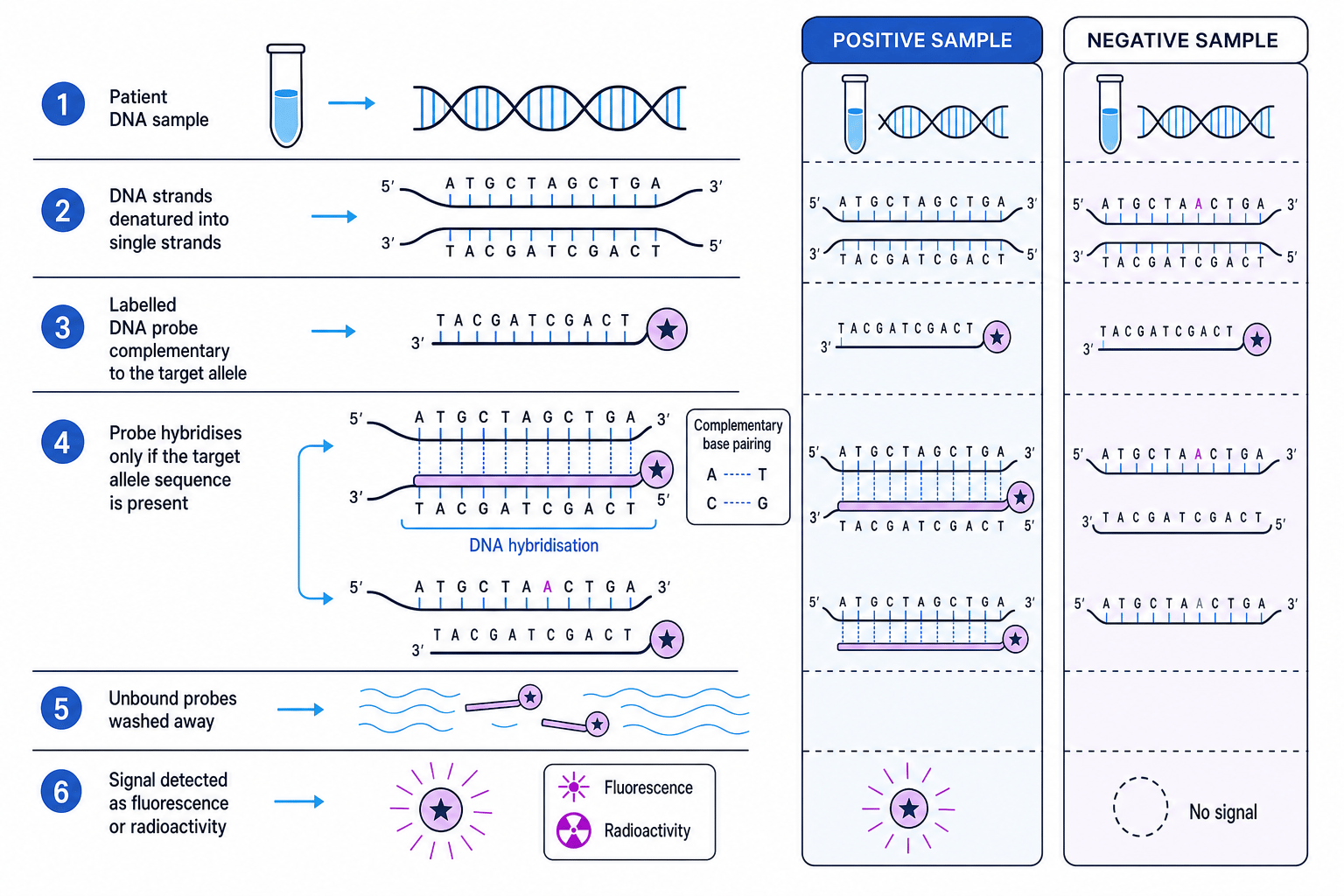
Before a probe can bind, the DNA being tested must usually be made single-stranded. This is called denaturation. Heating or using alkali breaks the hydrogen bonds between complementary bases, separating the two DNA strands without breaking the covalent bonds in the sugar-phosphate backbone.
When the labelled probe binds to its complementary target sequence, this is called DNA hybridisation.
DNA hybridisation
DNA hybridisation is the joining of two complementary single-stranded DNA molecules by hydrogen bonding between complementary bases.
The more complementary the probe and target sequence are, the more strongly they bind. If there is a mismatch, for example because the person has a different allele, the probe may not bind under carefully controlled conditions.
4. Using labelled probes to locate specific alleles
A typical probe-based test follows this logic:
- Take a sample containing DNA, such as blood, saliva or cheek cells.
- Extract the DNA.
- Denature the DNA to separate the strands.
- Add a labelled DNA probe complementary to the allele being tested.
- Allow hybridisation to occur.
- Wash away unbound probe.
- Detect the label.
A signal means the probe has bound, so the complementary allele sequence is present in the sample.
A probe can be designed for:
- a normal allele
- a mutant allele that causes a condition
- a risk allele associated with increased chance of disease
- an allele affecting drug metabolism or drug sensitivity
Interpreting probe results
A lab uses two probes for a gene:
- Probe N binds to the normal allele.
- Probe m binds to a mutant disease allele.
A patient’s DNA gives a signal with both probes.
-
A signal with Probe N means the patient has at least one normal allele.
-
A signal with Probe m means the patient has at least one mutant allele.
-
Because humans are diploid for autosomal genes, the patient has two copies of the gene.
-
Since both allele types are detected, the patient is heterozygous: one normal allele and one mutant allele.
What a positive signal really means
A positive probe signal shows that a particular DNA sequence is present. It does not automatically prove that a person has symptoms, because dominance, penetrance, environment and other genes can affect phenotype.
5. Screening for heritable conditions
Screening means testing individuals to identify whether they carry a particular allele or have increased genetic risk. People may be screened before symptoms appear.
Probe-based screening can be used for:
- carrier testing, where someone has one copy of a recessive disease allele but is usually unaffected
- prenatal testing, where fetal DNA is tested before birth
- newborn screening, where early treatment may prevent serious effects
- predictive testing, where an adult is tested for a later-onset condition
- pharmacogenetic testing, where alleles affecting drug response are identified
A carrier is an individual who has one copy of a recessive allele for a condition and one normal allele. They usually do not show the condition, but they can pass the allele to offspring.
Using screening results in inheritance risk
A recessive condition is caused by allele a. The normal allele is A. Two parents are both screened and found to be carriers, so both are Aa.
-
List the possible gametes from each parent. Each carrier can produce gametes containing either
Aora. -
Combine the gametes: possible offspring genotypes are
AA,Aa,Aaandaa. -
Identify the affected genotype. Only
aaindividuals have two recessive disease alleles, so they are affected. -
Calculate the risk for each child. One out of four possible genotypes is
aa, so the risk is 25% for each pregnancy.
6. Screening for drug responses and health risks
Not all useful DNA tests are for diagnosing a disease. Some alleles affect how a person responds to medicines. This is part of pharmacogenetics, the study of how genetic differences affect drug response.
For example, a person may have an allele that affects:
- how quickly an enzyme breaks down a drug
- whether a drug target has the correct shape
- the risk of a severe side effect
- the dose needed for the drug to be effective
This information can be used in personalised medicine.
Personalised medicine
Personalised medicine uses information about an individual, including their genotype, to choose prevention, diagnosis or treatment strategies suited to that person.
For health risks, a probe might detect an allele associated with increased risk of a condition. This does not always mean the person will develop the condition. Many conditions are multifactorial, meaning they are affected by multiple genes and environmental factors.
Risk is not certainty
If an allele increases disease risk, do not write that the person “will get” the disease unless the question clearly describes a fully penetrant single-gene condition.
7. Genetic counselling
Genetic counselling is support given by trained professionals to help people understand genetic test results, inheritance risks and possible choices.
Genetic counselling
Genetic counselling involves explaining genetic risks and options to individuals or families so they can make informed decisions.
Genetic counselling may include discussion of:
- the chance of developing a condition
- the chance of passing an allele to children
- whether further testing is available
- reproductive options
- treatment, monitoring or lifestyle changes
- emotional, social and ethical implications
Good counselling should be non-directive. This means the counsellor explains information clearly without pressuring the person into a particular decision.
8. Evaluating genetic screening information
In exam questions, you may be asked to evaluate screening for a heritable condition, health risk or drug response. Evaluation means weighing up both benefits and limitations.
Potential benefits include:
- earlier diagnosis
- earlier treatment or monitoring
- informed reproductive choices
- reduced adverse drug reactions
- more effective drug choice or dosage
- reassurance if a harmful allele is absent
Potential limitations include:
- false positives, where the test suggests a risk or allele is present when it is not
- false negatives, where the test misses an allele or risk
- a probe detecting only known alleles, not every possible mutation in a gene
- increased anxiety after a positive result
- privacy and confidentiality issues
- implications for biological relatives
- risk of discrimination or stigma
- uncertain results for multifactorial conditions
Evaluating a screening proposal
A clinic suggests screening all adults for one allele linked to increased risk of a disease. The allele increases risk, but many people with the allele never develop the disease, and there is no proven prevention.
-
Decide what the result means biologically. The allele is associated with increased risk, but it is not a guaranteed diagnosis.
-
Consider clinical usefulness. If there is no prevention or treatment, the benefit of knowing may be limited.
-
Consider harm. A positive result could cause anxiety, especially if the risk is uncertain.
-
Consider test coverage. If the probe detects only one allele, a negative result does not prove the person has no genetic risk.
-
Reach a balanced judgement. Screening may be more appropriate with counselling and clear consent than as a blanket test for everyone.
In the exam
-
Link probes to complementary base pairing and DNA hybridisation; these are usually the key marking points.
-
When interpreting screening results, distinguish between having an allele, being a carrier, having a disease, and having increased risk.
-
For evaluation questions, give both sides: benefits such as early treatment and informed choices, plus limitations such as false results, anxiety, confidentiality and uncertain risk.
Check yourself
- Why must the DNA sample be denatured before a labelled probe is added?
- What does it mean if a patient’s DNA hybridises with both a normal-allele probe and a mutant-allele probe?
- Why might a positive result for a risk allele not mean that the person will definitely develop the condition?