Principles of homeostasis and negative feedback (A-level only)
What you'll learn
- What homeostasis means in mammals, and why “stable” does not mean “unchanging”.
- Why core temperature, blood pH and blood glucose concentration must be kept within restricted limits.
- How receptors, coordinators and effectors form physiological control systems.
- How to recognise negative feedback and positive feedback from descriptions, data or graphs.
Why mammals need homeostasis
Mammals live in changing external environments, but their cells need a relatively stable internal environment to function properly. Your cells are not in direct contact with the outside air: most are surrounded by tissue fluid, which is affected by the composition of the blood.
Homeostasis
Homeostasis is the maintenance of a stable internal environment within restricted limits, despite changes inside or outside the body.
The internal environment means the conditions around body cells, especially in the blood plasma and tissue fluid. These conditions include temperature, pH, glucose concentration, water potential and ion concentrations.
Homeostasis is especially important in mammals because many metabolic reactions are controlled by enzymes. Enzymes are proteins with a specific active site, and their activity depends strongly on temperature and pH.
Stable, not fixed
Homeostasis keeps conditions within a normal range, not at one perfectly fixed value all the time. Small fluctuations around a normal level are expected.
Core temperature and enzyme activity
Core temperature is the temperature of the deep body tissues and organs, rather than the temperature of the skin surface. In humans it is usually close to 37 °C.
Temperature affects enzyme-controlled reactions because it affects the kinetic energy of molecules:
- If temperature is too low, enzyme and substrate molecules have less kinetic energy, so there are fewer successful collisions per second.
- If temperature is too high, bonds holding the enzyme’s tertiary structure may break.
- This changes the shape of the active site, so the substrate may no longer fit; the enzyme is denatured.
Denaturation
Denaturation is a change in a protein’s three-dimensional shape so that it can no longer function properly. For enzymes, this usually means the active site no longer has the correct shape.
Blood pH and enzyme activity
pH is a measure of hydrogen ion concentration. Blood pH must stay within a narrow range because changes in hydrogen ion concentration can disrupt ionic bonds and hydrogen bonds in proteins.
If blood pH changes too much, enzymes and other proteins may change shape. This can reduce enzyme activity and disrupt metabolism.
Saying enzymes are killed
Avoid saying “enzymes are killed”. Enzymes are not alive. Say that enzymes are denatured or that their active sites change shape.
Blood glucose concentration
Glucose is an important respiratory substrate: cells use it in respiration to release energy for ATP production. Blood glucose concentration must be regulated because both low and high concentrations can cause problems.
If blood glucose concentration is too low, cells may not receive enough glucose for respiration. This is especially serious for the brain, which depends heavily on glucose as a respiratory substrate.
If blood glucose concentration is too high, it lowers the water potential of the blood.
Water potential
Water potential is a measure of the tendency of water to move. Water moves by osmosis from a region of higher water potential to a region of lower water potential through a partially permeable membrane.
A high concentration of dissolved glucose in the blood makes the blood’s water potential more negative. Water may then move out of cells into the blood by osmosis, causing cells to lose water and function less effectively.
Linking blood glucose to water potential
A person’s blood glucose concentration rises well above the normal range after a meal.
- Identify the change in solute concentration: the blood now contains a higher concentration of dissolved glucose, so it has a lower water potential than normal.
- Compare the blood with nearby cells: if the blood has a lower water potential than the cell cytoplasm, a water potential gradient exists from the cells to the blood.
- Apply osmosis: water moves out of cells across their partially permeable cell-surface membranes into the blood.
- Link to the biological consequence: cells may lose water and shrink, which can interfere with normal cell reactions and tissue function.
Physiological control systems
A physiological control system is a body system that detects a change and brings about a response to correct it. These systems often involve nervous communication, hormonal communication, or both.
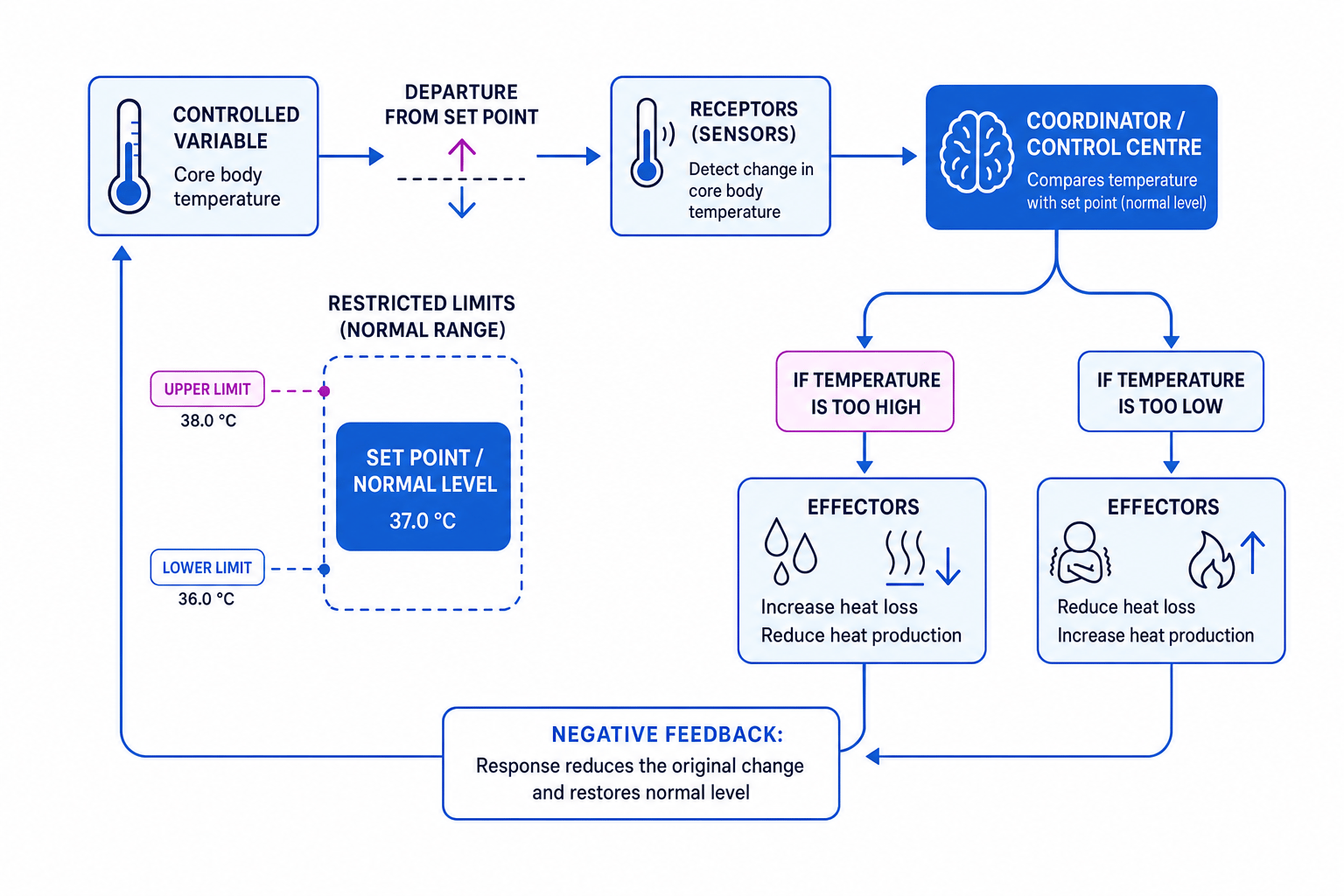
Most homeostatic control systems have the same basic parts:
- A controlled variable: the condition being regulated, such as core temperature or blood glucose concentration.
- A set point: the normal level or target value for that variable.
- Receptors: cells or proteins that detect a change in the variable.
- A coordinator or control centre: receives information from receptors and compares it with the set point.
- Effectors: cells, tissues or organs that bring about a response, such as muscles or glands.
This diagram shows the general pattern using core body temperature as the example.
Effector
An effector is a structure that carries out a response. In mammals, effectors are often muscles or glands.
Mapping a temperature-control pathway
A student has been running, and their core body temperature rises above the normal range.
- Identify the controlled variable: the variable being regulated is core body temperature.
- Identify the direction of change: temperature has increased above the set point, so the response must reduce core temperature.
- Assign the control-system parts: temperature receptors detect the rise, the hypothalamus acts as a coordinator, and effectors such as sweat glands and skin arterioles bring about responses.
- Link effectors to correction: increased sweating and increased blood flow near the skin increase heat loss, helping return core temperature towards the normal range.
Negative feedback
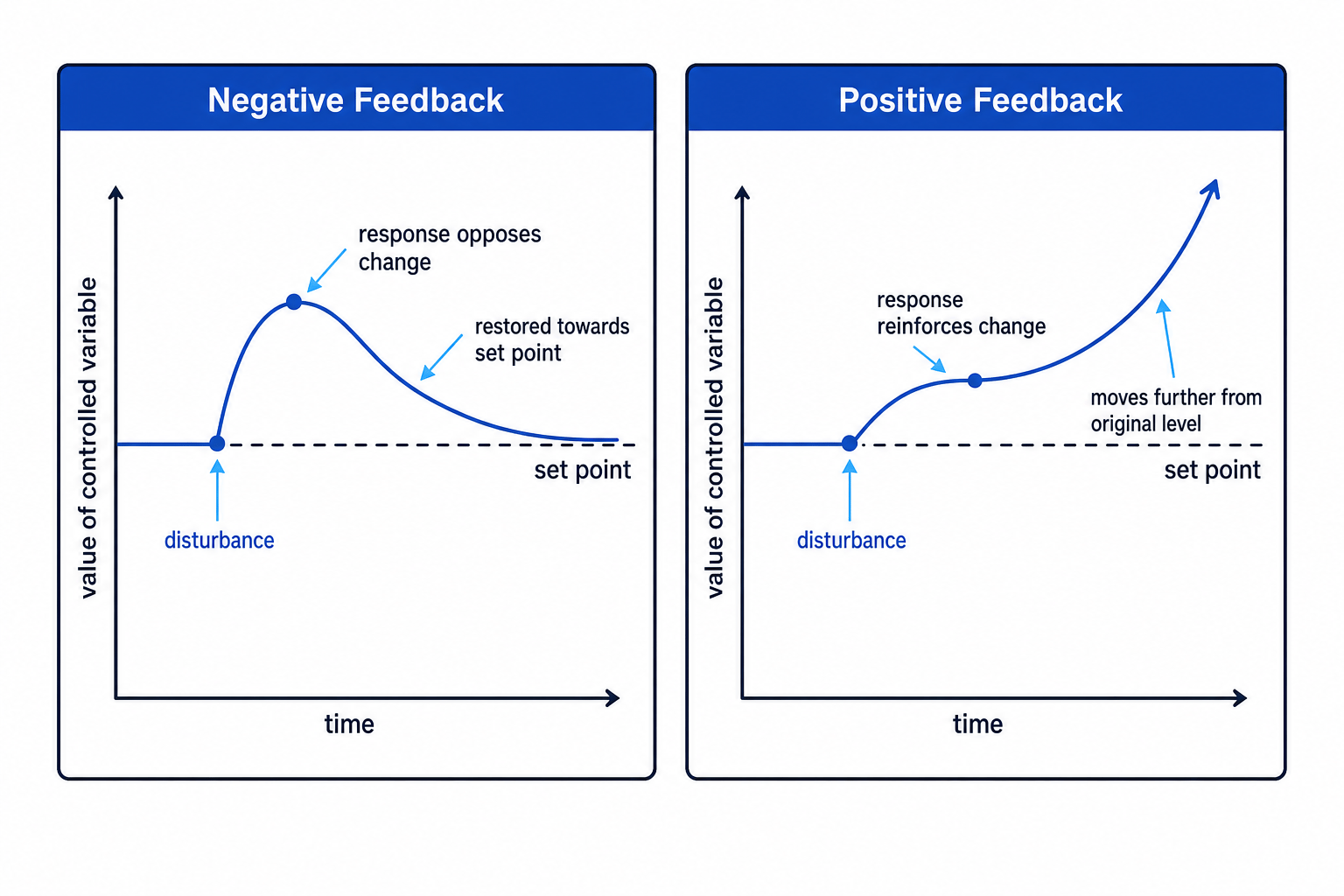
Negative feedback is the main principle behind homeostasis. It does not mean “bad feedback”. It means that the response is in the opposite direction to the original change.
Negative feedback
Negative feedback is a control mechanism in which a departure from the normal level triggers responses that reduce the departure and restore the variable towards its original level.
For example:
- If core temperature rises, responses increase heat loss and reduce heat production.
- If core temperature falls, responses reduce heat loss and increase heat production.
- If blood glucose concentration rises, responses reduce blood glucose concentration.
- If blood glucose concentration falls, responses increase blood glucose concentration.
Oppose the change
In negative feedback, the response always opposes the original change. A rise is corrected by lowering; a fall is corrected by raising.
Thinking negative feedback always lowers something
Negative feedback does not always decrease the variable. If the variable falls below the normal range, negative feedback raises it back towards the normal range.
Separate mechanisms for opposite directions
The specification emphasises that mammals often have separate mechanisms to deal with departures in different directions from the original state.
For example, temperature that is too high and temperature that is too low are corrected by different combinations of responses:
- Too hot: sweating, vasodilation of skin arterioles, reduced shivering.
- Too cold: reduced sweating, vasoconstriction of skin arterioles, shivering.
This gives a greater degree of control because the body can respond appropriately to both increases and decreases. It is not just switching one response “on” or “off”; it can activate different effectors depending on the direction of the change.
Choosing the correct negative feedback response
Blood glucose concentration falls below the normal range during prolonged exercise.
- Identify the departure: blood glucose concentration has decreased, so cells may receive less respiratory substrate.
- Decide what correction is needed: the response must increase blood glucose concentration, because negative feedback opposes the fall.
- Select the type of mechanism: processes that add glucose to the blood or release stored glucose would be appropriate; processes that remove glucose from the blood would worsen the departure.
- Check the endpoint: once blood glucose returns towards the normal range, the corrective response should be reduced.
Positive feedback
The A-Level part of this topic also expects you to interpret information about positive feedback. Positive feedback is different from homeostatic negative feedback because it amplifies the original change.
Positive feedback
Positive feedback is a control mechanism in which a change triggers responses that reinforce the change, moving the variable further away from its original level.
Positive feedback is not usually used to maintain stable internal conditions. However, it can be useful when a process needs to be driven rapidly to a clear endpoint, such as some stages of blood clotting or childbirth.
The key difference is shown below: negative feedback restores a variable towards the set point, whereas positive feedback moves it further away.
Positive feedback can still stop
Positive feedback does not necessarily continue forever. It often stops when an endpoint is reached, such as birth occurring or a blood clot sealing a wound.
Classifying feedback from a graph
A graph shows a hormone concentration rising. The rise stimulates a process that causes even more of the hormone to be released, so the concentration rises more steeply.
- Identify the original change: the hormone concentration initially increases.
- Compare the response with the original change: the response causes a further increase, rather than reducing the concentration.
- Classify the feedback: because the response reinforces the original rise, this is positive feedback.
- Avoid the trap: the word “feedback” alone is not enough; you must decide whether the response opposes or reinforces the change.
How to interpret unfamiliar feedback examples
In exam questions, you may be given a new example rather than one you have memorised. Focus on the direction of change.
Ask yourself:
- What variable is being controlled?
- What is the normal level or set point?
- Has the variable increased or decreased?
- What response occurs?
- Does the response reduce the original change or increase it further?
If the response reduces the original change, it is negative feedback. If the response increases the original change, it is positive feedback.
Quick test
Use this sentence frame: “The original change was ___, and the response made it ___.” If the response makes the change smaller, it is negative feedback. If it makes the change bigger, it is positive feedback.
In the exam
- Use precise wording: say “maintained within restricted limits” rather than “kept constant”.
- For negative feedback, always state the direction of the original change and how the response reverses it.
- When comparing negative and positive feedback, focus on whether the response opposes or reinforces the original change, not whether the final outcome is useful or harmful.
Check yourself
- Why can a change in blood pH reduce enzyme activity?
- How can a high blood glucose concentration affect the water potential of blood?
- In an unfamiliar feedback example, what evidence would show that the feedback is negative rather than positive?