Populations in ecosystems (A-level only)
What you'll learn
- How populations, communities, habitats, niches and ecosystems fit together.
- How abiotic and biotic factors affect population size and carrying capacity.
- How to estimate population size using quadrats, transects and mark-release-recapture.
- How succession changes communities, and why conservation often manages succession.
The basic levels: from species to ecosystem
A species is a group of organisms that can breed together to produce fertile offspring. Ecology then builds up from individuals to larger systems.
Population, community and ecosystem
A population is all the individuals of one species living in a particular area at the same time. A community is all the populations of different species living and interacting in that area. An ecosystem is the community plus the non-living, or abiotic, components of the environment.
Ecosystems vary hugely in size. A rotting log, a pond, a field, a woodland and the whole biosphere can all be considered ecosystems, depending on the scale of study.
Habitat and niche
A habitat is the place where an organism lives. A niche is the role of a species within its ecosystem, including where it lives, what it eats, when it is active, how it reproduces, and how it interacts with other organisms.
Niche
A species’ niche is governed by its adaptations to both abiotic conditions such as temperature, water availability and light, and biotic conditions such as competition, predators, pathogens and food supply.
If two species have very similar niches, they are likely to compete strongly because they use many of the same resources.
Carrying capacity and limiting factors
The carrying capacity is the maximum stable population size of a species that an ecosystem can support over time.
Population size does not usually stay exactly constant. It fluctuates because conditions change and because organisms interact.
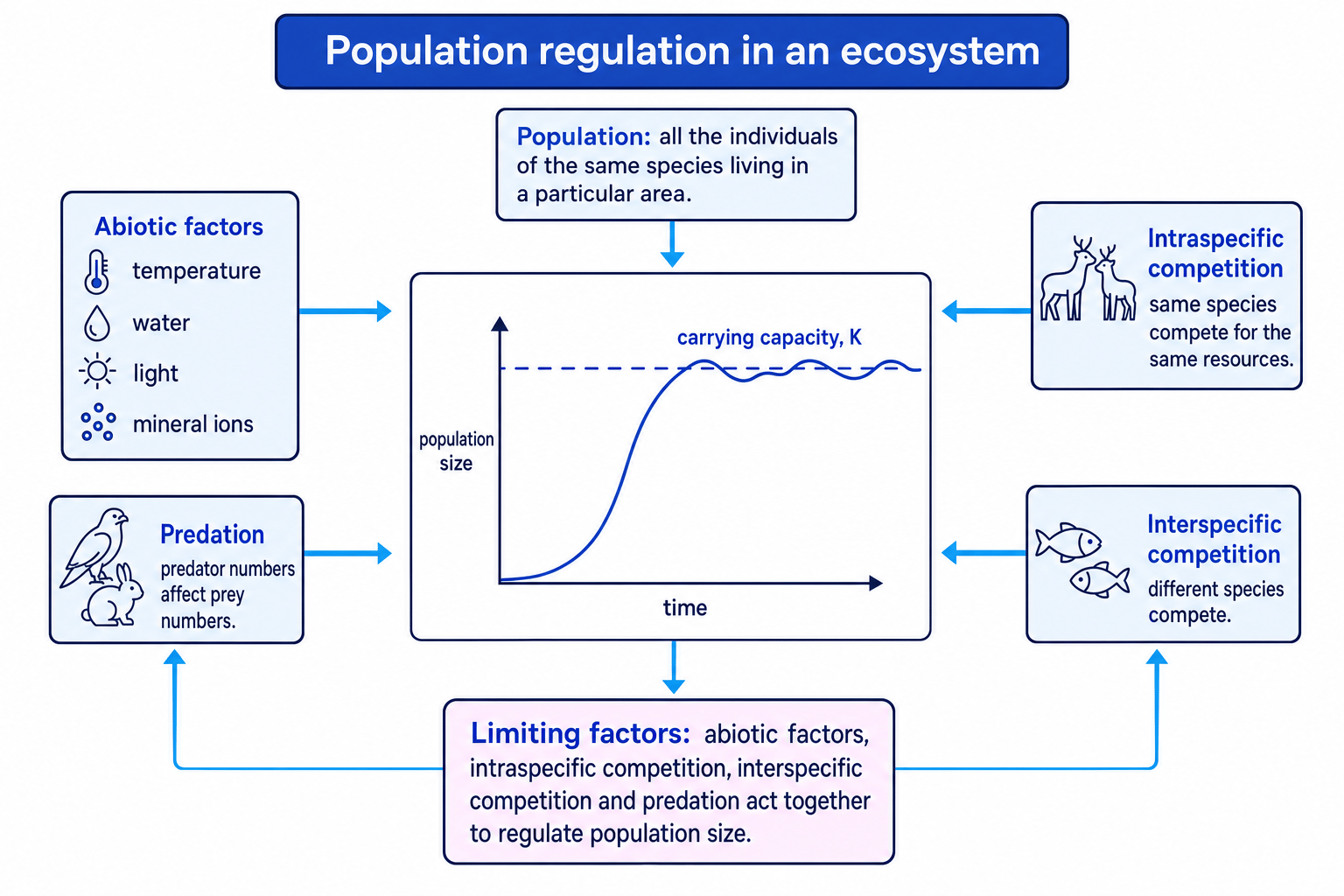
Abiotic and biotic factors
Abiotic factors are non-living factors, such as temperature, light intensity, water availability, soil pH and mineral ion concentration. Biotic factors are living factors, such as competition, predation, disease and food availability.
Competition and predation
Intraspecific competition is competition between individuals of the same species. It becomes stronger as population density increases because individuals need the same resources.
Interspecific competition is competition between individuals of different species. This can reduce the population size or distribution of one or both species.
Predation occurs when one organism, the predator, kills and eats another organism, the prey. Predator and prey populations may show cycles, often with a time lag: prey numbers rise first, then predator numbers rise because more food is available.
Population regulation
Population size is regulated by the combined effects of abiotic factors, intraspecific competition, interspecific competition and predation. These factors help determine the carrying capacity.
Interpreting a change in carrying capacity
A pond supports about 500 newts. After several dry summers, the stable population falls to about 300 newts.
- The original stable level, about 500 newts, represents the earlier carrying capacity.
- Dry summers reduce water availability, which is an abiotic factor affecting survival, breeding sites and prey availability.
- The new stable level, about 300 newts, suggests the pond’s carrying capacity has decreased because the habitat can now support fewer newts.
Estimating population size: quadrats and transects
For slow-moving or non-motile organisms, such as plants, lichens and barnacles, you usually sample using quadrats.
Quadrat
A quadrat is a frame of known area, often 0.25 m² or 1 m², used to sample organisms in a habitat.
Random quadrat sampling
Random sampling is used when you want an unbiased estimate of abundance across a habitat.
A good method is:
- Mark out the study area using tape measures.
- Generate random coordinates.
- Place the quadrat at each coordinate.
- Record abundance of the named species.
- Repeat many times and calculate a mean.
You may record abundance as:
- Density: number of individuals per unit area, such as plants m⁻².
- Frequency: percentage of quadrats in which the species is present.
- Percentage cover: estimated percentage of the quadrat covered by the species, useful for grasses, mosses or spreading plants.
Estimating population size using quadrats
A student samples a 120 m² field using twenty 0.25 m² quadrats. They count 86 daisies in total.
-
Work out the total area sampled:
20×0.25 m2=5.0 m220 \times 0.25\ \text{m}^2 = 5.0\ \text{m}^220×0.25 m2=5.0 m2 -
Calculate the mean density:
86 daisies5.0 m2=17.2 daisies m−2\frac{86\ \text{daisies}}{5.0\ \text{m}^2} = 17.2\ \text{daisies m}^{-2}5.0 m286 daisies=17.2 daisies m−2 -
Estimate the total population in the field:
17.2 daisies m−2×120 m2=2064 daisies17.2\ \text{daisies m}^{-2} \times 120\ \text{m}^2 = 2064\ \text{daisies}17.2 daisies m−2×120 m2=2064 daisies
Belt transects
A transect is a line placed across a habitat. A belt transect uses quadrats placed along the line, either continuously or at regular intervals.
Use a belt transect when you suspect a species changes along an environmental gradient, such as distance from the sea, light intensity under trees, soil moisture down a slope, or trampling near a path.
Required practical 12: environmental factor and distribution
In Required Practical 12, you investigate the effect of a named environmental factor on the distribution of a given species.
A clear investigation might ask: “How does light intensity affect the distribution of daisies across a field?”
Your independent variable is the environmental factor, such as light intensity, soil moisture, pH or temperature. Your dependent variable is the abundance or distribution of the species. You should control or record other factors where possible, repeat sampling, and use a suitable sampling method.
Choosing the sampling method
Use random quadrats if the habitat is fairly uniform and you want an overall estimate. Use a belt transect if the environmental factor changes across the habitat.
Biased quadrat placement
Do not place quadrats only where the species is easy to see. Random coordinates reduce bias and make the estimate more valid.
Mark-release-recapture for motile organisms
For mobile animals, such as woodlice, snails or small fish, quadrats may not work well. Instead, you can use mark-release-recapture.
Mark-release-recapture
Mark-release-recapture estimates population size by capturing a sample, marking them harmlessly, releasing them, then later taking a second sample and recording how many marked individuals are recaptured.
The formula is:
N=M×CRN = \frac{M \times C}{R}N=RM×Cwhere NNN is the estimated total population, MMM is the number marked in the first sample, CCC is the total number caught in the second sample, and RRR is the number of marked individuals recaptured.
Calculating population size by mark-release-recapture
A student captures and marks 80 woodlice. Later, they capture 100 woodlice, of which 20 are marked.
-
Substitute into the formula using M=80M = 80M=80, C=100C = 100C=100 and R=20R = 20R=20:
N=80×10020N = \frac{80 \times 100}{20}N=2080×100 -
Calculate the estimate:
N=400 woodliceN = 400\ \text{woodlice}N=400 woodlice -
Interpret the result: the population is estimated to contain about 400 woodlice, assuming the marked woodlice mixed randomly back into the population.
The main assumptions are:
- Marking does not affect survival or behaviour.
- Marks are not lost or removed.
- There are no significant births, deaths, immigration or emigration between samples.
- The marked individuals mix evenly with the rest of the population.
- Both samples are random.
When mark-release-recapture is unreliable
The method becomes unreliable if the population changes rapidly between samples, or if marked individuals become easier or harder to catch than unmarked individuals.
Succession: ecosystems change over time
Ecosystems are dynamic systems, meaning they change over time. One major type of change is succession.
Primary succession
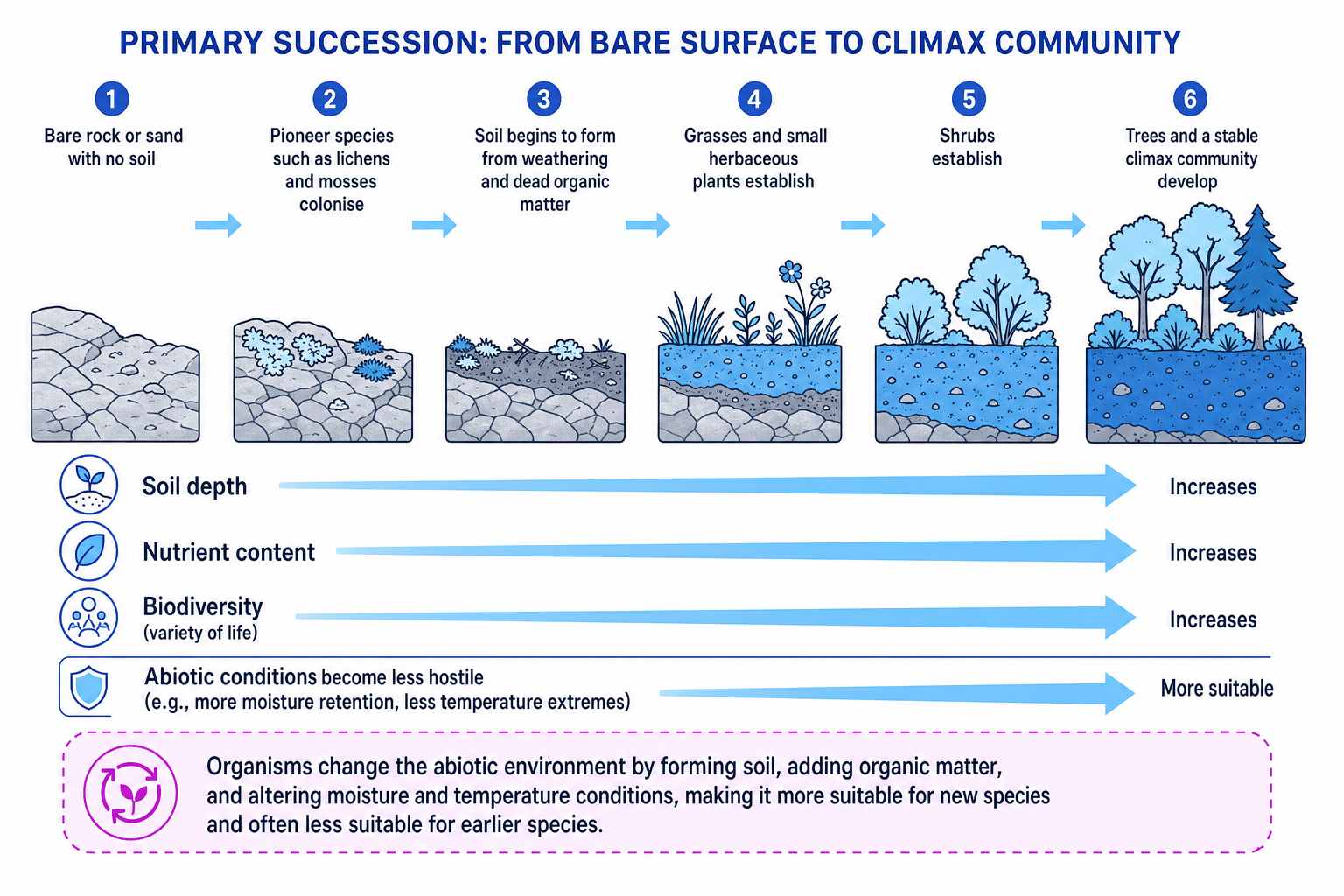
Primary succession is the gradual change in a community over time, starting from a bare surface with no soil, such as bare rock, sand dunes or land exposed by a retreating glacier.
From pioneer species to climax community
The first organisms to colonise are pioneer species, such as lichens and mosses. They are adapted to hostile conditions: little water, few nutrients, exposure to wind, and no developed soil.
As pioneer species die and decompose, they add organic matter. Weathering breaks down rock into mineral particles. Soil depth, water retention and mineral ion availability increase.
This makes the habitat more suitable for larger plants, such as grasses, then shrubs, then trees. Each stage may make the environment less suitable for the previous species, for example by increasing shade.
Climax community
A climax community is the relatively stable final community in succession, usually dominated by species best adapted to the prevailing climate and soil conditions.
Succession changes biodiversity
During succession, organisms alter the abiotic environment. Conditions usually become less hostile, new niches appear, and biodiversity often increases, although the exact pattern depends on the habitat.
Conservation and managing succession
Conservation often involves managing succession rather than simply leaving habitats alone. Some rare species depend on early successional habitats, such as grassland, heathland or open sand dunes. If succession continues unchecked, shrubs and trees may take over, shading out smaller plants.
Management can include:
- grazing by livestock to prevent scrub growth;
- mowing or cutting grassland;
- coppicing woodland to let light reach the ground;
- removing invasive species;
- controlled burning in some heathland systems.
Explaining why mowing can conserve grassland plants
A grassland contains rare small flowering plants. If mowing stops, shrubs begin to grow.
- Without mowing, succession continues, so taller plants and shrubs establish.
- These taller species compete for light and may shade the smaller flowering plants.
- Regular mowing slows succession and maintains the open grassland habitat needed by the rare species.
Conservation decisions often involve conflict. Humans may need land for housing, farming, timber, recreation or flood protection, while conservation aims to protect biodiversity and maintain ecosystem function.
Sustainability means using resources in a way that meets current human needs without preventing future generations from meeting theirs. In exams, you may need to evaluate evidence, including data quality, sample size, economic impacts, biodiversity measures and possible bias.
In the exam
- Define ecological terms precisely: population, community, ecosystem, habitat, niche and carrying capacity are not interchangeable.
- For sampling calculations, show the formula, substitute the numbers with units where relevant, then state the estimate clearly.
- For conservation questions, balance human needs against biodiversity and long-term sustainability rather than giving a one-sided answer.
Check yourself
- Why might a belt transect be better than random quadrats for studying plants down a sand dune?
- What assumptions must be met for mark-release-recapture to give a valid estimate?
- How do pioneer species make a bare habitat suitable for later successional species?