Evolution may lead to speciation (A-level only)
What you'll learn
- Why individuals in the same population can show wide variation in phenotype.
- How natural selection changes allele frequencies in a gene pool.
- The differences between stabilising, directional and disruptive selection.
- How isolation, genetic drift and selection can lead to new species.
The starting point: populations vary
Before speciation can happen, there must be variation: differences between individuals. In A-Level Biology, you usually explain evolution by linking variation to changes in allele frequencies over generations.
Population, species and gene pool
- A species is a group of organisms that can interbreed to produce fertile offspring.
- A population is a group of organisms of the same species living in the same area at the same time.
- A gene pool is all the alleles of all genes in a population at a particular time.
An allele is a version of a gene. A genotype is the alleles an organism has, while a phenotype is its observable characteristics. Phenotype is affected by both genotype and the environment.
Variation in phenotype may be caused by:
- genetic factors, such as different alleles;
- environmental factors, such as diet, temperature, water availability or disease;
- an interaction between both.
The primary source of new genetic variation is mutation, which is a random change in DNA. Meiosis produces further variation by shuffling alleles into new combinations, through crossing over and independent segregation. Random fertilisation then combines gametes at random during sexual reproduction.
Mutation creates new alleles
Mutation is the original source of new alleles. Meiosis and random fertilisation mainly create new combinations of existing alleles.
Explaining variation in plant height
A population of the same plant species shows a wide range of heights.
- Some of the variation may be genetic: different plants may carry different alleles affecting growth rate, hormone production or cell elongation.
- Some of the variation may be environmental: plants receiving more light, water or mineral ions may grow taller even if their genotypes are similar.
- If genetically identical plants grown in different conditions end up with different heights, that supports an environmental effect. If plants grown in the same conditions still vary, that supports a genetic effect.
Natural selection: differential survival and reproduction
Natural selection happens when individuals with certain phenotypes are more likely to survive and reproduce than others.
A selection pressure is an environmental factor that affects survival or reproduction. Examples include predation, disease, competition for food, competition for mates, temperature, drought and availability of light.
A phenotype gives a selective advantage if it increases an organism’s chance of surviving and successfully reproducing. Reproductive success means producing offspring that survive and can reproduce themselves.
The basic sequence is:
- Individuals in a population vary in phenotype.
- Some variation is caused by alleles, so it is heritable.
- A selection pressure causes differential survival and reproduction.
- Individuals with advantageous phenotypes are more likely to reproduce.
- They pass favourable alleles to their offspring.
- Over generations, favourable alleles increase in frequency in the gene pool.
Individuals do not evolve
An individual organism can survive, grow or reproduce, but it does not evolve. Evolution is a change in allele frequencies in a population over generations.
Explaining darker moths by natural selection
In a polluted woodland, tree bark becomes darker. Birds eat moths resting on the bark.
- A mutation may produce an allele that gives some moths a darker wing colour.
- Dark bark changes the selection pressure: pale moths are more visible to birds, so predation on pale moths increases.
- Darker moths are better camouflaged, so they are more likely to survive long enough to reproduce.
- Darker moths pass the allele for darker colour to more offspring.
- Over many generations, the frequency of the dark-colour allele increases in the moth gene pool.
Evolution as a change in allele frequency
Evolution is defined here as a change in allele frequencies in a population over time.
Allele frequency is the proportion of all copies of a gene in a population that are a particular allele. For a diploid species, each individual has two copies of each autosomal gene.
For allele B in a population with genotypes BB, Bb and bb:
pB=2nBB+nBb2Np_B=\frac{2n_{BB}+n_{Bb}}{2N}pB=2N2nBB+nBbwhere NNN is the total number of individuals.
Calculating an allele frequency
A population contains 100 beetles: 36 are BB, 48 are Bb and 16 are bb. Calculate the frequency of allele B.
- Count B alleles from BB beetles: each BB beetle has two B alleles, so there are 2×36=722 \times 36 = 722×36=72 B alleles.
- Count B alleles from Bb beetles: each Bb beetle has one B allele, so there are 48 B alleles.
- Find the total number of alleles for this gene: 100 diploid beetles have 2×100=2002 \times 100 = 2002×100=200 allele copies.
- Substitute into the formula:
The frequency of allele B is 0.60.
Three patterns of selection
Selection can change phenotype frequencies in different ways.
Stabilising selection
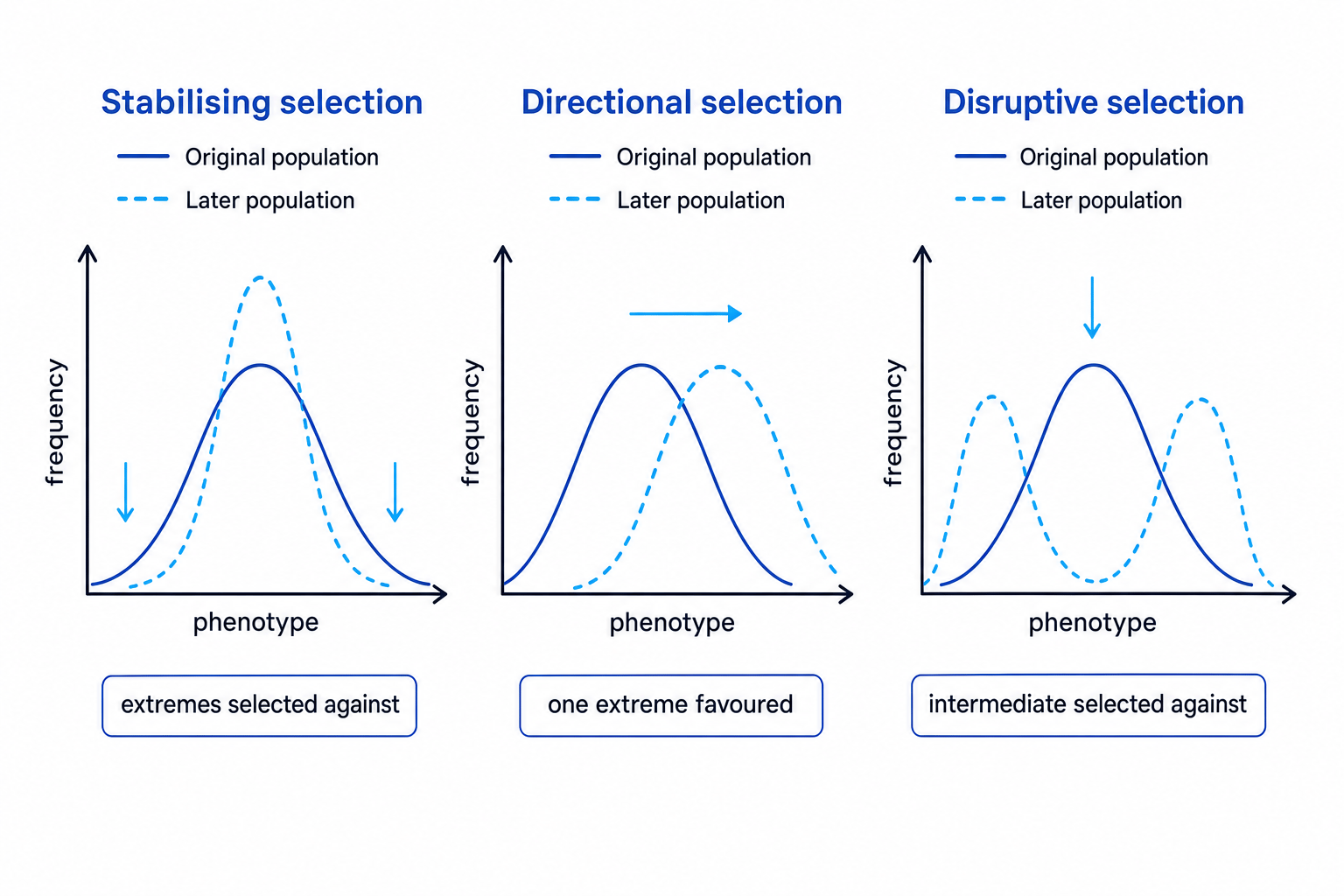
Stabilising selection favours intermediate phenotypes and selects against extremes. It tends to reduce variation and keep the mean phenotype similar.
A classic example is human birth mass: very low and very high birth masses are associated with higher risk, so intermediate birth masses are favoured.
Directional selection
Directional selection favours one extreme phenotype. The mean phenotype shifts in one direction.
This may happen when the environment changes, such as a drought favouring birds with larger beaks that can crack harder seeds.
Disruptive selection
Disruptive selection favours both extremes and selects against intermediate phenotypes. This can increase variation and may contribute to speciation if the two extreme groups become reproductively isolated.
The graphs below show how the frequency distribution of a phenotype can change under each type of selection.
Identifying the type of selection
After a drought, a bird population mainly has access to large, hard seeds. Birds with larger beaks survive better, and mean beak depth increases from 8.5 mm to 9.7 mm over several generations.
- Compare survival across phenotypes: larger-beaked birds have higher survival because they can feed on the available seeds.
- Decide whether the favoured phenotype is intermediate or extreme: one extreme, larger beak size, is favoured.
- Predict the distribution change: the mean beak depth shifts upwards.
- Therefore, this is directional selection, and alleles associated with larger beak size increase in frequency.
Selection does not create the needed mutation
Mutations occur randomly. Natural selection is not random: it increases the frequency of alleles that already give an advantage in that environment.
Genetic drift: random change in allele frequency
Genetic drift is a change in allele frequency caused by chance, rather than by natural selection.
It is especially important in small populations because each individual represents a larger fraction of the gene pool. Random events, such as which individuals reproduce or die, can have a big effect on allele frequencies.
Genetic drift can cause alleles to become more common, disappear completely or become fixed in a population, even if they are not advantageous.
Two useful cases are:
- A bottleneck effect, where a population is greatly reduced by an event such as a fire, flood or disease outbreak.
- A founder effect, where a few individuals start a new population and carry only a small, unrepresentative sample of the original gene pool.
Why drift is stronger in small populations
Compare the effect of losing one copy of an allele in a small population and a large population.
- In a population of 10 diploid individuals, there are 2N=202N = 202N=20 allele copies for a gene. Losing one allele copy changes the allele frequency by 120=0.05\frac{1}{20}=0.05201=0.05.
- In a population of 1000 diploid individuals, there are 2N=20002N = 20002N=2000 allele copies. Losing one allele copy changes the allele frequency by 12000=0.0005\frac{1}{2000}=0.000520001=0.0005.
- The same random loss has a much larger proportional effect in the small population, so genetic drift causes bigger fluctuations when population size is small.
Modelling genetic drift
You can model drift using coloured counters or beads as alleles. Randomly sample a small number to form the next generation, then repeat. Smaller samples usually show larger random swings in allele frequency.
From isolation to speciation
Speciation is the formation of a new species from an existing species.
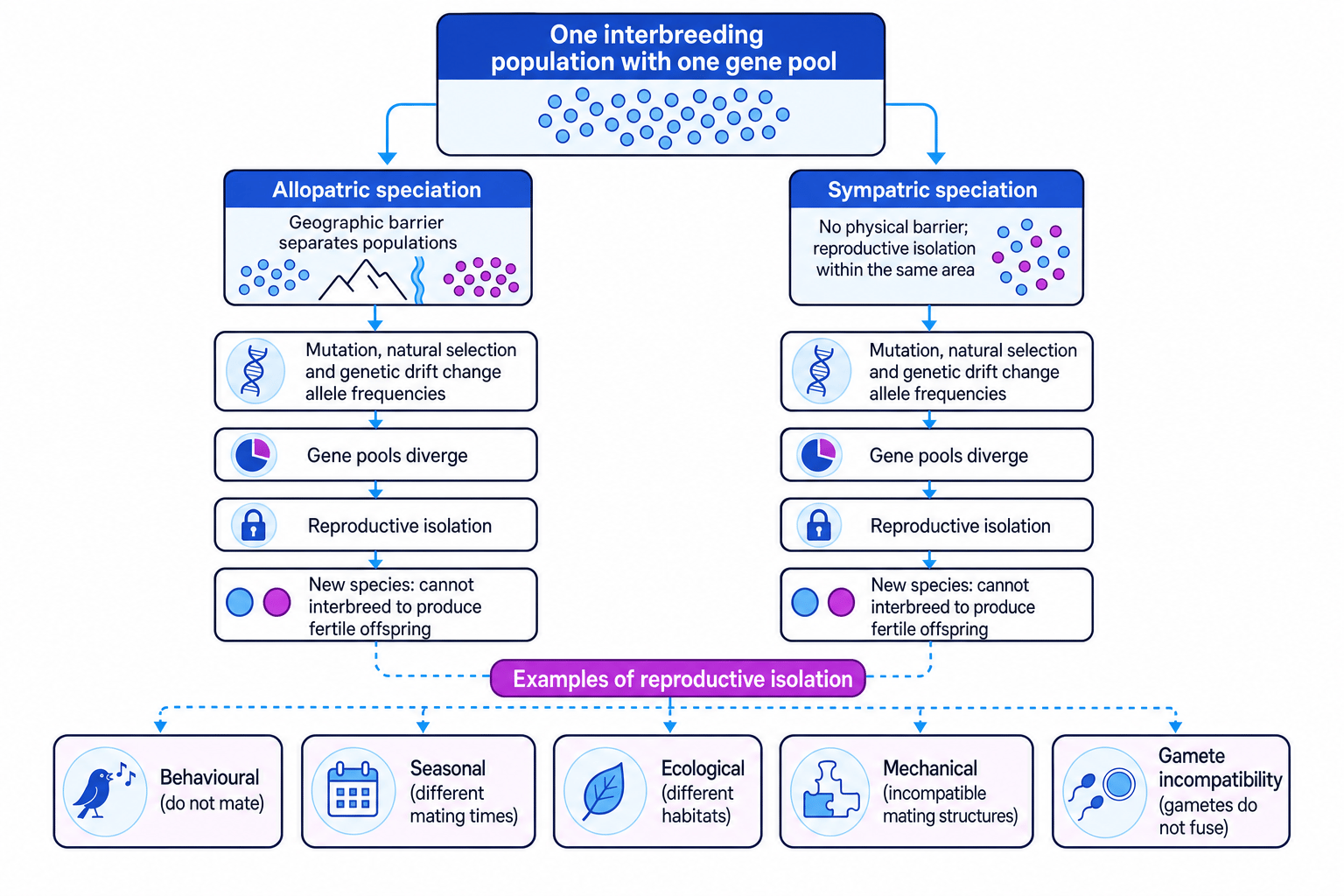
For speciation to occur, populations must become reproductively isolated, meaning they no longer interbreed successfully. If genetic differences build up so that members of the populations cannot interbreed to produce fertile offspring, they are considered separate species.
Gene flow is the movement of alleles between populations through interbreeding. Reproductive isolation reduces or stops gene flow, allowing gene pools to diverge.
The whole process can be summarised like this:
Allopatric speciation
Allopatric speciation occurs when populations are separated by a geographical barrier, such as a mountain range, river, glacier, desert or sea.
Because the populations cannot interbreed, there is little or no gene flow between them. Different mutations occur in each population, different selection pressures may act, and genetic drift may change allele frequencies, especially if one population is small.
Sympatric speciation
Sympatric speciation occurs without a physical geographical barrier. Populations live in the same area but become reproductively isolated in another way.
This might involve:
- behavioural isolation, such as different courtship behaviours;
- seasonal isolation, such as breeding at different times;
- ecological isolation, such as using different habitats or food sources in the same area;
- mechanical or gamete incompatibility, meaning mating or fertilisation is unsuccessful.
Explaining allopatric speciation
A population of lizards is split when sea level rises, leaving groups on two separate islands.
- The sea acts as a geographical barrier, so the two lizard populations can no longer interbreed. Gene flow between them stops.
- Different mutations occur in each island population. The islands may also have different predators, food sources or climates, creating different selection pressures.
- Natural selection and genetic drift change allele frequencies differently in the two gene pools over many generations.
- The populations accumulate genetic differences, causing differences in phenotype, behaviour or reproductive biology.
- If the two groups later meet but cannot interbreed to produce fertile offspring, speciation has occurred.
Evolution over long periods creates diversity
Over long periods of time, speciation can happen repeatedly. One ancestral species may split into several reproductively isolated populations, each adapting to different environments or ecological roles.
A niche is the role of a species in its ecosystem, including where it lives, what it eats and how it interacts with other organisms. Different niches create different selection pressures, so populations can diverge in different directions.
Over evolutionary time, repeated mutation, natural selection, genetic drift and isolation have produced the huge diversity of species seen today.
In the exam
- For natural selection, use the full chain: variation → selection pressure → differential survival and reproduction → favourable alleles passed on → allele frequency changes.
- For speciation, always include isolation, reduced gene flow, divergence of gene pools and inability to produce fertile offspring.
- Distinguish natural selection from genetic drift: selection is due to differences in survival or reproduction, while drift is due to chance.
- Use the correct selection type: stabilising favours the mean, directional favours one extreme, and disruptive favours both extremes.
Check yourself
- Why is mutation described as the primary source of genetic variation?
- Why does genetic drift have a larger effect in small populations?
- What must happen before two diverged populations count as separate species?