Nerve impulses (A-level only)
What you'll learn
- How a myelinated motor neurone is structured for rapid communication.
- How ion movement establishes the resting potential and generates an action potential.
- How action potentials travel along non-myelinated and myelinated axons.
- Why the refractory period matters, and what affects conduction speed.
The big picture: what is a nerve impulse?
A neurone is a specialised cell that transmits electrical signals. In this topic, the signal is not electricity flowing like a wire. It is a moving wave of changes in membrane potential, caused by sodium ions, Na⁺, and potassium ions, K⁺, moving across the axon membrane.
Nerve impulse
A nerve impulse is an action potential that travels along the axon membrane of a neurone.
This topic is A-level only, so you need to explain the mechanism using membrane permeability, electrochemical gradients and ion channels — not just say “an impulse travels”.
Structure of a myelinated motor neurone
A motor neurone carries impulses from the central nervous system to an effector, such as a muscle or gland.
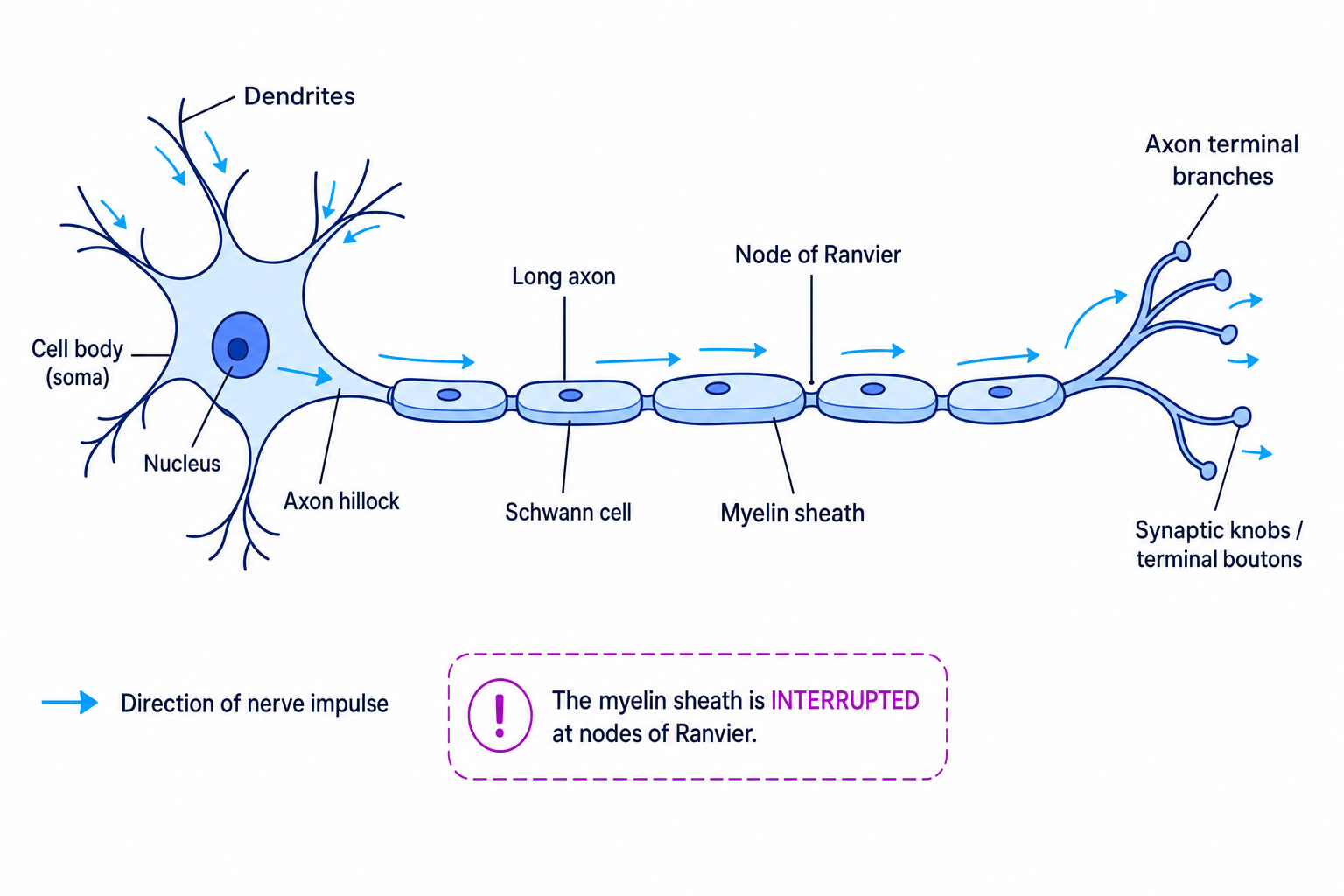
A typical myelinated motor neurone has:
- Dendrites: branched extensions that receive signals from other neurones.
- Cell body, also called the soma: contains the nucleus and many organelles.
- Axon hillock: the region where action potentials are usually initiated.
- Axon: a long extension that carries impulses away from the cell body.
- Schwann cells: cells that wrap around the axon.
- Myelin sheath: an insulating layer made from Schwann cell membranes.
- Nodes of Ranvier: gaps between myelin sheath sections.
- Axon terminals: branches that form synapses with another cell.
Structure supports function
The long axon carries impulses over distance, while the myelin sheath and nodes of Ranvier allow much faster transmission.
Membrane potential: the starting idea
The membrane potential is the voltage difference across the cell-surface membrane. In a resting neurone, the inside of the axon is usually about -70 mV compared with the outside.
Resting potential
The resting potential is the potential difference across the axon membrane when a neurone is not transmitting an impulse, typically about -70 mV.
The resting potential exists because ions are not evenly distributed across the membrane, and the membrane is more permeable to some ions than others.
Establishing the resting potential
Three ideas work together.
1. The sodium-potassium pump creates ion gradients
The sodium-potassium pump is a carrier protein that uses ATP to actively transport:
- 3 Na⁺ out of the axon
- 2 K⁺ into the axon
This makes Na⁺ concentration higher outside the neurone and K⁺ concentration higher inside.
2. The membrane has differential permeability
Differential permeability means the membrane allows different ions through at different rates. At rest, the axon membrane is much more permeable to K⁺ than Na⁺ because there are more open K⁺ channels.
So K⁺ diffuses out of the axon down its concentration gradient.
3. An electrochemical gradient develops
An electrochemical gradient is the combined effect of a concentration gradient and an electrical gradient.
As K⁺ leaves the axon, the inside becomes more negative. This negative charge then attracts K⁺ back in. Eventually, the outward movement of K⁺ is balanced by the inward electrical attraction.
Resting potential in one sentence
The resting potential is maintained because the sodium-potassium pump creates Na⁺ and K⁺ gradients, and the membrane is more permeable to K⁺ than Na⁺.
Predicting the effect of inhibiting the sodium-potassium pump
If a toxin stops the sodium-potassium pump, what happens to the resting potential over time?
- The pump can no longer move 3 Na⁺ out and 2 K⁺ in, so the Na⁺ and K⁺ concentration gradients are no longer actively maintained.
- Ions continue to move through leak channels, so the gradients gradually become smaller.
- With weaker ion gradients, there is less separation of charge across the membrane, so the resting potential becomes less negative and the neurone becomes unable to function normally.
Pump versus channels
The sodium-potassium pump maintains ion gradients, but the rapid changes during an action potential are mainly caused by voltage-gated Na⁺ and K⁺ channels opening and closing.
Generating an action potential
An action potential is a rapid, temporary reversal of membrane potential. The inside of the axon becomes positive compared with the outside, then returns to resting potential.
Threshold
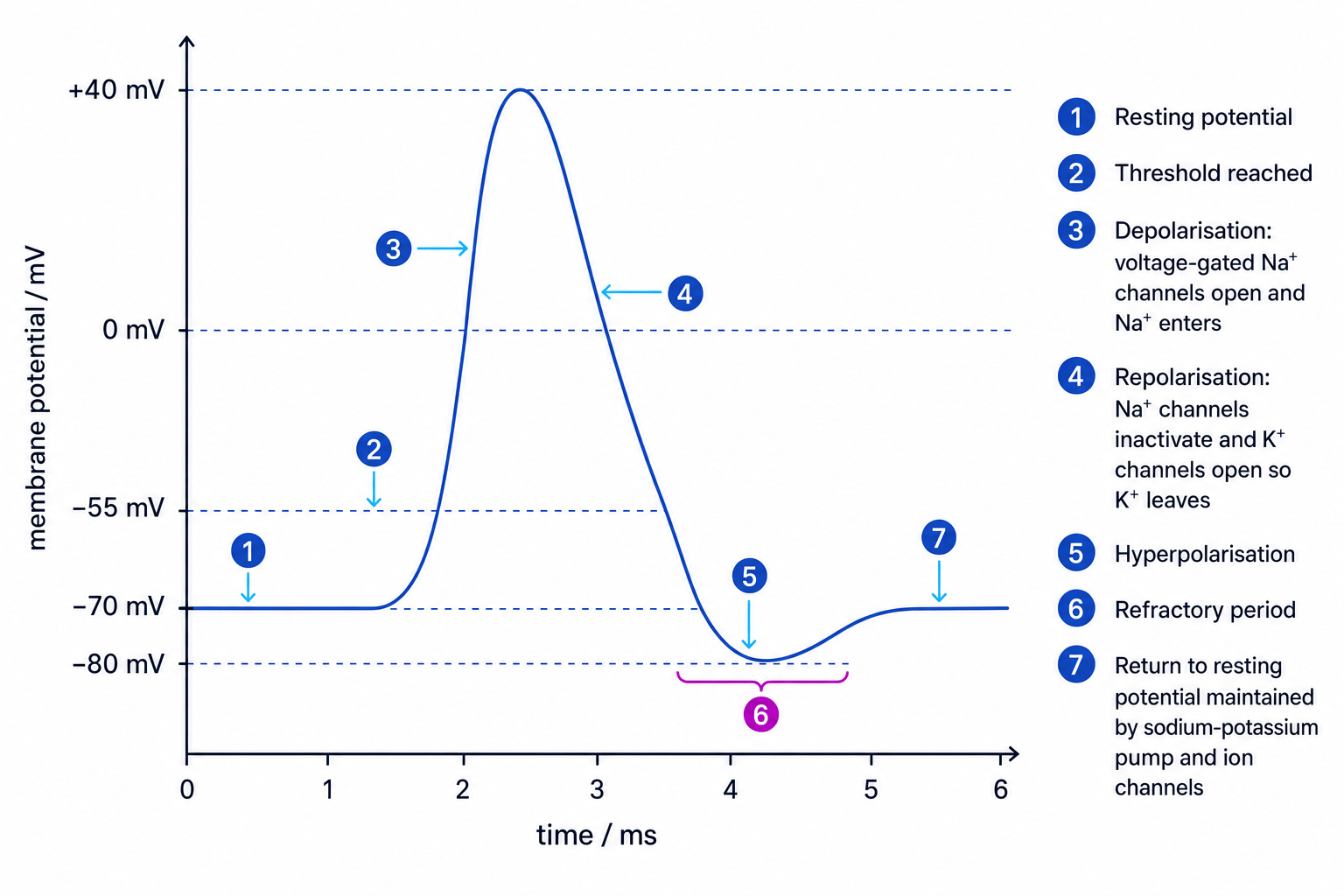
The threshold is the minimum membrane potential needed to trigger an action potential, usually about -55 mV.
Depolarisation
A stimulus causes some Na⁺ channels to open. If threshold is reached, many voltage-gated Na⁺ channels open.
Na⁺ diffuses into the axon down its electrochemical gradient. This makes the inside less negative, then positive. This is depolarisation.
Repolarisation
At around +40 mV, voltage-gated Na⁺ channels become inactivated, so Na⁺ stops entering.
Voltage-gated K⁺ channels open. K⁺ diffuses out of the axon, making the inside more negative again. This is repolarisation.
Hyperpolarisation
K⁺ channels close slowly, so too much K⁺ may leave. The membrane potential briefly becomes more negative than resting potential. This is hyperpolarisation.
The sodium-potassium pump and ion channels then restore the normal resting conditions.
All-or-nothing principle
The all-or-nothing principle means that if threshold is reached, a full action potential is generated; if threshold is not reached, no action potential is generated.
A stronger stimulus does not make a bigger action potential. Instead, it may increase the frequency of action potentials.
Applying the all-or-nothing principle
A stimulus depolarises an axon membrane from -70 mV to -58 mV. Will it generate an action potential?
- Compare the membrane potential with the threshold, which is about -55 mV.
- -58 mV is still more negative than -55 mV, so threshold has not been reached.
- No action potential is generated, because action potentials only occur when the threshold is reached or exceeded.
How an impulse travels along an axon
When one region of the axon is depolarised, Na⁺ has entered that region. This creates local currents that depolarise the next section of membrane to threshold.
That next section generates its own action potential. In this way, the action potential is repeatedly regenerated along the axon.
Non-myelinated axons
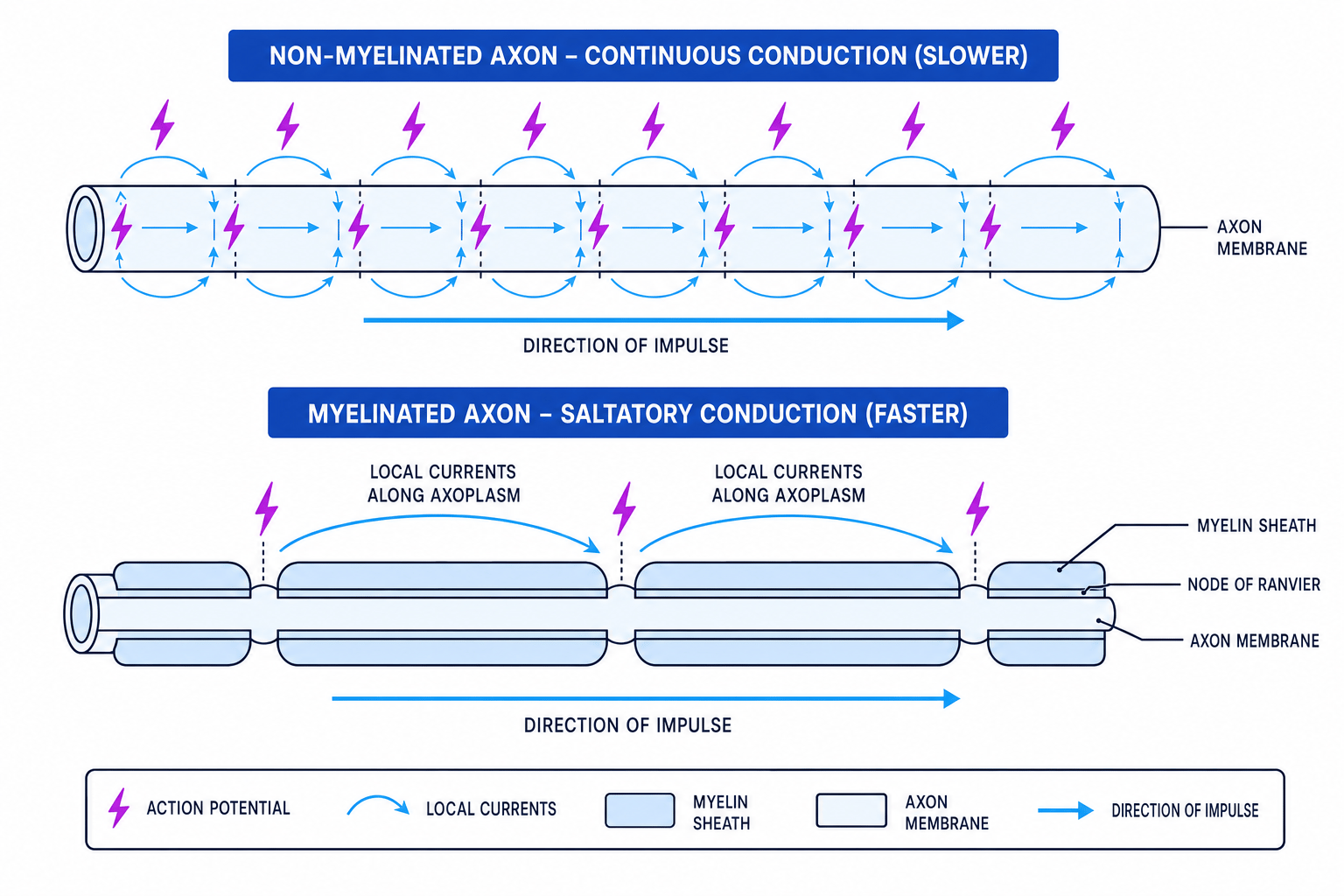
In a non-myelinated axon, the action potential is generated along every adjacent section of the membrane. This is called continuous conduction, and it is relatively slow.
Myelinated axons
In a myelinated axon, the myelin sheath acts as an electrical insulator. Ion movement can only occur at the nodes of Ranvier, where there are many voltage-gated Na⁺ channels.
The action potential appears to “jump” from node to node. This is called saltatory conduction.
Saltatory conduction
Saltatory conduction is the transmission of an action potential along a myelinated axon by depolarisation at successive nodes of Ranvier.
Remember saltatory conduction
“Saltatory” means jumping — the action potential is regenerated at the nodes, not along every part of the membrane.
The refractory period
After an action potential, the axon membrane cannot immediately generate another action potential. This is the refractory period.
It happens because voltage-gated Na⁺ channels are inactivated, and during hyperpolarisation the membrane may be further from threshold than usual.
Refractory period
The refractory period is the short time after an action potential when another action potential cannot be generated, or can only be generated by a stronger stimulus.
The refractory period is important because it:
- ensures impulses are discrete, so action potentials do not merge into one long depolarisation
- helps impulses travel in one direction, because the region behind the impulse cannot immediately fire again
- limits the maximum frequency of impulse transmission
Calculating maximum impulse frequency
A neurone has a refractory period of 2.0 ms. What is the maximum possible frequency of impulses?
- Use the relationship:
- Convert milliseconds into seconds:
- Substitute into the equation:
- State the answer: the maximum frequency is 500 impulses per second, or 500 Hz.
Factors affecting speed of conduction
Myelination
Myelinated axons conduct impulses faster because depolarisation only occurs at nodes of Ranvier. Less membrane has to be depolarised, so transmission is quicker.
Axon diameter
Larger diameter axons conduct faster. This is because there is less resistance to local current flow inside the axon.
Temperature
Higher temperature usually increases conduction speed because ions diffuse faster and channel proteins work faster.
However, if the temperature is too high, proteins such as ion channels and pumps may denature, and membranes may be disrupted. Very low temperature slows ion movement and protein activity.
Comparing conduction speed
Rank these axons from fastest to slowest: a large myelinated axon, a small myelinated axon, and a small non-myelinated axon at the same temperature.
- Myelination has a major effect because saltatory conduction allows action potentials to be regenerated only at nodes of Ranvier.
- Between the two myelinated axons, the larger diameter axon is faster because it has lower internal resistance to local current flow.
- The order is: large myelinated axon fastest, then small myelinated axon, then small non-myelinated axon slowest.
Bigger stimulus, bigger action potential
Do not say a stronger stimulus produces a larger action potential. Action potentials are all-or-nothing; stronger stimuli are represented by a higher frequency of impulses.
In the exam
- Use the key terms depolarisation, repolarisation, hyperpolarisation, threshold and refractory period accurately.
- When explaining resting potential, mention both the sodium-potassium pump and differential membrane permeability to K⁺ and Na⁺.
- For action potentials, link each phase to the correct ion movement: Na⁺ enters during depolarisation; K⁺ leaves during repolarisation.
- For frequency calculations, always convert milliseconds into seconds before using fmax=1trefractoryf_{\text{max}} = \frac{1}{t_{\text{refractory}}}fmax=trefractory1.
Check yourself
- Why is the inside of a resting axon negative compared with the outside?
- What happens to voltage-gated Na⁺ and K⁺ channels during an action potential?
- Why does myelination increase the speed of impulse transmission?