Genetic fingerprinting (A-level only)
What you'll learn
- The biological basis of genetic fingerprinting: what VNTRs are and why they make your DNA unique.
- The step-by-step process of producing a genetic fingerprint using PCR, restriction endonucleases, and gel electrophoresis.
- How to interpret DNA banding patterns to determine genetic relationships (like paternity).
- The uses of genetic fingerprinting in forensics, medicine, and agriculture.
The Biological Principle: VNTRs
It might surprise you to know that the vast majority of the human genome does not actually code for proteins. Spread throughout these non-coding regions are short, repeating sequences of DNA bases.
Variable Number Tandem Repeats (VNTRs)
Short sequences of non-coding DNA that are repeated many times back-to-back. The number of times these sequences are repeated at a specific locus varies wildly between individuals.
Because we inherit our chromosomes in homologous pairs—one from our mother and one from our father—we have two copies of every VNTR locus. For any given VNTR locus, you might have inherited a block of 151515 repeats from your mother and a block of 424242 repeats from your father.
The exact number of repeats at multiple different loci creates a unique combination for every single person. The probability of two individuals having the exact same VNTRs across all their loci is incredibly low (unless they are identical twins). This biological principle is the foundation of genetic fingerprinting.
The secret to genetic fingerprinting
Genetic fingerprinting does not look at the genes themselves. It works by measuring the lengths of non-coding VNTR fragments, which vary uniquely from person to person.
How to make a Genetic Fingerprint
Creating a genetic fingerprint involves five main stages.
1. Extraction and Amplification
First, DNA is extracted from a sample (e.g., blood, hair follicles, saliva). Because the sample size in real-world scenarios is often tiny, the Polymerase Chain Reaction (PCR) is used to amplify the DNA, creating millions of identical copies of the VNTR regions.
2. Digestion
Next, the DNA is cut into smaller fragments using restriction endonucleases.
Choosing the right enzyme
The restriction endonucleases must cut the DNA close to the target VNTRs but never inside the VNTR sequence itself. If the enzyme cut inside the repeat, it would chop the VNTR into tiny pieces and destroy the length variation we are trying to measure.
3. Separation (Gel Electrophoresis)
The fragments are separated by length using gel electrophoresis.
- The DNA mixture is placed into small wells at one end of a gel (like an agar jelly).
- An electrical voltage is applied across the gel.
- DNA is slightly negatively charged (due to its phosphate groups), so the fragments are attracted to the positive electrode at the far end of the gel.
- Shorter fragments experience less resistance and move faster and further through the gel than longer fragments.
4. Hybridisation
Once separated, the DNA fragments are transferred from the fragile gel to a sturdy nylon membrane. To make the invisible VNTRs show up, scientists add DNA probes. These probes are short, single-stranded pieces of DNA with a sequence complementary to the target VNTRs. They are labelled with either a radioactive isotope or a fluorescent tag. The probes bind (hybridise) to the VNTR fragments under specific temperatures and pH conditions. Any unbound probes are washed away.
5. Development
Finally, the visual "fingerprint" is developed.
- If radioactive probes were used, an X-ray film is placed over the nylon membrane. The radiation from the probes exposes the film (autoradiography).
- If fluorescent probes were used, the membrane is viewed under ultraviolet (UV) light. The result is a series of thick and thin horizontal bands, resembling a barcode.
Interpreting Genetic Fingerprints
In the exam, you may be asked to interpret data showing the results of gel electrophoresis. The most common scenario is a paternity test.
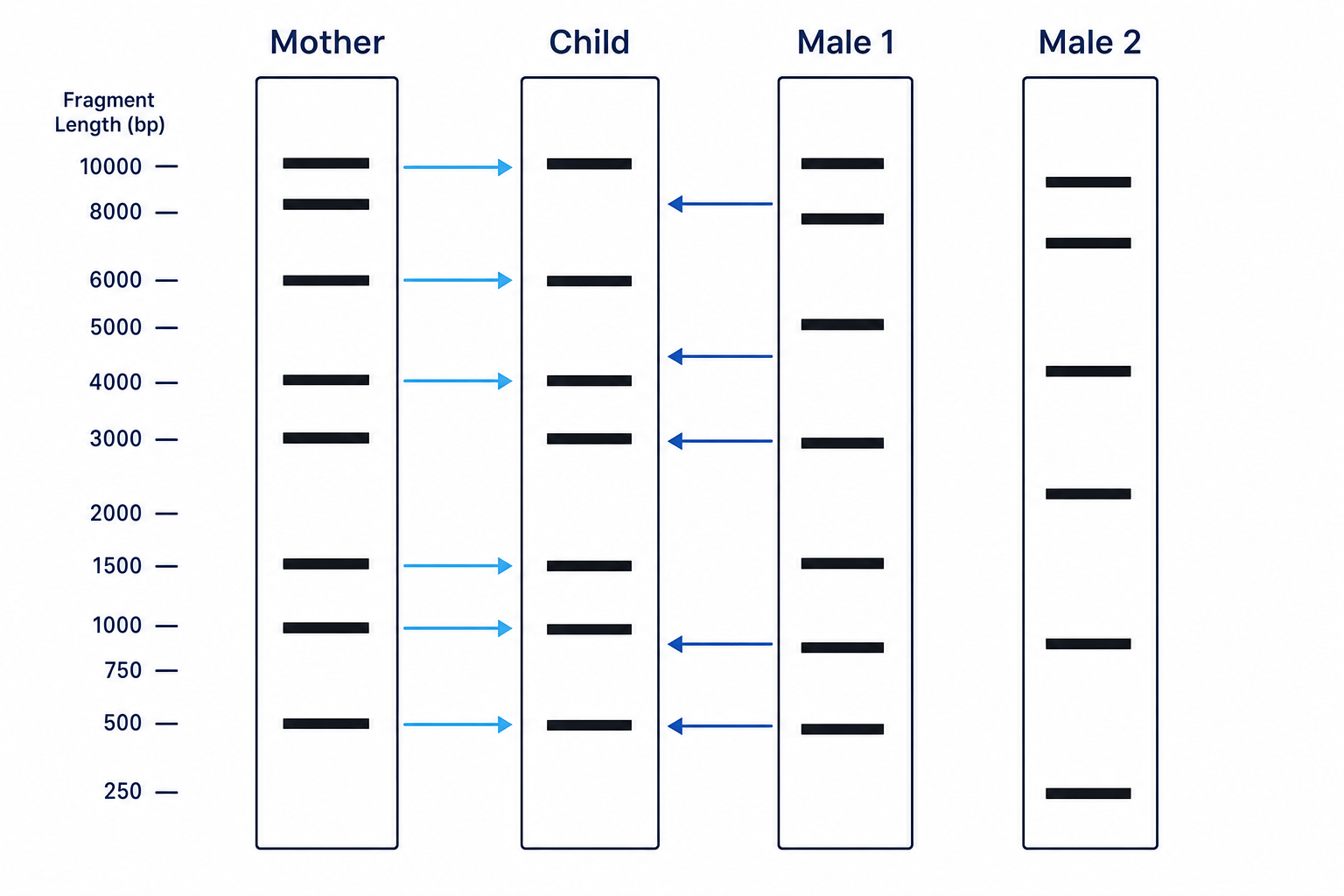
Because a child inherits half of their chromosomes from their mother and half from their father, every single band in the child's genetic fingerprint must appear in either the mother's fingerprint or the father's fingerprint.
Determining paternity from an autoradiograph
Looking at the image above, let's prove whether Male 1 or Male 2 is the biological father.
- First, identify all the bands in the "Child" lane.
- Compare the child's bands with the "Mother" lane. Any bands that match horizontally were inherited from the mother (indicated by the light blue arrows).
- Look at the remaining bands in the child's lane that did not come from the mother. These must have been inherited from the biological father.
- Compare these remaining bands to the potential fathers. The child's remaining bands match perfectly with the bands in the "Male 1" lane (indicated by the dark blue arrows).
- Conclude that Male 1 is the biological father. Male 2 has a completely different set of bands that do not account for the child's missing fragments.
Applications of Genetic Fingerprinting
Genetic fingerprinting isn't just for paternity tests. You need to be able to explain why scientists use it in four specific fields.
1. Determining Genetic Relationships and Variability
As shown above, it helps resolve questions of paternity and maternity. It can also be used to trace evolutionary relationships between different species or distinct populations. If a population of animals shows a wide variety of different banding patterns across its members, it indicates high genetic variability. If the fingerprints are all very similar, the population has low genetic diversity and may be vulnerable to disease.
2. Forensic Science
DNA is often left at crime scenes in blood, semen, skin cells, or hair. Forensic scientists can compare the genetic fingerprint of the crime scene DNA with that of a suspect. If the banding patterns match perfectly across multiple different VNTR loci, the probability that the DNA belongs to someone else is vanishingly small, placing the suspect at the scene.
3. Medical Diagnosis
Genetic fingerprinting can diagnose genetic disorders like Huntington's disease. Huntington's is caused by an abnormally large number of CAG repeats in the huntingtin gene. By running a genetic fingerprint, doctors can measure the length of the fragment containing this repeat. If the fragment travels a very short distance on the gel (indicating it is heavy and has many repeats), it confirms the patient has the disease-causing allele. It is also used to identify the specific strain of a pathogen (like a specific bacterial strain causing an outbreak) to target treatment.
4. Animal and Plant Breeding
Breeders use genetic fingerprinting to prevent inbreeding. By comparing the genetic fingerprints of a herd, a breeder can identify which animals are least closely related and selectively breed them. This maintains genetic diversity and reduces the risk of inheriting harmful recessive alleles. It can also be used to prove the pedigree (ancestry) of an expensive stud animal or a high-yield crop variety.
Confusing techniques
Students often mix up genetic fingerprinting with DNA sequencing. Sequencing determines the exact exact letter-by-letter order of bases (A, T, C, G) in a gene. Fingerprinting does not read the letters; it only measures the length of repeating non-coding fragments.
In the exam
- When interpreting gels, use a clear ruler to align the bands horizontally. Do not guess by eye.
- If asked to explain why fragments move different distances in electrophoresis, always state two things: the DNA is negatively charged so it moves to the positive electrode, AND smaller fragments move further/faster than larger ones.
- Be specific with your vocabulary. Refer to "VNTRs" or "non-coding repeat sequences", not just "genes" or "DNA".
- When describing the probability of a forensic match, do not say "it is 100% proof". Say "the probability of two individuals having identical VNTRs is very low."
Check yourself
- Why are non-coding VNTRs used for genetic fingerprinting instead of coding genes?
- What is the role of restriction endonucleases in producing a genetic fingerprint?
- Why do shorter DNA fragments end up further down the electrophoresis gel?
- If a child has a band on their genetic fingerprint that appears in neither the mother's nor the alleged father's fingerprint, what does this conclude?
- How could genetic fingerprinting help a captive breeding programme in a zoo?