Alteration of the sequence of bases in DNA can alter the structure of proteins (A-level only)
What you'll learn
- How gene mutations can arise during DNA replication.
- The main types of gene mutation: addition, deletion, substitution, inversion, duplication and translocation.
- Why some mutations change the amino acid sequence of a polypeptide, while others do not.
- How to predict whether a mutation causes a frameshift or changes just one triplet.
Starting point: DNA, genes and proteins
DNA is a polymer made from nucleotides. Each nucleotide contains a sugar, a phosphate group and one of four nitrogen-containing bases: adenine, thymine, cytosine or guanine.
A gene is a length of DNA that codes for a polypeptide or functional RNA. In this topic, we are focusing on genes that code for polypeptides, which can then fold to form proteins.
Base sequence
The base sequence is the order of bases along a length of DNA, such as A T G C C A. This order stores genetic information.
The sequence of bases in DNA determines the sequence of bases in messenger RNA, abbreviated to mRNA, during transcription. The mRNA sequence is then read during translation to produce a sequence of amino acids in a polypeptide.
Triplets, codons and amino acids
DNA bases are read in groups of three. A group of three bases in DNA is called a triplet. A group of three bases on mRNA is called a codon.
Triplet code
The triplet code means that each sequence of three bases codes for one amino acid, or for a start or stop signal during translation.
For example, the mRNA codon AUG codes for methionine and is also a start codon. A stop codon does not code for an amino acid; it tells the ribosome to stop translation.
DNA sequence affects protein structure
If a mutation changes the sequence of bases in a gene, it may change the sequence of codons in mRNA. This may change the order of amino acids in the polypeptide, which may alter the protein’s primary, secondary, tertiary or quaternary structure.
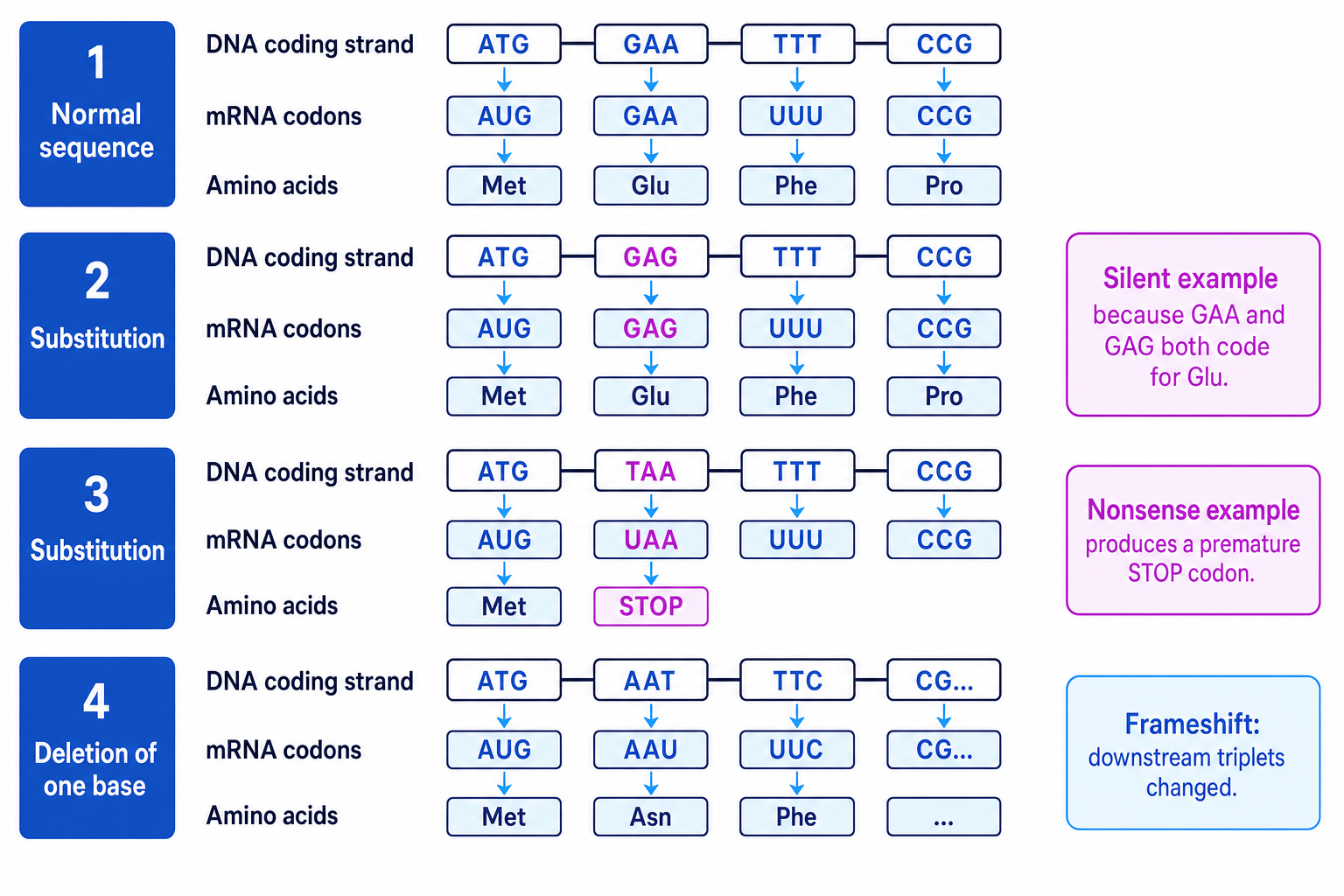
The diagram below shows how different changes in a base sequence can have different effects on the encoded polypeptide.
What is a gene mutation?
A mutation is a change in the genetic material of an organism. A gene mutation is a change in the sequence of bases within a gene.
Gene mutation
A gene mutation is an alteration in the sequence of bases in a gene. It may change the sequence of amino acids in the polypeptide encoded by that gene.
Gene mutations can arise during DNA replication, when DNA is copied before cell division. For example, an incorrect base may be inserted, or a base may be missed out.
Mutations occur spontaneously, meaning they can happen naturally without an obvious external cause. However, the mutation rate can be increased by mutagenic agents.
Mutagenic agent
A mutagenic agent is a factor that increases the rate of mutation. Examples include ionising radiation, ultraviolet radiation and some chemicals.
Mutation does not always mean harmful
A mutation is simply a change in DNA. Its effect may be harmful, beneficial or neutral, depending on how it affects the encoded polypeptide and the organism’s environment.
Substitution mutations
A substitution is when one base is replaced by another base.
For example:
- Original DNA triplet: CTT
- Mutated DNA triplet: CAT
Only one base has changed.
A substitution may affect only one triplet code. This means it may affect only one codon in the mRNA and therefore only one amino acid in the polypeptide.
However, the effect depends on what the new triplet codes for.
Possible effects of substitution
A substitution can produce:
- a silent mutation, where the amino acid does not change
- a missense mutation, where one amino acid is replaced by another
- a nonsense mutation, where a codon becomes a stop codon
Degenerate genetic code
The genetic code is degenerate because most amino acids are coded for by more than one codon.
This is why not all substitutions change the encoded amino acid. For example, GAA and GAG both code for glutamic acid, so changing GAA to GAG would not change the amino acid sequence.
Predicting the effect of a substitution
A section of mRNA has the codons:
AUG GAA UUU
A mutation changes the second codon from GAA to GAG. Both GAA and GAG code for glutamic acid.
- Split the mRNA into codons: AUG, GAA, UUU.
- Identify the codon affected by the mutation: only the second codon changes, from GAA to GAG.
- Compare the amino acids coded for: GAA codes for glutamic acid and GAG also codes for glutamic acid.
- Conclude the effect: the amino acid sequence is unchanged, so this is a silent mutation.
Addition and deletion mutations
An addition is when one or more bases are added into the DNA sequence.
A deletion is when one or more bases are removed from the DNA sequence.
Frameshift
A frameshift is a change in the way the base sequence is divided into triplets. It occurs when bases are added or deleted in numbers that are not multiples of three.
This matters because the ribosome reads mRNA codons in groups of three. If one base is inserted or removed, every triplet after the mutation is regrouped differently.
That means all codons downstream from the mutation may change. This can produce a very different amino acid sequence and may create an early stop codon.
Frameshifts are often more disruptive
A substitution often changes only one triplet. An addition or deletion of one or two bases causes a frameshift, so it can change many downstream codons.
Recognising a frameshift mutation
A DNA coding strand contains this sequence:
ATG GAA TTT CCG
One base, G, is deleted from the second triplet, giving:
ATG AAT TTC CG...
- Regroup the original sequence into triplets: ATG, GAA, TTT, CCG.
- Regroup the mutated sequence from the start: ATG, AAT, TTC, CG...
- Compare the triplets after the deletion: GAA becomes AAT, TTT becomes TTC, and the final triplet is incomplete in this short section.
- Conclude the effect: the reading frame has shifted, so the codons downstream from the deletion are changed.
Additions and deletions of three bases
If exactly three bases are added or deleted, the reading frame is not shifted. One amino acid may be added or removed, but downstream triplets can remain unchanged.
Inversion mutations
An inversion is when a sequence of bases becomes reversed within the gene.
For example:
- Original section: A T G C C A
- Inverted section: A C C G T A
The same bases may still be present, but their order has changed. Since the genetic information depends on base order, this can alter one or more triplets.
The effect depends on the length and position of the inverted sequence. It may change several amino acids, introduce a stop codon, or sometimes have little effect if the amino acid sequence is unchanged.
Duplication mutations
A duplication is when one or more bases are copied and inserted again into the gene.
For example:
- Original section: A T G C C A
- Duplicated section: A T G C C A C C A
If the duplicated section contains a number of bases that is not a multiple of three, it can cause a frameshift. If it contains a whole number of triplets, extra amino acids may be added without shifting the downstream reading frame.
Think in threes
For additions, deletions and duplications, ask: has the number of bases changed by a multiple of three? If not, expect a frameshift.
Translocation mutations
A translocation is when a section of bases breaks away and becomes attached at a different position. In this specification point, you can think of it as movement of a base sequence to a new location.
This can disrupt a gene if the moved sequence is inserted into it, removed from it, or changes how the gene is read. It may alter the amino acid sequence of the encoded polypeptide, especially if the reading frame is affected.
Confusing inversion and translocation
In an inversion, a sequence is reversed in place. In a translocation, a sequence is moved to a different position.
How mutations can alter protein structure
The primary structure of a protein is the sequence of amino acids in its polypeptide chain. This is directly determined by the sequence of codons in mRNA, which is determined by the base sequence in DNA.
If a mutation changes the primary structure, it may also change how the polypeptide folds. This can alter:
- hydrogen bonds, which help stabilise secondary and tertiary structure
- ionic bonds, which form between oppositely charged R groups
- disulfide bridges, which form between sulfur-containing R groups
- hydrophobic interactions, which affect how the protein folds in water
A change in shape can affect the protein’s function. For enzymes, a changed tertiary structure may alter the shape of the active site, reducing enzyme-substrate complex formation.
Linking a mutation to enzyme function
A substitution changes one codon so that a hydrophilic amino acid is replaced by a hydrophobic amino acid in an enzyme’s active site.
- Identify the level first affected: the mutation changes one codon, so it changes the primary structure by replacing one amino acid.
- Link amino acid properties to folding: replacing a hydrophilic R group with a hydrophobic R group may alter interactions with surrounding amino acids and water.
- Link folding to active site shape: altered interactions may change the tertiary structure of the enzyme, including the active site.
- Link structure to function: the substrate may no longer be complementary to the active site, so fewer enzyme-substrate complexes form.
Why some mutations have no effect
Some mutations do not alter the final polypeptide. This can happen because:
- the genetic code is degenerate, so a changed codon still codes for the same amino acid
- the mutation occurs in a non-coding region of DNA
- the changed amino acid has similar properties to the original amino acid
- the mutation does not affect a region important for protein function
For this spec point, the key explanation is usually the degenerate nature of the genetic code.
Same DNA change, different outcome
The effect of a mutation depends on exactly where it occurs, how many bases are affected, and whether the altered codons change the amino acid sequence.
Bringing it together
When you are asked to relate a mutation to its effect on a polypeptide, work from DNA to mRNA to amino acids to protein structure.
A strong answer usually follows this chain:
- State the type of mutation.
- State whether the triplet sequence changes.
- State whether one codon or many downstream codons are affected.
- State whether the amino acid sequence changes.
- Link the amino acid sequence to protein structure and function.
In the exam
- For substitutions, say that only one triplet may be changed, then explain whether the codon codes for the same amino acid, a different amino acid or a stop signal.
- For additions and deletions, check whether the number of bases changed is a multiple of three; if not, explain that a frameshift changes all downstream triplets.
- Always connect base sequence to amino acid sequence before discussing protein shape or function.
Check yourself
- Why can a substitution mutation sometimes have no effect on the amino acid sequence?
- What type of mutation is most likely to cause a frameshift: substitution, addition or deletion?
- How could a change in one amino acid alter the function of an enzyme?