Transfer Earnings and Rent
Definition
Transfer earnings: the minimum payment needed to keep a factor of production in its current use, equal to what it could earn in its next-best use.
Economic rent: any payment to a factor of production above its transfer earnings.
- A factor's total earnings can be split into transfer earnings and economic rent.
- Transfer earnings measure the factor's opportunity cost, so paying less would cause it to switch to its next-best use.
- Economic rent is a pure surplus, so removing it would not change how the factor is used.
- Total earnings = transfer earnings + economic rent.
Key Idea
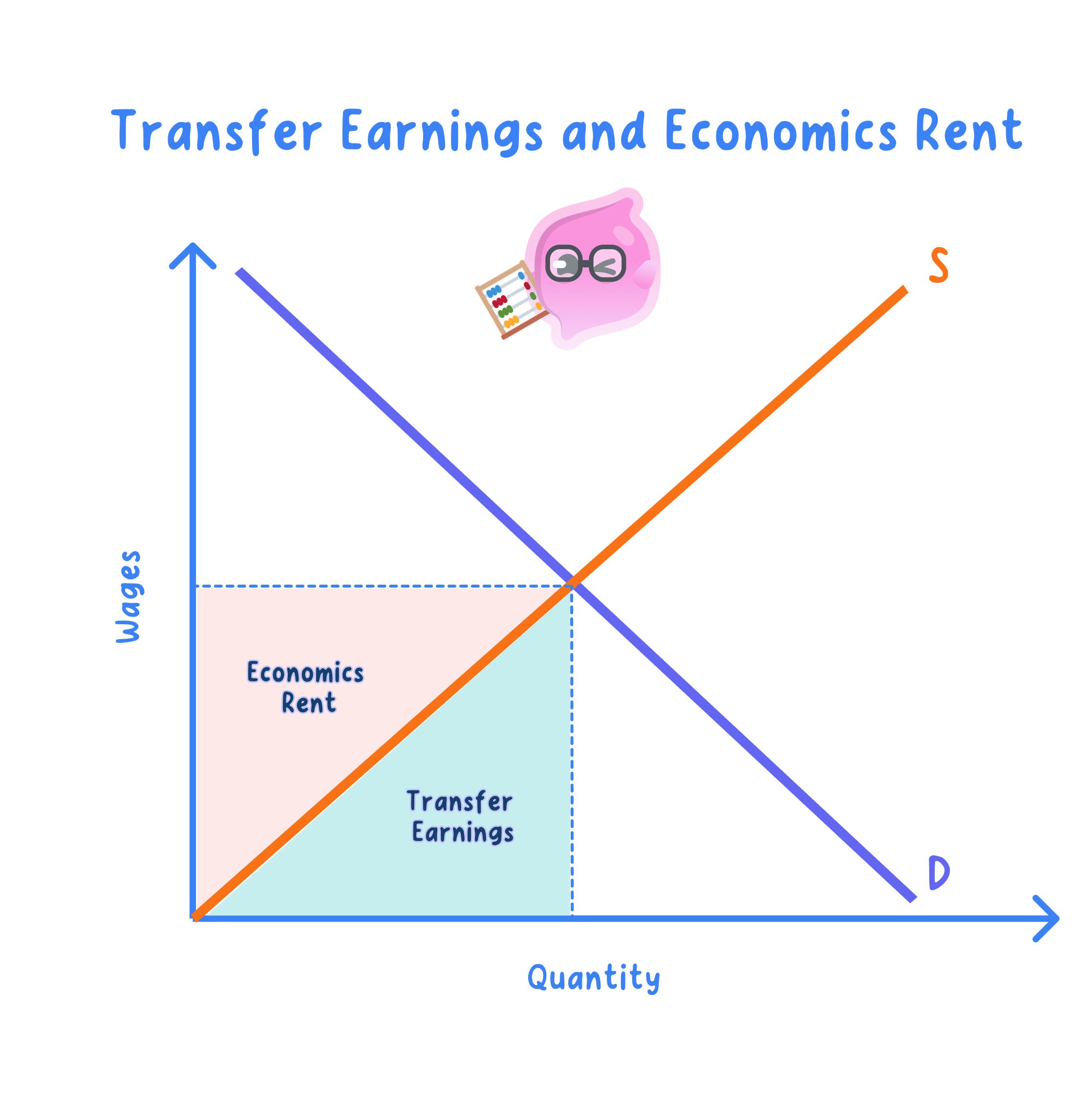
- On a labour supply diagram, the area under the supply curve up to employment is transfer earnings.
- The area above the supply curve and below the wage line is economic rent.
Splitting Earnings
- The supply curve shows the minimum wage each worker will accept to enter the occupation.
- The first workers accept low wages, so their transfer earnings are small and their economic rent large.
- The marginal worker earns only transfer earnings, with no economic rent.
Example
- Suppose 4 workers are hired at a market wage of £20, giving total earnings of 4 × £20 = £80.
- Their minimum acceptable wages are £8, £12, £16 and £20, so transfer earnings are £8 + £12 + £16 + £20 = £56.
- Economic rent = total earnings − transfer earnings, so £80 − £56 = £24.
- The last worker earns £20, exactly her transfer earnings, so she receives no economic rent.
What Affects The Split
- The more inelastic the supply of labour, the larger the share that is economic rent.
- The more elastic the supply, the larger the share that is transfer earnings.
- Scarce talent, as with a top footballer, earns mostly economic rent.
- Easily replaced, mobile labour earns mostly transfer earnings.
Example
- A star footballer paid £200,000 a week might still play for £5,000, so around £195,000 is economic rent because their talent is in fixed supply.
- A supermarket cashier could readily move to a similar job elsewhere, so most of their pay is transfer earnings.
Should governments tax away economic rent?
- In principle economic rent is an ideal tax base: because it is a pure surplus above transfer earnings, taxing it does not change how the factor is used, so a tax on the rent earned by a star performer or a prime city-centre site raises revenue without distorting the allocation of resources.
- But in practice the rent is hard to separate from transfer earnings: tax authorities cannot easily observe each worker's next-best pay, and setting the tax too high risks taxing transfer earnings and driving mobile talent abroad, as competition for skilled workers between Gulf states, Singapore and Europe shows.
- Some rent also rewards risk-taking and investment in rare skills, so taxing it heavily may weaken the incentive to train, innovate or relocate, reducing the long-run supply of scarce talent.
- On balance, taxing economic rent is more efficient than taxing transfer earnings, but the case depends on being able to measure the rent and on how mobile the factor is; rent tied to fixed land is a far safer target than rent earned by internationally mobile stars.
Exam technique
- Shade transfer earnings as the area under the supply curve and economic rent as the area above it up to the wage.
- Check that the two areas add up to total earnings, the wage × employment.
Common Mistake
- Do not confuse economic rent with the everyday meaning of rent for property.
- Do not treat all pay as transfer earnings; only the minimum to retain the factor counts.
Self review
- Define transfer earnings.
- Define economic rent.
- How do transfer earnings and economic rent relate to total earnings?
- How does the elasticity of labour supply affect the split?
