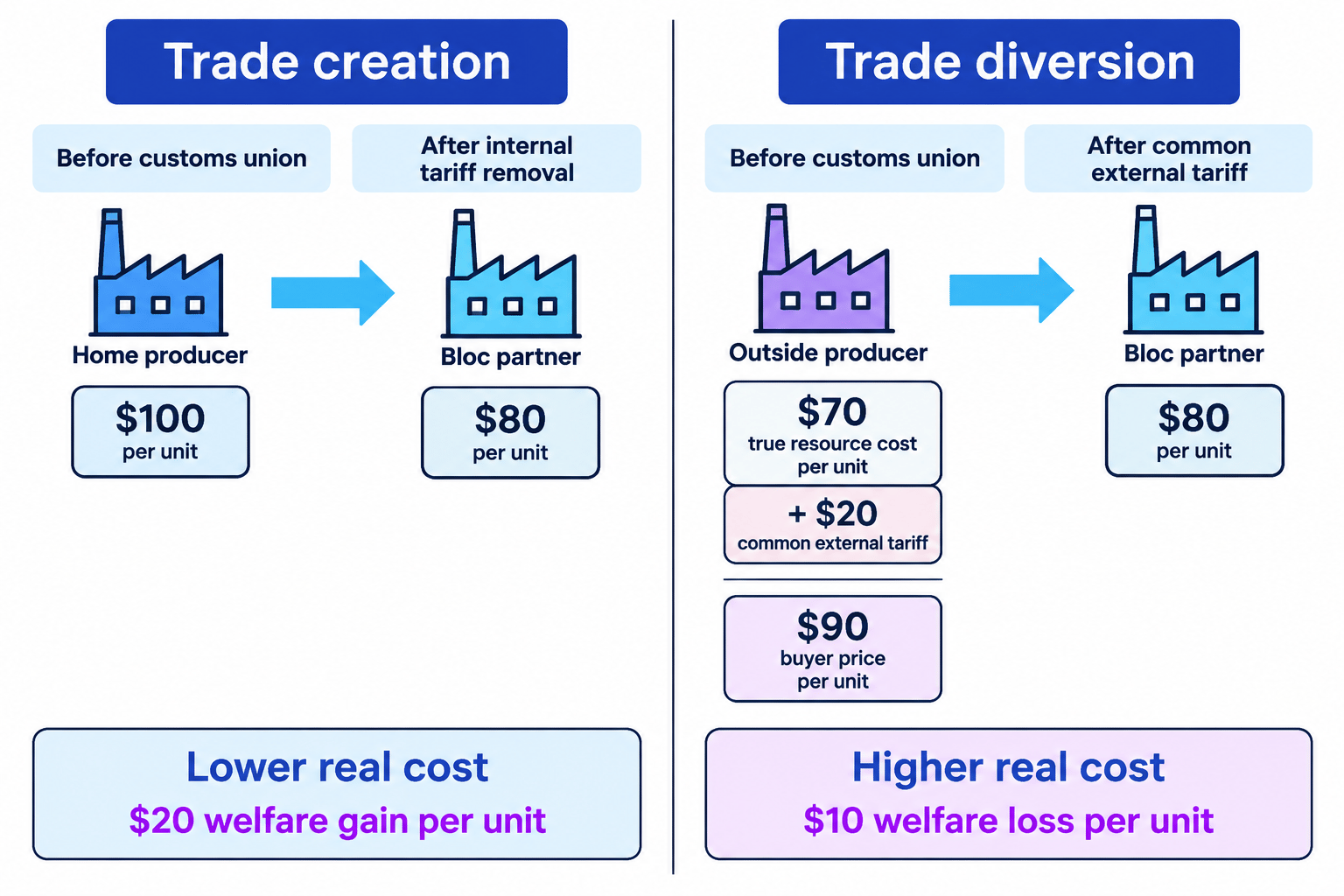
Creation versus diversion
Definition
Trade creation: the switch from higher-cost domestic production to lower-cost production from a bloc partner once internal tariffs are removed.
Trade diversion: the switch from a lower-cost producer outside the bloc to a higher-cost partner inside it, caused by the common external tariff.
Common external tariff: a single tariff that all members of a customs union charge on imports from outside the bloc.
- Trade creation raises welfare, while trade diversion lowers it.
- Trade creation replaces costly home output with cheaper partner output.
- Trade diversion replaces cheaper outside output with dearer partner output.
- The common external tariff is what causes diversion.
Key Idea
- Trade creation shifts production to a lower-cost partner.
- Trade diversion shifts it to a higher-cost partner behind the tariff.
- So joining a bloc does not always raise welfare.
Trade creation
- Before joining, a home tariff keeps out cheaper partner goods.
- The country makes the good itself at high cost, wasting resources.
- After joining, the internal tariff goes and the lower-cost partner supplies it.
- Resources move to the lower-cost producer, so consumers pay less and welfare rises.
Example
- Suppose home output costs $100 per unit while a bloc partner can supply the same good at $80 per unit.
- Importing at $80 instead of making it at $100 gives a $20 saving per unit, which is trade creation.
Trade diversion
- The lowest-cost world producer may sit outside the bloc.
- The common external tariff raises the price of its goods to buyers inside the bloc.
- So the country buys from a dearer partner instead.
- Resources move to a higher-cost producer, so welfare falls.
- When the UK joined the EEC in 1973, cheaper Commonwealth food such as New Zealand lamb was displaced by dearer European produce behind the common external tariff, a real case of trade diversion.
Example
- Suppose an outside producer's true cost is $70 per unit, the partner's is $80, and the bloc sets a $20 common external tariff.
- The tariff lifts the outside price to $90, above the partner's $80, so the country switches to the dearer $80 partner even though $70 was the true lowest cost, which is trade diversion.
Evaluation: does joining raise welfare?
- For joining: trade creation lowers costs and raises welfare.
- Against: trade diversion raises costs and lowers welfare.
- The net effect depends on which force is larger.
- On balance, joining a customs union raises welfare only if trade creation outweighs trade diversion, so the outcome depends on the pattern of costs inside and outside the bloc. Beyond these static effects, dynamic gains such as economies of scale in a larger market, sharper competition and extra investment can tip the balance towards a net gain even where some diversion occurs, though they build up only over time.
Exam technique
- Show trade creation as a shift to a lower-cost partner.
- Show trade diversion as a shift away from a cheaper outsider behind the tariff.
- Judge welfare by which effect is larger, and support it with numbers or a case.
Common Mistake
- Do not assume bloc membership always raises welfare.
- Trade diversion can outweigh trade creation.
Self review
- What is trade creation?
- What is trade diversion?
- What causes trade diversion?
- When does joining a bloc raise welfare?
- Why is membership not always beneficial?