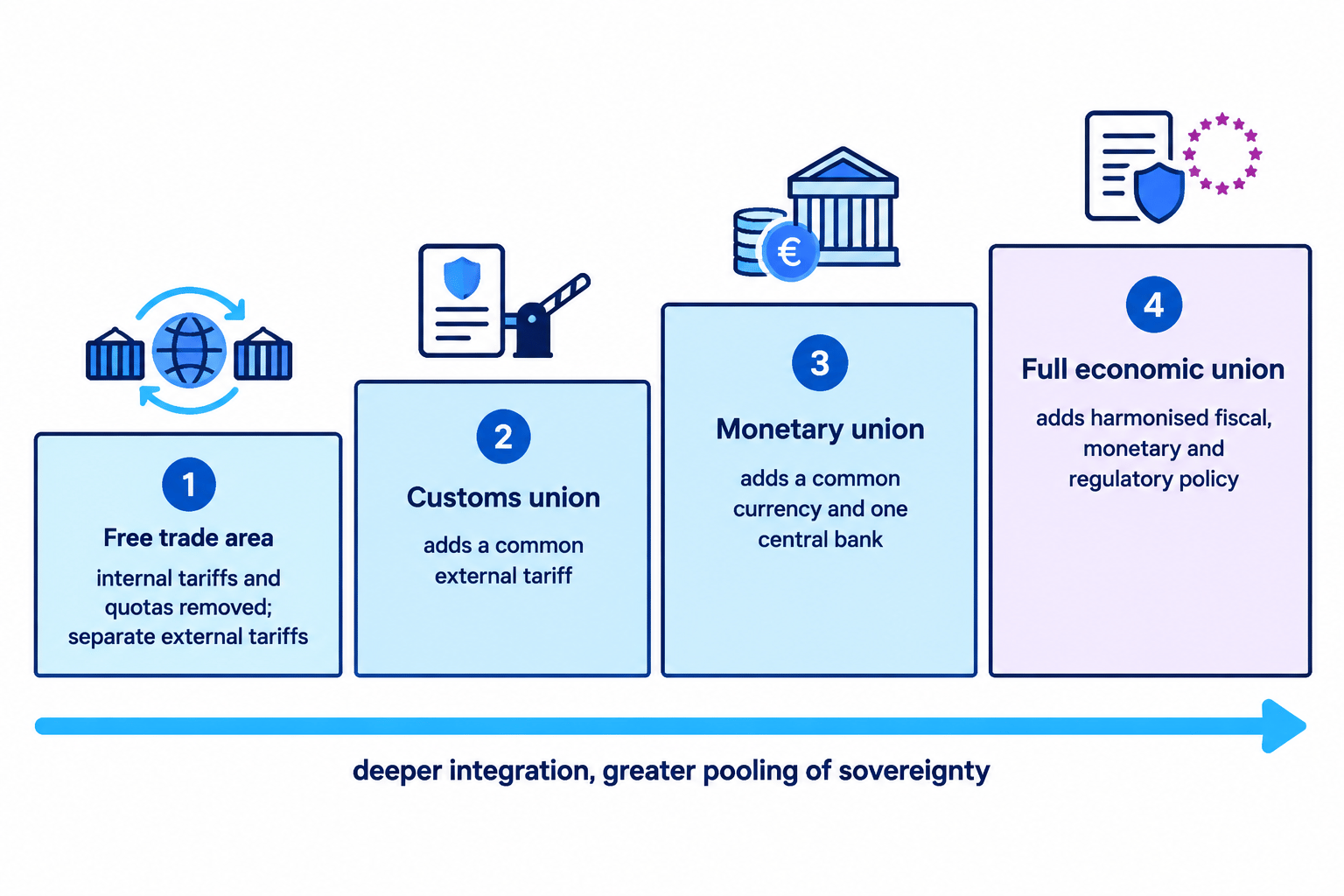
The integration ladder
Definition
Free trade area: a group of countries that removes tariffs and quotas on trade between members while each keeps its own external trade policy.
Customs union: a free trade area that also adopts a common external tariff on imports from non-members.
Monetary union: a group of countries that share a common currency and a single monetary policy set by one central bank.
Full economic union: the deepest stage, combining a single market and common currency with harmonised fiscal, monetary and regulatory policy.
Common external tariff: a single tariff that all members of a bloc charge on imports from outside the bloc.
- Regional economic integration describes countries joining together to reduce barriers between their economies.
- It ranges along a spectrum from shallow, removing tariffs, to deep, a single economy with shared policies.
- Each successive stage removes more barriers and requires members to give up more national policy independence.
Key Idea
- The ladder runs from a free trade area to a customs union, then a monetary union, up to full economic union.
- Each stage adds to the one before, so integration deepens step by step.
- Deeper integration brings larger gains but pools more sovereignty.
Free trade area
- It is the shallowest stage, removing tariffs and quotas on trade between its members.
- Each member keeps its own trade policy and its own tariffs against non-members.
- This requires rules of origin to stop imports slipping in through the member with the lowest external tariff.
Example
- The North American agreement (USMCA) is a free trade area between three countries.
- The European Free Trade Association links its members without a common external tariff.
- Members remain free to set their own tariffs on goods from outside the area.
Customs union
- It is a free trade area plus a common external tariff on imports from non-members.
- Members therefore act as a single bloc and negotiate external trade policy with the rest of the world as one.
- Because the external tariff is common, rules of origin between members are no longer needed.
Example
- MERCOSUR in South America operates as a customs union with a shared external tariff.
- Members lose the freedom to set their own tariffs on outside goods.
- The common external tariff is the feature that distinguishes a customs union from a free trade area.
Monetary union
- It goes further, as members adopt a common currency and a single monetary policy.
- A single central bank sets one interest rate for all members and exchange rates between them disappear.
- This usually builds on a single market in which goods, services, capital and labour move freely between members.
- Members gain exchange-rate certainty and lower transaction costs but lose their own monetary policy and exchange rate as tools.
Example
- The eurozone is a monetary union whose members share the euro and the European Central Bank.
- One interest rate applies across economies that may be at different points in the cycle.
- During its debt crisis Greece could no longer devalue its own currency to regain competitiveness, so adjustment fell on wages and jobs and the recession deepened.
Full economic union
- It is the deepest stage, combining a single market and common currency with harmonised economic policy.
- Members coordinate or centralise fiscal, monetary and regulatory policy, often through supranational institutions.
- This pools the most sovereignty, as members surrender substantial control over their own economic policy.
Note
- In practice blocs may sit between these stages, so a bloc can be a customs union without a common currency.
- Fuller economic and political union remains the deepest and rarest form of integration.
Evaluation: how deep to go?
- Deeper integration widens markets, encourages investment and can raise efficiency and growth.
- But it removes more national policy tools and can impose adjustment costs on some members and industries.
- A monetary union in particular works best when member economies are similar and their business cycles are aligned.
- On balance, the right depth of integration depends on how closely members' economies are linked and how much sovereignty they are willing to pool.
Exam technique
- Place each bloc on the spectrum from free trade area to full economic union.
- State precisely what each stage adds, especially the common external tariff and the common currency.
- Link the depth of integration to the loss of national policy independence.
Common Mistake
- Do not treat all trading blocs as identical, because they sit at different depths on the ladder.
- Do not confuse a free trade area with a customs union, as only the customs union has a common external tariff.
Self review
- What does a free trade area remove, and what does each member keep?
- What single feature distinguishes a customs union from a free trade area?
- What does a monetary union add, and what do members give up?
- What characterises a full economic union?
- Why does deeper integration involve pooling more sovereignty?