Elasticities and timing
Definition
Marshall-Lerner condition: a depreciation improves the current account only if the price elasticities of demand for exports and imports together exceed one.
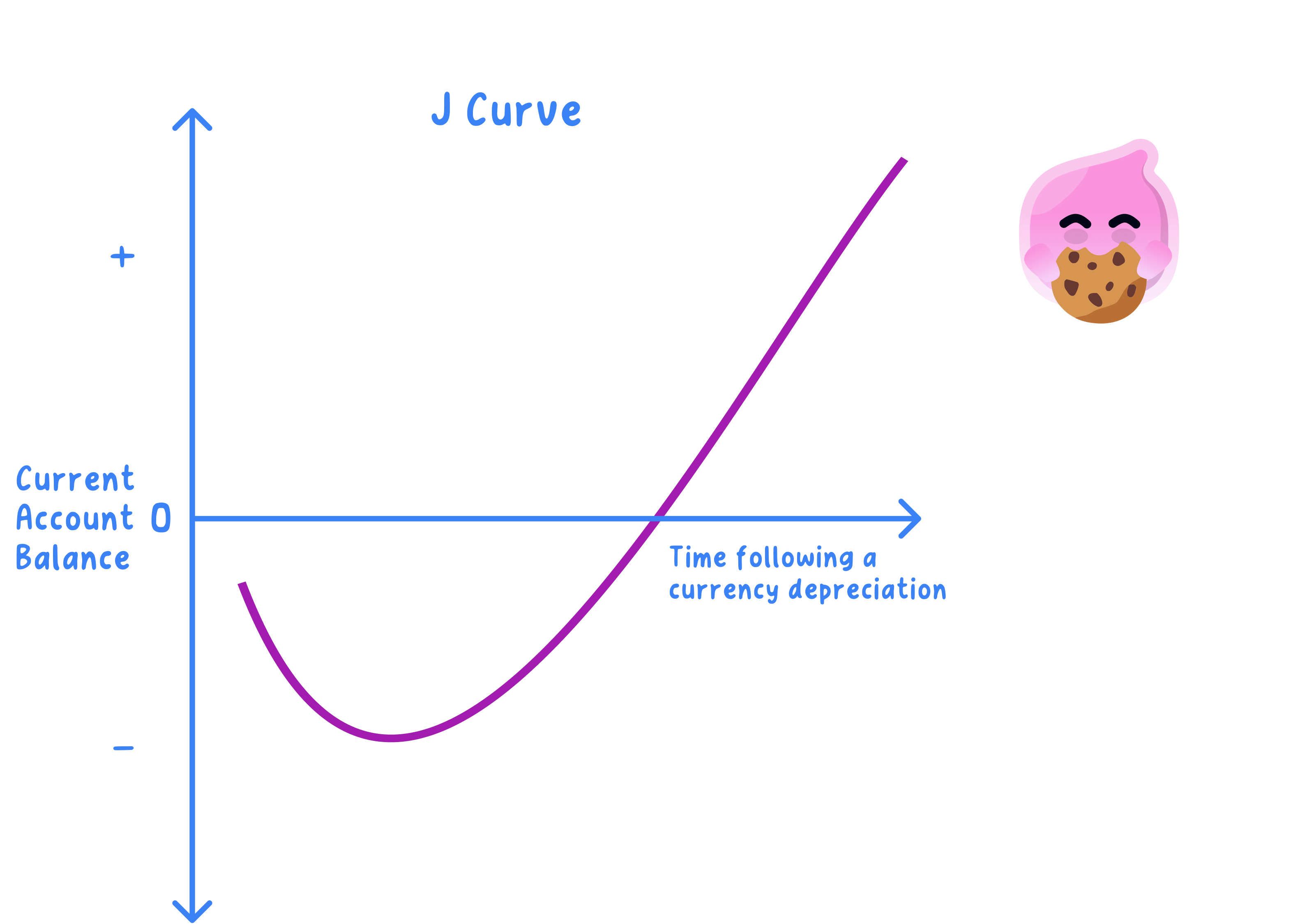
J-curve: the path showing the current account first worsening, then improving, in the months after a depreciation.
- The Marshall-Lerner condition sets when a depreciation or devaluation improves the current account.
- It improves only if the price elasticities of demand for exports and imports sum to more than one.
- The J-curve shows the current account worsening before it improves, because volumes adjust more slowly than prices.
The Marshall-Lerner condition
- A depreciation lowers export prices in foreign currency and raises import prices at home.
- Whether the current account improves depends on how far the quantities of exports and imports respond.
- If the elasticities of demand for exports and imports sum to more than one, higher export volumes and lower import volumes outweigh the dearer import prices, so the balance improves.
- If they sum to less than one, the higher import bill dominates and the balance worsens.
Marshall-Lerner condition: PED (exports) + PED (imports) > 1
Example
- Suppose the price elasticity of demand for exports is 0.6 and for imports is 0.7, after sterling's fall of about 25% on a trade-weighted basis in 2008.
- Their sum is 1.3, which is more than 1, so the Marshall-Lerner condition holds.
- The depreciation therefore improves the UK current account in time, though volumes took many months to respond.
The J-curve
- On the diagram, time is on the horizontal axis and the current account balance on the vertical axis.
- At first, volumes are slow to respond because contracts are fixed and buyers take time to switch supplier.
- Dearer imports raise the import bill straight away, so the current account worsens at first.
- As volumes adjust, exports rise and imports fall, so the balance improves and traces a J shape.
Note
- After a depreciation, the trade balance often worsens for a time before it recovers.
- Contracts and buying habits mean volumes take time to change, so the short-run elasticities are lower.
- The balance improves once buyers respond fully to the new prices.
Linking the two
- The J-curve is the path over time towards the Marshall-Lerner result.
- The short-run dip reflects slow volume adjustment, when the elasticities are still small.
- The later recovery reflects the elasticity condition finally holding as volumes respond.
- So the two ideas describe the timing and the condition together, so it depends on both elasticity and the length of the lag.
Is a depreciation a reliable way to strengthen the external economy?
- In its favour, where the Marshall-Lerner condition holds a depreciation lowers export prices and raises import prices, so net exports, output and jobs rise and a current account deficit narrows without deflating demand.
- Against this, the J-curve means the balance worsens first, while dearer imports raise cost-push inflation and worsen the terms of trade, so the competitiveness gain can be partly offset.
- It also depends on context: the gains are largest with spare capacity and price-sensitive, diversified exports, but small for commodity exporters or economies reliant on imported inputs, and they erode if trading partners retaliate or devalue in turn.
- On balance, a depreciation can strengthen the external position, but the outcome depends on the size of the elasticities, the time horizon, the inflation response and how trading partners react.
Exam technique
- State the Marshall-Lerner condition precisely as a sum of elasticities greater than one.
- Draw the J-curve with time on the horizontal axis and the current account balance on the vertical.
- Link the short-run dip to slow volumes and the recovery to the elasticity condition.
Common Mistake
- Do not assume a depreciation always improves the trade balance regardless of elasticities or time.
- It improves only if the elasticities sum to more than one, and only after a lag.
Self review
- State the Marshall-Lerner condition.
- What does the J-curve show?
- Why does the current account worsen at first?
- When does a depreciation improve the current account?
- How do the two ideas link together?
