The rules set the movement
Definition
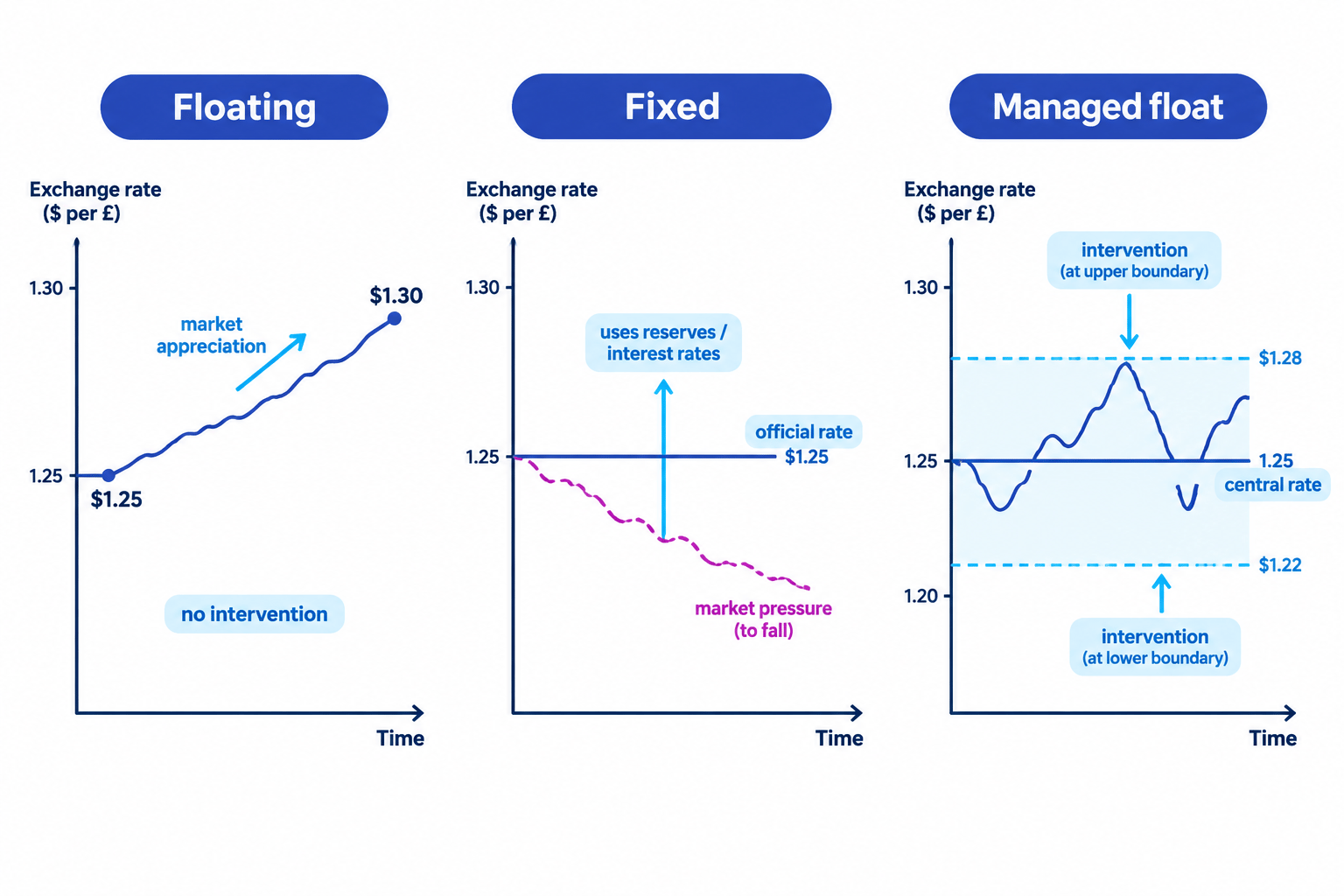
Floating exchange rate: a rate set purely by the market demand for and supply of the currency, with no central bank intervention.
Fixed exchange rate: a rate held at an official level by the central bank through buying and selling reserves and adjusting interest rates.
Managed (dirty) float: a rate that floats but is nudged by the central bank, often kept within a target band.
- How an exchange rate changes depends on the system in operation.
- The three main systems are floating, fixed and managed.
- Each allows a different amount of movement and a different role for the central bank.
The three systems
- Floating
- The rate moves freely with demand for and supply of the currency, so strong export demand pushes it up and heavy import spending pushes it down.
- The central bank does not intervene, so interest rates stay free for domestic goals.
- Fixed
- The authorities hold the rate at an official level, so any change must be a deliberate revaluation or devaluation.
- To defend it they buy or sell foreign currency reserves and adjust interest rates, which ties up reserves and constrains monetary policy.
- Managed (dirty float)
- The rate floats but the central bank intervenes when moves become too large or too fast.
- China runs such a system, letting the yuan trade within a daily band around a central reference rate set by the People's Bank of China.
Example
- Under a float, strong demand for UK exports lifts the pound in the market from $1.25 to $1.30.
- The pound appreciated 4% with no central bank action, a movement driven purely by market forces.
Note
- Under floating, movements are called appreciation and depreciation.
- Under fixed, deliberate changes are called revaluation and devaluation.
Trade-offs between the systems
- A floating rate frees interest rates for domestic goals and self-corrects imbalances, but it can be volatile and deter trade.
- A fixed rate gives certainty for exporters and investors, but it ties up reserves and limits monetary policy.
- A managed system tries to capture the benefits of both, so the best choice depends on whether stability or policy freedom matters more.
Exam technique
- Identify the exchange rate system before explaining how the rate changes.
- Match your language: appreciation and depreciation for floating, revaluation and devaluation for fixed.
- Explain the central bank's role under each system.
- Evaluate using the trade-off between stability and policy freedom.
Common Mistake
- Do not use floating and fixed terminology interchangeably.
- A currency appreciates under floating but is revalued under fixed.
- Do not describe a fixed rate as unchanging.
- It is held by active central bank intervention and can still be revalued or devalued.
Self review
- Name the three main exchange rate systems.
- How is the rate determined under a floating system?
- How do the authorities maintain a fixed exchange rate?
- What is a managed (dirty) float?
- Give one advantage of a floating rate and one of a fixed rate.